TOWNES VAN ZANDT NEVER HAD A #1 HIT IN HIS LIFE. STEVE EARLE STILL CALLED HIM “THE BEST SONGWRITER IN THE WHOLE WORLD” — AND SAID HE’D STAND ON BOB DYLAN’S COFFEE TABLE IN COWBOY BOOTS TO PROVE IT. They said his voice was too rough. His songs too dark. Too poetic for country radio. Nashville called him “a weird recluse” who’d show up, hand over a tape, and vanish. For most of his career, he played to crowds of fewer than 50 people in half-empty bars. But Willie Nelson and Merle Haggard took his “Pancho and Lefty” to #1. Emmylou Harris turned “If I Needed You” into a country classic. Guy Clark called him “the biggest single influence on my writing.” Bob Dylan owned every album he ever made. He was born into one of Texas’s wealthiest families — with a county named after them. He chose a tin-roofed shack outside Nashville with no heat, no plumbing, no phone. He didn’t want fame. He wanted truth. He died at 52 on New Year’s Day 1997 — the same calendar date Hank Williams died 44 years earlier. He never charted a single song under his own name. And yet, every songwriter who came after him knows exactly who he was… – Country Music
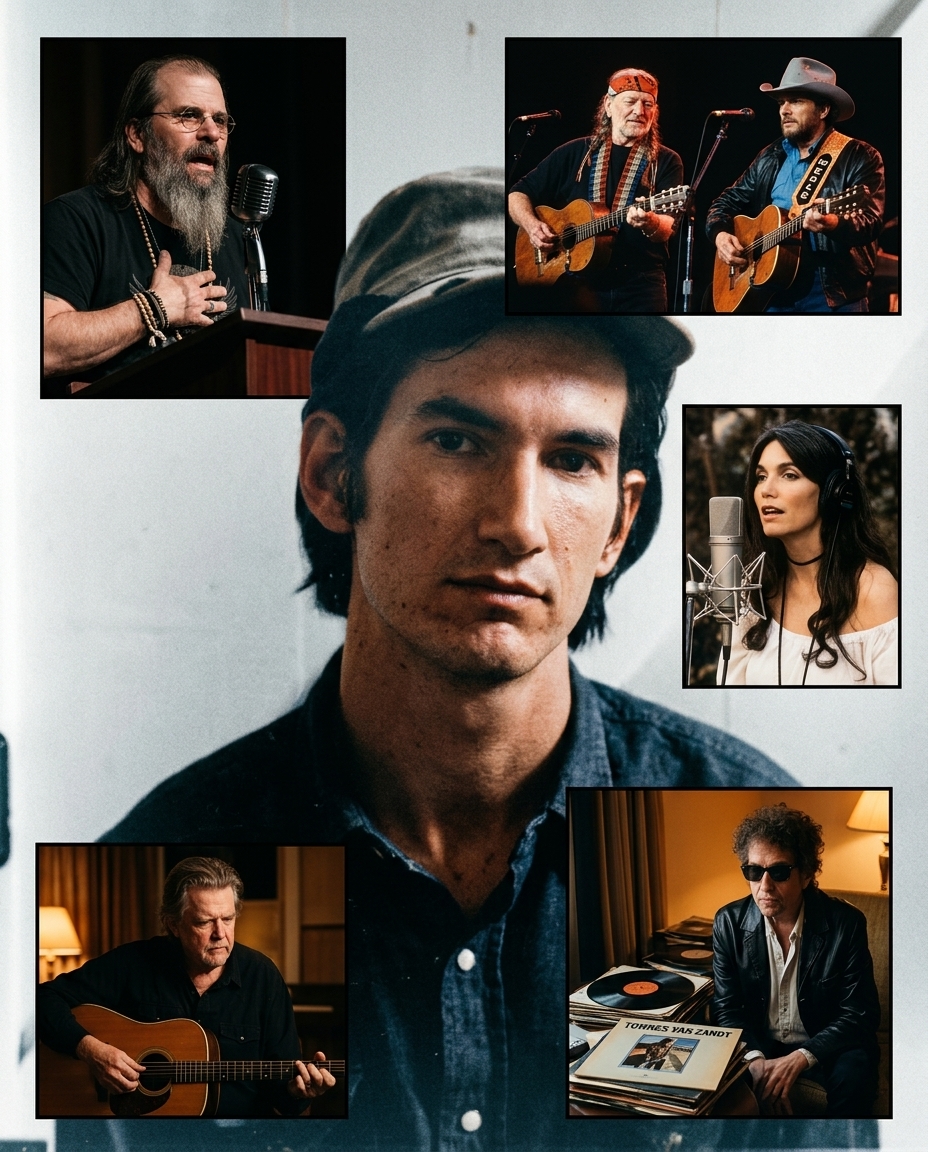
Townes Van Zandt Never Needed a Number One to Become a Legend
Townes Van Zandt never had a No. 1 hit with his own name on it. Not once. No gold-rush chart moment. No big Nashville coronation. No polished image built for country radio. And yet, decades after Townes Van Zandt drifted through bars, back rooms, and borrowed stages, some of the most respected songwriters in American music still speak about Townes Van Zandt with something close to awe.
That says everything.
Steve Earle once made one of the boldest declarations in modern songwriting lore when Steve Earle called Townes Van Zandt “the best songwriter in the whole world” and said he would stand on Bob Dylan’s coffee table in cowboy boots to prove it. It was a line that sounded half funny, half dangerous, and fully sincere. Because for the people who understood what Townes Van Zandt was doing, the argument was never about sales. It was about truth.
The Artist Nashville Could Not Quite Understand
Townes Van Zandt did not fit the usual mold. The voice was weathered, fragile, and sometimes almost unsettling in its honesty. The songs were not built to flatter listeners. They carried loneliness, regret, beauty, and silence in equal measure. There was poetry in them, but not the kind that showed off. Townes Van Zandt wrote like someone trying to survive his own thoughts.
That was never going to be easy for commercial country music to package. Nashville saw a man who could seem distant, wandering, even mysterious. Stories followed him everywhere. He might show up with a tape, offer a song, then disappear again. He played small rooms, half-empty bars, and spaces where the audience sometimes looked too thin for history to be happening. But history was happening anyway.
Because even when the crowds were small, the songs were not.
The Songs Traveled Further Than the Man
The strange twist of Townes Van Zandt’s life is that while Townes Van Zandt rarely found broad fame as a performer, the songs themselves kept escaping the room. They found bigger voices, bigger stages, and wider audiences. Willie Nelson and Merle Haggard took “Pancho and Lefty” all the way to No. 1 and turned it into one of the defining country recordings of its era. Emmylou Harris recorded “If I Needed You” and helped make it a standard that still feels intimate every time it plays.
That pattern repeated again and again. Songwriters recognized the depth immediately. Guy Clark openly credited Townes Van Zandt as a major influence on his own writing. Bob Dylan reportedly kept every Townes Van Zandt album he could get. Among artists, Townes Van Zandt became the kind of name spoken with respect before the song even started.
Townes Van Zandt did not need a hit to prove the songs mattered. Other artists proved it for him every time they sang one.
Born Into Comfort, Drawn Toward Something Harder
What makes the story even more fascinating is where Townes Van Zandt came from. Townes Van Zandt was born into wealth and Texas legacy, part of a family important enough to have a county named after them. The easy road was sitting right there. Respectability was available. Comfort was available. Stability was available.
Townes Van Zandt walked the other direction.
Instead of building a life around prestige, Townes Van Zandt chose a stripped-down existence that felt almost like a statement. A tin-roofed shack outside Nashville. No heat. No plumbing. No phone. It was not glamorous rebellion. It was closer to a refusal. Townes Van Zandt seemed uninterested in polishing life into something presentable. Fame did not appear to be the prize. Truth was.
And truth, as Townes Van Zandt understood it, was rarely clean.
A Legacy That Outlived the Charts
Townes Van Zandt died at 52 on New Year’s Day in 1997, a date that carried its own haunting echo because Hank Williams had died on that same calendar day 44 years earlier. By then, Townes Van Zandt still had not charted a major hit under his own name. On paper, that might look like a career that never fully arrived.
But paper cannot measure influence very well.
The writers who came after Townes Van Zandt knew. The musicians who chased honesty instead of fashion knew. The listeners who heard one Townes Van Zandt song at exactly the right moment knew. Some artists build fame first and legacy later. Townes Van Zandt built legacy almost by accident, one uncompromising song at a time.
That may be why the story still lasts. Townes Van Zandt never gave the industry what it wanted. Townes Van Zandt gave music something harder to find: songs that felt completely real. And in the end, that is why Townes Van Zandt never needed a No. 1 hit to become unforgettable.
Post navigation
They Hadn’t Sung Together in Over 15 Years. Then Crystal Gayle Returned to the Cabin That Started It All
Nobody scheduled it. Nobody announced it. And for a long time, nobody even knew it had happened.
By the time that quiet autumn morning arrived, the world had already spent months remembering Loretta Lynn. Since Loretta Lynn passed away in October 2022 at the age of 90, fans had shared old performances, favorite interviews, and stories about the fearless woman who turned a hard Kentucky childhood into one of country music’s most unforgettable legacies. But while the world was looking back, Crystal Gayle seemed to step gently out of view.
Crystal Gayle had always carried her own light. Her voice was softer, dreamier, built for a different kind of country magic. Yet no matter how far her career traveled, one truth never changed: Crystal Gayle and Loretta Lynn came from the same hills, the same struggle, and the same little place that shaped everything that came later.
That is what makes the story from Butcher Hollow feel so powerful.
A Return to the Beginning
According to the story that has quietly passed from one listener to another, Crystal Gayle drove alone to Butcher Hollow, Kentucky, on a cold autumn morning. No band. No manager. No press. Just a woman going back to where her life began.
The cabin was still small. Still plain. Still marked by the kind of hardship that does not disappear just because history remembers it kindly. This was the one-room home where the Webb family once lived, where money was scarce, where dreams must have seemed almost too large for the hills that held them.
For most people, it would have been just an old cabin. For Crystal Gayle, it was the first chapter.
She stood in the doorway for a long time before doing anything at all. Maybe she was listening. Maybe she was remembering. Maybe she was gathering the courage to stand in a place so full of voices that were no longer there.
The Song That Could Only Be Sung There
Then, as the story goes, Crystal Gayle closed her eyes and began to sing “Coal Miner’s Daughter.”
It was not a stage performance. It was not polished. It was not meant for applause. It was the kind of singing that belongs to memory more than music. The kind that rises from somewhere deeper than rehearsal.
That song had never belonged to only one moment. It carried the weight of a family, a region, and a childhood built on hard work and sacrifice. But in that doorway, it seems to have become something even more personal. Not just a tribute to Loretta Lynn the legend, but to Loretta Lynn the sister. The barefoot girl. The voice from the hills. The woman who never stopped telling the truth about where she came from.
Before Crystal Gayle even reached the end of the first verse, her voice reportedly cracked.
And maybe that is what made the moment feel real. Not perfection. Not performance. Just love meeting grief in the place where both of them first learned who they were.
No Audience, No Cameras, No Need to Explain
What makes this story linger is its silence. There were no bright lights, no microphones lifted into place, no crowd waiting for a final emotional note. Only the wind moving through Butcher Hollow and the sound of a sister singing to someone she had loved long before the world knew either name.
That is what gives the image its strength. Crystal Gayle did not return to reclaim attention. Crystal Gayle returned to stand inside the memory itself.
For artists whose lives become public property, private grief can feel almost impossible. Every tribute is watched. Every tear becomes part of the story. But this moment, at least in the way people now tell it, belonged only to Crystal Gayle and Loretta Lynn.
What She Left Behind
Then came the detail that turned a moving story into something unforgettable.
Before leaving, Crystal Gayle tucked a small folded note inside the cabin door.
No one knows for certain what the note said. That mystery is part of why the story has stayed alive. Some imagine it was a message to Loretta Lynn. Some believe it was a line from a hymn, or a private thank-you, or even just two simple words that said everything a sister still needed to say.
Whatever was written there, it was not written for headlines. It was written for the house, for the memory, and perhaps for the girlhood they once shared before music carried them in different directions.
And maybe that is enough.
A Goodbye That Felt Like Home
In the end, the power of this story is not in whether every detail can be proven. It is in what it understands about loss. When someone truly shaped your life, grief does not always ask for a stage. Sometimes it asks you to go back. To the road, the porch, the doorway, the room where everything started.
Crystal Gayle and Loretta Lynn had not sung together in over 15 years. But in that one-room cabin, with the hills listening and nobody else around, it feels possible that they found a way to share one final song anyway.
Not as stars. Not as legends. Just as sisters from Butcher Hollow.