PEOPLE CALL JOHNNY CASH AND JUNE CARTER THE GREATEST LOVE STORY IN COUNTRY MUSIC. IT STARTED AS AN AFFAIR, AND HIS FIRST WIFE NEVER FORGAVE THE WOMAN WHO WON. Here’s the version the legend leaves out. When they fell for each other, both were married to other people. Johnny had a wife, Vivian, and four daughters. Vivian filed for divorce in 1966 over his addiction and an affair she’d already sensed. In her own memoir she wanted one thing on the record: that June pursued Johnny, not the other way around. She said June once told her, plainly, that he would be hers. So no — not a fairy tale. A marriage ended. Four girls watched their father leave. But look at what the cynics stop short of. June refused to marry him while he was using. She moved into his house with her parents to drag him back from the edge. And even that wasn’t the happy ending — by the late ’70s the addiction had him again, and their son says they were “paperwork away from being divorced.” They forgave each other. They got strong again. As John Carter Cash put it: they didn’t live happily ever after. They lived happily after all. Thirty-five years. June died in May 2003. Johnny lasted four months. Kristofferson said he cried every night to the end. Even Vivian — the wife he left — came to see him after June was gone. Some folks say that love story was built on a betrayal. What do you call it? – Country Music
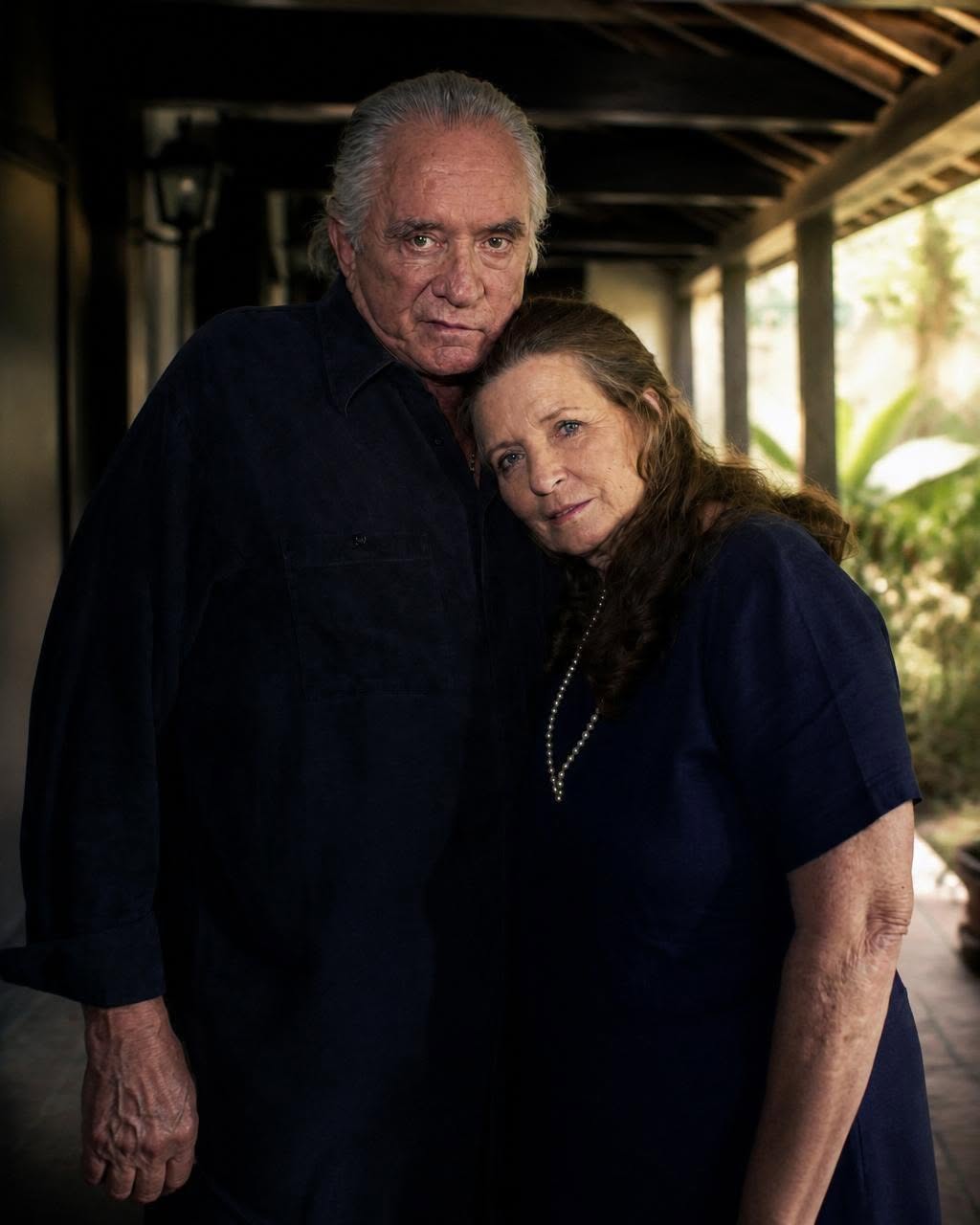
People still call Johnny Cash and June Carter Cash one of country music’s greatest love stories. That part is true. But the story did not begin as a fairy tale. It began in the middle of real life: two married performers, two complicated homes, and a connection that grew stronger than either of them seemed ready for. Johnny Cash was married to Vivian Liberto and had four daughters when his bond with June Carter began to deepen. June Carter was also married during part of that same early chapter.
By the mid-1960s, Johnny Cash’s personal life was unraveling. His addiction, his absences, and the strain of touring put enormous pressure on his marriage. Vivian Liberto Cash filed for divorce in 1966. Their marriage ended, but the pain did not vanish with the paperwork. Four daughters watched their family change in public, under the pressure of fame and rumor.
What makes the story endure is not denial of the mess, but the way Johnny Cash and June Carter Cash kept showing up for each other after the mess became impossible to ignore. June Carter Cash was not just a romantic partner. She was part of the rescue effort. She helped push Johnny Cash toward sobriety and steadiness, and sources describing their relationship consistently note that she insisted he change before she would fully commit to building a life with him.
They married on March 1, 1968, and the marriage lasted 35 years, until June Carter Cash died on May 15, 2003. Johnny Cash died less than four months later, on September 12, 2003. Their story was not neat, but it was lasting. It had music, faith, relapse, forgiveness, and the hard work of choosing each other again after the hardest years had already happened.
What do you call a love story built on betrayal, endurance, and repair? Maybe not a fairy tale. Maybe something more honest: a human story.
That honesty matters. Johnny Cash and June Carter Cash did not live a perfect life, and nobody should pretend they did. But they did live a life that changed each other. John Carter Cash has said they did not live “happily ever after” so much as “happily after all,” and that feels closer to the truth than any polished legend.
Even the people left behind became part of the larger story. Vivian Liberto’s place in that history remained painful, and her perspective reminds us that famous love stories often cast long shadows. Still, the ending that music fans remember is the one where Johnny Cash and June Carter Cash kept finding their way back, even when the road was broken. That is why the story still lingers: not because it was clean, but because it was real.
Post navigation
Marty Robbins, the Voice of the Last Ride
Millions came to know Marty Robbins through songs about men who rode toward danger, even when the ending seemed already decided. In El Paso, his calm, steady delivery made the cowboy’s return feel almost inevitable. The song carried risk, love, and fate in the same breath, and Marty Robbins sang it like he understood all three.
That feeling was not just performance. Away from the microphone, Marty Robbins lived with a real attraction to speed. He was deeply involved in stock car racing and competed in NASCAR events, putting himself on tracks where every lap demanded nerve, timing, and trust in the machine beneath him. Music made him famous, but racing gave him another stage entirely.
He did not treat racing like a hobby for photo opportunities. Marty Robbins kept returning to the driver’s seat even after serious health problems. He suffered heart trouble over the years, including major surgery, yet he still came back to the sport that had captured him. To fans, that only made the contrast more striking: the man who sang about danger on horseback was also chasing speed on asphalt.
A life lived at full throttle
Marty Robbins’ racing career became part of the larger story people told about him. He entered 35 career NASCAR Grand National Series races and earned six top-10 finishes. For a singer with a packed touring schedule, that was no casual side note. It was proof that he was willing to test himself in a world where talent alone was never enough.
His final NASCAR race came on November 7, 1982, in the Atlanta Journal 500. Just one month later, on December 8, 1982, Marty Robbins died at age 57 after another heart attack. The timing gives his story a hard edge. He did not drift away from racing quietly. He was still competing near the end, still choosing motion over caution.
He sang about men heading toward the inevitable, then spent his own life refusing to stand still.
Why the songs still matter
Part of Marty Robbins’ greatness came from the way he made danger feel human. His western ballads were not just stories of gunfire and dust. They were songs about longing, fear, loyalty, and the terrible pull of what a person loves most. That is why El Paso endures. It is dramatic, but it is also tender.
Knowing about Marty Robbins’ racing life adds another layer to that voice. He was not singing from a distance. He had his own relationship with risk, and perhaps that is why his performances felt so believable. The cowboy in the song and the driver on the track were both chasing something larger than safety.
In the end, Marty Robbins left behind more than hit records and racing statistics. He left a portrait of a man who kept moving, even when the road was dangerous. That combination of music, courage, and stubborn momentum is what makes his story still feel alive.