THEY BURIED HIM IN A CLOVER PASTURE BEHIND HIS OWN HOUSE. HIS TOUR BUS WAS PARKED SIDEWAYS TO BLOCK THE WIND. Merle Haggard was born in a converted boxcar outside Bakersfield and did nearly three years in San Quentin before he ever cut a record. He sang for the men country radio would rather not look at. Convicts. Drifters. Men behind on rent. On April 6, 2016, Merle died at his home in Palo Cedro, California. It was his 79th birthday. A week earlier, he had told his sons that this would be the day. The funeral was private, held April 9 on his ranch. Fifteen rows of folding chairs in the grass. His bus, the Super Chief, angled across the field as a windbreak. Merle had planned all of it himself — he picked the songs and asked Marty Stuart to officiate. It opened with a recording of Lefty Frizzell singing “I Love You a Thousand Ways.” Connie Smith sang “Precious Memories.” She and Stuart sang “Silver Wings.” What was left of the Strangers sat in the chairs. Then Kris Kristofferson stood up. Halfway through “Sing Me Back Home,” the wind took his lyrics off the stand. He smiled at it and kept singing. California sent him to San Quentin at twenty and pardoned him at thirty-four. Nashville put him in the Hall of Fame at fifty-seven. Bakersfield, the town whose jail he kept escaping from, got around to putting his name on a building in April 2018. About three hundred people came. It would have been his eighty-first birthday. – Country Music
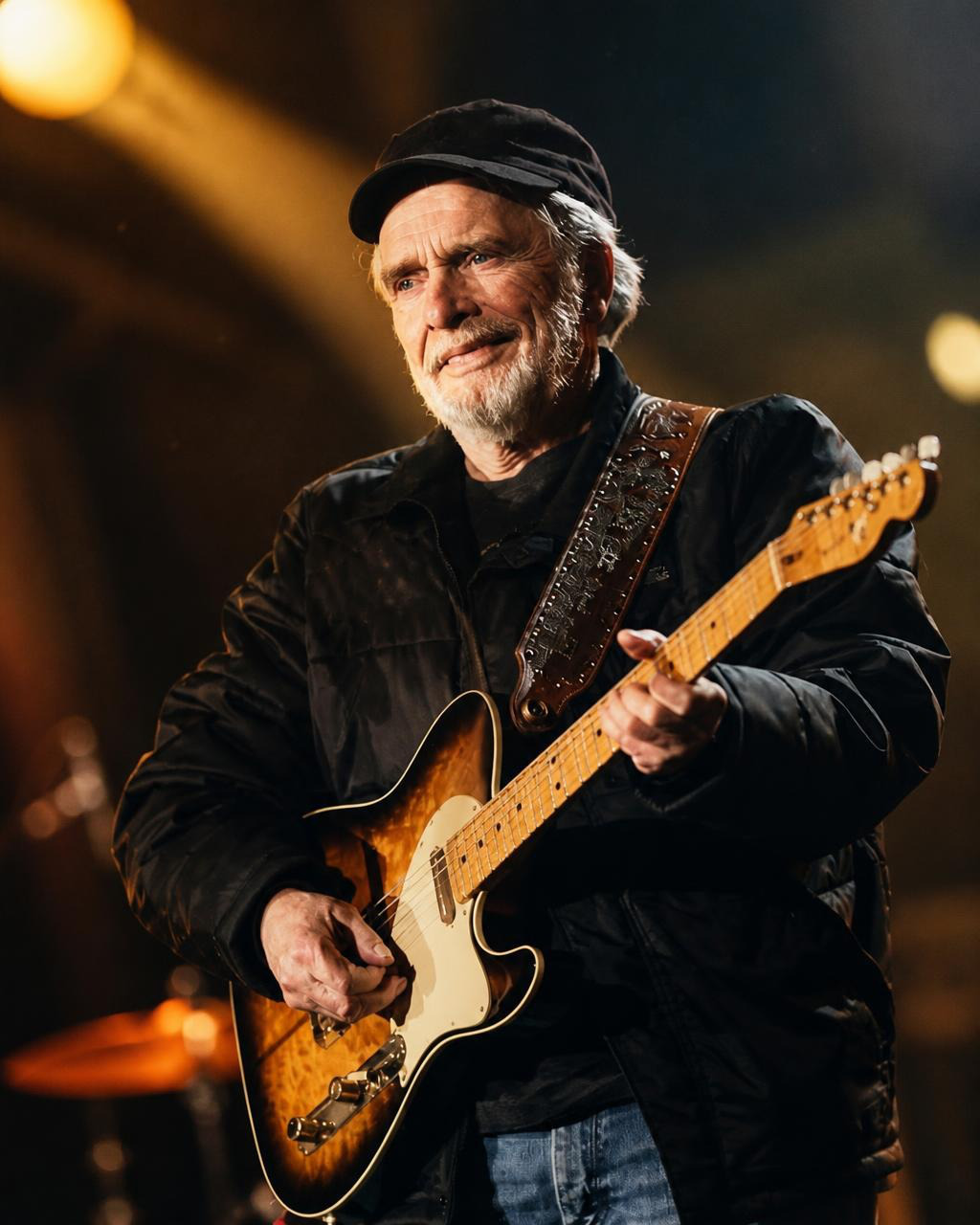
Merle Haggard’s Final Wish, and the Quiet Burial That Felt Like a Song
Merle Haggard spent much of his life singing for people country radio did not always want to see clearly: prisoners, drifters, working men, people carrying regret and pride in the same breath. Born in 1937 near Bakersfield, California, he became one of the defining voices of the Bakersfield sound and one of the most recognizable writers in country music. By the time he died on April 6, 2016, at his home in Palo Cedro, California, he had already told the story of where he came from and what it cost. He was 79, and it was his birthday.
What happened next was not a public spectacle, but a carefully planned farewell. The funeral was private and held on April 9 at his ranch. The setting was simple and personal: folding chairs placed in the grass, family and close friends gathered under an open sky, and Merle Haggard’s tour bus, the Super Chief, parked sideways to act as a windbreak. Every detail reflected his own hand in the arrangement. He had chosen the music, and he had asked Marty Stuart to officiate.
The service opened with a recording of Lefty Frizzell singing I Love You a Thousand Ways. Connie Smith performed Precious Memories, and Connie Smith and Marty Stuart sang Silver Wings. The Strangers, the band so closely tied to Merle Haggard’s sound, were there too, sitting in the chairs and listening as the songs he loved carried the moment forward.
He built a life out of hard-earned honesty, then asked for a goodbye that matched it.
Then Kris Kristofferson stood up and sang Sing Me Back Home. The wind moved through the field and lifted the pages on the stand, but Kris Kristofferson kept going anyway. It was a small detail, yet it fit the whole day: nothing overdone, nothing polished into something false, just music, weather, memory, and gratitude.
Merle Haggard’s life had carried a long arc, from a difficult youth and time in San Quentin to national recognition and the Country Music Hall of Fame. California had once locked him up, and later it honored him. Bakersfield eventually found its way to his name again too, with a post office naming ceremony in April 2018, held on the two-year anniversary of his death and what would have been his 81st birthday.
In the end, the burial behind his own house felt in keeping with the man: private, unpretentious, and fully his own. Merle Haggard did not leave behind a polished legend so much as a living map of American country music, full of grit, tenderness, and truth. The farewell matched the life.
Post navigation
When America Heard Loretta Lynn Again
She died on a Tuesday, but the silence did not last long.
On October 4, 2022, Loretta Lynn passed away peacefully in her sleep at her ranch in Hurricane Mills, Tennessee. She was 90 years old. By that evening, the news had already started to feel less like an announcement and more like a collective pause. Fans did what fans always do when an artist matters deeply: they went back to the songs.
Loretta Lynn had spent her life turning hard truths into country music. She grew up in Butcher Hollow, Kentucky, in a poor coal mining family. She married young, became a mother young, and spent years living the kind of life many women were expected to keep private. Instead, Loretta Lynn wrote about it. She sang about marriage, heartbreak, faith, cheating, motherhood, and the stubborn dignity of working women. Sometimes radio resisted her. Sometimes critics misunderstood her. Loretta Lynn kept singing anyway.
A Voice That Refused to Whisper
What made Loretta Lynn unforgettable was not just her success, but the way she earned it. Her songs did not float above ordinary life; they came from inside it. She gave country music a plainspoken honesty that felt radical because it was so direct. Songs like “Coal Miner’s Daughter” and “You Ain’t Woman Enough” did more than entertain. They described the world with a clarity that many listeners recognized instantly.
In the days after her death, that connection showed up in numbers and in memory. Streams of her music surged as listeners returned to the catalogue that had shaped them. People who had known Loretta Lynn for decades heard the songs differently. Younger listeners discovered that her voice carried not just history, but instruction: tell the truth, even when it costs you something.
Nashville did not let the moment pass quietly. Twenty-six days later, the Grand Ole Opry filled with tributes, and the night felt less like a concert than a shared goodbye. Artists stood in the circle and honored the woman who had become one of country music’s most important voices. The tributes were personal, and that was fitting. Loretta Lynn had made a career out of sounding personal without ever sounding false.
She was not only remembered as a legend. She was remembered as a writer who made room for other people’s lives.
Alan Jackson sang a song he had written for his own mother. George Strait, Dolly Parton, Jack White, Taylor Swift, and others joined the wider tribute to a woman who had spent decades refusing to be quiet. The scene carried a simple kind of grace: the industry that once questioned her was now standing still to thank her.
What Loretta Lynn Left Behind
Loretta Lynn did not just leave behind hit records. She left behind a standard. She showed that country music could be sharp, emotional, funny, defiant, and deeply human all at once. She also left behind a reminder that a working woman’s life, in all its struggle and contradiction, was worthy of the spotlight.
That may be why the grief felt so large. Loretta Lynn had not only sung for America; she had told America something about itself. And when she was gone, listeners reached for her songs as if they were reaching for proof that honesty still mattered.
By the end of that week, the world was listening again. Not because Loretta Lynn had become larger in death, but because people finally understood the size of what she had already given them in life.