“SHE TOLD THEM SHE WOULDN’T GROW OLD. FATE WAS LISTENING.” Patsy Cline didn’t just sing about heartbreak. She seemed to know something the rest of us didn’t. Friends whispered that she had a “second sight.” She gave away her personal treasures. She wrote her will on airline stationary. She told peers like Loretta Lynn and June Carter: “I’ve had two bad accidents. The third one will be the charm.” She wasn’t being morbid. She was being practical. She sang with a desperate urgency, as if she was trying to get all the music out before the clock stopped. On that foggy night in Tennessee, when the pilot was told to turn back, Patsy just smiled and said, “Don’t worry about me. When it’s my time to go, it’s my time.” The plane went down in the woods of Camden. The “Voice” was silenced at just 30 years old. But listening to her records now, you realize something chilling: She wasn’t singing to the audience in the room. She was singing to the generations she knew she’d never get to meet. She knew she was leaving. She just wanted to make sure she left an echo that would last forever. – Country Music
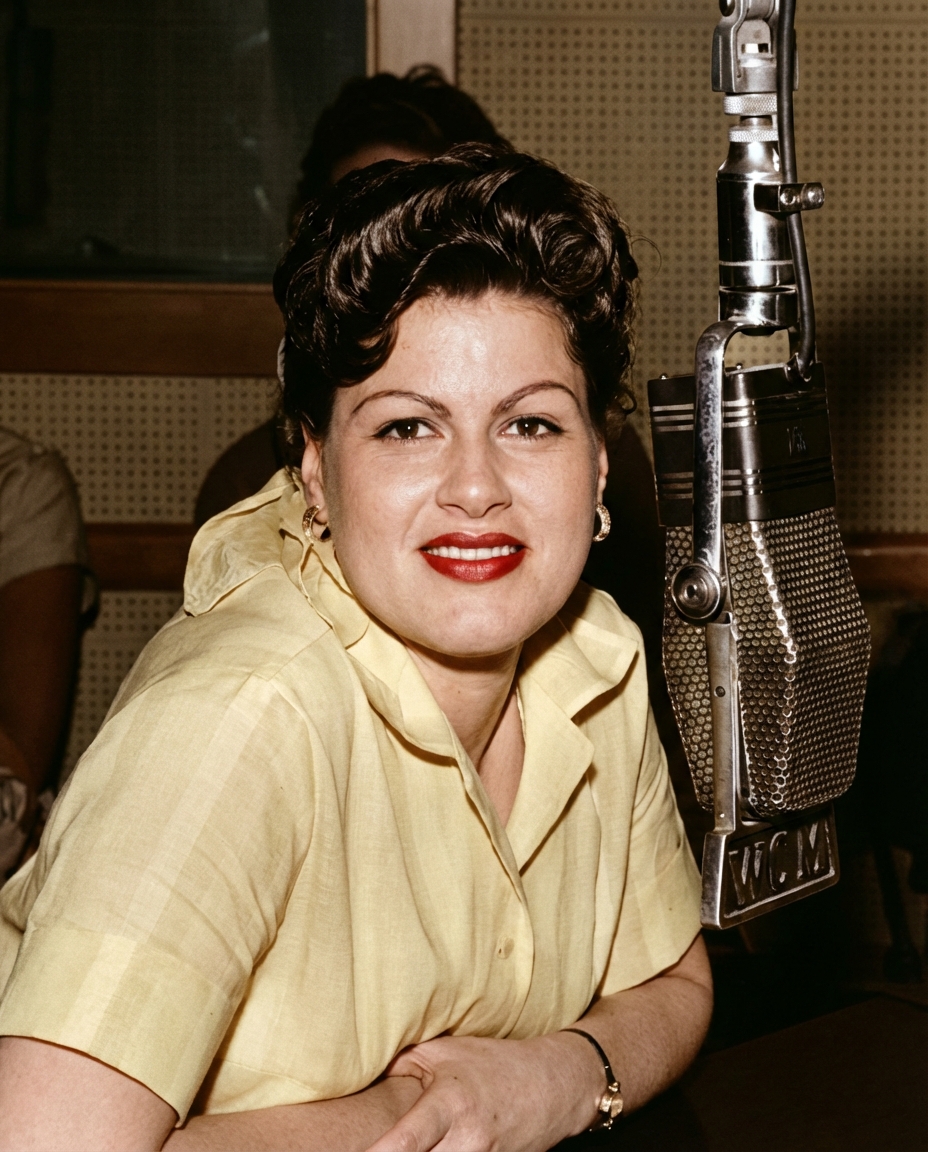
Some singers make you believe a lyric. Patsy Cline made you believe the silence between the lyrics, too. It wasn’t just the way she stretched a note until it felt like it might break. It was the feeling that she was rushing toward something she couldn’t name—like she had one hand on the microphone and the other on a door that was already half-open.
Years later, people would say Patsy Cline had a kind of “second sight.” Not in a dramatic, movie-scene way. More like a practical, unnerving calm. Friends remembered small choices that didn’t match the usual rhythm of a rising star: giving away personal treasures, tidying loose ends, speaking about time as if it were borrowed instead of promised.
One story that kept coming back was the will. Patsy Cline, according to those close to her, wrote her will on airline stationery. It’s the kind of detail that sticks because it feels too specific to be invented. And then there were the words she reportedly said to peers she trusted—Loretta Lynn and June Carter—words that landed with a half-laugh and a half-warning: she’d already survived two bad accidents, and the third one would be “the charm.”
“I’ve had two bad accidents. The third one will be the charm.”
If you read that on a page, it sounds morbid. But the people who loved her didn’t describe it that way. They described it as Patsy Cline being Patsy Cline—direct, unsentimental, and strangely organized about the things most of us avoid thinking about until we’re forced to. She wasn’t chasing darkness. She was making sure nothing was left undone.
That’s part of what made her voice feel so urgent. Patsy Cline didn’t sing like she had unlimited tomorrows. She sang like she had a list, and she was determined to finish it. Every record carried that quiet intensity: not panic, not melodrama—just purpose. A love song from her didn’t feel casual. A heartbreak song didn’t feel theatrical. It felt like a message delivered with both hands.
The Night the Sky Wouldn’t Clear
On the night that would become legend, the air over Tennessee was thick with fog and uncertainty. The details have been repeated so often they’ve become almost mythic: warnings, hesitation, the sense that nature itself was urging a pause. At some point, the pilot was told to turn back.
Patsy Cline, as the story goes, didn’t argue. She didn’t create a scene. She didn’t perform fear for anyone’s comfort. She simply smiled and said, “Don’t worry about me. When it’s my time to go, it’s my time.” It’s a line that sounds like a movie script—except it didn’t come from a script. It came from a woman whose friends had already heard her talk about time like it was a fixed appointment.
The plane went down in the woods near Camden. Patsy Cline was only 30 years old. The shock of that number never really fades, because her voice sounds older than time. It sounds like someone who has lived through several lifetimes of feeling, even if the calendar insists she did not.
The Echo She Left Behind
After the headlines quieted, what remained was the music—and the strange sensation that Patsy Cline had been preparing us for the absence all along. Listen now and you can hear it: not a goodbye tucked into the lyrics, but a kind of knowing in the delivery. She sang as if she understood that her audience would keep growing long after she stopped walking into studios.
That’s the chilling part people notice in hindsight. Patsy Cline wasn’t only singing to the crowd in front of her. Patsy Cline was singing to the generations she would never meet. Not because she could predict the future with certainty, but because she sang like she refused to waste a second pretending she had forever.
And maybe that’s the real legacy. Patsy Cline didn’t leave behind a mystery to solve. Patsy Cline left behind a standard to measure—what it sounds like when an artist puts everything on the line, not for attention, but for truth. She knew she was leaving, or at least she lived like she might. And she made sure the echo would last.
When you play her records today, it doesn’t feel like nostalgia. It feels like proof.
Post navigation
Jim Reeves didn’t arrive in country music like a storm. He didn’t shout, strain, or bend his voice until it cracked just to prove he felt something. Instead, he walked in calmly, stood still, and sang as if everything was already in place. His voice was smooth, deep, and balanced—never rushed, never forced, never trembling for effect. And somehow, that restraint made listeners trust him immediately.
There was a quiet certainty in Jim Reeves’ singing. He sounded like a man who knew exactly who he was and had no interest in convincing anyone else. Each note landed where it belonged, neither chasing emotion nor running from it. The result was a voice that felt dependable, like a steady hand on your shoulder rather than a dramatic confession across a crowded room.
A VOICE THAT NEVER BEGGED
At a time when many singers relied on vocal strain to communicate pain or passion, Jim Reeves did the opposite. He rarely raised his voice. He didn’t stretch notes until they broke. He let the song breathe, trusting that the listener would lean in on their own. That trust was his greatest strength.
His delivery suggested control not just over pitch, but over feeling itself. There was no sense of desperation. No audible struggle. He sang as if emotion didn’t need to announce itself loudly to be real. And because of that, his performances carried a kind of dignity that felt rare even then.
THE SOUND THAT MOVED INTO HOMES
Jim Reeves’ voice didn’t belong only in honky-tonks or late-night bars. It fit effortlessly into living rooms. Radios. Quiet evenings after work. His sound didn’t demand attention—it earned it. Families could listen together without tension, without edge, without feeling like something might spill out of control.
This was a crucial reason the Nashville Sound took shape around him. His singing embodied polish without coldness, softness without weakness. The orchestration that followed his voice wasn’t there to mask flaws—it was there to match his balance. Strings didn’t overpower him. They settled in behind him, as calm as he was.
He didn’t sing to impress. He sang as if being steady was already enough.
CONFIDENCE WITHOUT DISPLAY
What made Jim Reeves stand apart wasn’t technical perfection alone. It was the absence of ego in his delivery. He didn’t decorate songs with unnecessary flourishes. He didn’t signal emotion with dramatic pauses or exaggerated phrasing. He trusted the melody. He trusted the lyric. And most of all, he trusted himself.
That kind of confidence can be easy to miss. It doesn’t announce itself. It doesn’t compete for attention. But once you notice it, it’s hard to ignore. The calm in his voice suggested experience, patience, and self-knowledge—qualities that don’t age quickly.
WHY CONTROL CAN BE MISUNDERSTOOD
Some listeners mistake restraint for distance. They expect emotion to arrive loudly, visibly, undeniably. Jim Reeves challenged that expectation. His performances asked a different question: what if feeling doesn’t need to overflow to be honest?
In his voice, control wasn’t a limitation—it was a choice. A belief that sincerity could exist without excess. That strength could sound gentle. That certainty didn’t need volume.
Decades later, his recordings still feel composed, still feel sure of themselves. They don’t chase trends or react to the moment. They simply exist, steady and complete, as if they were never worried about being remembered.
Sometimes the calmest voice is the one that knows exactly where it stands. And maybe that’s why Jim Reeves still sounds so certain today. The question remains: is control in a voice a strength—or is it something we overlook because it never asks us to look twice?