In 1999, Alan Jackson and George Strait stepped onto the CMA stage and did something nobody expected. Both had spent the entire ’90s proving traditional country could still sell — hit after hit, no pop gimmicks. Then they walked out and performed “Murder on Music Row,” a song written by Larry Cordle and Larry Shell that flat-out said Nashville was killing the genre. The steel guitars disappearing. The fiddles getting swapped for pop drums. And here’s what made the whole room uncomfortable — the people the song was accusing were sitting right there in the front rows. The crowd jumped to their feet. Standing ovation. But the executives who’d been pushing country toward pop barely moved. The song was never officially released as a single. It still charted at #38 from radio requests alone. Then it won CMA Vocal Event of the Year in 2000 and Song of the Year in 2001. Two men told Nashville the truth to its face. And Nashville had no choice but to hand them the trophies for it. – Country Music
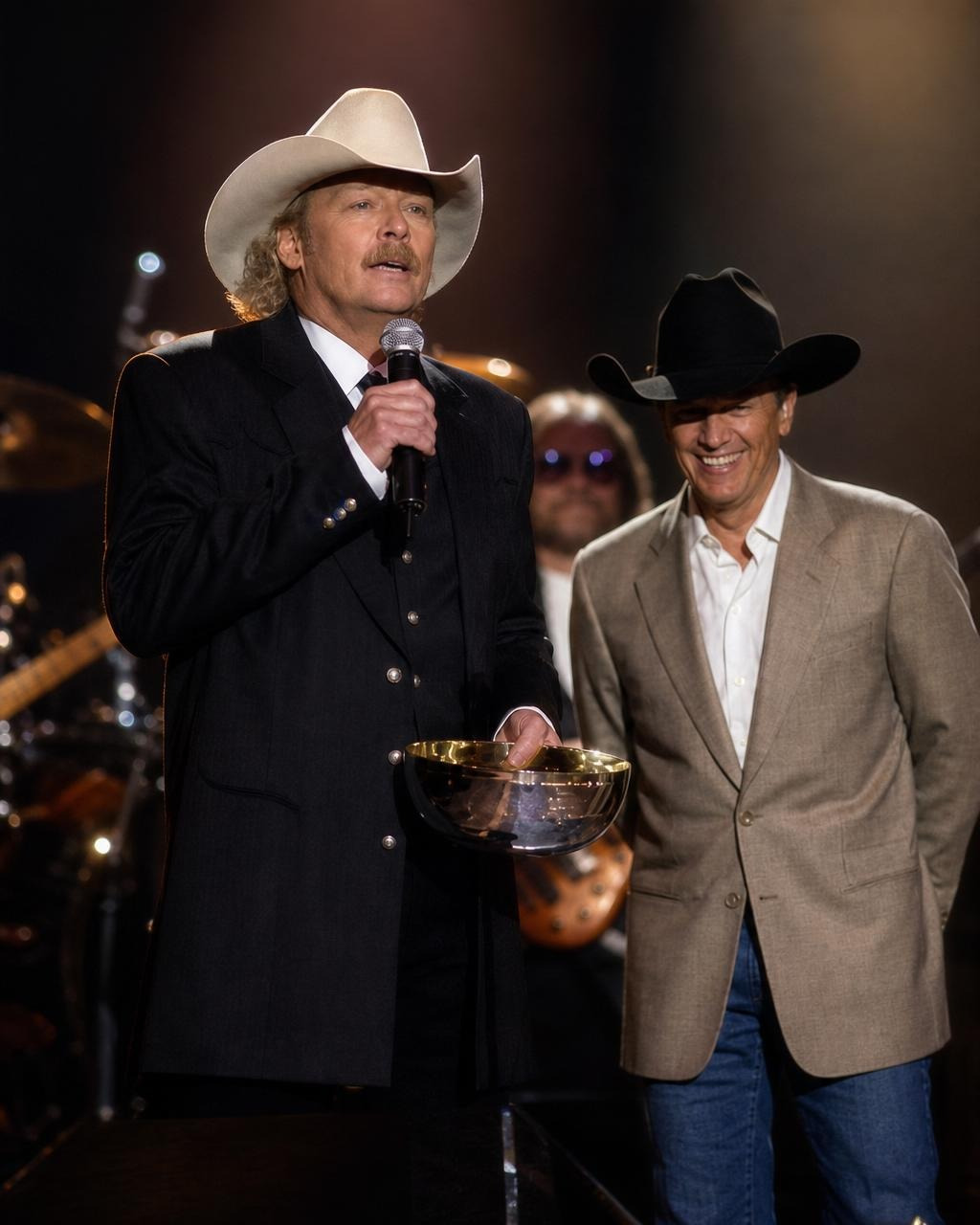
In 1999, the Country Music Association Awards delivered a moment that felt bigger than a performance. Alan Jackson and George Strait stepped onto the stage and sang Murder on Music Row, a song written by Larry Cordle and Larry Shell that spoke plainly about something many fans had been feeling for years: country music was changing, and not everyone liked the direction.
By the end of the 1990s, both Alan Jackson and George Strait had already built their reputations the hard way. They were not trying to chase trends. They were proving, one hit after another, that traditional country music still mattered. Their success was part of the reason the moment landed so hard. These were not outsiders complaining from the sidelines. These were two of the genre’s biggest names, standing at the center of Nashville and saying what they believed out loud.
A Song That Spoke for the Fans
Murder on Music Row did not use vague language. It was direct. The lyrics pointed to the fading presence of steel guitars, the growing influence of pop-style production, and the feeling that something essential was being pushed aside. For longtime listeners, the song sounded like a warning and a heartbreak all at once.
It was the kind of song that made people lean in, because it was not pretending to be neutral.
What made the performance even more unforgettable was the setting. The people being criticized by the song were sitting right there in the front rows. That meant the message was impossible to miss. Some in the audience rose to their feet in applause almost immediately. Others, especially the executives and industry insiders who had helped steer country music toward a more polished sound, stayed seated and quiet.
A Performance That Changed the Temperature in the Room
The contrast in that room said everything. Fans responded with a standing ovation because they heard honesty. The industry, on the other hand, had to sit with a song that challenged its choices in public. It was uncomfortable, but it was also powerful. Country music has always been at its best when it tells the truth, even when the truth is hard to hear.
Even though Murder on Music Row was never officially released as a single, it still found its audience. Radio requests carried it to #38, proving that listeners were paying attention. The song’s impact did not end with that night at the CMA Awards, either. In 2000, it won CMA Vocal Event of the Year, and in 2001, it earned Song of the Year.
Why the Moment Still Matters
More than two decades later, the performance still feels important because it captured a real tension in country music: the struggle between tradition and reinvention. Alan Jackson and George Strait did not make the argument with anger alone. They made it with melody, with restraint, and with the confidence of artists who had nothing to prove.
That is why the story lasts. Two legends walked into one of the genre’s biggest nights, sang a song that challenged the powerful, and left with the crowd on its feet. Nashville may not have loved the message, but it could not ignore the music. In the end, the same industry that was being called out had to honor the song for saying what so many fans already believed.
Sometimes the most memorable moments in music are not the ones designed to please everyone. Sometimes they are the ones that tell the truth so clearly that even the room full of decision-makers has to listen.
Post navigation
In country music, some legends win by turning everything up. Others win by leaving everything alone. Garth Brooks and George Strait spent the 1990s proving that both paths could lead to greatness, but they did it in completely different ways.
Garth Brooks brought fireworks to the genre. He filled stadiums, jumped into crowds, leaned into spectacle, and made country music feel larger than life. By the time he had sold more than 170 million records, he had already changed the business forever. He became a rare kind of star who could cross every boundary and still sound unmistakably like country.
George Strait took the opposite road. No drama. No giant production. No need to reinvent anything. He stepped onto the stage in a hat, boots, and a calm smile, then let the songs do the work. Night after night, album after album, George Strait built a career on restraint, tradition, and a voice that never needed help to be remembered.
A Line That Told the Whole Story
When Garth Brooks was inducted into the Country Music Hall of Fame in 2012, he did something unexpected. Instead of turning the moment into a victory speech, he talked about admiration. He spoke about hearing “Unwound” on the radio during college and realizing what kind of artist he wanted to become.
“I still want to be George Strait so damn bad.”
It was one of those rare public moments that felt completely honest. Garth Brooks had every reason to stand there with confidence. He had sold an impossible number of records. He had become one of the biggest performers in American music. Yet the artist he admired most was the one who seemed to do the least.
That line landed because it revealed something deeper than competition. It showed how strongly George Strait represented the ideal for so many country artists. Garth Brooks may have built the louder empire, but George Strait remained the standard.
Two Different Paths, One Shared Respect
Fans often compare these two men as if they were rivals fighting for the same crown. In truth, they were more like two answers to the same question: What can country music be?
Garth Brooks answered with movement, risk, and spectacle. George Strait answered with consistency, control, and timelessness. One sold the thrill of the moment. The other sold trust.
That is why the respect between them mattered so much. George Strait once responded with a quiet remark that fit his character perfectly:
“Garth has always treated me with the utmost respect… to have somebody look at me like I looked at George Jones is pretty special.”
It was a humble statement, and a powerful one. George Strait did not need to explain his legacy. He simply acknowledged it and moved on. That silence said as much as any long speech could have.
Why It Still Matters
The story of Garth Brooks and George Strait is not really about who won. It is about how country music made room for two giants at the same time. In the 1990s, listeners could choose the thunder of Garth Brooks or the steady glow of George Strait, and both choices felt right.
That is what makes the quote endure. Garth Brooks, standing at the peak of his own success, admitted that he still wanted what George Strait had: the calm authority, the ease, the sense that less could truly be more.
Today, that moment remains one of the most revealing lines in country music history. It reminds fans that greatness does not always erase admiration. Sometimes it sharpens it. And in the case of Garth Brooks and George Strait, it helped define an entire era of American music.