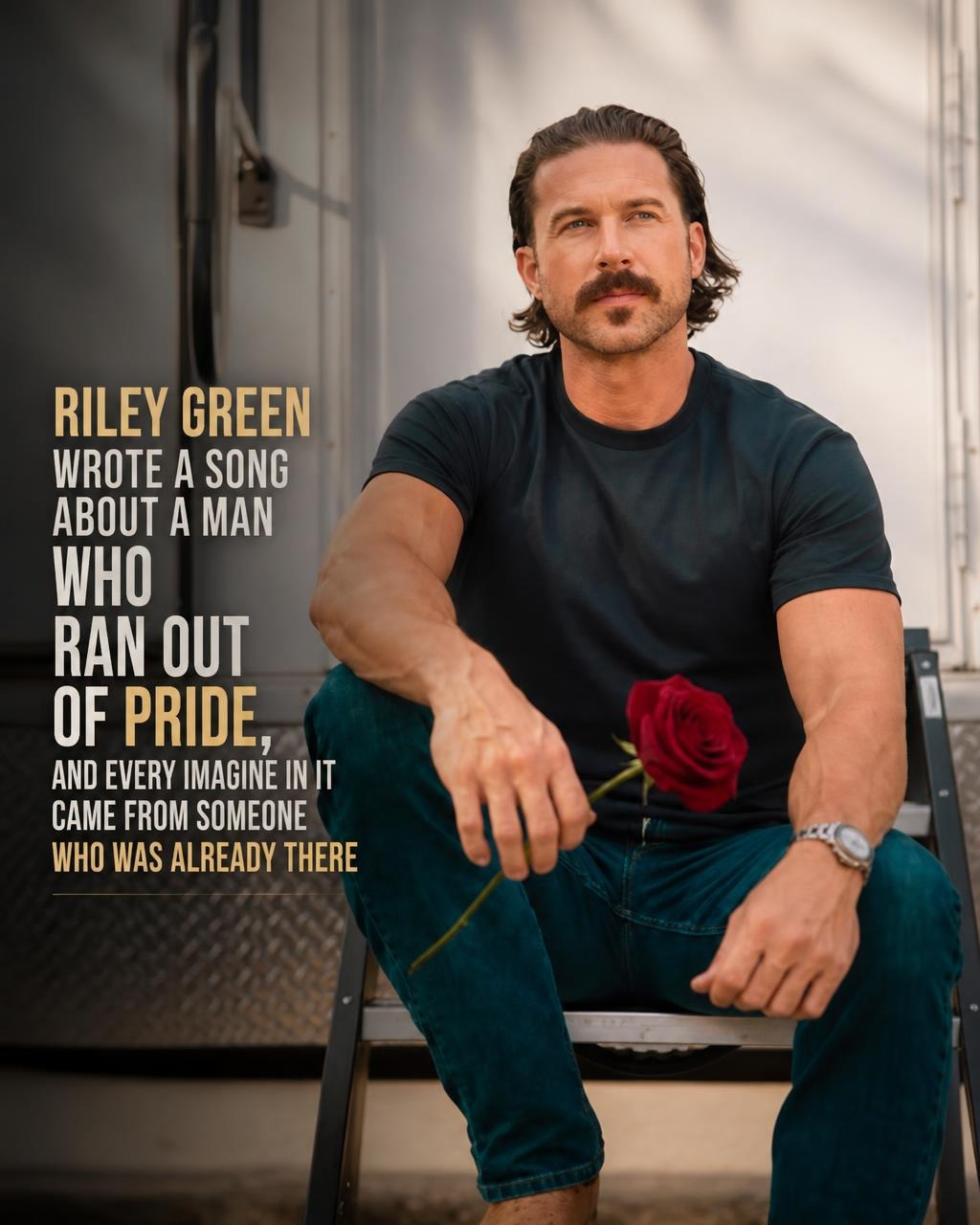
RILEY GREEN WROTE A SONG WHERE THE MAN HAS ALREADY RUN OUT OF PRIDE. “Imagine That” arrived Friday, July 31, as track five on That’s Just Me, the 19-song album he releases September 18. He wrote it with Jonathan Singleton and Ray Fulcher, and it’s stripped back to acoustic guitar and steel, the traditional sound he built his name on. The man in it calls an old love late at night. He doesn’t argue his case and doesn’t relitigate anything. He just describes the night the way it could still go: a truck ready to leave, a long drive, no reason to be anywhere by morning. Imagine that, he keeps asking her. Then he stops asking her to picture it. He tells her he’s standing right outside her door. That’s why the song lands. Every imagine in it came from a man who was already there. – Country Music
Riley Green’s “Imagine That” Finds Its Power in What Was Already There
Riley Green has built a career on songs that feel lived in, and “Imagine That” is one of those records that does not need to raise its voice to leave a mark. Arriving on Friday, July 31, the song appears as track five on That’s Just Me, the 19-song album Riley Green is set to release on September 18. The setting is familiar and intentional: acoustic guitar, steel, and a traditional country feel that gives the story room to breathe.
The song was written by Riley Green with Jonathan Singleton and Ray Fulcher, and that teamwork shows in the way the lyrics move. Instead of sounding like a dramatic confrontation, “Imagine That” plays more like a late-night confession. A man reaches out to an old love and does not spend his time arguing, defending himself, or trying to win the past back. He simply paints a picture of what could happen if she opened the door and let the night turn into one more chance.
A Story Told With Restraint
What makes the song land is its patience. The man in the song speaks in a voice worn down by time and pride, but not by bitterness. He talks about a truck ready to leave and a long drive with nowhere else to be by morning. He keeps returning to the same invitation, the same small dare: imagine that. In country music, that kind of repetition can become powerful when it feels honest rather than forced.
Then the song makes its quiet shift. The man is no longer asking her to picture the moment. He is there. Right outside her door. That detail changes everything, because it reveals the difference between dreaming about a second chance and showing up for one. The emotion comes from action, not volume.
Why the Song Feels So Human
“Imagine That” works because it understands how pride can hide behind calm words. The man does not arrive as a hero, and he does not arrive as a victim. He arrives as someone who has already decided the risk is worth it. That gives the song an emotional edge without turning it into a spectacle.
Every imagine in it came from a man who was already there.
That idea is what gives the song its weight. The title suggests possibility, but the ending suggests commitment. Riley Green keeps the performance stripped down so the listener can hear the tension between hesitation and courage. It is a simple setup, but that simplicity is part of the beauty.
As That’s Just Me moves toward its September 18 release, “Imagine That” stands out as a strong example of what Riley Green does best: telling a story plainly, trusting the feeling, and letting the song arrive without begging for attention. Sometimes the most moving country songs are the ones that do not chase drama. They just walk up to the door and wait.
Post navigation
In 2019, John Prine sat in the comfort of his Nashville home and recorded what would become his last song. There was no crowded studio, no bright wall of glass, and no sense that history was being made. Just John Prine, his guitar, producer Dave Cobb, engineer Gena Johnson, and a song he had written with longtime friend Pat McLaughlin. The track was called “I Remember Everything.”
That setting fit John Prine perfectly. For decades, he had built a career out of turning small details into something lasting. He wrote about motel rooms, worn highways, awkward love, and the kind of memories that live quietly in everyday people. He never needed to shout to be heard. His songs did the work for him.
A quiet recording with a lasting weight
When John Prine sang “I Remember Everything,” he was looking backward with a clear eye. The song moved through the landscape of a long life on the road: towns passed through too fast, guitars that were never quite perfect, and the kind of moments that seem ordinary until years later when they become precious. It was tender, direct, and unmistakably his.
John Prine had a gift for making memory feel human, not grand. In this final recording, that gift became even more moving because no one in the room knew it would be the last time the world would hear his voice on a new song.
John Prine died on April 7, 2020, at age 73, from complications of COVID-19. His death sent a wave of grief through music fans, fellow songwriters, and everyone who had grown up with his warm, observant writing. Two months later, his family released “I Remember Everything.”
The final release that found its audience
When the song arrived, it landed with special force. It was not just another posthumous release. It felt like a final postcard from an artist who had spent nearly 50 years giving voice to ordinary lives. The song went on to become the highest-charting single of John Prine’s career as a performer, a remarkable reminder of how deeply his music still connected with listeners.
Its later recognition was just as meaningful. At the 63rd Annual Grammy Awards, “I Remember Everything” won Best American Roots Performance and Best American Roots Song. For a songwriter who spent so much of his life honoring the overlooked corners of the world, the tribute felt especially fitting.
What remained after the last note
John Prine did not leave behind a dramatic farewell or a polished final statement. He left a song that sounded like honesty. He remembered the places, the faces, and the life that shaped him, and he trusted those memories to carry the story.
That is why “I Remember Everything” still feels so powerful. It is not only a final recording. It is a closing thought from an artist who understood that memory is one of the most enduring forms of love. John Prine spent his career singing for the rest of us, and in the end, he gave us one more reason to listen closely.