FORTY TIMES HE TOOK A SONG TO THE TOP OF THE COUNTRY CHART — AND NEVER ONCE RAISED HIS VOICE TO DO IT. Conway Twitty built one of the biggest careers in country music on the opposite of noise. Fans first fell for the way he opened “Hello Darlin'” in 1970, speaking those two words instead of singing them, soft enough that a whole auditorium leaned in. That closeness became his signature, and it never left his records. It’s the same thing you hear in “Tight Fittin’ Jeans,” his 26th No. 1, released in June 1981. On paper it’s just a story about a well-off woman walking into a roadside bar. In his voice it becomes three minutes of unspoken attraction, a working man who can’t find the words and doesn’t need to. He was the rare singer who understood that a country song isn’t a performance you hand to a crowd. It’s a confession you make to one person, and then let a few thousand strangers quietly overhear. That’s why the man they called the High Priest of Country Music still reaches people who never got to see him live. He didn’t sing at you. He sang to you. And more than thirty years after he was gone, the records still answer back. – Country Music
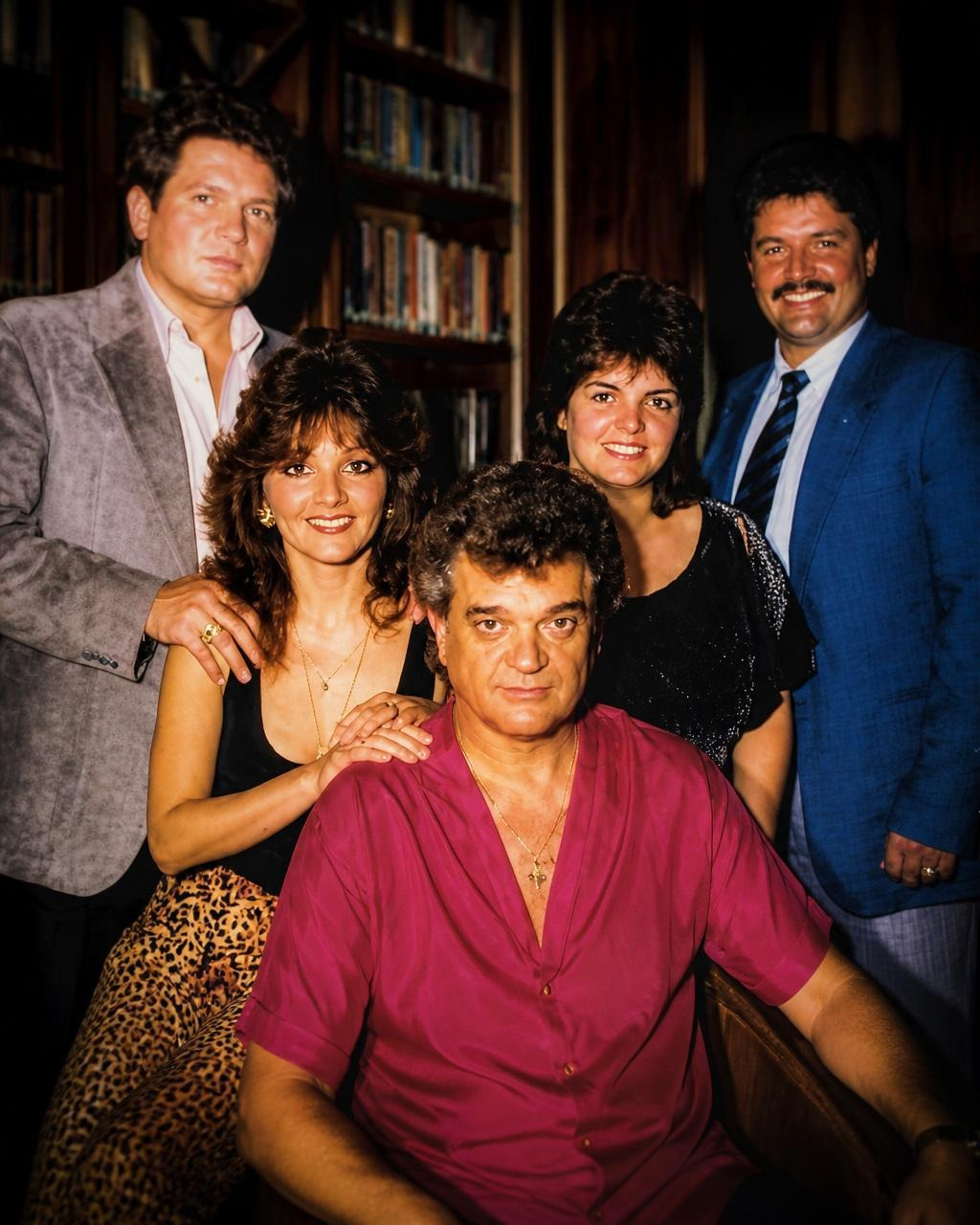
Conway Twitty and the Quiet Power of a Country Number One
Conway Twitty built a career on a sound that never needed to shout. He became one of country music’s defining voices by doing almost the opposite of what many stars do: he leaned in. Fans remember the opening of Hello Darlin’ because it begins with Conway Twitty speaking the title instead of singing it, and that simple choice made the song feel personal from the first second. Released in 1970, it spent four weeks at No. 1 on the country chart and became the year’s top country song.
That intimacy was not an accident. Conway Twitty’s records were built around emotional control, and his smooth delivery gave even ordinary stories a private, almost confessional feeling. The Country Music Hall of Fame and Museum has noted that songs such as Hello Darlin’, Fifteen Years Ago, You’ve Never Been This Far Before, There’s a Honky Tonk Angel, and Linda on My Mind helped define his career.
By the time Tight Fittin’ Jeans arrived in June 1981, Conway Twitty had already become a master of understatement. The song became his 26th No. 1 country hit, and it fit perfectly into his larger style: a small scene, a passing glance, a feeling that grows in the space between the words. The hook was never volume. It was tension, restraint, and the belief that a listener would lean closer if the singer trusted the story enough.
That may be why Conway Twitty still feels fresh to many listeners who never saw him in concert. His nickname, “The High Priest of Country Music,” came from the devotion he inspired, and it captured the almost reverent way audiences responded to him. The Country Music Hall of Fame says he earned forty No. 1 country hits, with eleven of them written by Conway Twitty himself.
Conway Twitty was not the loudest man in the room. He was the man who knew how to make a room go quiet. That is the real strength of his legacy: not spectacle, but connection. He sang as if each line belonged to one person, and millions of listeners answered back over time. Even now, more than three decades after his death on June 5, 1993, his recordings still sound immediate, warm, and certain of what country music can do when it speaks softly.
Conway Twitty never needed to raise his voice to be heard. He made quiet sound unforgettable.
That is the enduring miracle of Conway Twitty. He turned restraint into power, and intimacy into a signature. In a genre built on truth, he understood that the strongest confession is often the one delivered at a whisper.
Post navigation
Some moments in country music feel planned. This one did not.
At the Grand Ole Opry’s 100th anniversary celebration in 2025, Carrie Underwood walked onto the stage with a clear purpose: to honor Randy Travis, the man who once changed the course of her career. Years earlier, on March 15, 2008, Carrie Underwood had just finished singing Randy Travis’s “I Told You So” when Randy Travis surprised her onstage and invited her to become the Opry’s newest member. Carrie Underwood smiled through tears, joked, “Let me think about it,” and then said yes. It was a defining night for her, and the kind of Opry memory that never really leaves the room.
By 2025, the story had come full circle in a way few could have predicted. Randy Travis had suffered a stroke in 2013, and his ability to speak and sing was changed by aphasia. At Opry 100, Carrie Underwood chose songs that carried his legacy forward: “Three Wooden Crosses” and “Forever and Ever, Amen.” The audience listened closely as she sang with the kind of respect that comes from deep gratitude, not performance alone.
A Quiet Turn on a Loud Stage
The most powerful part came at the end. Carrie Underwood reached the final line of “Forever and Ever, Amen,” stepped off the stage, and walked toward Randy Travis’s seat in the front row. She held out the microphone. The room seemed to pause.
Randy Travis answered with one word: “Amen.”
That single word landed like a prayer and a promise. The crowd rose to its feet. Many were visibly emotional. It was not just a musical ending; it was a passing of the moment back to the man who had given Carrie Underwood one of the biggest blessings of her career years before.
The Meaning Behind the Moment
What made the scene so moving was its simplicity. There was no spectacle hiding the emotion. There was only Carrie Underwood honoring Randy Travis, and Randy Travis meeting her in the final note with grace and strength. In 2008, Randy Travis opened the Opry’s door for Carrie Underwood. In 2025, Carrie Underwood made sure Randy Travis was the one who closed the song.
For fans, it was more than nostalgia. It was proof that country music still remembers its own history, and still makes room for gratitude. The Opry has always been about continuity: one generation recognizing the next, one voice carrying forward another. On this night, that tradition felt especially human.
In one word, Randy Travis said everything the room was feeling.
Some endings are quiet. Some are unforgettable. This one was both.