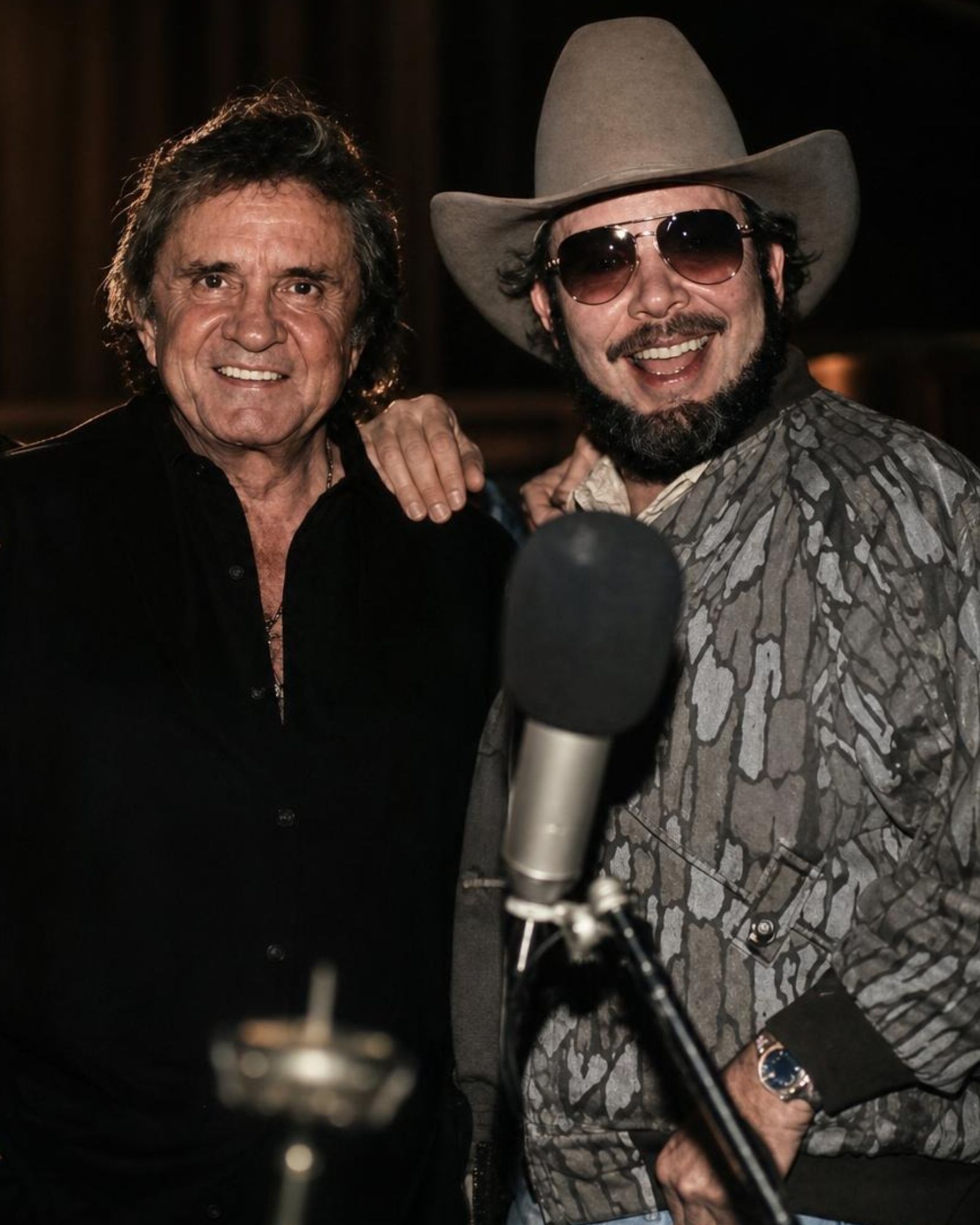
530 FEET. 17 SURGERIES. AND THE FIRST FACE HE SAW WHEN HE WOKE UP WAS JOHNNY CASH. August 8, 1975. Hank Williams Jr. was 26, hiking Ajax Peak in Montana. The snow collapsed under his feet and he fell over 500 feet, his face slamming straight into a boulder. He reached up to touch his nose. It wasn’t there. His teeth, parts of his jaw — fell out in his hand. His skull was fractured in so many places that doctors didn’t expect him to make it through the night. But what happened next is what nobody saw coming. When Hank Jr. finally opened his eyes in that hospital bed, two people were sitting right there — Johnny Cash and June Carter Cash. June was his godmother. She put a cross on him and whispered that everything would be okay. Over the next two years, he went through 17 surgeries to rebuild his face. He had to relearn how to talk, how to sing. His face never looked the same — the beard, the sunglasses, the hat weren’t a style choice. They were part of surviving. And from all that wreckage, Hank Jr. found his own voice — raw, outlaw, and completely his. – Country Music
Hank Williams Jr., the Mountain Fall That Changed Everything, and the Quiet Strength That Followed
On August 8, 1975, Hank Williams Jr. was only 26 years old when a day in Montana turned into a life-changing nightmare. He was hiking Ajax Peak when the snow gave way beneath him. In an instant, he fell more than 500 feet, crashing into rocks below and suffering devastating injuries that would test every part of his strength.
The accident was so severe that doctors feared the worst. His face had been badly shattered, his skull fractured in multiple places, and the injuries were unlike anything most people ever recover from. For Hank Williams Jr., survival was only the beginning of a long road ahead.
A hospital room filled with faith and familiar faces
When Hank Williams Jr. finally woke up, he was not alone. Sitting beside his bed were Johnny Cash and June Carter Cash, two of country music’s most important figures and two people who cared deeply about him. June Carter Cash was Hank Williams Jr.’s godmother, and her presence in that moment brought comfort when everything felt uncertain.
June Carter Cash placed a cross on him and quietly told him everything would be okay.
That simple gesture mattered. In a room filled with pain, fear, and uncertainty, it gave Hank Williams Jr. something to hold onto. Sometimes healing begins not with answers, but with someone showing up and refusing to let hope disappear.
The long recovery no one could see
Over the next two years, Hank Williams Jr. underwent 17 surgeries to rebuild his face and help restore what the accident had taken away. He had to relearn how to speak. He had to relearn how to sing. Every step forward came slowly, and every return to the stage demanded courage.
The man the world saw afterward was changed, and there was no hiding that truth. The beard, the sunglasses, and the hat were not just part of a performer’s image. They became part of how Hank Williams Jr. lived with the aftermath of that fall and faced the public on his own terms.
From survival to identity
What makes Hank Williams Jr.’s story so powerful is not only the accident itself, but what followed. Many people know him as a bold, unmistakable country voice, but that voice was shaped by pain, recovery, and determination. The fall did not erase him. Instead, it forced him to build himself again, piece by piece.
That struggle gave his music a different kind of weight. He did not simply inherit a legacy; he fought through one of the hardest chapters imaginable and created a voice that was unmistakably his own. The result was a career marked by grit, honesty, and resilience.
A story that still resonates
Hank Williams Jr.’s survival story is more than an accident tale. It is a reminder that identity can be rebuilt after loss, and that healing is often messy, slow, and deeply personal. The moment Johnny Cash and June Carter Cash sat at his bedside was only one small part of the story, but it captured something important: even in the darkest moments, people can carry each other through.
From that mountain in Montana came pain, recovery, and a new kind of strength. Hank Williams Jr. did not just survive the fall. He found a way to keep going, and in doing so, he became the artist the world would never forget.
Post navigation
Some songs feel larger than life because they begin with something small and true. In 1977, Gene Watson recorded “Paper Rosie”, a song written by his friend Dallas Harms after he heard about an old woman in Niagara Falls who used to walk into a bar selling paper roses for a dime. That simple image became one of country music’s most quietly heartbreaking stories.
In the song, a man sits in a tavern and buys a rose from a silver-haired woman. She smiles and walks away. Then he hears church bells. He hears a choir. Slowly, the meaning lands on him: the funeral happening next door is for the woman who just sold him the rose. It is a twist that hits hard, not because it is dramatic, but because it feels so human. A small kindness becomes the last memory of someone’s life.
A Song Built on a Real Moment
What makes “Paper Rosie” endure is that it does not sound invented. It sounds observed. Dallas Harms took a real-life detail and turned it into a story about dignity, memory, and the way ordinary people leave lasting impressions without ever knowing it.
Gene Watson’s delivery gave the song even more weight. His voice carried sorrow without shouting, tenderness without excess. When the record climbed the charts and reached #3 on Billboard and #1 in Canada, it proved that listeners connected with that feeling immediately. People did not just hear a song; they recognized a life.
“Rosie sold her roses for a dime. I’m giving you this guitar for a dime.”
The Guitar That Became Part of the Legend
The story behind the story may be even more touching. Gene Watson wanted the guitar Dallas Harms wrote “Paper Rosie” on. Dallas Harms would not take his money. So Gene Watson handed him a half dollar. Dallas Harms gave back four Canadian dimes and said, in effect, that the gesture should match the spirit of the song: Rosie sold her roses for a dime, so the guitar should change hands for a dime too.
That guitar still belongs to Gene Watson today. In a way, it holds two histories at once: the song itself and the friendship that protected it. It is more than an instrument. It is a reminder that some of the best country songs are built from generosity, memory, and respect.
Why “Paper Rosie” Still Matters
Decades later, “Paper Rosie” still resonates because it captures something people never forget: a brief encounter can reveal a whole life. The old woman in the song is not famous. She is not wealthy. She is not trying to be remembered. Yet the song gives her dignity, and in doing so, gives listeners something lasting.
That is the power of country music at its best. It takes a dime, a paper flower, and a quiet goodbye, and turns them into a story that stays with you long after the last note fades.