#3 ON BILLBOARD, #1 IN CANADA — ALL BECAUSE OF A PAPER FLOWER THAT COST A DIME. In 1977, Gene Watson recorded a song his friend Dallas Harms wrote about something real — an old lady who used to walk into a bar in Niagara Falls, selling paper roses for a dime. That image became “Paper Rosie.” A man sits in a tavern. Buys a rose from a silver-haired woman. She smiles, walks away. Then he hears church bells. A choir. And he realizes — the funeral happening next door is hers. But the real story behind the song? Maybe even more touching than the lyrics. Watson wanted the guitar Harms wrote “Paper Rosie” on. Harms wouldn’t take his money. So Watson handed him a half dollar. Harms gave back four Canadian dimes and said: “Rosie sold her roses for a dime. I’m giving you this guitar for a dime.” Watson still has that guitar today. – Country Music
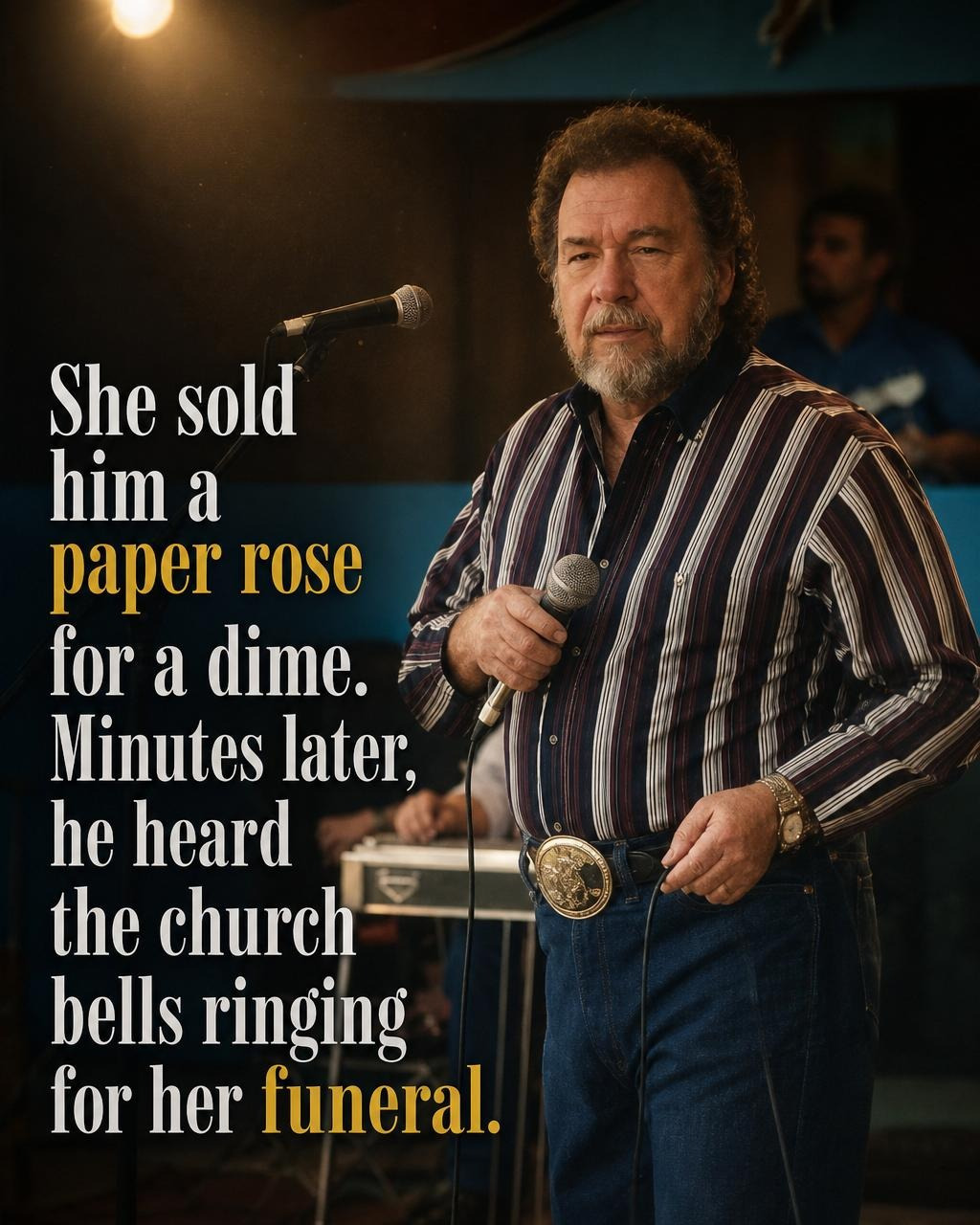
Some songs feel larger than life because they begin with something small and true. In 1977, Gene Watson recorded “Paper Rosie”, a song written by his friend Dallas Harms after he heard about an old woman in Niagara Falls who used to walk into a bar selling paper roses for a dime. That simple image became one of country music’s most quietly heartbreaking stories.
In the song, a man sits in a tavern and buys a rose from a silver-haired woman. She smiles and walks away. Then he hears church bells. He hears a choir. Slowly, the meaning lands on him: the funeral happening next door is for the woman who just sold him the rose. It is a twist that hits hard, not because it is dramatic, but because it feels so human. A small kindness becomes the last memory of someone’s life.
A Song Built on a Real Moment
What makes “Paper Rosie” endure is that it does not sound invented. It sounds observed. Dallas Harms took a real-life detail and turned it into a story about dignity, memory, and the way ordinary people leave lasting impressions without ever knowing it.
Gene Watson’s delivery gave the song even more weight. His voice carried sorrow without shouting, tenderness without excess. When the record climbed the charts and reached #3 on Billboard and #1 in Canada, it proved that listeners connected with that feeling immediately. People did not just hear a song; they recognized a life.
“Rosie sold her roses for a dime. I’m giving you this guitar for a dime.”
The Guitar That Became Part of the Legend
The story behind the story may be even more touching. Gene Watson wanted the guitar Dallas Harms wrote “Paper Rosie” on. Dallas Harms would not take his money. So Gene Watson handed him a half dollar. Dallas Harms gave back four Canadian dimes and said, in effect, that the gesture should match the spirit of the song: Rosie sold her roses for a dime, so the guitar should change hands for a dime too.
That guitar still belongs to Gene Watson today. In a way, it holds two histories at once: the song itself and the friendship that protected it. It is more than an instrument. It is a reminder that some of the best country songs are built from generosity, memory, and respect.
Why “Paper Rosie” Still Matters
Decades later, “Paper Rosie” still resonates because it captures something people never forget: a brief encounter can reveal a whole life. The old woman in the song is not famous. She is not wealthy. She is not trying to be remembered. Yet the song gives her dignity, and in doing so, gives listeners something lasting.
That is the power of country music at its best. It takes a dime, a paper flower, and a quiet goodbye, and turns them into a story that stays with you long after the last note fades.
Post navigation
How Lefty Frizzell Pushed Hank Williams Into One of Country Music’s Most Intense Creative Moments
In 1951, country music was changing fast, and one young singer from Texas stepped right into the center of it. His name was Lefty Frizzell, and at just 23 years old, he did something no artist had done before: he placed four songs in the country Top 10 at the same time. It would not happen again until The Beatles in 1964.
That kind of success was not supposed to happen so quickly. Lefty Frizzell had a voice that sounded effortless, smooth, and deeply personal, and listeners connected with it immediately. His songs did not just climb the charts; they stayed there. “I Want to Be with You Always” sat at number one for 11 weeks, and “Always Late (With Your Kisses)” followed with 12 more weeks at the top. For a young singer, it was an extraordinary run.
The King of Country Was Already There
At the time, the man sitting on top of country music was Hank Williams. He was already a giant, and his songs had helped define the sound of the era. In April 1951, Lefty Frizzell and Hank Williams even toured together. Handbills promoted them as the “Kings of the Honky Tonks,” a title that sounded perfect for two artists carrying so much weight in the genre.
But behind the bright billing and packed shows, something else was happening. Lefty Frizzell was quietly moving into Hank Williams’ territory on the charts. The younger singer was not chasing Hank Williams with anger or open competition. He was simply singing songs that audiences could not stop playing.
“I Want to Be with You Always” and “Always Late (With Your Kisses)” did more than become hits. They signaled a shift in country music’s center of gravity.
So what did Hank Williams do when this kid from Texas started pushing him aside? He went back to work, and he wrote some of the strongest songs of his life. Among them were “Cold, Cold Heart”, “Hey, Good Lookin’”, and “I’m Sorry for You, My Friend”.
That last song carried a special layer of legend. Lefty Frizzell always claimed Hank Williams wrote it about him, a sign that the rivalry between the two singers had become part of country music folklore. Whether true or not, the story reflects the pressure and energy of that moment. Lefty Frizzell’s rise did not end Hank Williams’ greatness. Instead, it seemed to sharpen it.
A Rivalry That Raised the Bar
Country music in 1951 was not built on friendly comfort alone. It was built on voices that could cut through a room and songs that felt honest enough to live with people. Lefty Frizzell brought one kind of brilliance, and Hank Williams brought another. Together, they helped push the genre forward.
The result was one of the most productive stretches in Hank Williams’ short life. The pressure did not break him. It challenged him. And because of that challenge, country music gained some of its most lasting classics.
Looking back, the story of Lefty Frizzell and Hank Williams is not just about chart positions. It is about two major artists meeting at the same moment in history, each forcing the other to be better. Lefty Frizzell arrived as a young man with a voice the public could not ignore. Hank Williams answered with songs that still matter today. That is how legends shape each other.