“Why My Baby?” — A Mother’s Grief After a Shooting That Shattered a Family. – Daily News
The house is quieter now.

Not the peaceful kind of quiet that comes at night, but the hollow kind—the kind that presses in on the chest and refuses to leave. For Lashanna Guines, silence has become the loudest reminder of what was taken from her on a day that should have been ordinary.
Her daughter, Mikiylia Guines, was seven years old.
Seven years old is supposed to be small shoes by the door, laughter spilling from the next room, questions asked just to hear the answer. It is not supposed to be memorial photos, police reports, and a mother learning how to breathe through grief that feels unbearable.
But that is where Lashanna now lives—inside a reality she never chose.
On a day that ended in terror, Daricka Moore, 24, allegedly went on a shooting spree across multiple locations in Mississippi. By the time it ended, six people were dead—including Mikiylia, Moore’s own father, brother, and uncle. Others were wounded. Families were broken beyond repair.
For Lashanna, the horror was not something she heard about later on the news.
She witnessed it.
“I saw my baby die right in front of my other two children,” she said, her voice heavy, cracked, and raw. “That’s something I can’t unsee. Ever.”
Those words alone have sparked fierce debate across the community and online. Some ask how such violence could unfold in front of children. Others ask why warning signs weren’t stopped sooner. Many ask questions that have no answers—and some that people are afraid to ask at all.
Lashanna asks only one.
Why?
“What ever it was,” she said through tears, “even if he would have just took it out on me and not my 7-year-old… why? Why my baby?”
There is no explanation that makes sense of a child’s death. No motive that softens it. No legal charge that fills the space left behind.
In the moments after the shooting, Lashanna says her mind fractured under the weight of what ifs.
“I can’t help but feel like I could have did more,” she said. “I tried to help her. I tried to save them. But I couldn’t.”
That guilt—common among survivors, devastating in its persistence—has become one of her constant companions.
“What if I did this? What if I did that?” she asked. “Would it have been a better outcome? I don’t know. I tried. I tried.”
Psychologists say this kind of self-blame is a natural response to trauma, especially for parents. But knowing that doesn’t make it stop.
“I just want my baby back,” Lashanna said quietly. “And I can’t have her back. Because she’s gone.”
The shooting spree has ignited controversy not only because of the number of victims, but because of how deeply intertwined the families were. Moore allegedly killed relatives—his own blood—before taking the life of a child who shared that same family tree.
That fact alone has left many struggling to understand how violence reached so far inward.
Authorities say Moore now faces a long list of charges: three counts of capital murder, three counts of first-degree murder, attempted murder of a child, attempted sexual battery, burglary of a dwelling, and multiple vehicle-related felonies. If convicted, he could spend the rest of his life in prison—or face even harsher penalties.
But for Mikiylia’s family, justice in court does not equal healing.
The child’s grandfather, Clemmie Guines, has stepped into a role no grandparent should ever have to assume—holding together a family ripped apart by grief.
“We just have to stay prayerful,” he said. “Keep our head in the Lord’s hands. That’s where we gonna get our strength to carry on.”
Faith has become a lifeline for some in the family. For others, it has raised painful questions.
How does faith coexist with this much loss?
How does prayer make sense after a seven-year-old is shot?
How does a community reconcile forgiveness with rage?
These are the questions fueling debate far beyond West Point.
Some community members are calling for deeper conversations about gun access, warning signs, and mental health interventions. Others caution against politicizing tragedy. Online, arguments flare—about responsibility, about accountability, about whether violence like this is preventable or inevitable.
Lashanna listens to none of it.
Her world has narrowed to memories.
She remembers Mikiylia’s smile. Her voice. The way she laughed without restraint. The way she moved through the world believing it was safe.
“She was just a baby,” Lashanna said. “She didn’t deserve none of this.”
Those who knew Mikiylia describe her as gentle, playful, and curious. The kind of child who wanted to be near her siblings, who asked questions, who still believed adults could fix everything.
Now, those siblings must learn to live with what they saw.
Experts warn that children who witness extreme violence—especially the death of a sibling—carry invisible wounds that can last a lifetime. Trauma does not end when the sirens fade.
It settles in.
For Lashanna, the nights are the hardest.
Sleep comes in fragments. Memories intrude without warning. Silence becomes unbearable, then overwhelming.
And yet, she speaks.
She speaks because staying silent feels like losing Mikiylia twice.
“I don’t want nobody else to feel this,” she said. “Nobody.”
That statement, too, has stirred controversy. Some hear it as a call for change. Others hear it as grief searching for meaning. But no one can deny its weight.
Six people are dead.
A family is shattered.
A community is reeling.
A mother is asking why.
And in the center of it all is a seven-year-old girl who should still be alive.
As the legal process moves forward, as charges are read and hearings scheduled, one truth remains unchanged: nothing will bring Mikiylia back.
Not a verdict.
Not a sentence.
Not public outrage.
Not prayers alone.
What remains is a mother learning how to live with unimaginable loss—and a question that may never be answered.
Why wasn’t it stopped?
Why did it reach her child?
Why does grief like this exist at all?
For Lashanna Guines, the world did not just break.
It stopped.
And every day since, she wakes up inside that moment—still reaching for her daughter, still whispering her name, still asking the question no parent should ever have to ask:
“Why my baby?”
Walter eased the porch door open inch by inch, careful not to let the wind tear it from his hands. The storm was relentless—sleet snapping sideways, needles of ice stinging his face, the kind of cold that crept straight into bone and memory. His breath came out thin and white, just like the world beyond the threshold.
And there, curled tight against the doorframe, was the dog.
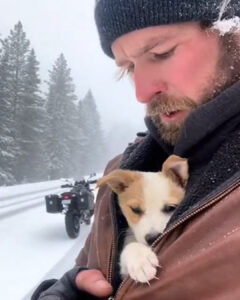
Small. Too thin. Ribs sharp beneath fur soaked dark by freezing rain. The animal’s body was drawn into itself, tail wrapped close, as if trying to disappear into the wood and concrete. Each breath fogged the air faintly, uneven and tired.
Walter’s heart sank.
“Lord,” he murmured, voice already rough from years of disuse and cold mornings. “You again.”
He had seen the dog before. Not close, never close. A shadow at the edge of the yard. A shape near the fence. Always gone when Walter looked twice. But tonight, the storm had chased everything living toward shelter—and the dog had chosen his door.
Walter stepped outside, boots scraping the porch boards. His knees protested as he lowered himself onto the step, the old ache blooming instantly. He didn’t rush. He never rushed anymore. Life had taught him that moving too fast only made things worse.
The dog lifted its head.
Just barely.
Dark eyes met his, wary but too tired for fear. The dog’s nose twitched, then leaned forward until it brushed Walter’s outstretched fingers.
Warm.
Alive.
Walter swallowed hard.
“Why you keep comin’ back?” he asked softly, words carried away by the wind. “Ain’t nothin’ here but an old man and bad bones.”
The dog’s tail thumped once. Weak. Mud-splattered.
Walter let out a sound that might have been a laugh once, long ago. “Old like me, huh?”
He reached out, gnarled fingers trembling, and rested his hand on the dog’s neck. The fur was cold and wet, but beneath it he felt the faintest pulse. A life holding on by stubbornness alone.
The storm howled louder, rattling the porch railing, shaking the bare trees beyond the yard. Neighbor lights flickered in the distance, yellow squares in a sea of dark. No one else stirred. No doors opened. No footsteps came.
It was just them.
Walter pushed himself up with effort and shuffled back inside, returning moments later with a threadbare blanket—the last one he hadn’t donated or worn through. He draped it gently over the dog, then paused.
The dog didn’t flinch.
It didn’t run.
It leaned closer.
Walter’s throat tightened.
“Alright,” he whispered, settling back down, pulling the blanket over his own legs too. “Stay then. No one should be alone tonight.”
The dog shifted, pressing its side against Walter’s shin. Shared warmth bloomed slowly, fragile but real. Walter adjusted the blanket, shielding them both from the wind as best he could.
Sleet stung his cheeks. His fingers went numb. His joints ached fiercely. But for the first time in a long while, the pain didn’t feel like the only thing in the world.
He listened to the dog breathe.
In. Out. In. Out.
The sound anchored him, steadying thoughts that often wandered into darker places on nights like this.
Walter had been alone a long time.
His wife had passed ten winters ago, quiet and sudden, leaving behind a house that felt too big and a silence that never quite lifted. Friends faded next—one by one, funerals blending together until he stopped going. His children lived far away, their calls growing shorter, then rarer, then turning into holiday cards with neat handwriting and careful words.
He didn’t blame them.
Life moved on. It always did.
Walter stayed.
Some nights, he talked to the walls. Some nights, he talked to the radio. Most nights, he said nothing at all.
But tonight—
Tonight, there was breathing beside him.
“You know somethin’, don’t you?” he murmured, staring out into the storm. “You knew where to come.”
The dog’s ear flicked. Its head rested against Walter’s leg, weight trusting, unguarded. The animal sighed—a long, deep exhale that seemed to release more than air.
Walter felt tears sting his eyes, freezing almost as quickly as they formed.
He remembered nights from long ago, sitting on this same porch with his wife, listening to rain instead of sleet. Her laughter. Her hand warm in his. The way she used to say, We’ll never be truly alone as long as we notice each other.
He hadn’t noticed much lately.
The storm roared, but it couldn’t reach them fully now. The blanket held. The porch roof groaned but stood. Walter leaned back against the door, feeling the solid wood at his spine.
“Don’t know what tomorrow looks like,” he said quietly. “But tonight’s alright.”
The dog shifted again, inching closer until its body pressed fully against his leg. Shared heat built slowly, breath mingling, two tired creatures borrowing strength from each other.
Minutes passed. Maybe hours.
Walter lost track of time, watching the sleet turn to thicker snow, the world beyond the porch softening under white. His hands went stiff, then warm again. His breathing slowed.
The dog slept.
Walter realized this not because he heard snoring, but because the tension left the animal’s body entirely. No more flinching. No more alert stillness. Just sleep—deep and needed.
He smiled.
“Good,” he whispered. “Get some rest.”
At some point, Walter’s own eyes closed.
When he woke, the storm had eased. Snow lay thick and quiet across the yard, muffling everything. The air felt calmer, cleaner, as if the world had exhaled.
The dog was still there.
Still warm. Still breathing.
Walter let out a shaky laugh, relief washing through him.
“Well,” he said, voice hoarse. “Guess we made it.”
He stood slowly, joints protesting loudly now, and opened the door wide. Warm air spilled out, carrying the smell of old coffee and wood and yesterday’s soup.
The dog stirred, blinking up at him.
Walter met its gaze.
“You can come in,” he said, almost shy. “Just for a bit. Get dry.”
The dog hesitated.
Then, with quiet certainty, it stood and stepped inside.
Walter closed the door behind them, shutting out the cold.
That morning, neighbors would later notice smoke curling from Walter’s chimney again—something they hadn’t seen in a while. Someone might mention it. Someone might smile.
But no one would know what truly happened on that porch.
They wouldn’t know that two forgotten souls had found each other in a storm. That warmth had been shared. That loneliness had loosened its grip, if only a little.
Walter knelt slowly beside the dog, wrapping it in another blanket, hands steady now.
“No rush,” he murmured. “You’re safe.”
The dog’s tail thumped once against the floor.
And in the quiet that followed, the house felt—at last—less empty.