Tuesday night on Jimmy Kimmel Live, The Chicks walked out dressed head to toe in red. No introduction. No explanation. They played “Not Ready to Make Nice” — the same song they wrote after country radio pulled every one of their tracks back in 2006. The same song born from death threats and public shaming, all because Natalie Maines said a few words about a president on a London stage in 2003. What happened next is the part people always forget. That album — Taking the Long Way — didn’t just survive. It debuted No. 1 on the Billboard 200 and swept five Grammys, including Album of the Year, Record of the Year, and Song of the Year. The very industry that shut them out handed them its highest honors. Now, 20 years later, Natalie, Martie, and Emily are taking that album back on the road. A full U.S. theater tour this fall. Every night, the complete album, front to back. Still in red. Still not ready. – Country Music
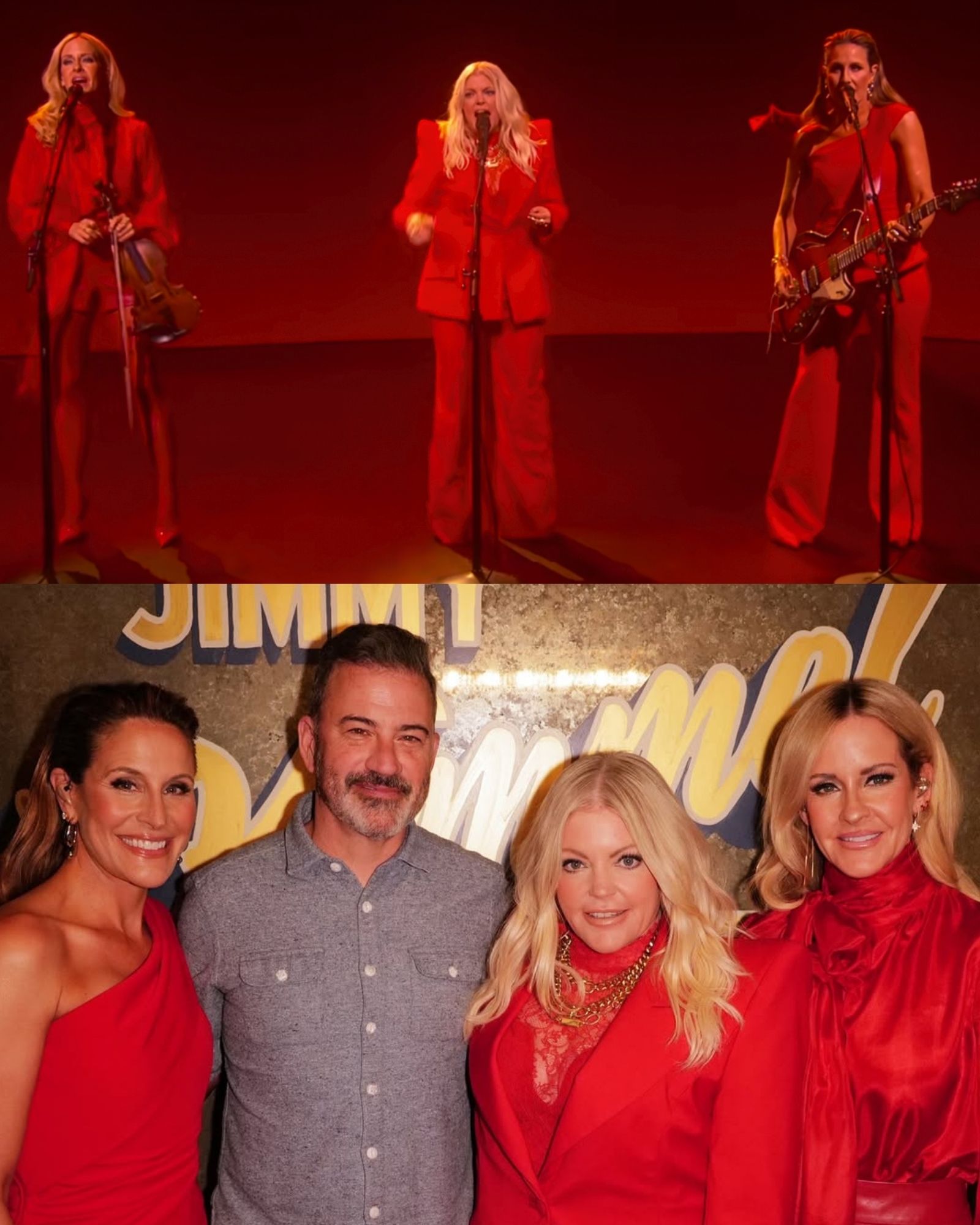
On Tuesday night on Jimmy Kimmel Live, The Chicks walked out dressed head to toe in red, and the moment carried more weight than a television performance usually does. Natalie Maines, Martie Maguire, and Emily Strayer did not just appear for nostalgia. They returned with purpose, stepped into the spotlight, and performed “Not Ready to Make Nice” with the kind of calm intensity that only comes from living through something unforgettable.
The song has always been more than a hit. It came from a storm. In 2003, Natalie Maines made a remark about a president during a performance in London, and the reaction in the United States was immediate and brutal. Country radio pulled The Chicks’ music, public criticism turned vicious, and the trio faced a wave of anger that went far beyond ordinary backlash. Death threats and public shaming followed, and the pressure would have broken a lot of artists. It did not break The Chicks.
Instead, they turned that experience into art. Taking the Long Way became the album that answered everything without sounding defensive. It was sharp, honest, and deeply human. When it arrived, it did not quietly fade away. It debuted at No. 1 on the Billboard 200, and then the music industry, which had once seemed ready to leave them behind, handed them its highest honors. The album won five Grammys, including Album of the Year, Record of the Year, and Song of the Year.
What once sounded like a shutdown became a statement of survival.
That is the part people often forget. The controversy was loud, but the comeback was louder in the long run. The Chicks did not chase approval. They kept making music, kept their identity intact, and let time do what time does best: reveal who was standing on principle and who was simply following a crowd.
Now, 20 years later, Natalie Maines, Martie Maguire, and Emily Strayer are bringing that album back to the stage. This fall, they will launch a full U.S. theater tour, performing Taking the Long Way from front to back each night. For longtime fans, it is a chance to hear the record in full again. For newer listeners, it is a reminder that some albums are not just collections of songs. They are chapters of a life.
There is something powerful about hearing “Not Ready to Make Nice” now, after all these years. The anger has aged into clarity. The hurt is still there, but so is strength. The red outfits on Jimmy Kimmel Live did not feel like costume. They felt like a signal: still here, still standing, still not ready to make nice.
Post navigation
Alan Jackson Gives Carlisle Wright a Family Moment She Will Never Forget
Carlisle Wright was sitting quietly with her dog Bing when her phone rang. On the other end was Alan Jackson, her great-uncle, calling on the exact 35th anniversary of his Grand Ole Opry induction. The timing alone would have made the moment special, but what happened next turned an ordinary conversation into a life-changing memory.
They started with normal family talk. Carlisle had been preparing for her CMA Fest debut, and Alan Jackson listened like any proud relative would. Then he brought up his own Opry anniversary, and Carlisle congratulated him. She had no idea that the conversation was building toward something she would never forget.
“They asked me to call you today to extend you an invitation to make your Opry debut on June 28th.”
Before Alan Jackson even finished the sentence, Carlisle Wright’s chin began to quiver. The tears came fast, and she could not stop them. At 19, as a Belmont University student chasing her dreams, she had just been handed a moment that many artists wait years to experience. The Grand Ole Opry is more than a stage. For country music performers, it is a rite of passage, a place where history feels alive every time the lights come up.
A Quiet Call With a Big Meaning
What made the moment even more moving was the way Alan Jackson delivered the news. There was no big stunt, no public reveal, and no dramatic buildup. It was a simple family phone call, full of warmth and trust. That is part of what made it feel so real. In a world filled with loud announcements, this one happened with tenderness.
Carlisle Wright has often been known by family nicknames, but this call showed something bigger than a nickname or a title. It showed a connection built over time, grounded in shared roots and mutual respect. Alan Jackson, one of country music’s most recognizable voices, was not just celebrating his own milestone. He was making room for the next generation.
The Weekend That Changed Everything
The Opry debut would already have been a career highlight, but Carlisle Wright’s weekend became even more remarkable. The night before stepping into the Opry circle, she was set to open for Alan Jackson’s sold-out final concert at Nissan Stadium. With 55,000 seats and a lineup that included George Strait, Luke Combs, and Miranda Lambert, the event carried the kind of scale that artists dream about.
For Carlisle Wright, the sequence of events felt almost unreal: a family call, a historic invitation, a stadium performance, and then the Opry debut. It was the kind of weekend that can shape a young artist’s confidence forever.
A Moment Full of Heart
Stories like this stand out because they remind people that behind every major stage is a human story. There are nerves, gratitude, family pride, and the overwhelming feeling that a dream has finally begun to open its door.
Alan Jackson did not just make a phone call. He gave Carlisle Wright a memory wrapped in love, tradition, and opportunity. For a young singer standing at the edge of her career, that gift meant everything. And for everyone watching from the outside, it was a reminder that sometimes the most powerful moments in music are the quiet ones.