Three Shares, a Lifetime of Patience. – Daily News
Grace Groner’s life did not begin with advantage.
It began with absence.
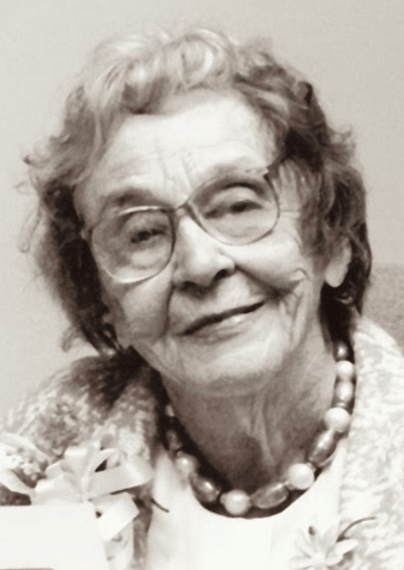
She was a child of the 1920s, growing up without parents in a country still learning how to care for its orphans. There were no safety nets, no guarantees—only uncertainty and the quiet fear of being left behind. What Grace did have, however, was a gentle resilience that never asked the world for more than it was willing to give.
When a generous family took her in, it changed the direction of her life. They didn’t give her luxury or comfort beyond the basics, but they gave her something far more powerful: belief. They believed she deserved an education. They believed she could build a future. And they paid for her to attend Lake Forest College.
Grace never forgot that.
She graduated in 1931, stepping into adulthood at the worst possible time. The Great Depression was swallowing jobs, savings, and hope itself. Families were hoarding coins, selling heirlooms, and praying simply to survive.
Grace did what she always did. She found work.
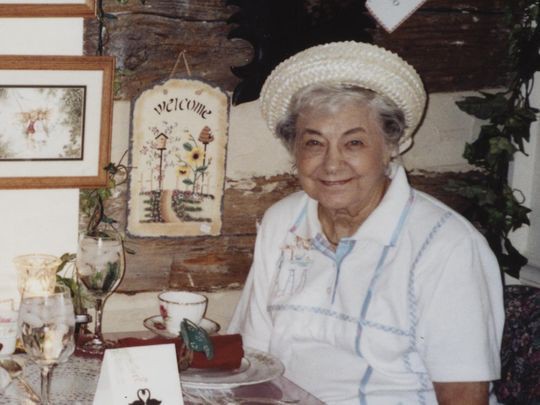
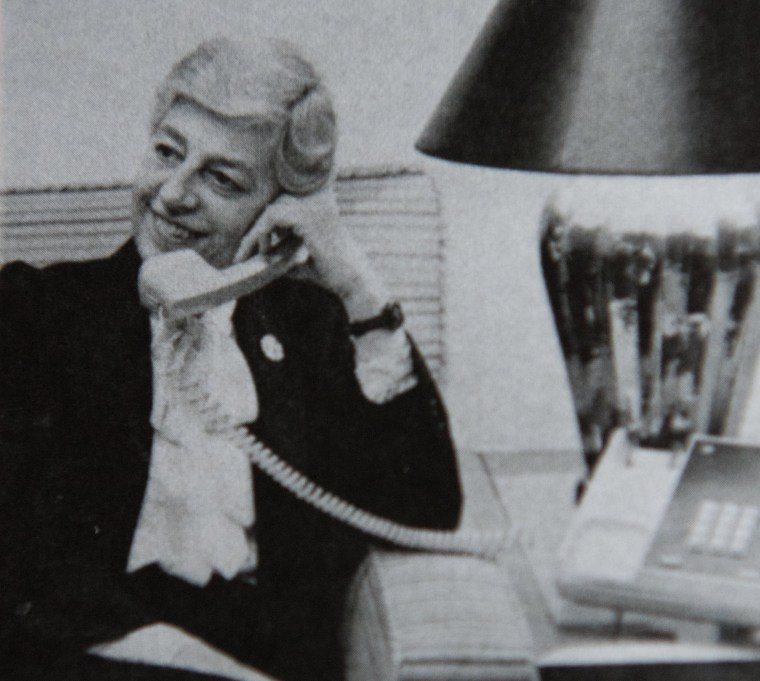
She became a secretary at Abbott Laboratories—quiet, diligent, dependable. She typed letters, answered phones, kept schedules in order. She showed up every day, grateful to be useful. For 43 years, she would work there, unnoticed and unassuming, never once making headlines.
But four years into that job, in 1935, Grace made a decision that would quietly rewrite her future.
With money most people were clinging to out of fear, she bought three shares of Abbott stock.
It cost her $180.
It wasn’t bold. It wasn’t flashy. It wasn’t part of some grand plan she talked about. In fact, almost no one knew she had done it at all.
And then she did something even stranger.
She never sold.
Not when markets crashed.
Not during World War II.
Not through recessions, oil crises, or economic booms.

While the world panicked, Grace waited.
She reinvested every dividend. She ignored the noise. She trusted time.
And while her investment quietly grew, her life stayed remarkably small.
Grace lived in a one-bedroom cottage that a friend later willed to her. She shopped at rummage sales and secondhand stores. She volunteered at church. She attended Lake Forest football games like she always had. When her car was stolen, she didn’t buy another one. She simply walked everywhere instead.
Even at 99 years old, she walked—with a walker.
Her neighbors saw a modest woman who waved politely and kept to herself. Her colleagues remembered a friendly secretary who never complained. No one suspected she was sitting on a fortune.
Because Grace never lived like someone who had one.
After retiring, she traveled a little—carefully, thoughtfully. She gave anonymously to people who needed help. She lived with the kind of quiet contentment that comes from knowing you already have enough.
All the while, something remarkable was happening in the background.
The stock split.
And split again.
Dividends compounded.
Shares multiplied.
That small $180 investment—three shares bought during one of the bleakest economic moments in history—grew and grew without Grace ever touching it.
Seventy-five years passed.
Grace turned 100 years old in 2010. When she died, there were no grand expectations. She left behind a modest home, simple belongings, and a life that seemed gentle and ordinary.
Then her attorney opened the will.
The three shares were now worth $7.2 million.
Shock rippled through everyone who heard the news. The woman who walked everywhere. The woman who shopped secondhand. The woman who lived in a cottage.
A millionaire?
But the real surprise wasn’t the money.
It was what she did with it.
Grace didn’t leave the fortune to distant relatives. She didn’t donate it for recognition or buildings named after her. She left nearly all of it to create the Grace Groner Foundation—a scholarship fund for Lake Forest College students.
The same college that had once given an orphaned girl a chance.
Through her foundation, Grace now provides funding for scholarships, internships, and study-abroad programs—opportunities for students who otherwise might never have them. Every year, her legacy generates around $300,000 to help young people do what she once did: take a step forward when the world feels stacked against them.
Even her cottage continues the story.
It was renovated and now houses two female students each year—students who live there as Grace’s guests, walking the same floors, carrying the same quiet hope she once carried.
The secretary who walked everywhere now helps hundreds walk toward their dreams.
Grace Groner never chased wealth.
She never chased recognition.
She never chased more.
She trusted patience.
She proved you don’t need privilege to build a legacy. You don’t need perfect timing or insider knowledge. Sometimes, all you need is a small decision, consistency, and the courage to wait.
She sat still for 75 years while the world rushed past. She lived simply while building something enormous. She understood what most people never do:
The most powerful investment isn’t what you buy.
It’s what you refuse to sell.
Three shares.
Seventy-five years.
Seven million dollars.
Countless lives changed.
All because one woman believed in time—and never let go.
The fog rolled in without warning, thick and heavy, swallowing the interstate until the world narrowed to a few blurred yards ahead. Headlights floated like ghosts. Engines idled. Somewhere in the distance, horns sounded—low, impatient, confused.
Logan had already slowed his bike, instincts tightening his grip as visibility dropped to almost nothing. The road felt wrong. Too quiet. Too still.
Then he saw her.
A shape in the fog, standing perfectly still between lanes.
He braked hard and skidded to a stop, heart jumping into his throat. Traffic behind him slowed, then stopped entirely, the interstate freezing into a long line of silent metal.
It was a German shepherd.
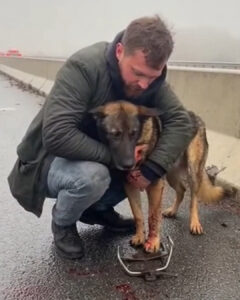
She stood with her head lowered, body trembling, one front paw held unnaturally high. Dark blood streaked down her leg, dripping onto the wet asphalt below. At her feet lay the reason she couldn’t move—a metal bike rack, twisted and clamped tight around her paw like a trap.
She didn’t bark.
She didn’t run.
She just stood there, frozen in shock, eyes wide and glassy, fog curling around her like breath.
Logan didn’t think.
He was already off the bike, crouching low, moving slowly so he wouldn’t scare her. The cold bit through his jeans as he dropped to one knee on the asphalt, the fog dampening everything—the air, the sound, the moment.
“Hey… hey, I see you,” he said softly, voice rough but gentle. “I’ve got you.”
The shepherd’s ears flicked. She growled—not aggressive, just afraid. Pain had stripped her down to instinct.
Logan raised his hands, palms open, letting her see him. He swallowed hard, eyes locking on the blood pooling beneath her paw.
“It’s okay,” he whispered. “I’m right here.”
Cars lined up behind them, engines idling, people watching through fogged windshields. No one honked. No one moved. The entire interstate seemed to understand this moment required stillness.
Logan edged closer.
The metal trap was embedded awkwardly, its bars slick with blood and rain. Every time the dog shifted her weight, she whimpered, breath breaking into shallow pants. Logan felt his chest tighten.
“You’re stuck,” he murmured, not to narrate, but to stay calm. “We’re gonna fix that.”
He reached for the metal.
The dog snapped—not at him, but at the pain. Logan flinched, then steadied himself again.
“It’s alright,” he said quickly. “I know. I know.”
He adjusted his grip, hands slipping on wet steel. The rack was bent, tensioned tight around bone and muscle. Logan pulled once—nothing.
He pulled again.
The shepherd cried out, a sharp, cracking sound that cut straight through him.
“I’m sorry,” Logan whispered, tears stinging his eyes. “I’m so sorry.”
Fog pressed in. Time stretched.
He braced his boot against the asphalt and used both hands, muscles straining, knuckles whitening. Pain shot up his arms as the metal resisted, unyielding.
“Stay with me,” he said through clenched teeth. “Don’t give up on me.”
The dog’s legs buckled slightly. Logan lunged forward instinctively, pressing his chest against her side, wrapping one arm around her ribs to keep her upright.
“Shh… shh,” he breathed, rocking her gently. “You’re safe. Breathe. I’ve got you.”
Her body shook violently against his, fear and shock tearing through her frame. Logan felt her heartbeat—fast, frantic—against his own.
Somewhere behind them, sirens wailed faintly. Help was coming. But not fast enough.
Logan looked back down at the trap.
One more try.
He repositioned his hands, ignoring the way his fingers burned and bled from the sharp edges. He pulled with everything he had—arms, shoulders, back, desperation.
The metal screamed.
Then—
It gave.
The rack snapped open with a violent jerk, clattering uselessly onto the road. Logan fell backward with the sudden release, gasping.
The shepherd collapsed.
Logan caught her instantly, arms wrapping around her chest as she sank, dead weight now, legs folding beneath her. Blood smeared across his jacket, warm and real.
For a terrifying second, she didn’t move.
Then she inhaled—deep, shuddering.
And again.
“She’s breathing,” someone whispered from a nearby car.
Logan didn’t hear them. He was already pressing his forehead to the dog’s neck, hands shaking as he held her close.
“You’re free,” he murmured. “You did it. You’re okay.”
The shepherd lifted her head weakly, eyes searching his face. Slowly, hesitantly, she licked his chin—mud, salt, blood, trust.
Logan broke.
A sob tore out of him, sharp and unfiltered, as he pulled her closer, rocking her gently on the cold asphalt.
“It’s okay,” he whispered again and again. “I’ve got you. I’ve got you.”
The fog began to thin.
Emergency lights broke through the gray—red and blue flashing softly, reflecting off wet pavement. First responders moved carefully, voices calm, measured.
One knelt beside Logan. “You did an incredible thing,” she said quietly.
Logan shook his head, still holding the dog. “She did,” he replied hoarsely. “She held on.”
They wrapped the shepherd’s leg, easing her onto a stretcher. Logan’s hands lingered, reluctant to let go. When they finally lifted her away, she whined softly, eyes locked on him.
“I’m here,” he said quickly. “I’m not going anywhere.”
And he didn’t.
He stayed kneeling on the interstate until the ambulance doors closed, until traffic slowly resumed, until the fog fully lifted and the road looked ordinary again.
But nothing about that morning was ordinary.
Later, photos would circulate. People would call him a hero. They’d praise his courage, his strength.
Logan would shrug it off.
Because from where he stood—knees soaked, hands torn, heart still racing—it didn’t feel like bravery.
It felt like seeing someone hurt and choosing not to walk away.
It felt like kneeling in the fog and holding on when everything said let go.
And somewhere, because of that choice, a shepherd with a wounded paw was still breathing.
Sometimes, that’s all the world asks of us.