THEY HELD HER FUNERAL AT THE HENDERSONVILLE CHURCH OF CHRIST. THE QUEEN OF COUNTRY MUSIC GOT ONE LAST STANDING OVATION. Twenty-five Top 10 hits. The first woman ever to top the country charts. From 1953 to 1968, every major poll in Nashville listed her as the No. 1 female country singer — fifteen years straight. On July 20, 2012, Marty Stuart, Connie Smith, Bill Anderson, Ricky Skaggs and the gospel group The Whites filled the pews to say goodbye. Eddie Stubbs — the voice of the Grand Ole Opry, who had once played fiddle for her — stood at the pulpit and asked the room to rise. Every person stood and applauded. Then he said: “It’s one thing to make a contribution in life. It’s another to make a difference. Kitty did both.” Ricky Skaggs and The Whites closed the service with I Saw the Light. When the last note fell, the casket was wheeled slowly from the church, her family following behind in tears. Loretta Lynn wrote that day: “Kitty Wells will always be the greatest female country singer of all time. She was my hero.” Charlie Daniels wrote: “A Queen died today. The lady who set the standard for all who followed.” She was buried at Spring Hill Cemetery in Nashville — the same city where, sixty years earlier, she had changed everything with one song and one voice nobody in Nashville had expected. – Country Music
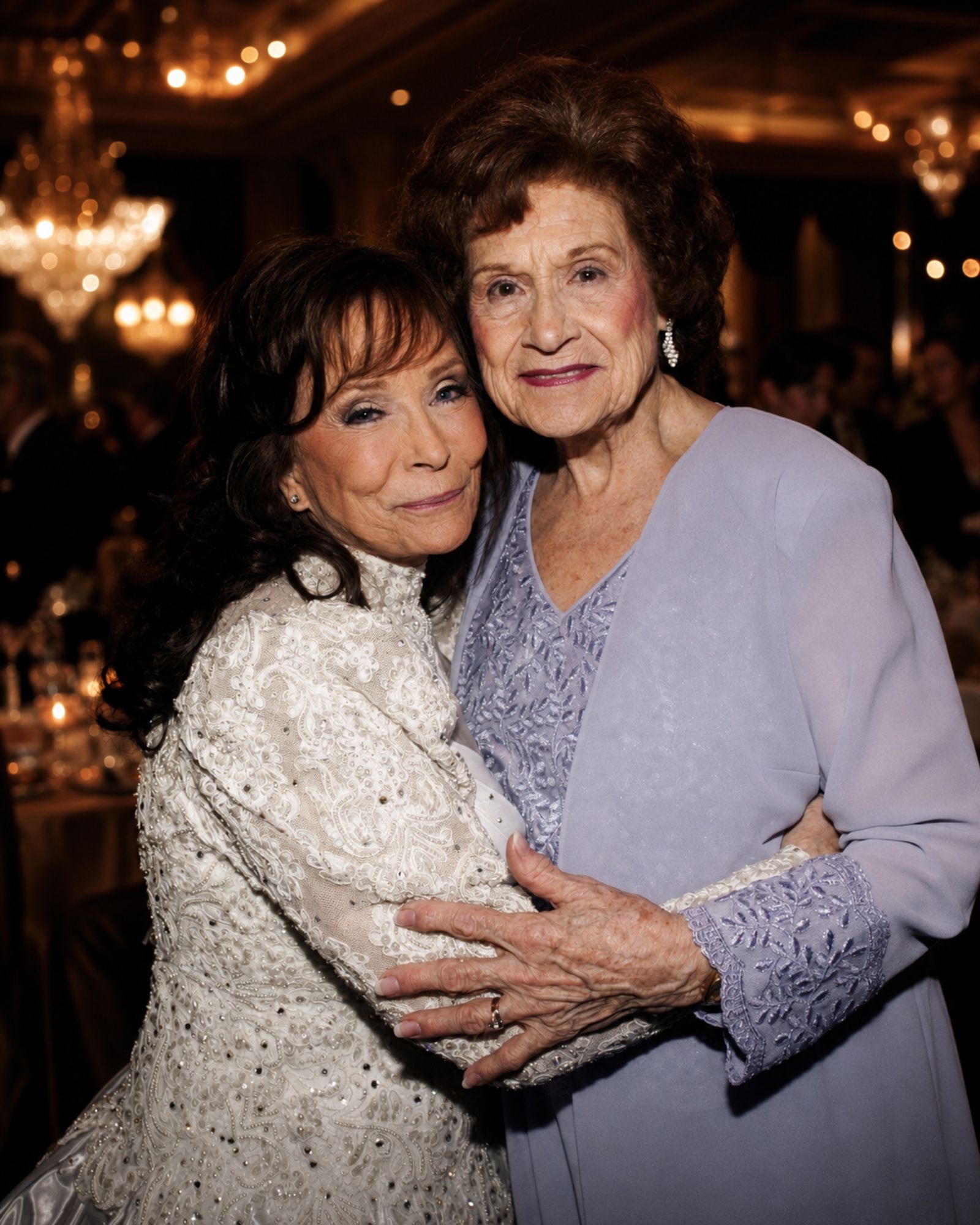
On July 20, 2012, a quiet church service in Hendersonville, Tennessee, became something bigger than a farewell. It became a tribute to a woman who had helped change the sound of country music forever. Inside the Hendersonville Church of Christ, friends, family, and fellow musicians gathered to honor Kitty Wells, the legendary singer many still called the Queen of Country Music.
The room was filled with familiar names and familiar grief. Marty Stuart was there. Connie Smith was there. Bill Anderson was there. Ricky Skaggs and the gospel group The Whites also came to say goodbye. These were not just famous visitors paying respect. They were artists standing in the shadow of someone who had opened doors long before many of them arrived.
At the pulpit stood Eddie Stubbs, the voice of the Grand Ole Opry, a man who had once played fiddle for Kitty Wells. He looked out at the crowd and asked everyone to rise. One by one, every person in the church stood and applauded. It was not the kind of applause heard in an arena after a hit song. It was slower, deeper, and full of gratitude. In that moment, it felt less like a funeral and more like a final standing ovation for a life that had truly mattered.
“It’s one thing to make a contribution in life. It’s another to make a difference. Kitty did both.”
Those words captured what made Kitty Wells so important. She was not only successful. She was historic. She had twenty-five Top 10 hits. She was the first woman ever to top the country charts. And for fifteen straight years, from 1953 to 1968, every major poll in Nashville listed her as the No. 1 female country singer. That kind of consistency is rare in any era, but in her time it was extraordinary.
Kitty Wells came along when country music was still largely a man’s world. Yet her voice cut through the noise with calm strength and unmistakable honesty. She did not need to shout to be heard. She sang in a way that made listeners stop and pay attention. Her songs gave shape to the feelings many women had but rarely heard expressed on radio. That is part of why her impact lasted so long.
The service at Hendersonville reflected that influence. The people in the church were not just mourning a performer. They were saying goodbye to someone who had helped define a whole generation of country music. When Ricky Skaggs and The Whites closed the service with I Saw the Light, the atmosphere became especially tender. The hymn carried through the church like a final blessing, soft and steady.
When the last note ended, the casket was wheeled slowly from the church. Her family followed behind in tears. The scene was simple, but the meaning behind it was immense. A voice that had once filled radio stations, concert halls, and homes across America was now being carried out of a small church by the people who loved her most.
Outside the service, the words of other country legends helped tell the story of how deeply Kitty Wells had touched her peers. Loretta Lynn wrote, “Kitty Wells will always be the greatest female country singer of all time. She was my hero.” Charlie Daniels wrote, “A Queen died today. The lady who set the standard for all who followed.”
Those tributes were more than polite gestures. They were acknowledgments from artists who understood the trail Kitty Wells had blazed. Without her, the path for women in country music might have looked very different. She had proven that a woman could not only sing country music beautifully, but also lead it.
Kitty Wells was buried at Spring Hill Cemetery in Nashville, the city where her story had once changed everything. Sixty years earlier, Nashville had not expected what would happen when one song and one voice arrived and turned the genre in a new direction. But that is exactly what Kitty Wells did.
Her funeral was the final chapter, but the legacy did not end there. Every applause, every tear, and every quiet farewell in Hendersonville pointed back to a larger truth: Kitty Wells did not just sing country music. She helped shape it. And on that July day, the Queen of Country Music received one last standing ovation worthy of the life she lived.
Post navigation
When Johnny Cash died on September 12, 2003, the world did not lose just a famous singer. It lost a man who spent his whole life standing in the doorway between darkness and grace, never pretending he was free from either one. Four months earlier, he had buried June Carter Cash, the woman who had steadied him, challenged him, and loved him with a rare kind of patience. When he followed her, he left behind more than records, awards, and the unforgettable black suit. He left behind a truth that felt bigger than fame.
Johnny Cash never tried to become a polished myth. He did not act as if pain could be edited out of a life. He admitted the struggle, the shame, the faith, and the failure. That honesty is what made people trust him. He once said, “All your life, you will be faced with a choice. You can choose love or hate… I choose love.” That line was not decoration. It was a summary of the life he fought to live.
The Man in Black and the Weight He Carried
Johnny Cash became known as the Man in Black, and the image meant more than style. He wore black for the people who were ignored, hurting, or forgotten. In a world that often prefers bright smiles and easy answers, Johnny Cash looked straight at sorrow and refused to look away. He gave voice to prison inmates, grieving families, lonely workers, and people who had made mistakes they could not erase.
He understood that being human meant being divided. “Sometimes I am two people. Johnny is the nice one. Cash causes all the trouble. They fight.” That confession made him feel real in a way many stars never do. He was not selling perfection. He was offering recognition. For listeners who had ever battled their own habits, regrets, or fears, Johnny Cash sounded like someone who knew the road from the inside.
June Carter Cash and the Love That Anchored Him
Any honest story about Johnny Cash must include June Carter Cash. Their relationship was not a polished fairytale; it was a hard-won bond built through years of performing, resisting, breaking down, and trying again. June saw the man underneath the chaos, and Johnny never stopped knowing how much that mattered.
He spoke about love in a way that turned ordinary life into something sacred. He said paradise could be found in a simple moment: “this morning, with her, having coffee.” That is what made Johnny Cash so moving. He did not define joy as fame, wealth, or applause. He found it in a kitchen, in a quiet morning, in a person who stayed.
When June died in May 2003, Johnny Cash was already weakened, already grieving, and already closer to the edge of his own ending. But even then, his message did not change. Loss did not make him bitter. It made him more honest.
Facing Grief Without Running From It
Johnny Cash had a way of speaking about pain that felt almost like guidance. “There’s no way around grief and loss. You just have to go into it, through it.” That sentence carries the force of experience. He knew sorrow was not something to outsmart. It had to be endured. It had to be felt. And somehow, on the other side of it, there could still be dignity.
That is why so many people still return to his music after heartbreak, failure, or disappointment. His songs do not pretend the world is easy. They make room for confession. They make room for repentance. They make room for the hope that a broken person can still be loved, still be forgiven, still be changed.
Johnny Cash left behind a reminder that truth is stronger than image. He did not ask to be remembered as perfect. He asked, through his life, to be understood as real.
A Legacy Fame Could Not Manufacture
Long after the cameras stopped and the stage lights faded, Johnny Cash remained. Not as a statue, but as a voice. Through every broken man searching for God, through every woman hoping for a love that lasts, through every soul that needs permission to be human, his songs still arrive with the same steady power.
That is what makes his legacy so enduring. It was never built on pretending. It was built on confession, and confession is hard to fake. Johnny Cash told the truth about sin, faith, sorrow, and love. He admitted the shadow and still reached for the light. He wore black not to celebrate despair, but to stand beside the forgotten. He loved June Carter Cash with a devotion that made ordinary life feel holy. He faced grief and did not run.
What Johnny Cash left the world was not simply a legend. It was a living testimony: a sinner who refused to lie about it, a man who chose love, and a voice that still reminds us that grace can survive the darkest hours.