The Turtle Who Found the Right Boat: A Story of Instinct, Trust, and Rescue. – Daily News
Sometimes, nature seems to whisper in ways we can’t explain — a quiet instinct, a guiding pull toward hope. That’s exactly what appeared to happen one calm morning in St. Joe Bay, Florida, when a distressed sea turtle swam straight toward the very people who could save its life.

The team aboard the small research vessel belonged to the Northern Gulf Turtle and Coastal Research Group, scientists who dedicate their days to studying and protecting marine life along Florida’s coast.
They had been out since sunrise, scanning the waters for sea turtles to tag and monitor as part of their ongoing conservation work.
Then they saw it.
At first, it looked like a floating bundle of seaweed or driftwood. But as they drew closer, they realized it was moving — struggling. Beneath the surface, a large loggerhead turtle was caught in a tangled mass of ropes, plastic, and buoys.

It was trapped in what’s known as a Fish Aggregating Device (FAD) — a floating structure meant to attract fish, but one that often drifts away and becomes deadly marine debris.
FADs are illegal in protected waters like St. Joe Bay, and this was a perfect example of why. The ropes had coiled around the turtle’s fins, cutting into its skin. Exhausted from fighting to stay afloat, the animal looked moments from giving up.
Then, something extraordinary happened.

Instead of panicking, the turtle began to swim directly toward the researchers’ boat. Slowly, laboriously, it paddled closer, as if drawn by some deep, instinctive understanding that these humans were different — that they could help.
“It swam right up to us,” one of the rescuers later recalled. “Almost like it knew.”
Without hesitation, the team went to work. One scientist reached into the water, gently steadying the animal while the others pulled the heavy FAD closer to the boat. It took all their strength to lift the massive creature — nearly 300 pounds of shell, muscle, and spirit — safely onto the deck.

The turtle’s breaths came slow and uneven. Tangled cords cut across its front flippers, and barnacles clung to its shell.
Every movement was labored. Yet, even in its distress, it stayed calm — eyes blinking, flippers twitching slightly, as the team spoke to it in soothing voices.
“Hang in there, big guy,” one murmured. “We’ve got you.”
For several minutes, the sound of the waves mixed with the snip of knives and cutters as the team worked quickly to free it. Piece by piece, the ropes came away. With each cut, the turtle’s breathing seemed to ease — until finally, the last strand dropped to the deck.
They took a moment to examine their patient, checking for wounds and injuries.
Despite the ordeal, the loggerhead was remarkably strong — a survivor in every sense. After a few minutes of observation, it lifted its head high and took a deep, full breath of salty air.
That was their signal.
The researchers eased it back into the turquoise water. For a moment, the turtle lingered beside the boat, turning its head toward them. The ocean rippled around it, sunlight glinting off its shell like gold. Then, with one powerful kick, it glided away — free once more.
There was silence on deck for a few seconds, the kind of silence that only comes after witnessing something sacred. Then someone exhaled, smiling through the stillness. “That,” they said softly, “is why we’re here.”
Later, the Northern Gulf Turtle and Coastal Research Group shared the rescue video on Instagram — not for attention, but as an urgent reminder.
“FADs are illegal in marine protected areas such as St. Joe Bay because they often become debris and can cause entanglement of sea life such as sea turtles,” the caption read.
The video spread quickly, touching hearts around the world. People commented on the turtle’s incredible timing — how it had seemed to seek out its rescuers — and on the compassion of the scientists who answered its silent plea.
It was, at its core, a story of trust: a wild creature choosing to approach the hands of humans, and humans choosing to use that trust for good.
The researchers ended their post with a gentle warning to fishermen and boaters — to follow the rules, to protect the fragile ecosystems they depend on, and to remember that even one piece of carelessness can cost a life.
For that one loggerhead turtle, the ocean is safe again. And somewhere in the blue depths of St. Joe Bay, a survivor now swims freely — a living reminder that sometimes, when all hope seems lost, help is closer than we think.
Every night, after the streets have emptied and the world has gone quiet, a man and his dog settle down on a patch of cold stone beneath the pale glow of a streetlight. There is no door to lock, no roof to shelter them, no bed to call their own. Yet, if you look closely, you’ll see something that many homes never hold — peace.

The man spreads out a thin sheet, worn but clean. He lays down first, then gently pats the smaller blanket beside him. The dog — a tan, loyal creature with kind eyes and a tired body — knows the signal well. He circles twice, lies down, and the man pulls the blanket up over his tiny shoulders. The dog sighs, closing his eyes as if to say, “We made it through another day.”
It’s a scene of quiet devotion that countless strangers walk past without truly seeing. Some stop for a moment — to take a photo, to leave a coin, to whisper a prayer. But most just hurry on, unaware that in this fragile little corner of the world, love still lives in its purest form.
The man’s name isn’t known to many. He used to have a job, a small apartment, and a wife. But life, with its unpredictable cruelty, stripped all that away. The factory closed. The rent climbed. His wife left when the money stopped coming. Then one night, he found an abandoned puppy shivering near a trash bin — frightened, hungry, alone. He didn’t think twice. He lifted the trembling creature into his coat and shared the little bread he had left. That night, he wasn’t alone anymore.

Since then, they’ve been inseparable. Whatever scraps he receives — a half sandwich from a kind stranger, a bit of rice from a market stall — he divides into two portions. One for him. One for the dog. When it rains, he covers the dog with his jacket first. When the sun burns too hot, he finds shade for them both.
He has been called many things — homeless, poor, forgotten. But to that dog, he is everything. A protector. A provider. A friend. And to anyone with eyes to see, he is something far more profound: proof that the measure of a man isn’t in what he owns, but in what he gives.
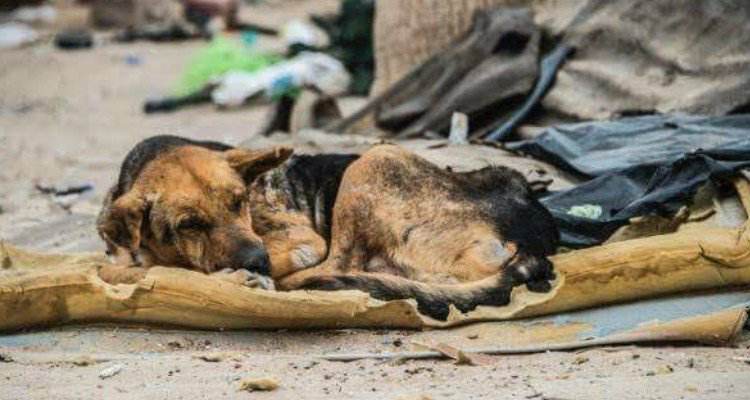
In a world obsessed with wealth and comfort, their quiet companionship tells a different story. It reminds us that compassion doesn’t require abundance — it requires a heart willing to share what little it has. Even in the harshest conditions, love can make a sidewalk feel like home.
Each morning, as the sun rises and the city awakens, the man stirs first. He checks his companion’s breathing, gives him water, and smiles when the dog’s tail flicks against the pavement. It’s another day — another chance to keep going, side by side.
He may not know it, but those who see them will remember that image long after they pass: a man who has nothing but still gives everything; a dog who owns no collar of gold but wears loyalty like a crown. Together, they show us what true richness looks like.
Sometimes, those who have the least… give the most.
