The Starving Bear That Broke the World’s Heart. – Daily News
When photographer Paul Nicklen rounded a rocky bend on Canada’s Baffin Islands one August afternoon, he saw what he thought was a discarded white blanket caught on the rocks. But then, the “blanket” moved. It was breathing — barely.
What lay before him wasn’t just a polar bear. It was a ghost of what a polar bear once was — skeletal, trembling, struggling to stand on legs that could no longer hold its weight. That moment, captured on camera, would soon become one of the most haunting reminders of a planet in crisis.

A Glimpse of Suffering
Nicklen, a National Geographic photographer and co-founder of the conservation group Sea Legacy, had seen wildlife in peril before. But nothing prepared him for this.
“When you see something like that, it breaks something inside you,” he said later.
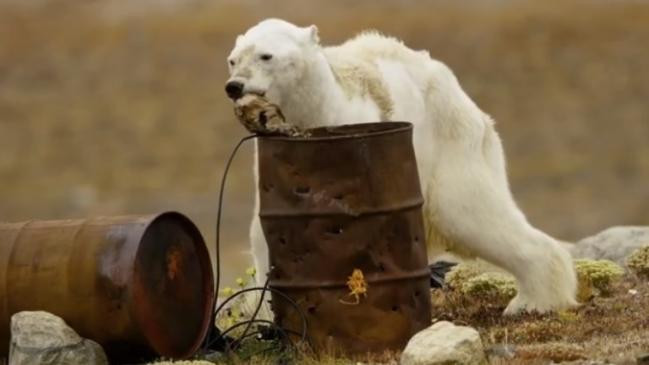
He raised his camera and began filming. The bear moved slowly, its fur hanging loosely on bones, its massive frame reduced to a fragile shell. It sniffed at the ground, dragging its back legs, searching for food that wasn’t there. Every step looked like agony.
In the video, the bear is seen rummaging through a rusted garbage bin, pawing weakly at discarded items — perhaps fish scraps, perhaps nothing at all. It was a futile act of instinct: a hunter searching for life in a land where the ice, and everything it once promised, had vanished.

The Image That Shook the Internet
When Nicklen posted the footage to Instagram, it ignited the internet. Within hours, millions had watched, shared, and wept. Some called it the most painful wildlife video they’d ever seen. Others said it was the single image that made climate change real to them.
“It still haunts me,” one viewer commented. “You can’t unsee that kind of suffering.”
Nicklen’s caption read simply:
“This is what starvation looks like. This is what climate change looks like.”
His intent wasn’t shock for shock’s sake — it was a plea. A visual testament to the reality that scientists had long warned: as global temperatures rise, Arctic ice is disappearing at alarming speed, robbing polar bears of their primary hunting ground.
The Vanishing Ice
For polar bears, sea ice isn’t just a place to stand — it’s the foundation of their survival. From that frozen platform, they hunt seals, rest, and travel vast distances. But as the climate warms, the ice melts earlier each spring and refreezes later each winter.
That means fewer days to hunt, less food to build fat reserves, and longer periods of starvation on land.
When summer arrives, many bears are forced ashore, where they can find little to eat. Unlike grizzlies, they can’t simply switch diets. They evolved to live on fat-rich seal meat, not berries or carcasses.
Without ice, they are stranded — and slowly starve.
Wildlife experts estimate that polar bears number around 26,000 worldwide, but that figure could drop by more than 30% by 2050. In some regions, particularly around Hudson Bay, scientists are already seeing thinner bears, fewer cubs, and increasing deaths.

Between Hope and Controversy
As Nicklen’s video spread across the globe, it also drew criticism. Some experts cautioned that while the bear’s suffering was undeniable, there was no proof it had starved specifically due to climate change. It could have been old, injured, or sick — not every starving bear is a direct victim of melting ice.
But Nicklen never claimed certainty about that bear’s story. His point was broader — symbolic.
“We can’t say this bear died of climate change,” he acknowledged, “but we can say that this is what a world without ice looks like.”
And that message struck a nerve. For millions, the image of the emaciated bear wasn’t just about one animal’s suffering — it was about an entire planet gasping for breath.
The Human Response

The emotional power of the video sparked an outpouring of grief and action. Donations to conservation groups surged. Classrooms used the footage to teach about global warming. Politicians cited it in speeches.
Yet, for Nicklen and his team at Sea Legacy, the viral fame was bittersweet. “We didn’t film it to break hearts,” he said. “We filmed it to open them.”
Their goal wasn’t to evoke despair but to stir resolve — to make people understand that climate change is no longer a distant threat. It is happening now, and its victims are already visible.
The Story Behind the Lens
For Nicklen, who grew up in the Arctic as part of the Inuit community, this wasn’t an abstract issue. He remembers childhood days when the sea ice stretched as far as the eye could see — thick, strong, alive with movement.
“Back then, the ice would come early and stay late,” he recalled. “Now, it’s unpredictable. Some years, it barely forms at all.”
He has spent decades documenting wildlife, but he describes this bear as the most haunting image of his career.
“I cried behind the camera,” he admitted. “You don’t ever get used to seeing suffering like that. But I knew that if people could see what I saw, maybe they would care enough to act.”
The Warning Beneath the Silence
In the Arctic wilderness, death is a constant companion. But what Nicklen’s footage showed wasn’t the natural rhythm of predator and prey — it was something unnatural, a system unraveling.
When the ice disappears, so does everything built upon it — the bears, the seals, the fish, even the people who depend on those waters for food and culture. The Arctic is the planet’s early warning system. What happens there will echo everywhere.
If the ice melts completely each summer, the polar bears will be among the first to vanish — but they won’t be the last.
A Call That Still Echoes
Years later, the video of the starving bear still circulates online, reigniting debate every time it resurfaces. Some argue it manipulates emotion; others say it’s precisely what the world needs to see.
Either way, it has become a symbol — a visual shorthand for the price of indifference.
And somewhere in that haunting image, in the lonely figure of a once-mighty predator reduced to frailty, lies a question humanity can’t ignore:
If the most powerful creature of the north can no longer survive, what does that say about us?
Because the truth is simple: the bear may have died, but the warning it carried still lives.
If we look away now, one day we’ll realize that the ice — and everything it sustained — melted not just from the heat of the planet, but from the coldness of our inaction.
When loss came to the plains of South Africa, it came quietly — in the form of a calf standing beside the still body of his mother. For a baby elephant named Themba, that moment changed everything.
Alone and frightened, he stood beneath the vast African sky, crying out into the silence. But no answer came. His mother was gone.
That’s how Themba’s journey began — not in a herd surrounded by his kind, but in the Sanbona Wildlife Sanctuary, where human hands tried to mend what nature had broken.
A Lonely Beginning

When rescuers first brought Themba to Sanbona, they feared the worst. At just six months old, elephants are deeply dependent on their mothers — for nourishment, protection, and, most importantly, comfort. The trauma of separation can be fatal, even more so than hunger or disease.
For the first week, staff at the sanctuary watched over him day and night. They fed him, monitored his health, and tried to soothe his cries. But nothing could replace the gentle rumble of a mother’s call. Themba often stood motionless, swaying slightly, the way grieving elephants do in the wild.
The team knew that what he needed most wasn’t just care — it was companionship.
The Unlikely Solution
So they tried something that sounded, at first, impossible.
In a nearby enclosure lived a young sheep named Albert, quiet and unassuming, with wool as white as clouds drifting over the savanna. When the idea was suggested — pairing a baby elephant with a sheep — even the caretakers hesitated. Could such different creatures ever connect?
Still, desperate to give Themba a friend, they opened the gate.
Albert took one look at the enormous gray newcomer and bolted. He hid in a cave for twelve straight hours, trembling and confused. Themba, curious but gentle, waited outside. He seemed to understand — loss recognizes loss.
And then, the next morning, something miraculous happened.
Albert stepped out of the cave. Themba was waiting. He extended his trunk, curious and patient, brushing the air between them. And from that moment, he refused to leave Albert’s side.
The Birth of a Bond

Over the following days, a strange rhythm formed. Albert grazed, Themba followed. Themba played in the mud, Albert stayed nearby, bleating softly whenever the elephant wandered too far. When Themba lay down to rest, Albert nestled close, as if guarding him.
Their friendship defied every rule of the wild — a six-month-old elephant and a timid sheep — yet it grew stronger with every sunrise.
Soon, Themba began to act like his new friend. He nibbled at grass, then at thorny acacia bushes — Albert’s favorite snack. Even his caretakers were astonished.
“Albert adopted Themba’s energy, and Themba learned calmness from Albert,” said Dr. Johan Joubert, director of the wildlife center. “It’s as if they understood what the other needed.”
The two were often spotted exploring the sanctuary together, dust swirling behind them as the African sun dipped low. Visitors who saw them couldn’t help but smile — the image of two orphans who had found family in each other.
Healing, Together
Animals, like people, mourn in their own ways. But friendship, it seems, is a language that transcends species.
Themba began to thrive. His appetite returned, his skin grew smooth and glossy, and he started to play again — splashing in waterholes, trumpeting softly, chasing after birds that dared to land too close. And through it all, Albert was there.
Caretakers would often find the pair napping on top of a termite mound, the massive elephant calf stretched out beside his woolly friend, their bodies warm in the afternoon sun.
“They’re inseparable,” one caretaker said. “You can’t imagine one without the other.”
A Lesson in the Wild

While the story of Themba and Albert captured hearts around the world, the sanctuary never forgot its mission: to prepare Themba for life back in the wild. Elephants, after all, are social animals who belong in herds.
Dr. Joubert and his team began planning for the future — one that would eventually mean saying goodbye.
“It won’t be easy,” he admitted. “But Themba must learn to be an elephant again. Albert helped him heal. Now, we must help him return home.”
And so, little by little, preparations began. Themba was introduced to other elephants, while Albert remained nearby, watching quietly as his friend began to rediscover his instincts.
It was bittersweet — a necessary parting, but one built on love and trust.
What They Taught the World

The story of Themba and Albert spread across social media, touching millions who saw in it a reflection of their own longing for connection. It became a symbol — a reminder that compassion doesn’t require similarity, only understanding.
In a world divided by difference, an elephant and a sheep had found harmony.
“They remind us that love isn’t limited by shape or size,” one volunteer wrote online. “It’s about presence — about being there when someone needs you most.”
A Friendship Beyond Goodbye
When the day comes for Themba to walk free into the wild, Albert will stay behind at the sanctuary. But their bond — born out of grief and nurtured through kindness — will never fade.
For Themba, the sheep will always be the first creature who stood by him when he was lost. For Albert, the elephant will always be the giant who taught him courage.
And for those who witnessed their friendship, the lesson will endure: even the deepest wounds can heal when met with love.
Somewhere in the rolling hills of Sanbona, when the evening sun turns gold and the air grows still, you might still see them — a small sheep and a young elephant walking side by side, proof that the heart always finds a way to belong.