THE SONG HE WROTE FOR HIS WIFE WHILE SHE WAS OUT BUYING HAMBURGERS — A LOVE LETTER SO HONEST IT WAS COVERED 150 TIMES, AND SHE STILL SANG BACKUP FOR HIM AFTER THE DIVORCE In the late 1960s, this artist was standing at the LAX luggage carousel after a brutal months-long tour with his wife Bonnie Owens. He looked at the exhaustion all over her face and said, “You know, we haven’t had time to say hello to each other.” Both of them — songwriters by trade — heard the line at the same time and knew it was something. A few weeks later, on the road, he asked her to run out and grab some hamburgers from a place down the street. By the time she came back to the motel room with a paper sack, he had a piece of paper covered in the title written over and over: Today I Started Loving You Again. He gave her half the songwriting credit. He said it was only fair. The song was buried as the B-side of his 1968 number-one hit “The Legend of Bonnie and Clyde” and never charted on its own. It didn’t matter. It became one of the most-covered country songs in history — over 150 versions, by everyone from Emmylou Harris to Conway Twitty to Dolly Parton. His manager later said it was probably the greatest gift he ever gave her. Every time he sang it on stage, he wasn’t reaching for a character. He was singing the exact moment he had looked at her at an airport, tired and quiet, and realized he had never stopped loving her — even when life had stopped giving them time to say so. – Country Music
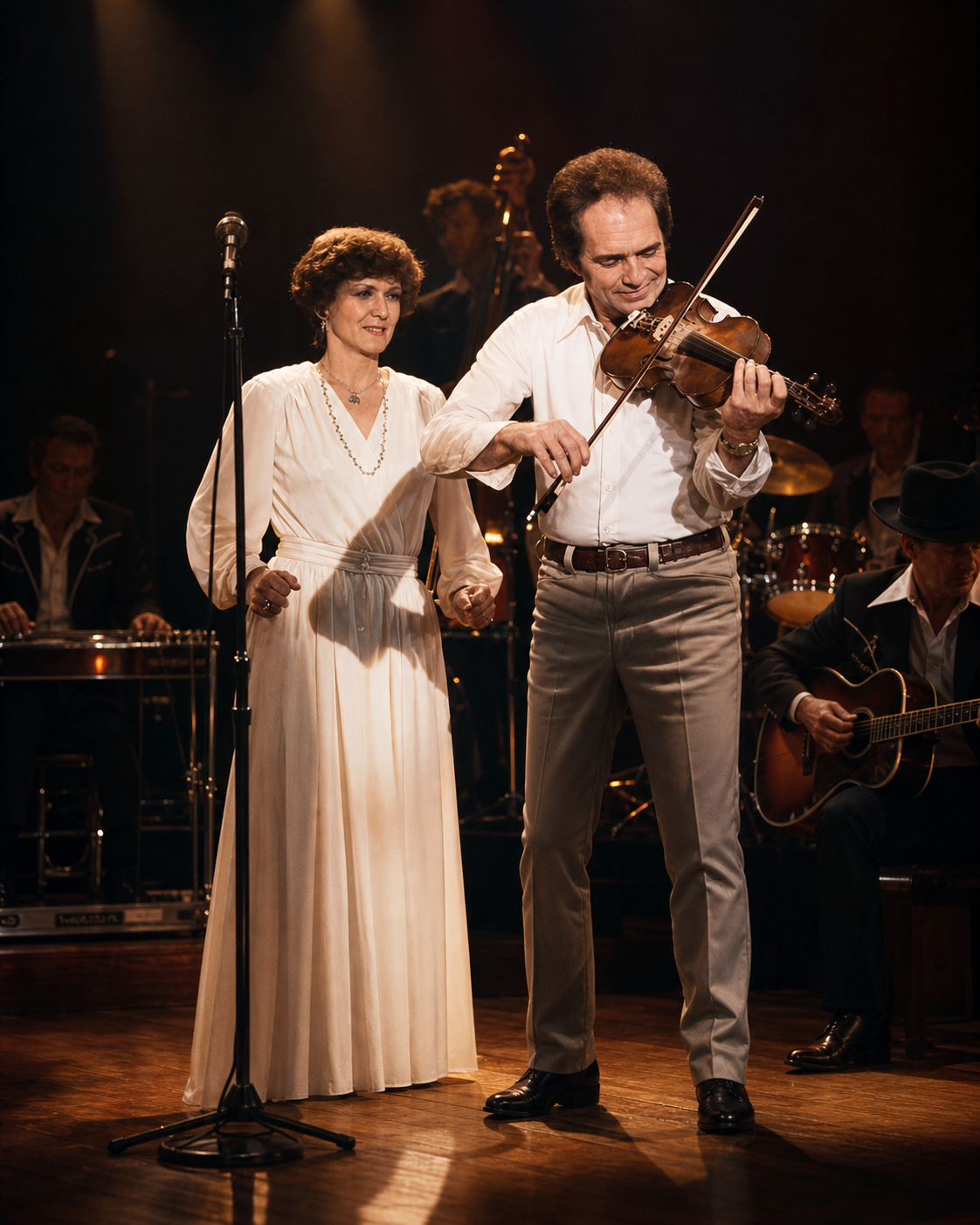
Some country songs are born in studios, polished under bright lights, and shaped by producers until every line feels ready for the radio. Others begin in smaller places — a motel room, a tired marriage, a paper sack of food, and a sentence that sounds too simple to be forgotten.
For Merle Haggard and Bonnie Owens, the song “Today I Started Loving You Again” did not arrive like a grand announcement. It came quietly, during a season when life on the road had stretched both of them thin.
In the late 1960s, Merle Haggard and Bonnie Owens were coming home through Los Angeles International Airport after a long, punishing tour. Bonnie Owens was not just Merle Haggard’s wife. Bonnie Owens was also part of his band, a singer with her own history, her own voice, and her own deep understanding of country music’s emotional language.
As the two stood near the luggage carousel at LAX, Merle Haggard looked at Bonnie Owens and noticed the exhaustion written across her face. The road had given them applause, work, and distance, but it had also stolen something simple from them.
“You know, we haven’t had time to say hello to each other.”
For most couples, that might have been a passing remark. For two songwriters, it was something else. Both Merle Haggard and Bonnie Owens heard the weight inside the line at almost the same moment. It sounded like regret. It sounded like tenderness. It sounded like the beginning of a song.
A Motel Room, a Paper Sack, and a Title That Would Not Let Go
A few weeks later, while Merle Haggard and Bonnie Owens were still on the road, the idea returned in the most ordinary setting imaginable. Merle Haggard asked Bonnie Owens to go out and pick up hamburgers from a place down the street. There was nothing dramatic about the request. It was just another small errand in another town, during another night between shows.
But while Bonnie Owens was gone, Merle Haggard sat in the motel room with the phrase circling in his mind. By the time Bonnie Owens returned carrying the food in a paper sack, Merle Haggard had filled a piece of paper with the title written again and again: “Today I Started Loving You Again.”
Bonnie Owens sat down and helped shape what the song would become. Merle Haggard did not read music easily, and Bonnie Owens often helped him hold an idea still before it slipped away. She wrote down the chords for him, giving structure to the feeling he had found. In return, Merle Haggard gave Bonnie Owens half of the songwriting credit. According to the story, Merle Haggard believed that was only fair.
That detail matters. Because “Today I Started Loving You Again” was not just a song written about Bonnie Owens. It was a song built with Bonnie Owens. The honesty belonged to both of them.
A B-Side That Refused to Stay Hidden
When the song was released in 1968, it was placed on the B-side of Merle Haggard’s number-one hit “The Legend of Bonnie and Clyde.” On paper, that should have made it secondary. It did not chart on its own. It was not pushed as the main event.
But country music listeners have a way of finding the truth, even when it is tucked away. Musicians found it too. Over time, “Today I Started Loving You Again” became one of the most-covered songs in country music history, recorded by more than 150 artists. Emmylou Harris, Conway Twitty, Dolly Parton, and many others carried the song into new rooms, new voices, and new generations.
Its power was never complicated. The song captured a painful, familiar feeling: the moment love returns before the heart has fully healed. It was not about perfect romance. It was about the strange cruelty of missing someone again after trying so hard not to.
When the Marriage Ended, the Music Stayed
Merle Haggard and Bonnie Owens divorced in 1978, but their story did not end with bitterness. Bonnie Owens continued singing backup in Merle Haggard’s band. Bonnie Owens was even the maid of honor at Merle Haggard’s next wedding.
That kind of bond is difficult to explain from the outside. Their marriage had changed shape, but the respect between them remained. The music, too, kept its place between them.
Some love stories become famous because they last forever in the usual way. Merle Haggard and Bonnie Owens had something different. Their marriage ended, but one song stayed alive — a love letter born while Bonnie Owens was walking back to a motel room with hamburgers, unaware that Merle Haggard was writing a line that would help carry her name through country music history.
“Today I Started Loving You Again” remains more than a classic country song. It is a reminder that sometimes the most lasting love letters are not written in perfect moments. Sometimes they are written in tired rooms, during ordinary errands, when two people have almost lost the time to say hello.
Post navigation
Merle Haggard spent more than half a century living the kind of life most country songs only try to describe. He knew highways, motels, stages, early mornings, late-night applause, and the strange quiet that comes after a crowd has gone home. For Merle Haggard, the road was not just a way to reach the next show. The road was part of who Merle Haggard was.
That is why the final chapter of Merle Haggard’s life feels so closely tied to the story he had been singing all along. On April 6, 2016, Merle Haggard passed away on his 79th birthday at his ranch in Palo Cedro, Shasta County, California. He died from complications of double pneumonia, an illness that had already forced Merle Haggard to cancel tour dates earlier that spring.
But what made the moment feel especially powerful to many fans was where Merle Haggard spent his final hours. Merle Haggard was surrounded by family on his tour bus, parked outside his home. For a man who had carried his music across America for decades, it was a deeply fitting place to say goodbye.
A Life Built on Highways, Honesty, and Hard Songs
Merle Haggard did not become a country music icon by pretending life was easy. Merle Haggard sang about working people, hard luck, regret, pride, loneliness, and the stubborn strength it takes to keep going. His voice carried the dust of Bakersfield, the weight of experience, and the kind of truth that made listeners feel seen.
Known to millions as the voice behind “Okie from Muskogee,” Merle Haggard became one of the defining figures of American country music. Across his career, Merle Haggard earned 38 number-one country hits, but his legacy was never only about chart success. It was about connection. When Merle Haggard sang, people believed him.
There was a lived-in quality to every line. Merle Haggard did not sound like a man performing a character. Merle Haggard sounded like a man telling the truth, even when the truth was uncomfortable.
The Final Illness and a Strange Prediction
In the weeks before his death, Merle Haggard’s health had become a serious concern. Double pneumonia had weakened him, and the April tour dates that fans had hoped to see were canceled. For an artist who had spent much of life moving from stage to stage, slowing down was not easy.
Those close to Merle Haggard later shared that Merle Haggard had reportedly predicted the date of his own death. Whether heard as intuition, acceptance, or something more mysterious, the detail added another layer to the final days of a man who had always seemed unusually aware of life’s darker turns.
Some artists fade away quietly. Merle Haggard seemed to understand that his ending was near, and even then, the road remained close.
There is something haunting about that image: Merle Haggard near his home, with family nearby, inside the tour bus that had carried him through so many miles, so many towns, so many songs. It was not a grand stage. It was not a bright spotlight. It was simply the place that had become familiar after a lifetime of music.
The Last Studio Session
Just weeks before Merle Haggard died, Merle Haggard stepped into a recording studio one final time. On February 9, 2016, Merle Haggard recorded what would become his last song, “Kern River Blues.” His son Ben Haggard was there beside him on guitar, creating a quiet father-and-son moment that now feels even more meaningful in hindsight.
At the time, Merle Haggard did not know it would be his final recording session. But “Kern River Blues” carried the feeling of farewell. The song looked back toward Bakersfield, toward memory, frustration, disappointment, and leaving something behind. It was not loud. It was not dressed up. It felt like Merle Haggard speaking plainly, one more time, before the curtain fell.
Released shortly after Merle Haggard’s death, “Kern River Blues” became a quiet closing note to an extraordinary career. It did not need to shout. Merle Haggard had never needed to shout to be heard.
A Goodbye That Felt Like a Country Song
The passing of Merle Haggard felt personal for many country music fans because Merle Haggard had spent decades giving voice to their lives. Merle Haggard sang for people who worked hard, lost love, made mistakes, missed home, questioned authority, and kept moving even when the road was lonely.
In the end, Merle Haggard’s final day seemed to reflect the life he lived. Merle Haggard died on his birthday, near his home, surrounded by family, inside the tour bus that symbolized so much of his journey. It was a farewell filled with sadness, but also with a strange sense of completeness.
Merle Haggard belonged to the road, to the stage, to the stories of ordinary people, and to the long American tradition of songs that tell the truth without decoration. His final recording, his final ride, and his final resting place in the hearts of fans all point to the same thing: Merle Haggard did not simply sing country music. Merle Haggard lived it.
And when the road finally ended, Merle Haggard was exactly where his story always seemed destined to close.