The Night a Guard Became a Lifeline. – Daily News
The construction site never truly slept.

Even after the workers went home, the place hummed with leftover energy—metal cooling in the night air, loose tarps snapping softly in the wind, sodium lights buzzing overhead like tired sentinels. Maria had worked night security long enough to know the rhythm. Walk the fence. Check the locks. Keep moving.
She was halfway through her round when she heard it.
A soft rattle.
Not metal-on-metal. Not wind. Something uneven. Almost… pleading.
Maria slowed, lifting her flashlight. The beam slid across dirt piles and steel beams until it caught movement at the far corner of the chain-link fence.
Two eyes reflected back at her.
Small. Bright. Afraid.
She approached carefully and saw him—a shepherd puppy, maybe four months old, ribs too visible beneath a dirty coat. One paw was pressed against the fence, clawing weakly at a gap too narrow to escape. His nose pushed through again and again, followed by a thin, desperate whine every time he failed.
“Hey, little one,” Maria said softly.
The puppy startled, scrambling backward until the fence stopped him. His body shook so hard the collar around his neck rattled against the wire.
Maria knelt immediately, angling the flashlight down so it wouldn’t blind him. “It’s okay,” she said, slow and steady. “I’m not gonna hurt you.”
The puppy didn’t believe her. Not yet.
She examined the fence—old, rusted, neglected. The gap looked like someone had tried to squeeze through and failed. Maybe he’d been chasing something. Maybe he’d been running from something worse.
“You picked a bad place to get lost,” Maria murmured, gripping the loose panel and pulling. The metal groaned, but it shifted.
The puppy watched every movement, tail tucked tight against his belly.
As the opening widened, he gathered what little courage he had and lunged forward. For one hopeful second, it looked like he’d make it.
Then he yelped.
His collar caught.
The sound ripped straight through Maria.
“Easy,” she whispered, dropping the flashlight and reaching in slowly. “I know, I know… you’re stuck.”
The puppy thrashed once, then froze, breath coming in short, panicked bursts. Maria could feel his fear through the fence—raw, shaking, absolute.
She slid her fingers under the collar, careful not to pull. The fabric was frayed, cheap, already tearing.
“Almost there,” she murmured, more to herself than him.
With one firm tug, the collar ripped free.
The puppy tumbled forward, momentum carrying him straight into her arms.
He shook violently, head pressed into her chest, paws clinging as if the world might pull him away again. Maria wrapped her jacket around him without thinking, shielding him from the cold wind sweeping across the site.
“There you go,” she whispered. “No more fences tonight.”
Her radio crackled at her hip—routine check-in. Maria didn’t answer. Not yet.
She carried the puppy to her truck and settled him onto the passenger seat. Under the soft dashboard glow, she could finally see him clearly: muddy paws, torn collar, eyes still wide but searching her face now instead of the dark.
She started the engine.
The puppy hesitated, then—almost imperceptibly—his tail twitched once.
Maria smiled, a quiet, tired smile.
“Yeah,” she said softly. “I think we’ll be okay.”
And as the truck pulled away from the empty site, the fence stood silent behind them—one less place in the world holding something trapped.
Snow had fallen quietly overnight, the kind that doesn’t announce itself with wind or drama, but settles gently, covering everything in a thin white hush. The suburban baseball field on the edge of Detroit looked frozen in time—bleachers dusted pale, foul lines erased, the dugouts dark and empty. It was the sort of morning that made the world feel paused, as if everyone had agreed to sleep a little longer.
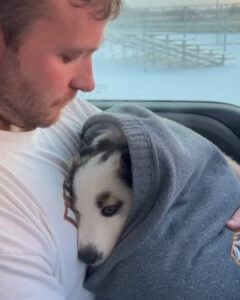
Everyone except Tom.
Running at dawn was his ritual. Not because he loved the cold or the ache in his lungs, but because it gave him space—space from a job that drained him, from a house that felt too empty since the divorce, from thoughts that grew louder the longer he stayed still. So he jogged, breath clouding in the air, shoes crunching softly against the frozen track.
He was halfway through his second lap when he noticed it.
A dark shape huddled by the dugout.
At first, Tom barely slowed. Trash bags collected there sometimes after weekend games, forgotten and half-buried by snow. But as he passed, something shifted. Just slightly. Enough to make his steps falter.
He turned back.
The shape moved again.
Tom jogged closer, heart picking up for reasons he couldn’t quite name. His breath caught when the beam of the field’s lone security light revealed what the snow had tried to hide.
A dog.
A border collie lay curled tightly into the corner where the dugout met the wall, her body pulled inward as if she were trying to disappear. Snow clung to her fur. Frost dusted her whiskers. One ear hung torn and dark with dried blood. Her chest rose and fell so faintly Tom had to stare to be sure she was breathing at all.
“Oh… hey,” he whispered, stopping several feet away. “Hey, girl.”
The dog lifted her head just enough for him to see her eyes—dull, exhausted, more resigned than afraid. She looked at him for a second that felt far too long, then let her head drop again with a soft, defeated huff.
Tom swallowed hard.
She hadn’t barked.
She hadn’t tried to run.
She hadn’t even flinched.
That scared him more than anything else.
“You can’t stay out here,” he said quietly, as if raising his voice might shatter her. “Not like this.”
The dog didn’t respond.
Tom glanced around the empty field, the silent houses beyond the fence. No one else was coming. No one else was here. Whatever had happened to her—whoever had hurt her or left her—it was over now. It was just the two of them.
He pulled off his hoodie, the cold biting instantly through his T-shirt. His hands shook, partly from the temperature, partly from the weight of the moment. He crouched low and tossed the hoodie gently across the snow, letting it land a few feet from her like an offering.
“Okay,” he murmured. “We’ll do this slow. I promise.”
The dog’s nose twitched. Weakly. She sniffed the air, then the fabric, testing the scent of sweat and detergent and something human. Something warm.
Minutes passed.
Tom stayed where he was, crouched and shivering, talking about nothing and everything just to fill the silence.
“I usually run later,” he said softly. “But my alarm went off early. Guess it was bad coffee yesterday… or maybe the Tigers losing again. Hard to say.”
The dog didn’t move, but she listened. He could tell by the way her ears shifted, by the slight tension in her shoulders easing as his voice continued.
“My name’s Tom,” he added. “I don’t know yours. But that’s okay.”
Finally, slowly, she nudged the hoodie with her nose.
Tom’s breath hitched.
She nudged it again, then dragged herself forward inch by inch, every movement stiff and careful, until she was lying fully on the fabric. Her body sagged, as if the effort had taken everything she had left.
“Good girl,” Tom breathed, his voice cracking. “That’s it. You’re doing great.”
He waited another long moment, then moved closer, careful not to startle her. When he reached out, she didn’t pull away. She just closed her eyes.
Gently, reverently, he gathered the hoodie around her and lifted.
She was shockingly light.
Too light.
Her body was cold against his chest, trembling despite herself. Tom instinctively wrapped his arms tighter, shielding her from the wind that cut across the open field.
“I’m taking you somewhere warm,” he whispered, as if it were a sacred promise. “No arguments.”
The walk to his truck felt longer than it should have, each step measured, each breath held. He opened the passenger door and settled her onto the seat, then cranked the heat as high as it would go. Warm air flooded the cab.
The dog let out a sound that wasn’t quite a whine, wasn’t quite a sigh—but something close enough to gratitude that Tom had to look away.
Snow melted off her fur, forming small puddles on the seat. Her breathing deepened. Her body relaxed against him, trusting him in a way that felt almost unbearable.
Dawn crept over the horizon, pale and slow, painting the snow in soft gold. The world stirred awake inch by inch.
Tom sat there, one hand resting lightly on the dog’s side, feeling the steady rise and fall beneath his palm.
“You’re safe now,” he said quietly. “I’ve got you.”
He didn’t know where she’d come from. How long she’d been there. What pain she carried beneath her matted fur and torn ear. Those answers would come later—at a vet’s office, at a shelter, maybe in stories she could never tell.
For now, it was enough that she was breathing.
That she was warm.
That she wasn’t alone.
The dog shifted slightly, then pressed her head into his side. And just before she drifted into sleep, her tail thumped once—soft, hesitant, real.
Tom smiled through the ache in his chest.
The field behind them remained empty, bleachers still and silent under melting snow. But somewhere between the dugout and the driver’s seat, something had changed.
Sometimes rescue doesn’t look like sirens or uniforms.
Sometimes it looks like a jogger who stopped.
A hoodie on the snow.
A promise whispered before dawn.
And sometimes, that’s enough to save a life.