The Last Roar of Freedom: The Story of Mufasa, the Mountain Lion Who Waited 20 Years to Be Free. – Daily News
For two long decades, the sound of applause meant pain for him. The flashing lights, the music, the shouting—all reminders of a world that had stolen his own.
His name was Mufasa, a mountain lion who spent twenty years chained to the back of a rusted truck, traveling from one dusty village to another, forced to perform in an illegal Peruvian circus.

He was never meant for the spotlight.
He was meant for the forest — for the sound of wind through trees, not the clang of chains.
A Life in Chains
When rescuers from Animal Defenders International (ADI) finally found him, Mufasa was hidden beneath a pile of old tarps and metal bars. The smell of gasoline, sweat, and fear filled the air. His body was wrapped in a heavy harness, his fur patchy, his ribs showing through his skin. He didn’t growl. He didn’t move. He just watched, silent and defeated, as if the will to live had been drained from him years ago.
Jan Creamer, the president of ADI, later described that moment:
“It was the most sad, wretched thing you’ve ever seen. It was like he wasn’t even alive.”

They had to cut the chains one by one.
When the last one fell, Mufasa stretched — a slow, trembling movement, like an old soldier remembering what freedom feels like. It was the first time in twenty years that his body wasn’t bound.
The rescue wasn’t easy. The circus owners resisted, sparking an eight-hour standoff before finally surrendering the animal. But when it was over, Mufasa’s long captivity had finally come to an end.
Learning to Breathe Again

At the ADI rescue center, Mufasa’s healing began. The staff approached him gently, knowing his fear ran deep. He had lived his entire life surrounded by noise and abuse, forced to perform tricks under threat. Every human face had meant danger.
For the first few weeks, he remained nervous — eyes darting, muscles tense, as if he expected the whip to follow every movement. But slowly, things began to change.
His rescuers fed him carefully chosen meals. His coat, once dull and thin, grew rich again. He learned that hands could comfort, not hurt. He began to relax in the shade of trees, listening to sounds that were no longer human — the songs of birds, the whisper of leaves, the low hum of freedom returning to him.
His caretakers called him “Grandfather Mufasa.” Though he was old and fragile, there was still a quiet strength in him — the spirit of a lion who had survived the impossible.
A Forest Reborn

When Mufasa was strong enough, ADI made the decision to move him to the Taricaya Ecological Reserve — a protected sanctuary deep in the Amazon rainforest. He could never be released fully into the wild; after so many years in captivity, he wouldn’t have survived on his own. But in this new place, he would finally live as he was meant to — among trees and rivers, under open skies, with no more chains.
The team built him a spacious enclosure surrounded by forest. And on the day he arrived, something magical happened.
They opened the gate.

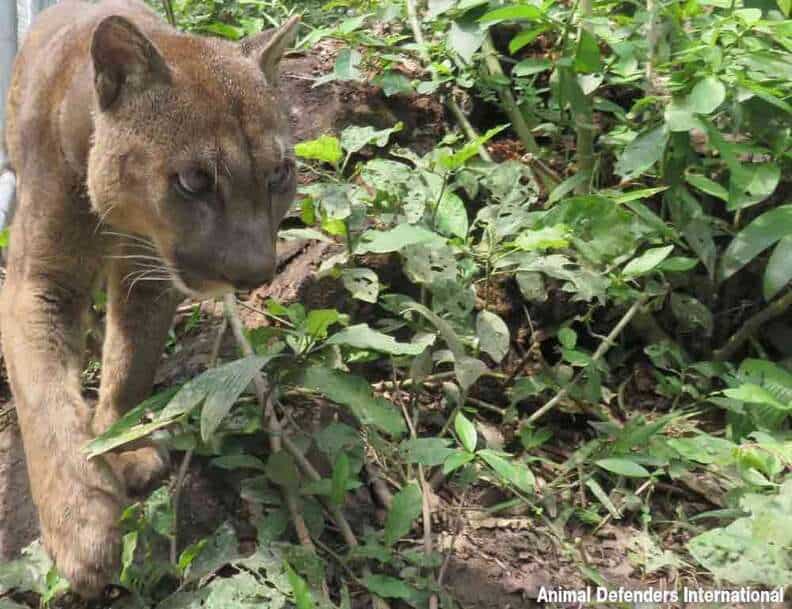
For a moment, Mufasa hesitated. The air smelled different — rich and alive. Then, slowly, he stepped forward. His paws sank into the soft earth. He looked up at the canopy above him, blinking as sunlight filtered through the leaves. And then, with a deep breath, he walked into his new home.
“It was magical to see him moving among the trees,” Jan Creamer said. “Mufasa was torn from the wild and endured the worst possible life. His story symbolizes the suffering we have ended.”
A Symbol of Change
Mufasa’s rescue was part of Operation Spirit of Freedom, an ADI campaign launched after Peru banned wild animal circuses in 2015. The mission freed over 100 animals — monkeys, bears, lions, birds — all victims of a cruel industry that had treated life as entertainment.
But Mufasa’s story stood out. Maybe because of his age. Maybe because of his quiet grace. Or maybe because he reminded the world that even after years of pain, it’s never too late to be free.

He lived his final days in peace, under the open sky. There were no cages, no crowds, no chains — only the rustle of the forest and the warmth of the sun on his fur.
The Legacy of a Lion
Mufasa’s life became more than a story of cruelty — it became a lesson in compassion. His rescue showed what can happen when people choose empathy over indifference, when they fight not for profit, but for life.
He never roared for the crowd again. But in a way, his silence spoke louder than any roar could.

Because when Mufasa finally took his first steps into freedom, he wasn’t just walking for himself — he was walking for every animal still waiting behind bars, every creature still dreaming of the forest.
In the end, his story wasn’t about tragedy. It was about triumph.
After twenty long years, Mufasa — the old mountain lion who once lived in chains — finally got to be what he was always meant to be: wild, free, and home.
And though his body has long returned to the earth, his story still echoes through the forests of Peru — a whisper that says, no life deserves to be caged.
The sun was beginning to rise over the quiet coast of Oman, painting the sky in soft pinks and golds. The tide whispered against the rocks, and seabirds called lazily overhead — it was the kind of morning made for peace.

Hand in hand, a young couple walked barefoot along the sand, leaving footprints that the sea would soon erase. They weren’t looking for anything — just enjoying the stillness, the sound of the waves, the rhythm of each other’s company. But fate, as it often does, had other plans.
Because just ahead, between two massive rocks, something moved.
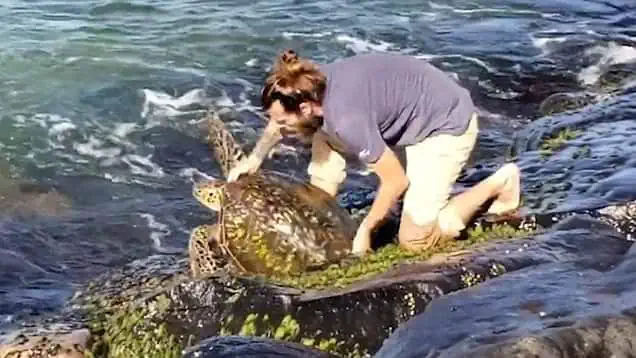
At first, they thought it was driftwood. But as they drew closer, their hearts froze. It wasn’t wood — it was a sea turtle. A giant green sea turtle, one of the ocean’s oldest travelers, wedged helplessly between the rocks, its flippers pressed against stone, its shell scraping as it struggled to move.
The girl gasped. “Oh my God… it’s stuck.”
Her boyfriend crouched down beside it. The turtle’s eyes blinked slowly, its breath shallow. Sand clung to its wet shell. It didn’t cry, but there was a quiet desperation in its movement — as if it knew it was trapped.
“If we don’t help it,” she whispered, “it’ll die here.”
And so, without hesitation, they began.

The Struggle
The turtle was enormous — easily over 300 pounds. Lifting it was impossible. They tried pulling gently, then pushing from behind, but the rocks held it firm, like the earth itself refused to let go. The girl’s hands slipped on the smooth shell, her palms raw from the effort. The boy gritted his teeth, trying to wedge his arms beneath it, but the creature barely budged.
“What do you think?” she asked, panting. “Maybe if we get something under it?”
He nodded, looking around. The beach was scattered with driftwood. He grabbed a thick board and wedged it under one side while she pulled at the top of the shell. “On three,” he said.
“One… two… three!”
They heaved together — sand flying, sweat dripping — but the turtle didn’t move. It was wedged too tightly, its body pressed by the weight of its own size.
The girl sat back on her heels, frustration in her eyes. “We can’t just leave it.”
He looked at her — the determination, the fear, the kindness — and shook his head. “We’re not leaving.”

The Turning Point
They changed tactics. Using their hands, they dug into the wet sand, clearing space around the turtle’s flippers. Every handful of sand mattered. The boy’s back ached, the girl’s knees were scraped, but still they dug.
And then, something changed.
As they worked, the turtle began to stir. Its flippers moved again — weakly, then stronger. It was as if it sensed that help had come.
“Come on,” the girl urged softly, her voice trembling with hope. “Push with us.”
The boy positioned the wooden board again, using it as a lever. The girl braced her hands against the shell. “Ready?” he said.
“Ready.”
They pushed — hard. The turtle flapped wildly, its front flipper sweeping inches from the man’s head. Sand flew. The board creaked. And then, suddenly, something gave.
The turtle shifted.
“Again!” the girl shouted.

They heaved with everything they had left. The turtle moved another inch. Then another. The suction of sand broke with a deep, wet sound — and finally, impossibly, the giant creature slid free.
The Moment of Freedom
For a moment, no one moved. The couple sat in the sand, breathless, covered in salt and sweat. The turtle lay between them, stunned but alive. Then, with slow, deliberate movement, it lifted its head.
It turned toward the sea.
And then — it began to crawl.
The girl let out a sob that turned into laughter. “Oh my God, we did it!” she cried, clapping her hands. Her boyfriend could only nod, too exhausted to speak, watching as the great turtle dragged its heavy shell toward the waves.
Each movement was labored but determined. The ocean seemed to sense the reunion and sent a gentle wave forward, lapping against its flippers as if welcoming it home.
The girl knelt in the sand, tears in her eyes. “Go on,” she whispered. “You’re free now.”
The turtle paused at the edge of the water, as if to look back at them — a silent farewell — and then slipped beneath the waves.
Just like that, it was gone.
The Silence That Follows
For a long time, they sat there, listening to the sound of the ocean filling the space the turtle had left behind. The morning sun shimmered on the water, and a breeze carried the scent of salt and life.
“I can’t believe we actually did it,” the girl said quietly.
The boy smiled, his voice hoarse. “We didn’t just move a turtle,” he said. “We moved the sea.”
She laughed softly and leaned against him. “Do you think it’ll be okay?”
He nodded, watching the horizon. “Yeah. It’s where it belongs now.”
A Ripple of Kindness
Later that day, they would share the video of their rescue — the struggle, the laughter, the final triumphant moment when the turtle reached the waves. People from all over the world would watch and smile, feeling that same warmth, that same spark of hope that comes from witnessing kindness in its purest form.
But for the couple, it wasn’t about views or praise. It was about that moment — the weight of the turtle against their hands, the sound of its body breaking free, the sight of it disappearing into the deep.
They would remember how it felt to fight for something that couldn’t ask for help.
They would remember the look in its eyes — a mix of fear and trust, as if it knew that, for once, humans had come not to harm, but to save.
As the tide rose that afternoon, the waves covered the rocks where the turtle had been trapped. The sand smoothed over the marks of the struggle, erasing every trace.
But for two people — and one very lucky sea turtle — the memory would never fade.
Because on that morning in Oman, a young couple learned what it meant to truly lift something greater than themselves.
And somewhere, far out in the blue, a green sea turtle glides through the current — free, alive, and forever a reminder that even the smallest acts of compassion can change the course of a life.