The Hidden Lakewood Trust No One Told Her About – usnews
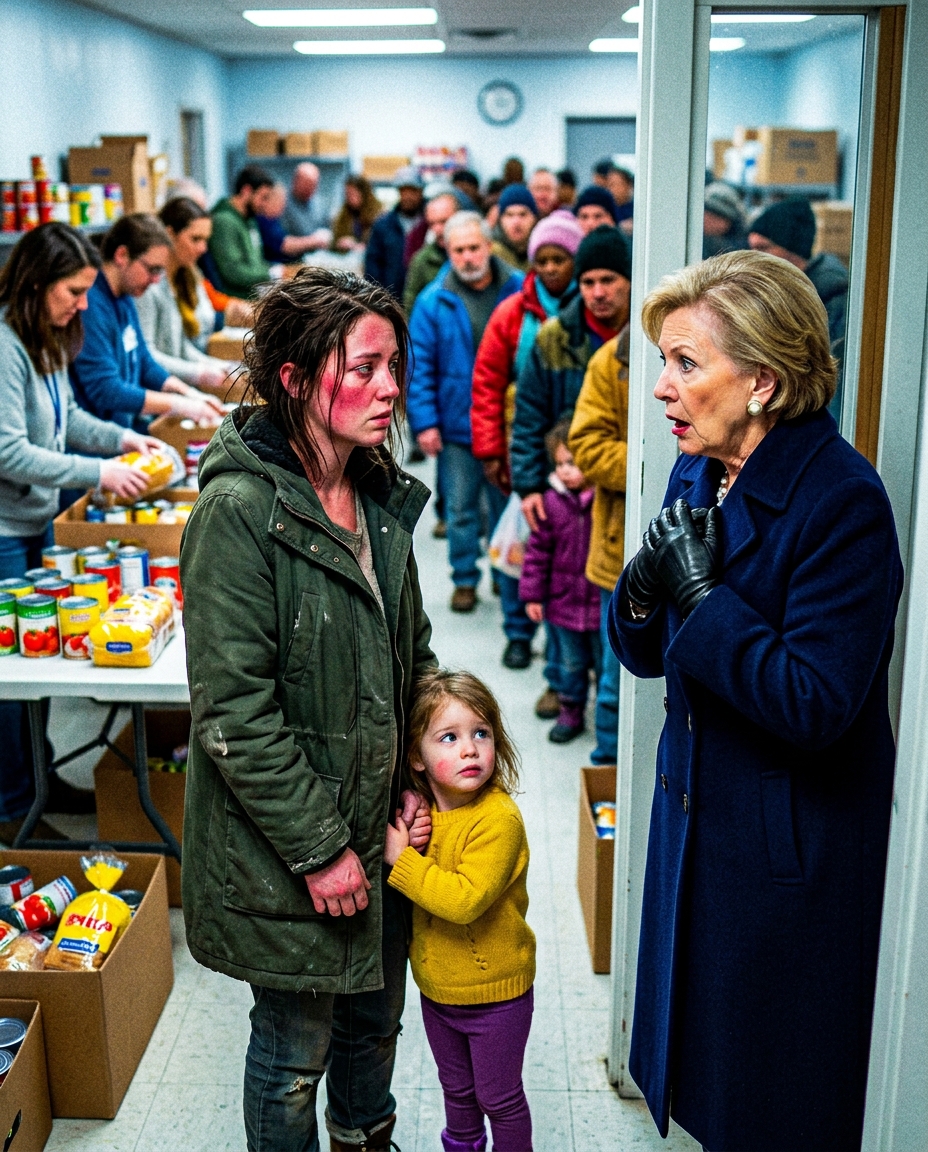
The first thing Natalie noticed at the Riverside Community Food Bank was always the smell.
It was never just food.
It was bleach, damp wool coats, old cardboard, and coffee that had been sitting too long on a burner near the volunteer table.
It clung to her hair and her coat and the inside of her throat, and somehow it always found its way into the part of her that still believed she should not be there.
Her three-year-old daughter, Maya, stood beside her with one small hand wrapped around Natalie’s fingers.
The child’s purple leggings were faded gray at the knees, and her yellow sweater had come from a daycare donation bag labeled “might still fit.” Natalie had tucked the fraying cuff back inside twice before they reached the front half of the line.
“Mommy,” Maya whispered, leaning against her leg, “is this the apple place?”
Natalie looked toward the produce table.
There were potatoes in cardboard bins, a few soft-looking oranges, and two volunteers sorting through crates.
She could not see apples yet.
“Sometimes,” Natalie said.
“Sometimes they have apples.”
Maya accepted that with the solemn patience of a child who had learned too early that maybe was not the same as no.
Natalie hated that she knew the rhythm of the food bank.
She knew which volunteer was kind but slow, which one slipped extra canned soup into bags when the director wasn’t looking, which Tuesdays the bakery on Main Street donated bread.
She knew how to stand with her chin level and her face blank in case someone looked too closely.
People did not expect to see a Lakewood in that line.
The Lakewood name meant stone houses near the river, charity galas, country club brunches, scholarship funds, and her grandmother’s photograph in local magazines beside polished silver centerpieces.
Natalie’s parents still lived in the brick house where she had grown up, the one with iron gates and white hydrangeas along the walkway.
Her younger sister, Cynthia, had taken engagement pictures at a vineyard and sent them out on thick cream cards.
Natalie worked the front desk at a dental office.
She smiled at patients who argued about insurance.
She answered phones, confirmed appointments, and ate peanut butter crackers at her desk when lunch became too expensive.
Every night after putting Maya to bed, she sat at the kitchen table with her bank app open, moving numbers around as though she could trick arithmetic into kindness.
Rent.
Daycare.
Electricity.
Gas.
Cough medicine.
Laundry detergent.
Toilet paper.
Food came last, because food was the one necessity that could be stretched until it almost disappeared.
She had stopped telling her family the truth long ago.
Her mother, Anne, had a gift for turning pain into evidence.
You should have listened about Jake.
You never think long-term.
Art history, Natalie? Really?
Cynthia was always more practical.
Her father, Richard, was quieter but worse in some ways.
He would look down, sigh, and act as if Natalie’s life had become an inconvenience he was too decent to mention directly.
When she left Jake, Maya’s father, after his promises turned into unpaid bills and sudden disappearances, her parents had not asked if she was safe.
They asked why she had ignored their warnings.
So Natalie learned to edit herself.
She said
things were fine.
She said work was busy.
She said Maya was growing fast.
She did not say she had cried in the kitchen three nights earlier because there was enough macaroni left for Maya or enough gas to get to work, but not both.
A volunteer called the next family forward.
Natalie shifted her empty tote onto her wrist and checked the clock above the folding table.
If the line moved quickly, she could still make it to daycare before the late fee kicked in.
The fee was only fifteen dollars, but fifteen dollars could become milk, eggs, and a loaf of bread if she was careful.
Then she heard her name.
“Natalie?”
Not ma’am.
Not miss.
Her full name, spoken in a voice that belonged to marble foyers, handwritten thank-you notes, and Sunday dinners with too many forks.
Natalie turned.
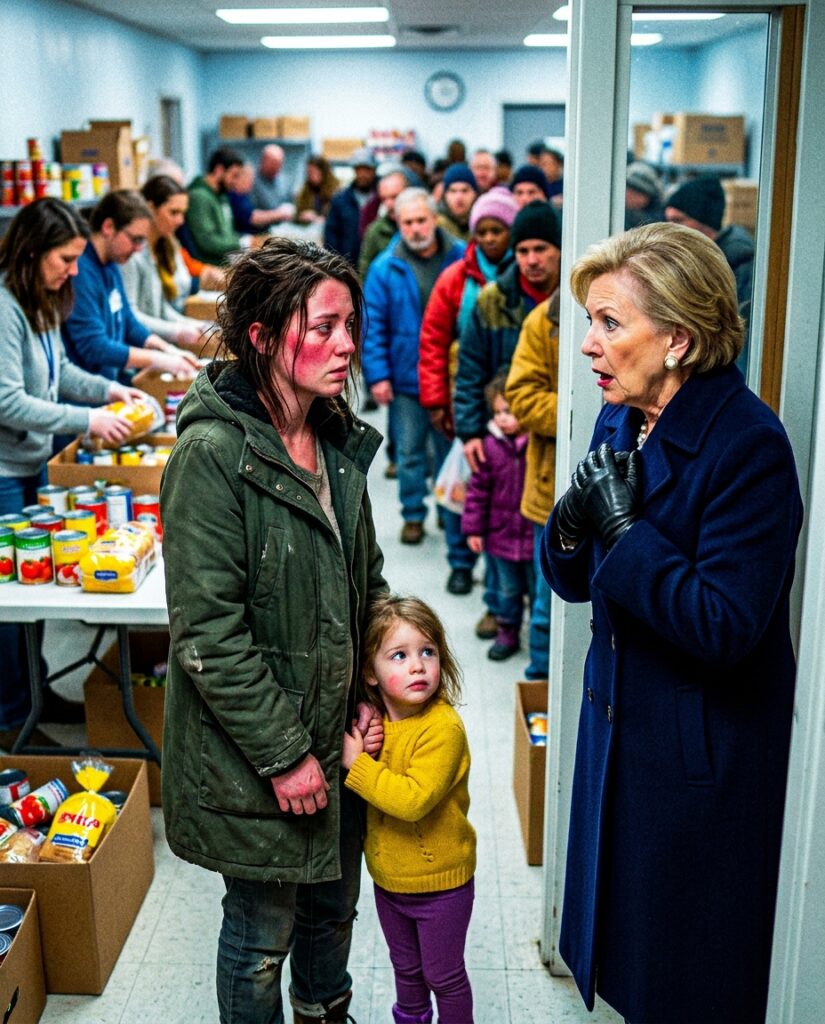
Her grandmother stood just inside the side entrance.
Eleanor Lakewood wore a navy coat with sharp shoulders, leather gloves, and a pale handbag that looked too expensive for the room.
Her silver hair was smooth and swept back, her lipstick precise.
Even beneath the hard fluorescent lights, she looked composed in a way Natalie had never learned how to be.
For one terrible second, Natalie thought shame had made her hallucinate.
“Grandma,” she said.
Her voice sounded thin.
“What are you doing here?”
The question was absurd the moment it left her mouth.
Eleanor was holding a volunteer badge.
Behind her, an older man in an apron waved as if he knew her well.
“I volunteer here on Tuesdays,” Eleanor said.
Natalie blinked.
“You do?”
“For five years.”
The words landed strangely.
Natalie knew her grandmother hosted charity luncheons, wrote checks, served on boards.
She did not know Eleanor spent Tuesdays inside a church gym handing out canned beans and bruised fruit.
That ignorance hurt, not because Eleanor owed her a schedule, but because it proved how far Natalie had drifted from her own family.
Eleanor’s eyes moved from Natalie’s face to Maya, then to the line, then to the empty tote bag hanging from Natalie’s wrist.
“Natalie,” she said quietly, “what are you doing here?”
The truth stood between them with nowhere to hide.
Natalie wanted to say she was volunteering.
She wanted to say she was helping a friend.
She wanted to laugh lightly and make it all disappear.
But Maya’s hand was warm in hers, and the tote bag was empty, and pride was a poor substitute for dinner.
“Things have been difficult,” she whispered.
Eleanor stepped closer.
“Difficult how?”
“Grandma, please.
Not here.”
But Eleanor’s expression had changed.
It was not disgust.
It was not pity.
It was confusion, tightening into alarm.
“How difficult?” she asked.
Natalie swallowed.
“I’m behind on everything.
I’m working, but daycare takes almost half my paycheck.
I’m doing what I can.”
Eleanor stared at her.
Then she frowned.
“Why aren’t you using the Lakewood Trust?”
Natalie’s first instinct was to smile because the words made no sense.
“The what?”
“The Lakewood Trust,” Eleanor said, lowering her voice.
“Your grandfather’s trust.
The one set aside for you.”
Natalie’s fingers loosened around her tote handle.
“What trust?”
Eleanor went still.
The room kept moving around them.
A volunteer stacked cans.
A child cried near the coat rack.
Someone laughed softly by
the bread table.
But between Natalie and her grandmother, the air changed so completely that Natalie felt as if the floor had shifted under her shoes.
“Natalie,” Eleanor said carefully, “who has been handling your distributions?”
“My what?”
Eleanor’s face lost color.
She turned to Maya, and in one smooth motion became the grandmother Natalie remembered from childhood, warm and calm even while something burned behind her eyes.
“Sweetheart,” she said, crouching slightly, “would you like to help me choose some apples?”
Maya looked up at Natalie.
Natalie nodded because she did not know what else to do.
Eleanor took Maya to the produce table and helped her pick three apples from a small crate Natalie had not noticed.
Her hand trembled once as she opened a paper bag.
She recovered quickly, but Natalie saw it.
She also saw the way Eleanor glanced back at her, not with judgment, but with dread.
Ten minutes later, Eleanor walked them to Natalie’s car.
It was an old sedan with a cracked windshield, a low rear tire, and a booster seat in the back with worn straps.
Overdue envelopes were tucked under a cardigan on the passenger seat.
Natalie moved automatically to hide them, then stopped.
There was no point anymore.
Eleanor stood beside the driver’s door and looked at the car, the envelopes, the child seat, the little bag of apples in Maya’s lap.
“Did your mother ever discuss the trust with you?” she asked.
“No.”
“Your father?”
“No.”
“Did anyone from the bank contact you when you turned twenty-five?”
Natalie stared at her.
“No.”
Eleanor’s mouth tightened.
“Did you ever sign documents regarding family estate planning?”
A memory moved through Natalie so sharply that she felt cold.
She was twenty-two, newly pregnant, exhausted, and sitting at her parents’ kitchen island while her mother slid a stack of papers toward her.
Her father stood behind Anne with a pen in his hand.
Cynthia had been there too, scrolling on her phone, barely interested.
It’s just estate housekeeping, Natalie, her mother had said.
Everyone is signing.
Don’t make a production of it.
Natalie had asked if she needed to read it.
Her father had sighed.
For once, can you trust us?
She had signed.
“I signed something years ago,” Natalie said.
“I don’t know what.”
Eleanor closed her eyes.
When she opened them, she no longer looked confused.
She looked furious in a quiet, controlled way that frightened Natalie more than shouting would have.
“Do not call your parents,” Eleanor said.
“Why?”
“Because I need to find out exactly what they did.”
That evening, Natalie sat at her kitchen table after Maya fell asleep and stared at her phone.
Twice she almost called her mother.
Twice she stopped herself, hearing Eleanor’s voice.
Do not call your parents.
At 9:17 p.m., Eleanor called.
Her voice was clipped.
“Natalie, I need you to tell me everything you remember about the papers you signed.”
“I barely remember anything.”
“Start with the room.”
So Natalie told her.
The kitchen island.
The blue folder.
Her mother’s impatience.
Her father’s pen.
Cynthia laughing about something on her phone.
The way Anne had placed her hand over the top of the document when Natalie tried to flip back a page.
Eleanor was silent for several seconds.
Then she asked, “Did
they ever ask for your bank information?”
“No.”
“Did you ever receive annual statements?”
“No.”
“Did you ever receive a letter from my attorney, Mr.
Harrow?”
“No.”
Eleanor inhaled slowly.
“I see.”
“Grandma, what is happening?” Natalie asked.
The silence on the other end felt heavy.
“Your grandfather created the Lakewood Trust before he died,” Eleanor said.
“It was designed to provide education, housing support, medical support, and living assistance for each grandchild.
You, Cynthia, and any children you might have were named beneficiaries.
When you turned twenty-five, you were supposed to begin receiving direct information and request rights.”
Natalie’s hand tightened around the phone.
“I’m twenty-nine.”
“I know.”
Maya shifted in her sleep down the hall and made a small humming sound.
Natalie looked toward the bedroom door, then at the peeling corner of the kitchen linoleum.
“How much?” she asked.
Eleanor did not answer immediately.
“Enough that you should never have been choosing between gasoline and groceries.”
Natalie pressed a hand to her mouth.
She did not cry right away.
The shock was too large for tears.
It moved through her as a blankness, a kind of stunned quiet that made the room seem farther away.
“Who controlled it?” she asked.
“Your father was co-trustee for administrative convenience,” Eleanor said, and her voice hardened on the phrase.
“Your mother had no authority, though I suspect that did not stop her from behaving as if she did.
I retained oversight rights, but I was told you preferred distance from the family and did not want involvement.
I was told your distributions were being handled privately at your request.”
Natalie thought of every birthday where her mother said Eleanor was traveling.
Every Christmas card that arrived late and strangely formal.
Every time Anne said, Your grandmother is disappointed in your choices, Natalie.
Don’t make it worse.
“I thought you were ashamed of me,” Natalie whispered.
Eleanor’s breath caught.
“Oh, Natalie.”
Those two words broke something open.
Natalie cried then, silently at first, then with a force that bent her forward over the table.
She cried for every meal stretched too thin, every bill paid late, every time she had told Maya no with a smile, every family dinner she had avoided because she could not bear to be measured and found lacking again.
Eleanor did not try to fill the silence.
She stayed on the phone until Natalie could breathe.
The next day, Eleanor arrived at Natalie’s apartment with Mr.
Harrow, a tall attorney with tired eyes and a leather briefcase old enough to look trustworthy.
Natalie had cleaned frantically before they came, hiding laundry in the bedroom and wiping down counters that were already peeling at the edges.
Eleanor noticed, of course.
She noticed everything.
But she said nothing.
Mr.
Harrow spread documents across the small kitchen table.
Natalie saw her own signature first.
It was at the bottom of a document titled beneficiary communication waiver and discretionary distribution consent.
She did not understand all of it, but Mr.
Harrow explained it in careful, plain language.
The paper had allowed the trustee to receive notices on her behalf and manage certain requests through an intermediary.
“It did not remove you as beneficiary,” he said.
“It did not permit anyone to use funds for another beneficiary’s benefit.
It also appears
to have been presented to you under misleading circumstances, based on what you’ve described.”
Eleanor sat beside Natalie, her hands folded so tightly her knuckles showed white.
“What happened to the money?” Natalie asked.
Mr.
Harrow looked at Eleanor.
“Tell her,” Eleanor said.
He opened a folder.
There had been distributions.
Not small ones.
Housing assistance.
Educational reimbursement.
Emergency medical support.
Child welfare allotments after Maya was born.
Annual living support.
The records showed payments approved for Natalie’s benefit and directed through accounts controlled by Richard Lakewood.
Natalie stared at the page.
There were notes attached to several transactions.
Temporary transfer pending Natalie’s housing stabilization.
Childcare support disbursed per beneficiary preference.
Beneficiary declined direct contact.
Natalie could hardly read the words.
Her vision kept blurring.
“I never received this,” she said.
“We know,” Eleanor replied.
Her voice was so cold that Mr.
Harrow looked down at the papers rather than at her.
One transaction made Natalie’s stomach turn.
A large distribution had been requested six months earlier under emergency child welfare support.
It was the month Maya had pneumonia, the month Natalie had paid the urgent care bill on a credit card and skipped two utility payments.
The distribution note said funds had been applied to beneficiary household expenses.
Natalie remembered that same month clearly because her mother had called to remind her about Cynthia’s vineyard deposit.
Your sister only gets married once, Natalie.
Try to be happy for someone besides yourself.
Now Cynthia’s engagement party was three days away.
Natalie almost laughed when she realized it.
The tent.
The champagne tower.
The flowers.
The string quartet her mother had mentioned twice in a voice meant to make Natalie feel uncultured for not being impressed.
“How much did they take?” she asked.
Mr.
Harrow gave a number.
Natalie sat back as if struck.
It was more money than she had earned in years.
Eleanor reached for her hand.
“I am so sorry.”
Natalie looked at her grandmother.
She wanted to be angry at everyone at once.
Her parents.
The attorney who had not noticed sooner.
Eleanor for believing Richard.
Herself for signing without reading.
But Eleanor’s face was full of a grief so raw that Natalie could not mistake it for performance.
“What happens now?” Natalie asked.
Eleanor’s answer was immediate.
“We confront them.”
Natalie shook her head.
“No.
I can’t walk into that house and do this in front of everyone.”
“Yes,” Eleanor said, “you can.”
“I don’t want a scene.”
“You did not create the scene.” Eleanor leaned closer.
“They did, years ago, and then they hid it behind manners.”
The words stayed with Natalie all night.
On Saturday evening, she dressed Maya in the nicest outfit she owned, a navy dress with tiny white flowers.
Natalie wore a black dress she had bought for a work holiday party two years before and low heels with scuffed backs.
She brushed her hair until it shone, then stood in front of the mirror and almost changed into jeans.
At six o’clock, a black car pulled up outside her apartment.
Eleanor stepped out wearing pearls, red lipstick, and an expression Natalie had never seen before.
Not anger exactly.
Something steadier.
A decision already made.
“Bring Maya,” she said.
“To Cynthia’s engagement party?” Natalie asked.
“To your family’s party,” Eleanor corrected.
The Lakewood house glowed when they arrived.
White tents covered the back lawn.
String lights hung from the trees, and waiters moved between guests with silver trays.
Through the front windows, Natalie saw her mother laughing with a champagne flute in one hand, dressed in pale gold.
Her father stood beside her, smiling broadly.
Cynthia held out her left hand while a circle of women admired the ring.
Natalie’s throat tightened.
Eleanor touched her elbow.
“Walk in.”
The front door opened before Natalie could knock.
A catering assistant smiled, then stepped aside when he saw Eleanor.
The sound inside softened almost instantly.
Anne saw them first.
Her smile froze.
Richard turned with champagne in his hand.
For one second, he looked merely surprised.
Then he saw the folder under Eleanor’s arm, and his face drained of color.
Cynthia’s eyes moved from Natalie to Maya to Eleanor, and irritation flashed across her face before fear arrived.
“Mother,” Richard said, setting down his glass too quickly.
“We didn’t know you were bringing guests.”
Eleanor looked at him.
“Natalie is not a guest.”
Anne recovered faster.
She came forward with a bright, brittle smile.
“Natalie, sweetheart, this really isn’t a good time.
Cynthia’s photographer is taking family shots soon, and we weren’t sure you were coming.”
Natalie almost apologized.
The habit rose in her like a reflex.
Then Maya pressed closer to her leg, and Natalie remembered the food bank floor, the blue tape arrows, the way her daughter had asked for apples as if apples were a luxury.
“I was invited,” Natalie said.
Anne’s smile tightened.
“Of course.
I only meant—”
“We need to speak privately,” Richard interrupted, looking at Eleanor.
“No,” Eleanor said.
The word was not loud, but it carried.
Several guests turned.
The string quartet near the tent kept playing, then faltered when no one seemed to be listening anymore.
Richard lowered his voice.
“Mother, whatever this is, do not do it here.”
Eleanor’s eyes narrowed.
“You chose here when you spent trust money on this party.”
The silence that followed was immediate and total.
Anne’s champagne glass trembled.
A drop slid over the rim and onto her fingers.
Cynthia stepped forward.
“What are you talking about?”
Eleanor opened the folder.
Natalie felt her knees weaken, but she stayed standing.
Mr.
Harrow had offered to attend, but Eleanor had said the first words needed to come from family.
He was waiting nearby in the car with copies, emails, bank records, and a petition already prepared.
“Your grandfather created the Lakewood Trust for his grandchildren,” Eleanor said.
“Natalie was entitled to support from it years ago.
Richard, as co-trustee, approved distributions in her name while telling me she wanted no contact and telling Natalie nothing at all.”
A murmur moved through the room.
Richard’s jaw tightened.
“That is a gross oversimplification.”
“Then simplify this.” Eleanor held up a page.
“Emergency child welfare support for Maya, requested six months ago.
Where did it go?”
Richard looked at Natalie for the first time.
Not at her face exactly, but near it, as though eye contact would cost him something.
Anne stepped in.
“Natalie has never been responsible with money.
We were protecting the family assets until she stabilized.”
Natalie felt the words hit the old bruises.
There it was.
The shape of
every judgment she had swallowed for years.
Eleanor turned slowly toward Anne.
“You had no authority over those assets.”
“I am her mother.”
“You behaved like her jailer.”
Anne’s face flushed.
“How dare you?”
“No,” Natalie said.
Her own voice startled her.
It was not loud.
It was not polished.
But it stopped Anne mid-breath.
Natalie stepped forward, one hand holding Maya’s.
“You let me stand in a food bank line with my daughter,” she said.
“You knew I was struggling.”
Anne’s mouth opened.
“You knew,” Natalie repeated.
“You called me irresponsible.
You told me I made bad choices.
You watched me wear the same dress to every family dinner because I couldn’t afford anything else.
You asked why Maya’s shoes were too small.
And all that time, there was money Grandpa left for me?”
Richard’s face hardened.
“It was not that simple.”
“Then make it simple now,” Natalie said.
“Where did it go?”
No one moved.
The photographer lowered her camera.
Cynthia’s fiancé, Mark, stood near the fireplace, looking from one Lakewood to another as if he had walked into the wrong life.
Cynthia’s voice came out thin.
“Dad?”
Richard rubbed his forehead.
“Some funds were temporarily reallocated.”
“To what?” Eleanor asked.
Anne snapped, “To things that benefited the family.”
The answer hung there, naked and ugly.
Cynthia took a step back.
“My wedding?”
Anne turned on her.
“Do not be dramatic.”
But Cynthia was already looking around the room.
The flowers, the servers, the champagne, the violinists, the photographer, the ice sculpture near the dessert table.
Her face changed as she understood before anyone said it out loud.
“My wedding?” she whispered.
Richard said nothing.
Natalie felt strangely calm.
The pain was still there, but beneath it was something harder, cleaner.
“You used Maya’s childcare money for champagne,” Natalie said.
Anne’s face twisted.
“Don’t be vulgar.”
Eleanor slapped the folder shut.
The sound cracked through the foyer.
“Vulgar,” she said, “is stealing from a child and calling it family management.”
Richard stepped toward her.
“Mother, you need to be careful with accusations.”
“I have been careful.” Eleanor’s voice was ice.
“For three days, I have been careful.
I have reviewed bank records, trustee correspondence, signatures, transfer logs, and every lie you sent through my attorney’s office.
Mr.
Harrow is outside with the full file.
As of this afternoon, you have been removed from all trustee functions pending legal action.”
Richard staggered slightly, as though the words had physical weight.
Anne’s face went white.
“You can’t do that,” Richard said.
“I already did.”
For the first time in Natalie’s life, her father looked small.
Cynthia started crying, but not loudly.
She covered her mouth and looked at Natalie with a horror that seemed almost childlike.
“I didn’t know,” she said.
“Natalie, I swear I didn’t know.”
Natalie believed her.
Cynthia was spoiled, careless, used to being favored, but the shock on her face was real.
Anne immediately reached for her.
“Cynthia, don’t let her ruin your night.”
Cynthia pulled away.
That small movement did more damage than shouting could have.
Guests began whispering.
Someone near the hallway said Richard’s name in disbelief.
Mark crossed the room and stood beside Cynthia, not touching her, but close enough to make it clear he was not standing with Anne.
Richard looked at
Natalie then.
Really looked at her.
For a second, she almost saw regret.
Then he said, “We were trying to prevent you from wasting it on another mistake.”
The room seemed to inhale.
Natalie felt Eleanor stiffen beside her, but she raised a hand before her grandmother could speak.
“Another mistake,” Natalie repeated.
Richard’s eyes flicked toward Maya.
That was enough.
Natalie stepped between them, her body moving before thought could catch up.
“Do not look at my daughter when you say that.”
Richard looked away.
Anne whispered, “Natalie, don’t be so sensitive.”
“No,” Natalie said.
“I have been sensitive.
I have been quiet.
I have let you make me feel ashamed of needing help while you took the help that was mine.
I let you convince me that poverty was proof of my character.
It wasn’t.
It was proof of yours.”
Eleanor’s eyes shone, but her face remained steady.
She turned to the room.
“This party is over.”
Anne made a strangled sound.
“Mother!”
“The trust will seek full restitution,” Eleanor continued.
“Natalie will receive direct access to her rightful support immediately.
Maya’s benefits will be placed under separate protection.
And if either of you contacts Natalie except through counsel, you will regret it.”
No one questioned whether she meant it.
The guests began leaving in waves, murmuring apologies that sounded too late and too small.
Waiters froze near the dining room until the caterer quietly started clearing glasses.
The string quartet packed up without being asked.
Cynthia sat on the bottom stair in her white engagement dress, crying into her hands while Mark spoke to her in a low voice.
Natalie wanted to comfort her and did not.
Not yet.
Maybe someday, but not while the champagne still stood in towers behind her.
Anne stood in the foyer like a woman watching her own portrait being removed from the wall.
“You’ve humiliated this family,” she said to Natalie.
Natalie looked at Maya, who was holding Eleanor’s hand and staring at the lights beyond the window.
“No,” Natalie said.
“You did.”
Richard did not speak again.
Outside, the evening air felt cold and clean.
Natalie buckled Maya into the car seat while Eleanor stood beside her, the folder pressed to her chest.
“Are we going home?” Maya asked sleepily.
“Yes, baby,” Natalie said, smoothing her hair.
“We’re going home.”
Eleanor touched Natalie’s shoulder.
“Tomorrow, Mr.
Harrow will arrange the first transfer.
We will also replace the car seat.
And the tire.”
Natalie laughed once, unexpectedly, with tears still on her face.
“The tire?”
“The tire,” Eleanor said firmly.
“And then everything else.”
For the first time in years, Natalie did not feel like she was calculating the cost of breathing.
The legal aftermath took months, but the truth did not disappear.
Richard resigned from the club board.
Anne stopped attending luncheons where people could ask questions she did not want to answer.
Restitution was ordered through a settlement designed to avoid a criminal trial, though Eleanor made sure the consequences were permanent.
Richard lost control of every trust account.
Anne lost the ability to pretend she had only been protecting anyone.
Natalie moved with Maya into a safer apartment closer to daycare.
She paid off the urgent care bill.
She bought groceries without counting every apple.
She cried the
first time Maya opened the refrigerator and asked for yogurt without Natalie feeling panic before answering.
Cynthia postponed the wedding.
Weeks later, she came to Natalie’s apartment carrying a small box of Maya’s favorite fruit snacks and no excuses.
She stood in the doorway and said, “I don’t know how to apologize for something I benefited from without knowing.
But I’m sorry.
And I’m going to spend a long time proving it.”
Natalie did not hug her.
But she let her in.
Eleanor began coming every Tuesday for dinner after volunteering at the food bank.
Sometimes she brought apples.
Sometimes she and Maya made soup together, and Natalie would stand in the doorway watching them, feeling the ache of all the years stolen and the strange comfort of the years still possible.
There were things money fixed quickly.
Bills.
Rent.
Car seats.
Empty cabinets.
There were things it could not repair on command.
Natalie still flinched when her mother’s name appeared in an email thread from the attorney.
She still heard Richard’s voice in her head when she made a mistake.
She still wondered how many times a family could call cruelty concern before everyone believed it.
But one night, months after the engagement party, Maya climbed onto Natalie’s lap with a slice of apple in each hand and asked why Grandma Ellie always brought the shiny red ones.
Natalie kissed the top of her daughter’s head.
“Because she knows you like them,” she said.
That answer was simple.
It was also everything.
Some people thought Eleanor had gone too far by exposing Richard and Anne in front of their friends.
Others thought she had not gone far enough.
Natalie stopped trying to decide which kind of justice looked polite, because politeness had been the curtain her parents hid behind for years.
What stayed with her was not the ruined party or the settlement papers or even the money.
It was the moment her grandmother saw her in that food bank line and did not look away.