The Hardest Promise: Staying Clean for the Life He Left Behind. – Daily News
So I’m in recovery in the methadone clinic, I’ve been sober since March from fentanyl, crack, and Xanax

I never imagined my life would split into “before” and “after” so cleanly. Not like this. Not with silence where a voice used to be, not with a tiny heartbeat sleeping against my chest while the world feels impossibly loud inside my head.
Recovery is strange. People think it’s about quitting drugs. It’s not. It’s about learning how to sit with pain without trying to disappear from it. Every morning at the methadone clinic, I remind myself why I’m there. Some days that reminder is strength. Other days it’s fear. Most days, it’s my son.
I’ve been sober since March. Before that, I used anything I could get my hands on—fentanyl, crack, Xanax, whatever would quiet the chaos for a few hours. I didn’t wake up one day wanting that life. It crept in slowly, disguised as relief, as escape, as something that made surviving feel easier. Until it wasn’t.
He was there through all of it.
We met when I was fourteen and he was sixteen—just kids, really. Too young to know how dangerous the world could be, too young to understand how deeply you can bind your life to someone else. We grew up together. Learned everything together. Loved each other in that fierce, reckless way that only happens when you don’t yet know how much there is to lose.
Seven years. We were inseparable. We weren’t perfect, but we were each other’s constant. When things were good, they were beautiful. When things were bad, we faced them side by side, convinced that as long as we had each other, we’d be okay.
Then, on my twenty-first birthday, everything changed.
I found out I was pregnant.
I remember staring at the test, my hands shaking, my heart pounding so hard I thought I might pass out. Fear hit first. Then disbelief. Then something softer, quieter—hope. When I told him, he cried. Real, unguarded tears. We both did.
That was the moment we decided to get clean.
It wasn’t easy. It was terrifying. But it felt possible because we were doing it together. He got sober in April. I followed. We talked about names, about what kind of parents we wanted to be, about doing things differently than the lives we’d known. He would rest his hand on my stomach and talk to the baby like he could already hear him.
When our son was born, I saw a version of him I had never seen before.
He was an incredible father. Gentle. Present. In love in a way that took my breath away. He would hold our baby and just stare at him, smiling like the world had finally made sense. “I didn’t know I could love like this,” he whispered once, his voice breaking. “I’ll never mess this up.”
He meant it.
But addiction doesn’t care about promises.
On November 28, he relapsed once.
Once was all it took.
I replay that word in my head constantly—once. As if I could rewind time, as if I could catch him before that moment, as if loving him harder might have saved him. He passed away when our son was just over a month old.
One month.
Our baby will never remember his father’s voice. Never remember the way he laughed, or how carefully he held him, or the way his eyes lit up when he said, “That’s my son.”
I will.
And I will carry that memory for both of them.
Grief in recovery is brutal. There’s no numbing it, no escaping it. I feel everything—every wave of loss, every surge of anger, every moment of disbelief. Some days it feels like the pain might actually tear me apart from the inside.
People say, “Stay strong,” like strength is something you can just reach for when your world collapses. The truth is, some days I don’t feel strong at all. Some days I sit on the edge of my bed and cry because I don’t know how I’m supposed to do this without him. Because the person who knew me better than anyone is gone. Because the future we planned disappeared overnight.
And then there’s my son.
He’s almost three months old now. He has his father’s eyes. When he sleeps, his tiny chest rising and falling, I feel something fierce and protective bloom inside me. He is the reason I get up. The reason I go to the clinic. The reason I stay sober even when everything in me wants to run.
CPS is involved. That fear is always there, hovering. It shouldn’t be my only motivation, but some days it is. And that’s okay. I remind myself that staying sober isn’t just about keeping custody—it’s about giving my son a life his father wanted for him. A life where he’s safe. Loved. Stable.
I worry constantly about the future. About the day my son asks where his dad is. How do you explain addiction and loss and love to a child? How do you tell him that his father fought so hard, that he loved him more than anything, that one mistake doesn’t erase a lifetime of goodness?
I don’t have those answers yet.
What I do have is this photo—the only one we got together with our son. Three bodies close on a bed, exhausted, imperfect, real. Proof that for a moment, we were whole.
Sometimes I stare at it and let myself remember. Other times it hurts too much. But I keep it close, because it reminds me why I’m still here.
I don’t have many people I can talk to about this. About the drugs. About the grief. About loving someone who lost their battle even after trying so hard. It feels isolating, like I’m carrying a weight no one else can see. Writing this is the only way I know how to let some of it out.
If there’s one thing recovery has taught me, it’s that surviving doesn’t mean forgetting. It means choosing, every day, to stay. To feel. To keep going even when your heart is shattered.
I loved him since I was a kid. He was my other half. Losing him is the hardest thing I’ve ever endured.
But I’m still here.
And for my son, for the love we shared, for the future that still deserves a chance—I will keep choosing sobriety. Even on the days it feels impossible.
Especially on those days.
The moment an elephant calf is born, there is no pause to celebrate, no quiet stretch of time to rest. Life, in the wild, does not wait.
The newborn arrives with a heavy thud — nearly three feet to the ground — blinking into a world that demands strength immediately. Its legs tremble, unfamiliar with their own weight. At barely minutes old, the calf weighs more than many adult humans, yet it must do what survival requires: stand up.
This is where the mother steps in.
In a video that has quietly captured hearts around the world, a mother elephant stands close to her newborn, her massive body forming a shield as her calf struggles to rise. The baby sways, knees buckling, unsure of how to carry itself. Each attempt ends in a soft collapse, dust rising around its tiny, wrinkled form.
The mother does not rush. She does not panic.
Instead, she lowers her trunk gently, wrapping it around her calf’s body — not to lift, but to guide. To steady. To say, I’m here.
Elephants are born into motion. Unlike human babies, who take months to crawl and nearly a year to walk, elephant calves must stand within minutes of birth. In the wild, hesitation can mean danger. Predators watch. The herd must keep moving. The calf must learn quickly or be left vulnerable.
But learning does not happen alone.
The mother nudges her baby again, patient and precise. The calf leans into her touch, trusting it instinctively. Its legs straighten just a little longer this time. The ground feels different now — less threatening, more familiar. The calf stumbles forward one step, then another, before collapsing once more.
Still, the mother stays.
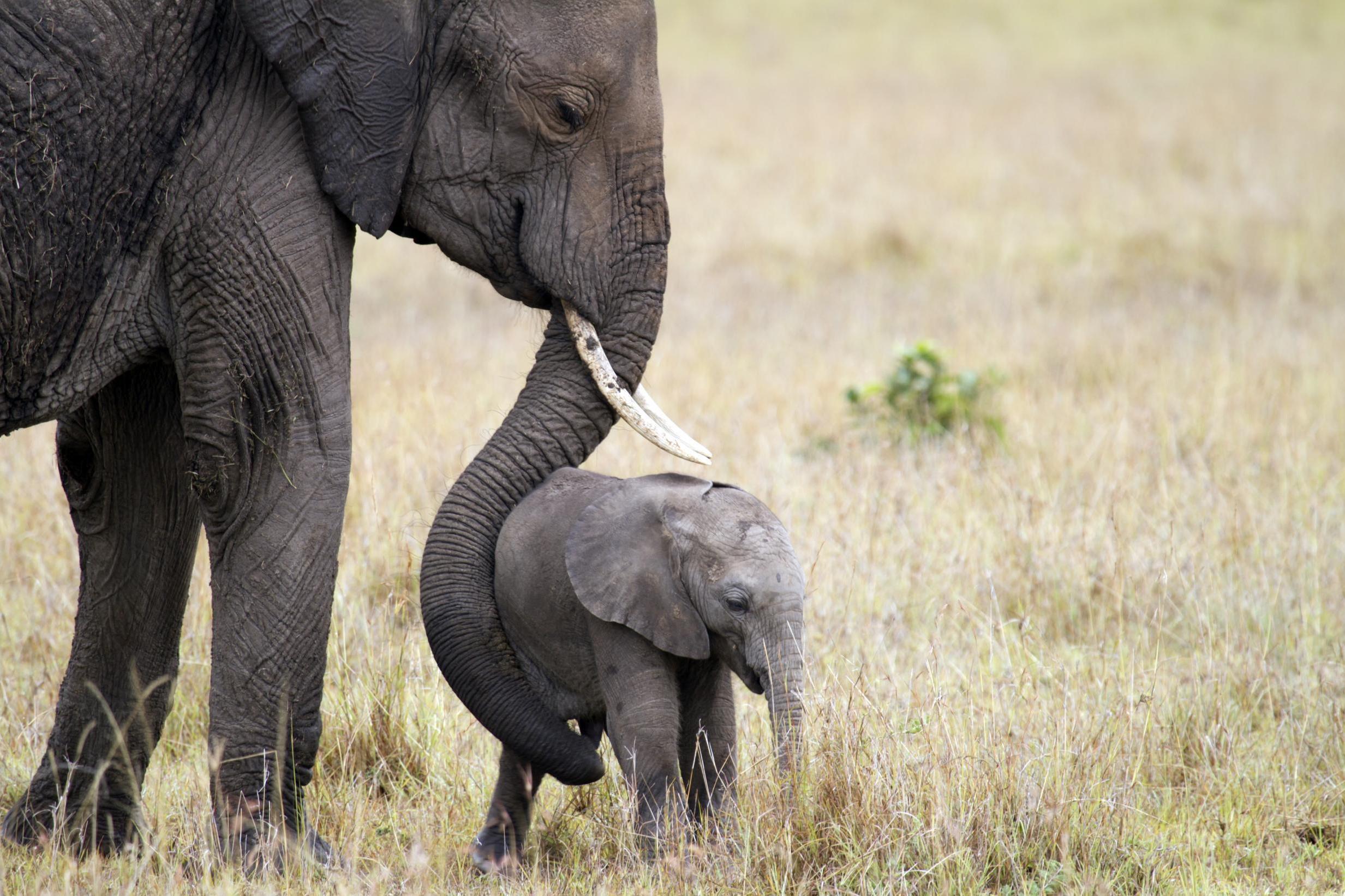
Around them, the herd gathers. Aunts and sisters step closer, forming a protective circle. They do not interfere, but they watch closely, ready to help if needed. This is how elephants raise their young — together, through shared memory and collective care.
The calf tries again.
This time, the mother braces her trunk against the calf’s chest, adjusting her position so the baby can find balance. The calf’s legs shake violently, but they hold. For a brief moment, the newborn stands.
It is not graceful.
It is not steady.
But it is enough.
That first stand marks the beginning of a life that will stretch across decades — a life shaped by migration routes remembered by elders, by water holes passed down through generations, by constant touch and quiet communication.
The mother rumbles softly, a sound too low for humans to fully hear, but rich with reassurance. The calf responds by leaning closer, pressing its small body against her leg as if anchoring itself to the world.
Walking will come soon enough. Confidence will grow. Strength will follow.
But in this moment, what matters most is not the milestone — it is the bond.
The video does not show struggle as something cruel or harsh. It shows learning as something shared. It shows that even in a world where survival demands early strength, gentleness still has a place.
Elephant mothers do not push their calves forward and walk away. They stay close. They slow down. They guide, protect, and wait.
And as the calf finally manages a few unsteady steps, the herd begins to move — carefully, deliberately — adjusting their pace to the smallest member among them.
Because in elephant families, no one is left behind.
What we witness in those first steps is more than instinct. It is love shaped by necessity, patience forged by experience, and a quiet reminder that even in the wild, growth happens best when someone steady is close enough to lean on.
The calf will walk far in its lifetime.
But it will never forget who helped it stand.
D
