The Dog Who Stayed Until the End. – Daily News
They called her Pancake because she arrived at the sanctuary thin, quiet, and folded into herself — a street dog with no history, no name, and no reason to trust the world. But Boon Lott’s Elephant Sanctuary in Thailand had a way of turning the lost into the loved, and before long, Pancake was no longer a stray.
She was family.

No one expected her to become the kind of dog who stayed for good. Strays usually wander. They come, they eat, they leave. But Pancake stayed. She followed the volunteers. She followed the elephants. And more than anyone, she followed Katherine Connor, the woman who built the sanctuary out of grief, love, and a promise to never let an old elephant die alone again.
Katherine used to laugh and say, “Pancake is my shadow.”
But no one knew how true that would become — not until the day Boon Thong began to fade.

Boon Thong was in her sixties, her skin weathered like old maps, her eyes soft with the kind of sadness that only elephants carry — the sadness of remembering everything. For nearly thirty years, she carried tourists on her back under the sun, walking in circles, day after day, never asked what she felt, never allowed to choose her own steps.
By the time she arrived at the sanctuary, she had nothing left but tired bones and a heart full of memories she never asked to keep.
But the sanctuary gave her something she had never known:
Freedom.
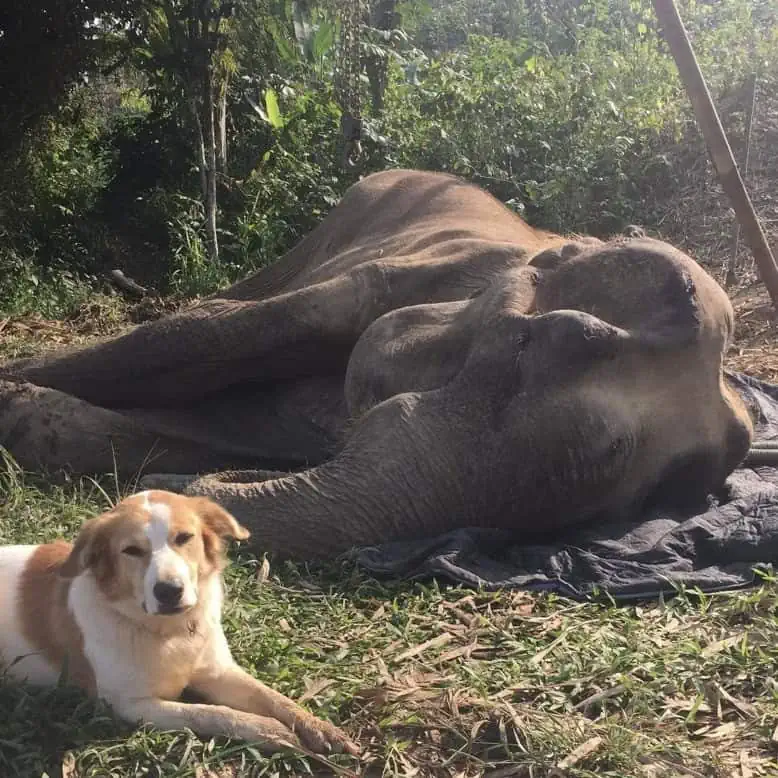
For five years, she walked where she wanted.
She bathed when she wanted.
She slept without chains.
She learned that silence did not always mean danger.
She learned that no one would climb onto her back again.
And she made friends — especially with Sao Noi, another elderly elephant who once lay dying while Boon Thong stroked her with her trunk, refusing to let her pass alone.
Elephants do not forget love.
And they do not forget loss.
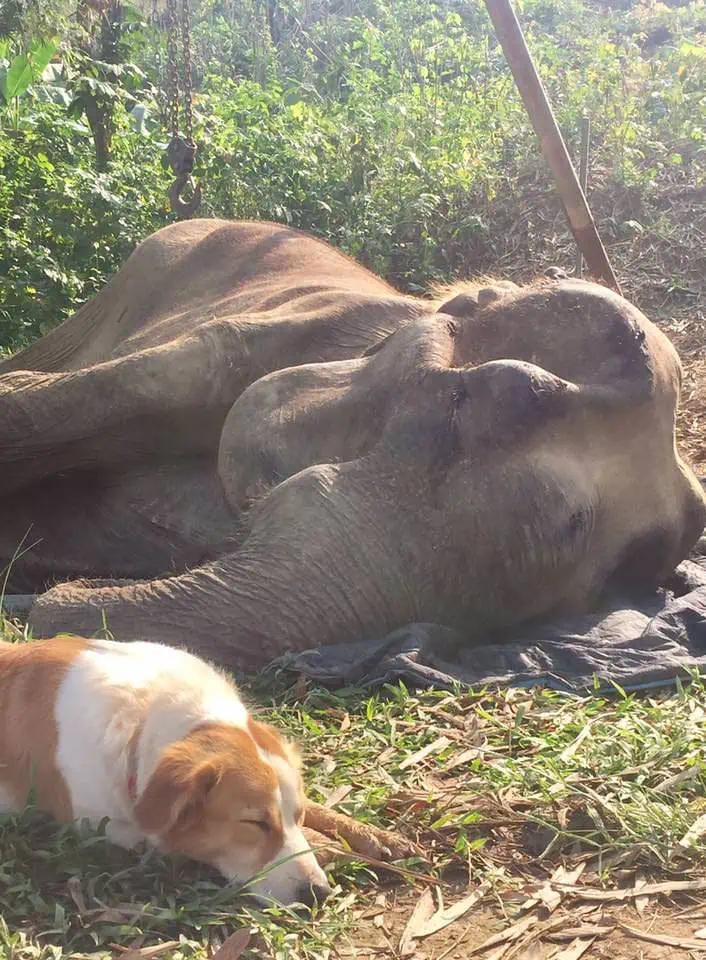
So when Boon Thong began to sink — eating less, walking slower, lying down longer — the sanctuary knew what was coming.
Old elephants do not fight the end.
They listen for it.
And Pancake listened too.
No one called her. No one trained her. No one told her what was happening.
But the moment Boon Thong lay down for the last time in the forest clearing, Pancake walked to her side and lay beside her — head down, ears low, breathing slow, as if she knew exactly what was being asked of her.
Not to save her.

Just to stay.
Katherine sat on the ground beside them, leaning gently against the elephant’s wrinkled skin, speaking softly about the life Boon Thong had rebuilt — the friends she made, the mud she had splashed, the first night she slept without fear. She spoke not to comfort herself, but to remind the elephant that her life had mattered.
Pancake didn’t move.
She didn’t bark.
She didn’t wander off.
She just stayed.
For nine hours.
Nine hours beside a creature a thousand times her size — not afraid, not impatient, not confused — simply present, offering the only thing she had:
Companionship.
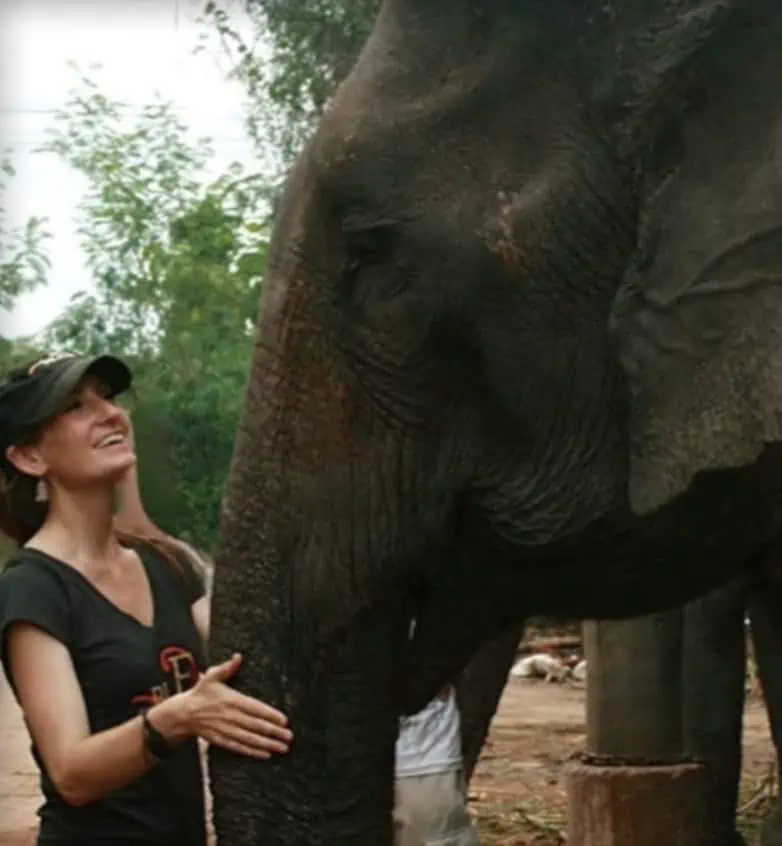
Elephants know the difference between those who stay and those who leave. And as Boon Thong’s breathing slowed, as her chest rose and fell one last time, Pancake kept her head pressed against her side, the way animals do when they know love matters more than words.
When her final breath came, the forest was still.
Not silent — just still, like the world was bowing.
Katherine closed her eyes.
Pancake didn’t.
She watched.
She understood.
She stayed a little longer.
Because death is only scary to those who fear being alone.
The burial happened at dusk, when the air smelled of earth and rain and slow goodbye. They laid Boon Thong to rest in the same field where Sao Noi had been buried years before, surrounded by flowers, fruits, and the quiet blessing of the elephants who remained.
Elephants mourn with their feet — they stand over the graves of those they love.
Dogs mourn with their bodies — they refuse to walk away.
Pancake sat beside the grave long after the others left.
Not because she was waiting.
But because she was remembering.
When Katherine finally walked her back to the sanctuary, Pancake hesitated, turned once more toward the earth, and then followed — not because she was done grieving, but because grief does not end. It just learns to walk.

People who visit BLES often ask the same thing:
“How did a stray dog become so loyal to an elephant?”
But that is the wrong question.
The real question is:
“How did the world forget that animals love each other the way we do?”
Because Pancake didn’t stay to be heroic.
She didn’t stay to be noticed.
She didn’t stay because she understood death the way humans do.
She stayed because love taught her not to leave.
She stayed because someone once stayed with her.
She stayed because loyalty is not language — it is presence.
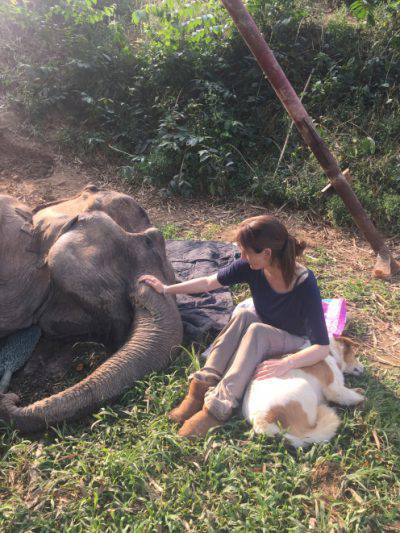
Today, when visitors ask Katherine where Pancake came from, she smiles and says:
“Oh, she found us. Strays always find the right place to heal.”
What she doesn’t say is this:
Pancake is not a dog who was rescued.
She is a dog who remembers what rescue feels like.
And that is why she stayed.
That is why she lay beside a dying elephant for nine hours.
That is why she became proof of something we forget:
Love doesn’t need matching shapes.
Love doesn’t need matching species.
Love just needs someone who refuses to walk away.
Before the world knew her as Audrey Hepburn — the woman in the little black dress, the silver-screen icon, the symbol of elegance — she was just a hungry girl in a war-torn country, trying to stay alive.
And she danced.

Not on stages, not under spotlights, not for applause — but in secret, in cellars and barns where the windows were covered and every breath felt borrowed. She danced because movement was the only thing the war couldn’t steal from her. She danced because even a starving body still had a soul that needed rescue.
It was the winter of 1944 — the last winter of the war, the coldest, the hungriest. In the Netherlands, where Audrey lived with her mother, everything that once felt normal was gone. Streets were patrolled by German soldiers. Food disappeared. Electricity vanished. Families burned furniture to stay warm. Children walked miles for scraps of potato peels, or boiled tulip bulbs just to quiet the ache in their stomachs.
Audrey was 15. Her cheeks were hollow. Her arms, once strong from ballet, were thin as reeds. Some days she was so malnourished she fainted in the middle of practice — but she always got up again.
Because practice was not about perfection anymore.
It was about resistance.

The Dutch underground needed money. And money, in wartime, needed courage. Audrey and a small group of dancers, musicians, and young performers offered what they had — their talent, their bodies, their risk.
They held what they called “black performances.” Secret shows. Illegal gatherings. Curtains drawn, candles lit, no applause — because applause could mean discovery, and discovery meant arrest.
Children stood guard outside as lookouts, pretending to play while memorizing the rhythm of footsteps. If soldiers approached, they tapped the window twice. Inside, the music would stop. The dancers would scatter, bodies pressed into corners, breath frozen in throats.
But as long as the candles still flickered, the show continued.
“We couldn’t clap,” Audrey later said, “but I could feel their hearts beating with mine.”
That was the first audience she ever loved.
And maybe the most grateful one she ever had.
War was not just hunger — it was loss.
Her uncle was taken and executed by the Nazis, a punishment meant to terrify the town into obedience. Her brother was sent to a labor camp. Audrey herself carried underground messages inside her worn shoes, pretending to skip along the road like a child, even though every step carried danger.
She learned very early that the smallest person can risk the biggest thing.
But hunger — hunger was the slowest kind of violence. She was so weak she couldn’t lift her leg high at the barre anymore. When she walked, she felt the bones move under her skin. Her mother rationed food carefully, sometimes giving Audrey her own portion. “You’ll need your strength when the war ends,” she said. Audrey never forgot it.
There were days when tulip bulbs were dinner. Bitter, gritty, almost impossible to swallow — but food. “I can still taste them,” she said many years later, “and I can still feel the shame of eating them.”
But she survived.

And survival is its own quiet kind of rebellion.
When the war finally ended, she didn’t celebrate. She didn’t cheer. She slept — for hours, then days — until the body that had carried too much finally let go.
She would never be the prima ballerina she dreamed of becoming. The war had taken too much strength from her bones. But it had given her something else — something rarer, something she didn’t realize she was carrying:
Depth.
The kind that cannot be taught.
The kind that does not fade with beauty.
The kind that lets the world look at your face and feel something behind it.
Years later, when the world watched her in Roman Holiday, they saw a princess escaping a cage she didn’t ask to live in — and they believed her.
When she held a guitar in Breakfast at Tiffany’s and sang “Moon River” so softly it felt like a confession, they leaned in without knowing why.
It was because Audrey didn’t act softness.
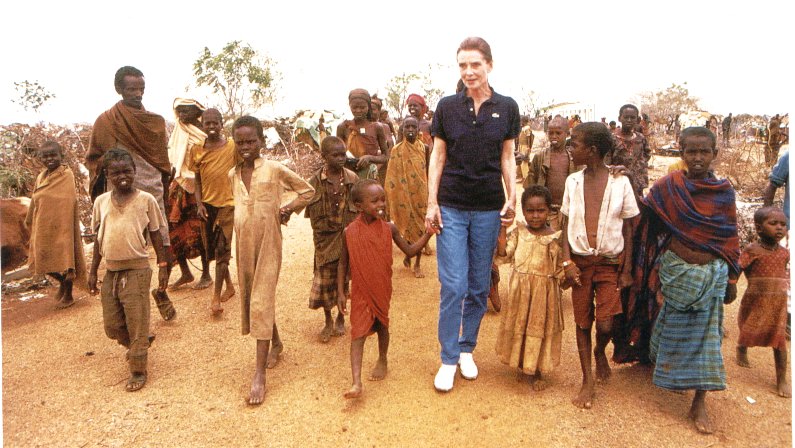
She had earned it.
Fame didn’t change her. It simply gave her access to the kind of life she once thought existed only for other people. But she never forgot the child she had been — the one who chewed grass to survive, the one who looked at bread like a miracle, the one who danced to raise money for resistance instead of applause.
So when UNICEF asked her to serve as an ambassador, she didn’t hesitate.
She went to Ethiopia — and recognized the eyes of starving children as if she were looking into a mirror from 50 years earlier. She flew to Bangladesh, to Somalia, to the places the world pretended not to see, and she did not smile for the cameras.
She wept.
“I know what hunger feels like,” she told reporters. “I know what it’s like to be afraid — truly afraid.”
But the most powerful thing she ever said was quiet:
“I remember. That is why I am here.”
Her fame bought her a platform.
Her past gave it meaning.

When she died, the world grieved a movie star.
But the people who knew her best — the ones who saw her sit cross-legged in the dirt, spoon-feeding children who hadn’t eaten in days — they grieved something else.
They grieved a woman who never let the world harden her.
A woman who survived war but never stopped believing in gentleness.
A woman who once danced in the dark to help strangers live another day — and later spent her life helping strangers survive whole wars of their own.
Audrey Hepburn’s legacy isn’t the little black dress.
It isn’t Tiffany’s window.
It isn’t the diamonds, or the posters, or the legend of flawless beauty.
Her legacy is a teenage girl with an empty stomach and a full heart, standing barefoot on a cracked wooden floor in a candle-lit barn, dancing for people who could not clap…
…and doing it anyway.
Because hope is never measured by applause.
It is measured by the courage to keep moving — even when the world around you is falling apart.