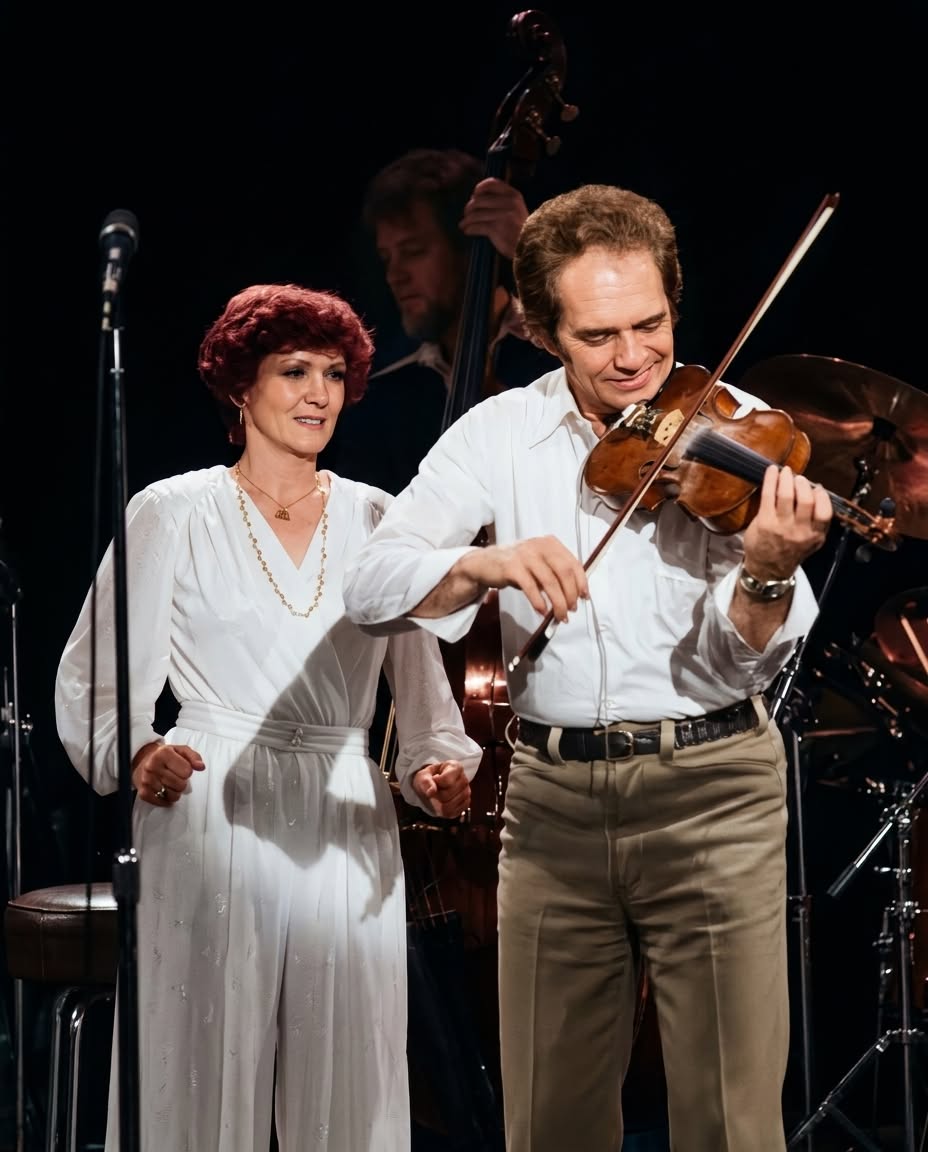
SHE WON COUNTRY’S TOP FEMALE VOCALIST AWARD IN 1965. THAT SAME YEAR SHE MARRIED MERLE HAGGARD AND STARTED SINGING BEHIND HIM. In 1965 the Academy of Country Music named Bonnie Owens its female vocalist of the year. She had records under her own name and a marriage to Buck Owens already behind her. She was not a wife who happened to sing. She was a Bakersfield artist at the top of her category. That was also the year she married Merle Haggard, and the year her own climb stopped. What she did instead was make herself the conditions he wrote in. By his own telling, if he so much as looked like he might start writing, she was already there with a pad. On a break from the road he said to her, “I finally have time to love you again.” She told him that was a song, went out to get him something to eat, and came back to find it written. He signed a large share of the publishing over to her. They divorced in 1978. She stood up as maid of honor at his next wedding. Then she went back out on the road and sang harmony behind him for twenty-eight more years, until she died in 2006. His line about still loving her gets quoted constantly. The harder question is why she stayed — and the plainest answer isn’t romantic. Nobody else could sing that harmony. It was hers. She went back for her own part. – Country Music
In 1965, Bonnie Owens stood at a rare high point in her own career. The Academy of Country Music named her female vocalist of the year, a recognition that fit what country insiders already knew: Bonnie Owens was not an accessory to fame. She was a Bakersfield singer with her own records, her own reputation, and a voice that could hold its place in a crowded room.
That same year, Bonnie Owens married Merle Haggard. Their connection was both personal and professional, and it quickly became part of country music history. Merle Haggard was building momentum, and Bonnie Owens became part of the sound around him. She was already an experienced performer, and she did not enter the relationship as someone waiting in the wings.
What followed was a working partnership that shaped both of their careers. Bonnie Owens sang with Merle Haggard and the Strangers, and by the late 1960s she remained a regular presence on the road and in the studio. The blend of their voices became part of the Bakersfield style that fans still remember: hard-edged, direct, and full of feeling.
Merle Haggard later described moments in their life together in a way that made Bonnie Owens sound like a partner in the creative process as well as in marriage. He often said she was there when the songs came. One of the best-known stories from that era is simple: he began to speak a line, and Bonnie Owens recognized it as the start of a song before he did. That kind of moment says a lot about how closely she listened, and how deeply she understood the life they were living.
They divorced in 1978, but that did not erase the musical bond between them. Bonnie Owens remained part of Merle Haggard’s world for years afterward, and she continued singing harmony behind him. In country music, that kind of continuity is rare. It speaks less to romance than to trust, taste, and timing.
Bonnie Owens also had her own career to protect. Before and after Merle Haggard, she had already lived as a singer with an identity of her own, including earlier work with Buck Owens. That matters, because it changes the story. Bonnie Owens was not simply someone who followed a famous man from stage to stage. She was a professional vocalist with a voice that fit the music and a presence that earned respect.
She died in 2006, but the story still resonates because it is more complicated than nostalgia. Bonnie Owens stayed connected to Merle Haggard’s music, yet she never became invisible inside it. Her harmony was not an afterthought. It was the part only Bonnie Owens could sing.
And that may be the plainest answer of all: Bonnie Owens did not just return to Merle Haggard. She returned to her own sound.
How Loretta Lynn’s Childhood Home Survived Because Herman Webb Refused to Let It Fade
There are some places that become famous only after a person leaves them behind. For Loretta Lynn, Butcher Hollow was never just a name in a song. It was the rough little Kentucky hollow where she was born, raised, and shaped by hardship, family, and memory. But while Loretta Lynn went on to become a country music legend, one of her brothers stayed home and became the guardian of the story.
Herman Webb, one of Loretta Lynn’s brothers, never made the journey out of the hollow in the same way she did. He stayed in the Van Lear area of Kentucky and later helped run the old company store near the mouth of the hollow, the kind of place that carried the weight of local history long after the mines changed the land and the families moved on. Over time, he also became the familiar face guiding visitors to the Webb family homeplace.
The house itself was never glamorous. It was a modest cabin, tied to a life of coal dust, long workdays, and children growing up fast. By the time the movie Coal Miner’s Daughter made Loretta Lynn’s childhood world famous in 1980, the real home up the hill was falling apart. The screen version had helped people imagine the place, but the actual cabin still needed someone willing to save it.
One Brother Rebuilt What Time Was Taking Away
That someone was Herman Webb. According to local accounts, he rebuilt the family home himself when it was starting to collapse. He did more than repair wood and boards. He preserved the room where Loretta Lynn was born, the bed his mother slept in, and the ordinary details that made the place feel real to visitors who came from across the United States and overseas.
For decades, Herman Webb welcomed people who drove up the dirt lane looking for the house they had heard about in Loretta Lynn’s songs and memoirs. He gave tours, answered questions, and kept the family story alive with the patience of someone who understood that memory can disappear if no one stands watch over it.
“Without my father there would be nothing left standing up there at all.”
His daughter, Hermalee, has said that her father was the reason the house remained standing. That family pride mattered. It was not about nostalgia for its own sake. It was about making sure the next generation could still see where the story began.
A Family Legacy That Endured
Visitors once described Herman Webb as the unofficial sheriff of Butcher Hollow, a title that fit the way he carried himself and the way the community trusted him. People came to see the cabin, but they also came to meet the brother who had kept it from vanishing. Loretta Lynn wrote the song and carried the memory onto stages around the world. Herman Webb made sure the place itself was still there to be found.
Herman Webb died in July 2018, and Loretta Lynn died four years later. But the house remains on the hill, plain and quiet, still connected to the family that built its meaning. The story of Loretta Lynn is often told as a rise from poverty to stardom. Yet Butcher Hollow reminds us of something else too: sometimes the people who stay behind are the ones who save the past.