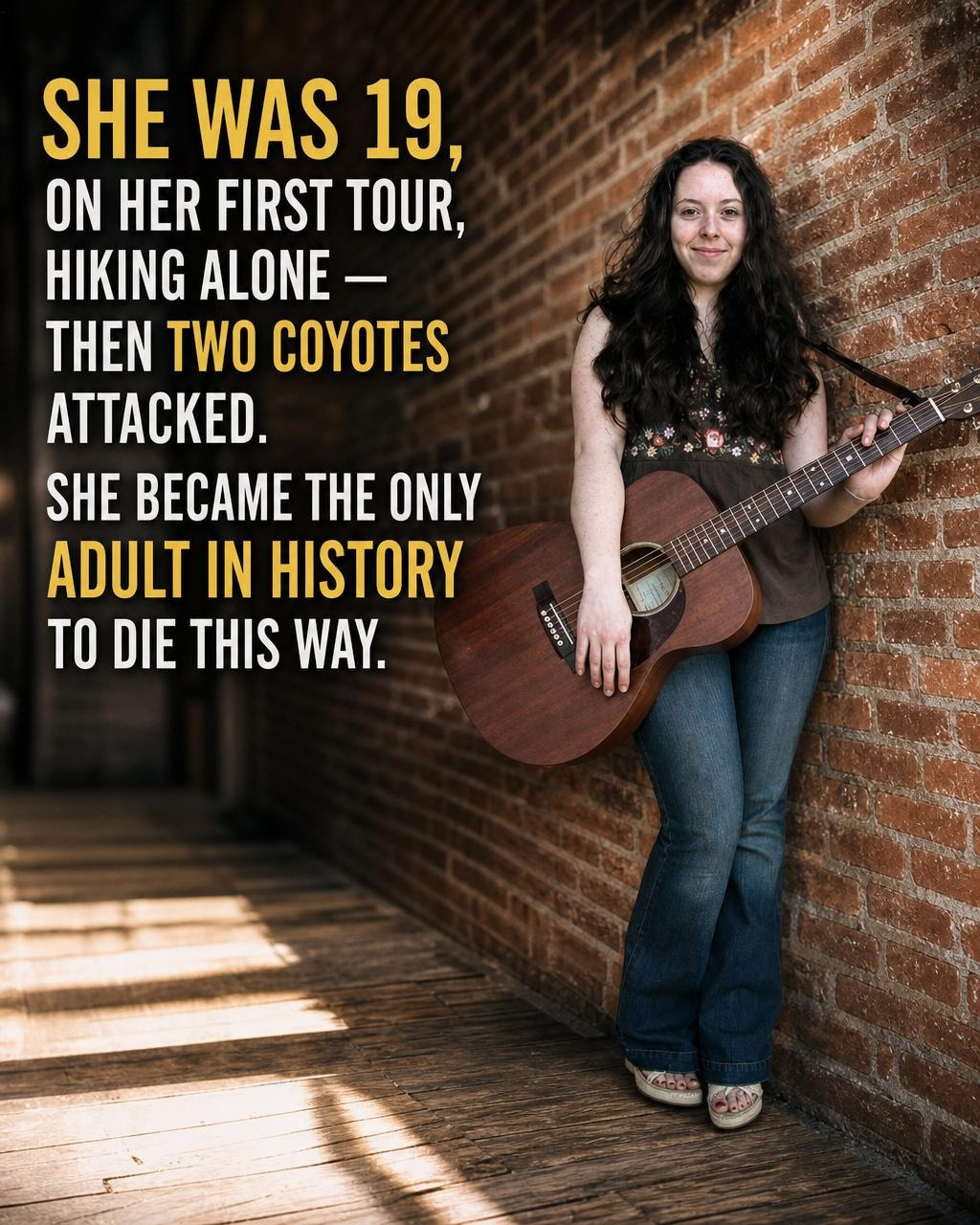
SHE WAS 19, JUST RELEASED HER FIRST ALBUM, AND WENT HIKING ALONE ON A TRAIL THAT 20,000 PEOPLE WALK EVERY YEAR. SHE NEVER CAME BACK. In October 2009, Taylor was touring Canada’s Maritime provinces to promote her debut album “For Your Consideration,” released just 7 months earlier. A few days before, she’d been nominated for a Canadian Folk Music Award as Young Performer of the Year. Between gigs, she decided to hike the Skyline Trail in Cape Breton — a popular path that sees over 20,000 visitors a year. She went alone that afternoon. What happened next still puzzles wildlife experts to this day. At least two eastern coyotes attacked her on the trail. Four hikers found her and scared the animals away, but the wounds were too severe. She was airlifted to Halifax and passed away hours later. When Parks Canada decided to kill the pack, her mother said something no one expected: “I clearly heard Taylor’s voice say — please don’t, this is their space.” She loved animals. She was planning to volunteer at a wildlife center. Even in death, her family chose to protect the creatures that took her. – Country Music
The Story of Taylor Mitchell and the Skyline Trail Tragedy
In October 2009, Taylor Mitchell was 19 years old, full of promise, and only months into the public life that came with releasing her debut album, For Your Consideration. She was touring Canada’s Maritime provinces, meeting listeners, performing songs, and beginning to build a name for herself as a young folk artist. Just days earlier, she had been nominated for a Canadian Folk Music Award as Young Performer of the Year.
Then, in the middle of that journey, Taylor Mitchell chose to spend part of a quiet afternoon on the Skyline Trail in Cape Breton, a well-known hiking path visited by thousands of people every year. She went alone. It was the kind of decision many travelers make without thinking twice: a walk in nature, a moment of peace, a break between performances.
A Trail That Seemed Ordinary
The Skyline Trail is popular for a reason. It is scenic, accessible, and often described as one of the most beautiful walks in the region. On most days, hikers pass through without incident, enjoying the ocean views and the open space. But on that day, something went terribly wrong.
According to reports, at least two eastern coyotes attacked Taylor Mitchell on the trail. Four hikers eventually found her and managed to scare the animals away, but the injuries were extremely serious. She was airlifted to Halifax for emergency care, yet despite every effort, Taylor Mitchell died later that day.
Her death stunned not only her family and fans, but also wildlife experts, park officials, and the wider public who struggled to understand how such a tragedy could happen on a trail so many people used every year.
More Than a Musician
Those who knew Taylor Mitchell often spoke about her love of animals. She was said to be planning to volunteer at a wildlife center, and that detail became especially moving after her death. It showed a young woman whose life was connected not only to music, but also to compassion and curiosity about the natural world.
In the days that followed, Parks Canada faced the difficult decision to kill the pack believed to have been involved. That choice brought grief into another form, and Taylor Mitchell’s mother responded in a way that surprised many people. She said she clearly heard Taylor Mitchell’s voice saying, “please don’t, this is their space.”
A Legacy Marked by Sadness and Grace
That reaction captured something important about Taylor Mitchell. Even in a story filled with shock and loss, there was also a reminder of who she was: a young artist who loved life, loved animals, and seemed to see the world with a gentle respect.
Her story remains painful because it happened in a place that felt safe, on a trail that countless people had walked before. It also remains unforgettable because it asks a hard question: how quickly can an ordinary day turn into a tragedy?
For many people, Taylor Mitchell is remembered not only for the music she had already shared, but for the career that never had the chance to fully unfold. Her debut album had only just been released. Her audience was still growing. Her future was still opening.
And yet, even in that short time, Taylor Mitchell left behind a story that people still tell with sorrow, respect, and a kind of lasting tenderness.
Post navigation
In the middle of 1950s America, when rock and roll still felt new and a little dangerous, one song changed everything. “Blue Suede Shoes” became the first Sun Records single to sell more than a million copies. It reached No. 1 on the country chart and the R&B chart, and No. 2 on the pop chart. For a country artist, that kind of crossover was almost unheard of.
But behind the success was a painful twist. While the song was climbing the charts, Carl Perkins was not standing under bright lights or celebrating on a stage. He was in a hospital bed, recovering from a serious car crash that nearly ended his rising career before it had fully begun.
How the Song Was Born
Carl Perkins wrote “Blue Suede Shoes” after watching a man at a dance get angry when someone stepped on his shoes. The moment stayed with him because of how much the man cared about the shoes, even more than the girl beside him. Carl turned that small scene into a song that was sharp, playful, and impossible to forget.
The lyrics captured something bigger than fashion. They reflected pride, attitude, and the new energy of rock and roll. The song felt fun, but it also had edge. That balance helped it spread fast, first through regional audiences, then across the country.
“Blue Suede Shoes” had the kind of simplicity that made it stick. People heard it once and remembered it.
A Career Ready to Explode
Sam Phillips, the founder of Sun Records, understood what the record could become. He had a plan to surprise Carl Perkins with a gold record during an appearance on the Perry Como Show in New York. It was the kind of moment that could have marked the start of a bigger national breakthrough.
Instead, fate took a brutal turn on March 21, 1956. Somewhere in Delaware, the driver of the car carrying Carl Perkins fell asleep. The vehicle slammed into a truck. Carl Perkins survived, but when he woke up a day later, he had three fractured vertebrae and a broken collarbone. His brother Jay Perkins was hurt even worse and would never fully recover from the crash.
The Song Went on Without Him
While Carl Perkins lay injured, the song he wrote kept moving forward. Elvis Presley performed “Blue Suede Shoes” on national television three times that year, giving the song even more exposure. For many listeners, the performances helped turn it into a rock and roll standard.
There was a strange kind of heartbreak in that moment. The writer of the song was confined to a hospital bed, unable to stand, while the world celebrated the music he had created. Success arrived, but it arrived without the man who made it possible.
A Legacy Built on Timing and Talent
Carl Perkins eventually returned to music, and his place in rock and roll history remained secure. “Blue Suede Shoes” was more than a hit. It was proof that a simple idea, written honestly and performed with attitude, could cross every boundary that radio had once tried to keep in place.
Even now, the story feels powerful because it holds both triumph and tragedy. A song about shoes became a milestone in American music, but the man who wrote it paid a heavy price just as the world was beginning to listen.
Carl Perkins gave rock and roll one of its most enduring anthems. The music went on to make history. His story reminds us that sometimes, the moment a dream comes true is also the moment life tests everything.