She Took Her Last Breath in My Arms — A Mother’s Promise to Make the World Hear Kali’s Name. – Daily News
There are moments in life that split time in two.

Before.
And after.
For me, that moment came when my youngest daughter, Kali, took her last breath in my arms.
There is no language that truly prepares a mother for that instant. No class, no warning, no story you hear from someone else that can soften it. Your body moves on instinct, trying to do what it has always done — protect, soothe, fix. But your heart refuses to accept what your eyes are seeing.
Closing my baby up was the hardest thing I have ever done.
Every part of me screamed against it. Every instinct I have ever had as a mother begged me to pull her back, to warm her, to breathe for her if I had to. Love tells you that you can always do something. Reality tells you that sometimes, even love is not enough to keep a child here.

That night, the world changed forever.
Kali was my youngest daughter, but she was also my twin in spirit. From the beginning, it was always us. My shadow. My heartbeat outside my body. Where I went, she followed. Where she laughed, I laughed harder. Where she hurt, I felt it deep in my chest.
She had a way of grabbing my face with both hands, forcing me to look at her, and saying, “Mommy, listen.”
And I always did.

I listened to her laugh.
I listened to her fears.
I listened to the sound of her breathing when it became tight and strained — the sound that had haunted me for years.
Because Kali lived with asthma.
Asthma is a word people say lightly. It’s treated like an inconvenience, a condition you “manage,” something that fits neatly into prescriptions and routines. People say, Oh, she’ll be fine, or You worry too much.
But asthma is not gentle.

Asthma is panic.
Asthma is watching your child fight for air.
Asthma is counting seconds and praying lungs will obey.
I knew that. I had lived that fear again and again.
I took Kali to the emergency room more times than I can count. I chose hospital lights over silence. Oxygen over convenience. I chose life, every single time, even when people rolled their eyes or questioned me.
Her father used to get frustrated. He worried about the bills. He said I took her in too often. I tried to explain what it felt like to watch a child’s chest struggle, to hear that wheeze that meant danger. I tried to explain that asthma doesn’t always give warnings — that one attack can be the last.

I even tried to explain it in court.
I tried to explain it to Judge Rhonda K. Forsberg.
I spoke about Kali’s fragile breathing, about how quickly things could turn, about how every flare-up felt like a ticking clock. I begged for urgency. I begged for protection. I begged for belief.
And still, my baby was sent home.
That is the part that breaks me in ways I cannot fully put into words.

Because I fought. I did not ignore signs. I did not stay quiet. I did not choose comfort over caution. I chose my child — again and again — until the system chose differently.
The night Kali died, I watched fear fill her eyes. She looked at me the way children do when they believe their mother can fix anything. I held her. I spoke to her. I tried to keep the air in her lungs with my arms alone.
And for the first time in her life, I couldn’t.
When her breathing stopped, something inside me shattered so completely that I am not sure it will ever fully come back together. Grief does not knock politely. It steals your breath the way asthma stole hers. It comes in waves that feel like drowning.
My house feels wrong now.

Too quiet.
Too still.
Too empty in the spaces she once filled.
Every corner echoes with her presence — her voice, her footsteps, the way she would appear beside me without warning. Sometimes I catch myself listening for her, forgetting for a split second that she is gone.

People say, “She’s with God now.”
I believe that. I hold onto that belief with everything I have left.
But belief does not erase responsibility here on earth.
Sending my baby home did not end my journey. It began it.
Because Kali will not become just another statistic.

I will take her name to the Department of Justice.
I will take her name to Washington, D.C.
I will take her name into every room where decisions are made without urgency for children like her.
This is not just about anger. It is about accountability. It is about awareness. It is about protecting children whose illnesses are too often minimized until it is too late.
Some people will say this was “just” an asthma attack. They will say these things happen. They will try to soften the edges of something that should never be softened.
But I know what I saw.

I saw terror.
I saw suffocation.
I saw time slip through my fingers while my child fought for oxygen.
Asthma is not just wheezing. It is watching your baby drown on dry land.
And when it ends, it leaves a silence that screams.

A silence no apology can fill.
A silence that lives with you forever.
I am still Kali’s mother. Death did not change that. Love did not stop because her heart did.
I will carry her into every meeting, every letter, every step forward. Kali will walk beside me into rooms she never got to enter herself. Her voice will be in mine. Her name will demand attention.

To the mothers reading this: listen to your instincts. Do not let anyone convince you that you are doing too much. Doing too much can save a life.
To the systems meant to protect children: do better. Do not dismiss chronic illness as inconvenience. Do not measure care in dollars instead of lives.
Grief has given me a responsibility I never asked for — but I will carry it. I will speak until change is forced. I will say her name until the world remembers it.

Kali, Mommy is listening.
I hear you in every breath I take.
And I promise you this:
You will never be forgotten.


The road cut quietly through the reserve, a thin ribbon of asphalt laid across an ancient landscape that had existed long before humans ever arrived. On most days, it was only a passing inconvenience for the animals who lived there—a brief pause in their wandering, a momentary negotiation between steel and skin, engines and breath.
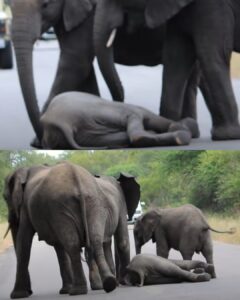
On this day, traffic stopped.
Not because of an accident.
Not because of a signal.
But because an elephant herd was crossing.
They emerged slowly from the trees, one by one, their massive forms moving with a patience that felt almost ceremonial. Dust rose gently beneath their feet. Sunlight filtered across their backs. Drivers sat frozen, engines idling, watching something far older and far wiser than the road itself reclaim the space.
At the front walked the matriarch.
She was easy to recognize—not because she was the largest, but because of how the others moved around her. Her steps were steady, unhurried. Her ears lifted and fell with intention. Every decision passed through her first, shaped by decades of memory: droughts survived, predators faced, calves born and lost, paths remembered across years.
Behind her came the family—females of different ages, calves tucked close to their sides, trunks occasionally brushing against one another in quiet reassurance.
And then, in the middle of the crossing, it happened.
The smallest calf faltered.
At first, it was barely noticeable—a stumble, a hesitation, the kind that happens to young bodies still learning how to carry their own weight. But then the calf’s legs buckled completely, and the tiny elephant collapsed onto the warm asphalt.
The sound was soft.
The impact gentle.
But the meaning was immediate.
The herd froze.
In the animal kingdom, moments like this can mean life or death. A fallen young one is vulnerable—to predators, to exhaustion, to the merciless logic of nature that does not pause for weakness.
But elephants are not creatures of abandonment.
They are creatures of memory.
Of relationship.
Of protection.
The reaction was instant.
Without panic, without chaos, the herd shifted as one. Large bodies turned inward. Adults stepped closer, forming a wide, living circle around the fallen calf. Tusks angled outward. Massive legs planted firmly between the baby and the open road.
The matriarch moved closer, lowering her head. Another female reached out with her trunk, touching the calf’s side, then its face. The touch was not rough. It was deliberate. Gentle. The way a mother might wake a sleeping child.
The calf did not rise.
For a moment, the world seemed to hold its breath.
Cars remained still. No horns sounded. No engines revved. Humans, suddenly aware of their smallness, watched in silence as something profoundly intimate unfolded in front of them.
Inside the circle, the elephants worked quietly.
One nudged the calf’s back legs.
Another brushed dust from its face.
A third stood so close her shadow completely covered the small body, shielding it from the sun.
This was not confusion.
This was care.
Elephants are known for their intelligence, but intelligence alone does not explain what was happening here. What surrounded that calf was not instinct alone—it was relationship. Elephants live in tight-knit family units, often led by a matriarch who carries the accumulated knowledge of generations. They recognize one another by scent, by sound, by memory that can stretch across decades.
They mourn their dead.
They celebrate their young.
They remember.
The calf lay still, sides barely moving.
Perhaps the long journey had drained it.
Perhaps thirst had taken more than expected.
Perhaps its small body simply needed rest.
Whatever the cause, the herd did not rush.
They waited.
Minutes passed.
The matriarch shifted her weight, releasing a low rumble from deep within her chest—a sound below the range of human hearing, but one that carries through the ground itself. Other elephants responded in kind, a quiet conversation conducted through vibrations rather than words.
The calf stirred.
One leg twitched.
Then another.
Encouragement came immediately. Trunks reached in again, brushing, lifting slightly, guiding without forcing. No one pulled. No one pushed too hard. They understood something humans often forget: strength cannot be rushed back into a body.
The calf tried to rise.
It failed.
And instead of leaving, instead of moving on, the herd closed in even tighter.
A wall of bodies.
A barrier of loyalty.
Predators could not reach it.
Danger could not approach.
The world would wait.
Another attempt.
This time, the calf managed to lift its front legs, wobbling, swaying dangerously. A female stepped closer, pressing her side gently against the calf’s body, offering support without overwhelming it.
The matriarch watched closely, her gaze fixed, her posture alert. She had seen this before. She knew when to wait. She knew when to act.
With one final effort, fueled by rest, encouragement, and the undeniable presence of family, the calf stood.
The moment it found its balance, the energy shifted.
Low rumbles spread through the herd.
Ears flapped.
Trunks lifted.
Not celebration as humans know it—but relief.
The calf stood for a few seconds, legs shaking, then leaned instinctively into the nearest adult. The adult did not move away. She absorbed the weight, adjusted her stance, and stayed.
Only when the calf took a step on its own did the circle begin to loosen.
Slowly, deliberately, the herd reformed its line. The matriarch moved forward again, pausing only once to glance back—an unspoken check to ensure the youngest was truly ready.
Traffic remained stopped until the very last elephant disappeared into the trees.
Only then did engines restart.
Only then did the road return to what humans expected it to be.
But something had changed.
Those who witnessed it would later struggle to explain what they felt. It wasn’t just awe. It wasn’t just admiration. It was recognition.
Because what they had seen was not so different from what humans call love.
Elephants are often described by their size, their strength, their power. But moments like this reveal something far more profound. These animals do not survive simply because they are large. They survive because they belong—to families, to histories, to one another.
In a world that often rewards speed, elephants choose patience.
In a world that often abandons the weak, elephants protect them.
In a world that moves on quickly, elephants stay.
That calf will not remember the road.
It will not remember the cars.
It may not remember the moment its legs failed.
But it will remember the feeling of trunks against its skin.
Of bodies standing close.
Of safety created by others.
Because elephants remember not just events—but bonds.
And for those who watched from behind windshields and glass, the scene lingered long after the herd was gone. It raised quiet questions humans don’t always like to ask:
If animals can stop everything to protect their young…
If they can wait without impatience…
If they can build circles instead of walking away…
Then what does that say about the world we choose to create?
On that road, for a few unforgettable minutes, humans were not in charge.
Family was.