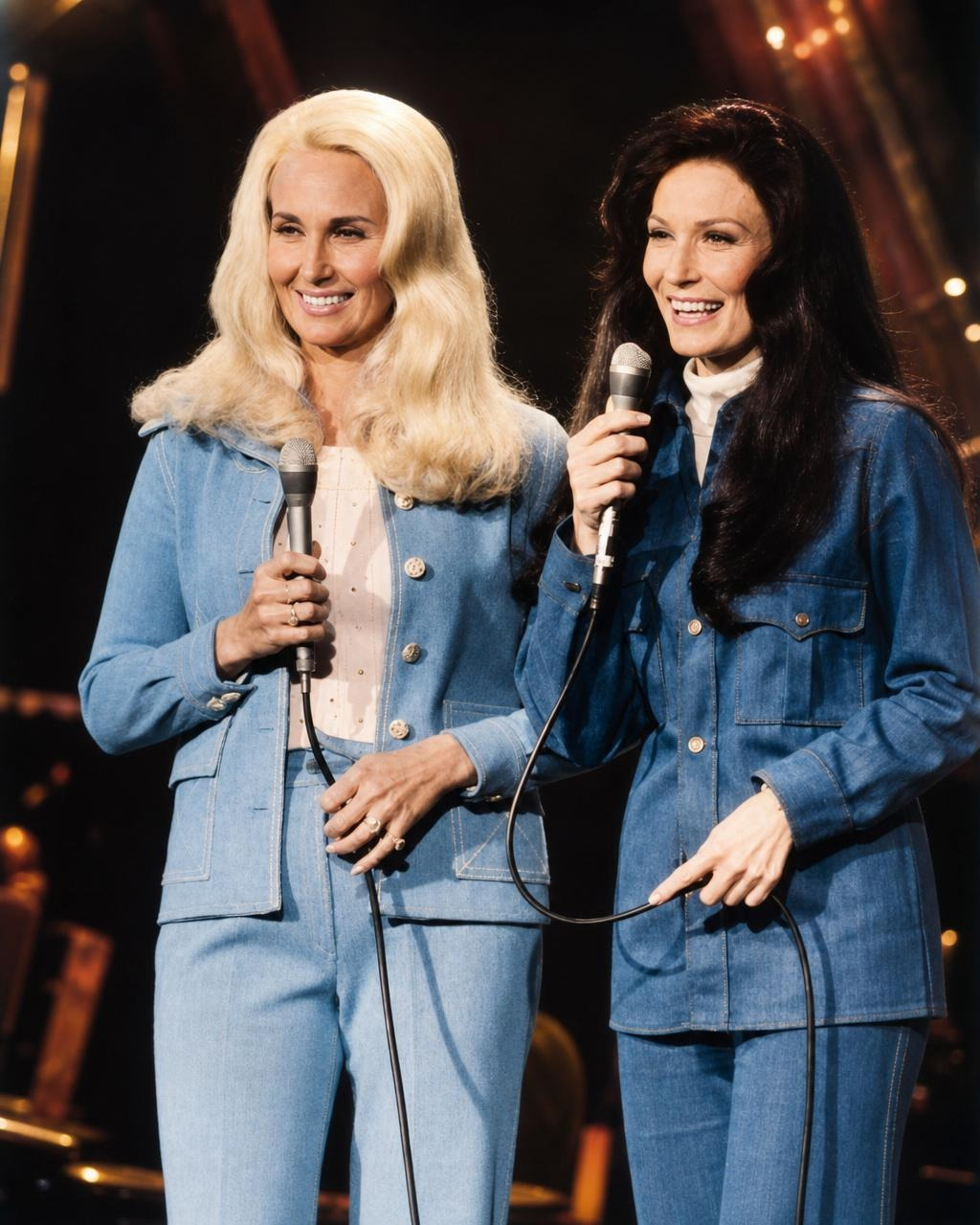
SHE SANG “STAND BY YOUR MAN” — THEN DIVORCED 5 TIMES. SHE SANG “DON’T COME HOME A-DRINKIN'” — THEN STAYED 48 YEARS. Tammy Wynette recorded the most famous loyalty anthem in country music in 1968. Then she went through five marriages. The woman who told millions of women to stay… couldn’t. Loretta Lynn recorded “Don’t Come Home A-Drinkin'” in 1966 — a song that basically told husbands to straighten up or get out. Then she stayed married to Doolittle for 48 years through cheating, drinking, and fights that would’ve ended most marriages in a week. But here’s what nobody talks about enough. These two women weren’t rivals. They weren’t opposites. In 1993, they stood together in a studio with Dolly Parton and recorded Honky Tonk Angels — laughing like old friends. And when Tammy died in 1998 at just 55 years old, Loretta didn’t talk about music or legacy. She just said Tammy was her best girlfriend in country music, and that she loved her more than any other girl singer in Nashville. Two women. Two songs that said completely different things. And both of them knew something the rest of us are still figuring out — that love and marriage never follow the lyrics you write for them. – Country Music
When Country Music’s Strongest Love Songs Met Real Life
Few stories in country music feel as human, or as complicated, as the lives of Tammy Wynette and Loretta Lynn. One sang the unforgettable promise of devotion in “Stand by Your Man” and went through five marriages. The other delivered the sharp warning of “Don’t Come Home A-Drinkin’” and stayed married to Doolittle Lynn for 48 years. On paper, they seemed to represent opposite sides of the same story. In real life, both women understood something deeper: love is rarely as simple as a song.
Tammy Wynette and the weight of a famous lyric
When Tammy Wynette recorded “Stand by Your Man” in 1968, the song became one of the most recognized anthems in country music. It was bold, emotional, and unforgettable. But the public often treated the song like a direct statement about Tammy Wynette herself, as if one recording could explain an entire life.
It could not.
Tammy Wynette lived through heartbreak, pressure, and five marriages. She knew the tension between the ideal of loyalty and the reality of being a woman trying to survive love, fame, and personal pain. That is part of why her voice connected so deeply. Tammy Wynette did not sound like she was preaching from a perfect life. She sounded like someone who had lived through the mess of it all.
Loretta Lynn and the voice of hard truth
Loretta Lynn took a different path, but she was no less honest. In 1966, “Don’t Come Home A-Drinkin’” gave listeners a blunt message: a husband who comes home drunk should expect consequences. It was direct, funny, and fearless.
And yet Loretta Lynn stayed married to Doolittle Lynn for nearly half a century. Their marriage included struggles, arguments, cheating, and drinking. It was not a fairy tale. It was a real marriage, with all the pain and stubborn loyalty that real marriages can carry.
What made Loretta Lynn powerful was not that her life matched her lyrics perfectly. It was that she never pretended marriage was neat, tidy, or easy. She sang from experience, and the experience was complicated.
Not rivals, but sisters in the same tradition
It would be easy to frame Tammy Wynette and Loretta Lynn as opposites. One sang about staying. One sang about drawing the line. But that misses the truth. Both women were telling the story of women who had to make difficult choices in a world that often asked them to endure too much.
By 1993, that shared understanding brought them together with Dolly Parton to record Honky Tonk Angels. The session was remembered not for rivalry, but for laughter, warmth, and the easy comfort of old friends who knew they had survived the same kind of industry and the same kind of judgment.
“Tammy was my best girlfriend in country music,” Loretta Lynn said after Tammy Wynette’s death in 1998. “I loved her more than any other girl singer in Nashville.”
The lesson hidden in both songs
Tammy Wynette and Loretta Lynn left behind more than hit records. They left behind a clearer picture of women’s lives than many people expected to hear in country music. Their songs were not instructions for perfect relationships. They were windows into real ones.
Together, they remind us that a lyric can be powerful without being literal. A woman can sing about loyalty and still suffer heartbreak. Another can sing about limits and still stay. Both can be true. Both can be honest.
That is why Tammy Wynette and Loretta Lynn still matter. They did not just sing about love and marriage. They showed how difficult, emotional, and deeply personal both can be. And in doing so, they gave country music some of its most enduring truth.
Post navigation
How Johnny Cash and Waylon Jennings Reclaimed Country Music on Their Own Terms
In 1968, Johnny Cash walked into Folsom State Prison with a guitar, a small band, and a career that was losing momentum. He was not the safe bet Columbia Records wanted him to be. The idea of recording a live album inside a maximum-security prison sounded risky, maybe even reckless. But Johnny Cash was never built to follow a comfortable path.
He stepped onto that stage anyway, standing in front of prisoners who understood regret, hardship, and second chances better than anyone. The performance was raw, urgent, and honest. It felt less like a concert and more like a confession. When the recording was released as At Folsom Prison, it did more than revive Johnny Cash’s career. It reminded the music world that truth could still sell, and that audiences were hungry for something real.
That moment mattered because it proved a simple but powerful idea: an artist did not have to obey every rule to find success. Johnny Cash showed that speaking in your own voice could be more powerful than fitting neatly into an industry plan.
Waylon Jennings Took That Lesson Even Further
Four years later, another country star decided he was finished waiting for permission. Waylon Jennings was recovering from hepatitis in a Nashville hospital when he made a decision that would change his life. He was tired of other people controlling his music, tired of rules that limited his sound, and tired of the standard Nashville machine.
So Waylon Jennings hired Neil Reshen, a New York lawyer with no Nashville connections, and asked him to renegotiate his RCA contract. It was a bold move, especially in a business where artists were often expected to be grateful for whatever they were given.
Waylon Jennings did not just want a record deal. He wanted ownership of his creative life.
What Neil Reshen secured was extraordinary for a major-label country artist at the time: full creative control. Waylon Jennings could use his own songs, his own band, and his own producer. He did not have to ask executives for approval every time he wanted to make a decision. That freedom helped shape the outlaw country movement and gave other artists a new model to admire.
Two Men, One Shared Message
Johnny Cash and Waylon Jennings came from different moments, but their stories are connected by the same brave idea. Johnny Cash proved that an artist could say no to the expected path and still come back stronger. Waylon Jennings proved that an artist could take back control and build a career without surrendering his identity.
Together, they changed what country music could mean. Their choices were not polished or safe. They were personal. They came from frustration, pride, and a deep belief that music should sound like the person making it.
That is why their stories still resonate. In an industry that often rewards conformity, Johnny Cash and Waylon Jennings showed the lasting power of independence. They did not just make hits. They made room for honesty, and in doing so, they left behind a legacy that still feels alive today.