Piggy Bank the Turtle: The Price of Human ‘Good Luck. – Daily News
In the coastal town of Sriracha, near Bangkok, a green sea turtle named Omsin — which means “Piggy Bank” in Thai — became the center of one of the most extraordinary animal rescues ever recorded. Her story began not with cruelty, but with superstition.

For years, visitors at a local pond had tossed coins into the water, believing the act would bring them good luck and long life. What none of them realized was that their harmless wish for fortune was slowly becoming a death sentence for the creatures below.
Omsin, curious and hungry, had swallowed the coins — one by one, day after day. Over time, the metallic mass in her stomach grew until it became unbearable. The weight pressed against her organs, made it painful to swim, and eventually left her floating weakly at the surface, unable to dive or eat.
When rescuers discovered her condition, they rushed her to Chulalongkorn University’s Veterinary Faculty, where a team led by Dr. Nantarika Chansue prepared for a surgery unlike any they had ever attempted.

It took seven long hours.
Omsin was carefully anesthetized, her shell gently opened to access the stomach beneath. What they found inside left even the seasoned surgeons speechless — a pile of coins weighing over 5 kilograms (11 pounds). Pennies, baht, and foreign coins alike had fused into a solid mass of corrosion and metal, filling her abdomen like ballast.
At one point, the surgeons tried to remove the coins through an incision in her shell, but quickly realized it was impossible. They had to go deeper, working delicately around her organs to remove the last of the metallic debris — coin by coin, piece by piece — until finally, the stomach was empty again.
Omsin herself weighed 59 kilograms, meaning nearly one-tenth of her body weight had been pure metal.

When the surgery ended, there was a heavy silence in the operating room — part relief, part guilt. The team had saved her life, but the reality of what had brought her there was hard to ignore.
Dr. Chansue later told reporters, “It’s heartbreaking. People thought they were making merit, but what they did was cause harm.”
Omsin was placed in intensive care, where she would spend weeks under close observation, her diet carefully controlled, her movements monitored. Her rescuers called her “Piggy Bank” with affection, but the nickname carried a deeper message — a reminder of how thoughtless gestures, even well-meaning ones, can wound the world we share.

Experts used Omsin’s case to warn the public. Tossing coins into ponds, rivers, or fountains might feel symbolic, but for wildlife, it’s deadly. The metals corrode, release toxins, and can be mistaken for food.
As Rungrote Thanawongnuwet, head of the university’s Veterinary Science program, put it bluntly:
“This is not making merit. This is sinning.”

Omsin’s recovery became a national story — not just because of the miracle surgery, but because of what she represented. A gentle creature, harmed by human superstition, given a second chance by compassion and science.
Today, her image serves as a lesson carved into memory: that true good fortune isn’t made by tossing coins into the water — it’s made by protecting the life that swims beneath it.


I have always dreamed of seeing elephants in the wild — not behind bars, not chained in a circus tent, but roaming free under the vast sky where they belong. Elephants have always stirred something deep within me. They are creatures of great intelligence and emotion, capable of love, empathy, grief, and play. They remember faces, hold grudges, recognize themselves in mirrors, and even appear to smile when they’re happy. They are, in every sense, among the most extraordinary beings to walk this Earth.
Recently, that quiet longing to see them free was reignited when a photographer named John Lindie captured a breathtaking scene in Phuket, Thailand. The photo showed a young elephant standing at the edge of the sea, waves lapping at its feet, as storm clouds rolled in over the horizon.
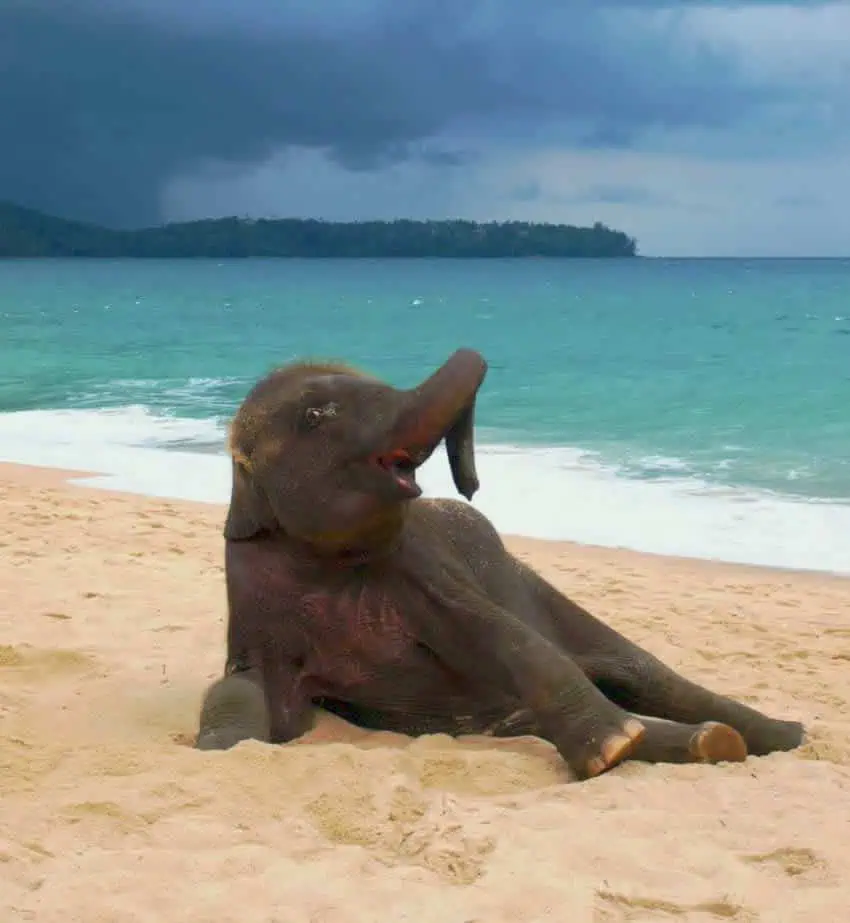
At first glance, it looked almost unreal — a wild elephant framed by the foamy surf, trunk lifted high as if to taste the salty air. But the longer you looked, the more human it felt: the joy, the curiosity, the awe. The elephant wasn’t afraid of the approaching storm. It seemed enchanted by it.
A Child of the Wild
Observers said the young elephant acted just like a child seeing the ocean for the first time — splashing, stomping, and letting the waves crash around its legs. In every flick of its tail and every rumbling trumpet, there was something pure and timeless — the universal thrill of discovery.
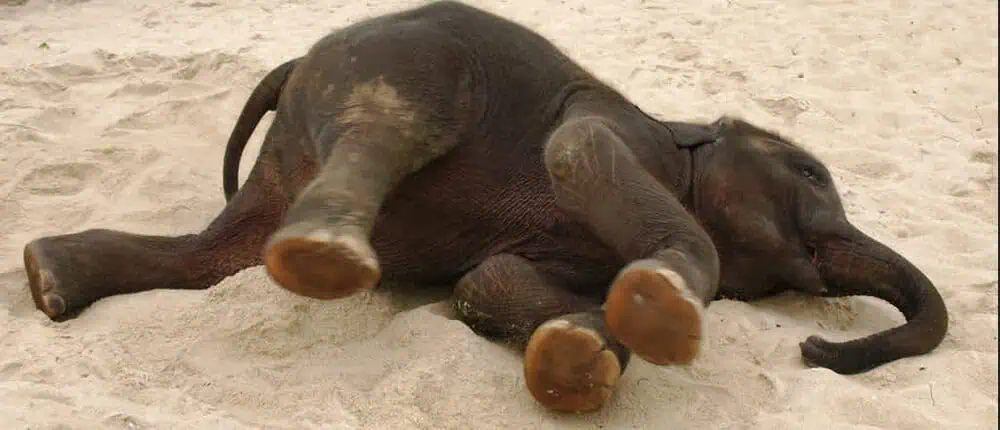
Scientists have long known that elephants are highly social and playful. In the wild, herds often engage in what can only be described as laughter. Calves wrestle in the mud, chase birds, and spray water at each other with their trunks, their eyes sparkling with mischief. These playful moments aren’t just fun — they are vital to bonding and emotional health, proof that joy runs deep even in the animal kingdom.
That’s what made Lindie’s photograph so powerful: it reminded people that elephants are not beasts of burden or performers for amusement — they are sentient, feeling souls, capable of wonder.
A Fading Legacy
But beneath the beauty of that image lies a harsh truth. Thailand’s wild elephants are disappearing. Once numbering in the tens of thousands, only 2,000 to 3,000 remain today — a staggering decline since the 19th century. Deforestation, poaching, and decades of human expansion have pushed them from their ancestral ranges into fragmented patches of wilderness.
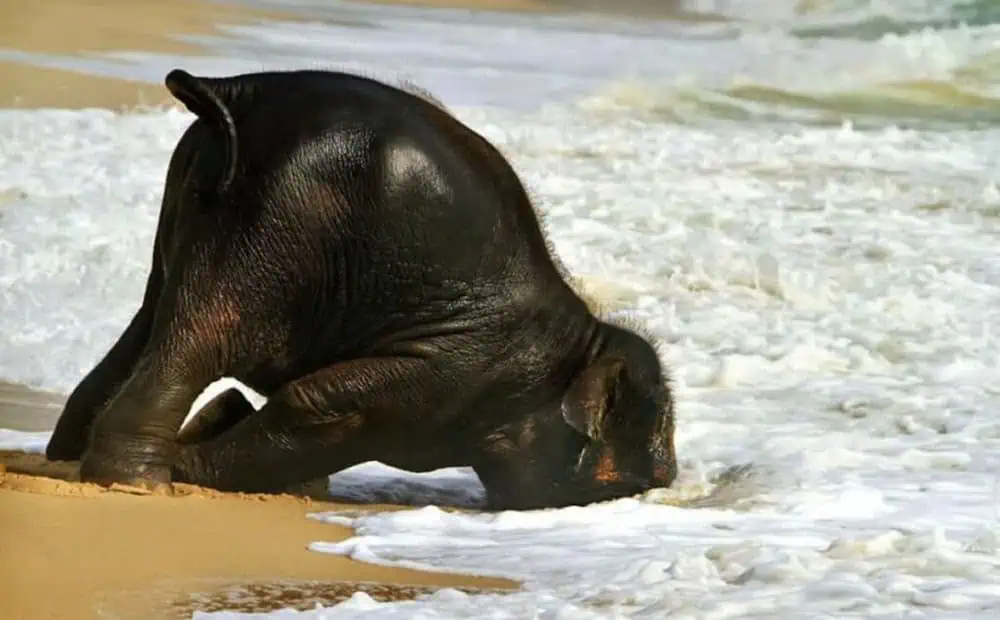
Many elephants in Thailand are now domesticated, used in logging or the tourism industry. In some sanctuaries, they live better lives — fed, protected, and free from harm. But in others, their existence is one of quiet suffering, forced to perform or carry tourists for hours in the heat.
The debate continues: can human care truly replace the freedom of the wild?
Some conservation programs have found creative ways to bridge the gap. One, called Black Ivory Coffee, uses elephants to produce one of the world’s rarest and most expensive coffees. The animals consume coffee beans that are later harvested from their waste, producing a smoother flavor due to the natural fermentation process. Supporters argue it creates a sustainable income for elephant caretakers. Critics question the ethics.
Even so, the goal remains the same — to find ways for elephants and humans to coexist without exploitation or loss.
The Spirit of Play

Back in Phuket, the young elephant in Lindie’s photo became a small symbol of hope. Its carefree play in the waves reminded millions of people around the world that joy is a form of freedom — even fleeting moments of it can heal something deeper within us.
Elephants, when given space and kindness, show us how naturally life returns to balance. They play. They love. They forgive. And they remember — always.
These gentle giants can live up to 80 years in the wild, but captivity often cuts that short to around 46 years. The contrast is heartbreaking. It means generations of laughter, wisdom, and love are being lost — not because nature failed them, but because we did.
A Wish for Tomorrow

As I look at that photograph again, I imagine the young elephant running toward the surf, trunk raised in triumph, the waves crashing around it like applause. Maybe it was the first time it had ever seen the ocean. Maybe it was the first time it had ever felt free.
And I can’t help but hope that somewhere, it still is — living under the Thai sun, playing in the water, and breathing in the salt-sweet air of a life unchained.
Because elephants are not meant to live in cages or march to commands. They are meant to roam, remember, and rejoice.
The photo captured just a single moment — but within it, the world glimpsed something eternal: the joy of a free spirit rediscovering the wild.