One Slip, One Choice, One Life Saved. – Daily News
The river behind the factory had never mattered to anyone.
It wasn’t scenic. It wasn’t useful. It wasn’t even particularly visible unless you knew where to look. It ran low and gray behind concrete walls and rusted fencing, carrying runoff and forgotten trash, freezing over every winter just enough to look solid without ever truly being safe.
Kids skipped stones there in the summer. Workers cut across the bank on their way home. No one stopped. No one lingered.
And that was exactly why no one noticed when the ice began to crack.
Son took the long way home that evening because he didn’t want to think. His headphones were on, music loud enough to blur the day into something manageable. His backpack hung off one shoulder, heavy with books and half-finished assignments. The sky was already darkening, winter light fading fast.
He almost didn’t see it.
At first, it was just movement at the edge of his vision — a splash where there shouldn’t have been one. A sudden disturbance in the stillness. He slowed, pulled one earbud out.
The sound came again.
Water hitting ice.
Hard.
Panicked.
Son stopped.
For a moment, the surface of the river looked empty again, smooth except for a jagged line where the ice had fractured near the bank. His heart began to race anyway, instinct screaming before his brain caught up.
Then something slammed up against the ice from below.
A paw.
Claws scraped desperately, leaving white lines before slipping back into the dark water. A dog’s head burst through the gap, muzzle slick and black, eyes wide with terror as it sucked in air and went under again.
“Hey!” Son shouted, yanking both earbuds out and letting them dangle uselessly around his neck. His backpack slid off his shoulder and hit the ground. “Hey! Stay there!”
The dog, of course, didn’t understand.
It thrashed harder, back legs kicking uselessly beneath the surface, breaking more ice with every frantic movement. The hole widened. The water swallowed it higher.
Son’s chest felt tight.
He ran toward the edge, then stopped himself just short, shoes skidding on the thin layer of frost near the bank. One wrong step and he’d be in too.
“Think,” he muttered. “Think.”
There was no one else around. The factory was shut down for the evening. The street beyond the fence was quiet. If he ran for help, the dog wouldn’t last that long.
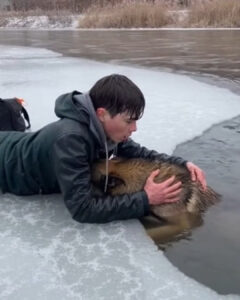
Son dropped to his knees, then flattened himself onto his stomach, spreading his weight the way he’d once been taught in school during some long-forgotten safety lesson. The ice creaked under him.
“Okay,” he whispered, more to himself than the dog. “Okay, okay.”
He slid forward inch by inch, arms extended, heart pounding so hard it felt like it might drown out the sound of the river. The cold seeped instantly through his jacket and jeans, biting sharp and unforgiving.
The dog’s head reappeared, barely above water now, mouth open, breath coming in ragged gasps. Its eyes locked onto Son’s face with desperate intensity — not trust, exactly, but something close enough.
“Come on,” Son said, voice shaking. “Just… just a little closer.”
He reached out.
The moment his fingers hit the water, the cold exploded through his hand, so intense it felt like pain rather than temperature. He sucked in a breath through clenched teeth.
The dog surged forward instinctively, trying to climb onto his arm. Its claws raked across his sleeve, then his bare skin, leaving burning lines he didn’t have time to register fully.
“No, no,” Son gasped. “Easy—easy!”
The ice groaned beneath them both.
The dog slipped again, weight dragging downward, pulling Son’s arm with it. For a terrifying second, Son felt himself sliding closer to the edge, chest pressing into the ice, water licking at his sleeves.
“I’ve got you,” he shouted hoarsely, panic breaking through his voice. “I’ve got you—don’t let go!”
He shifted his weight back, dug his free elbow into the ice, and pulled with everything he had.
The motion was clumsy. Desperate. Uncoordinated.
But it worked.
The dog’s body came up in a sudden, heavy rush — water pouring off its fur, legs scrambling uselessly until Son managed to drag it fully onto the ice beside him. The animal collapsed instantly, sides heaving, chest rising and falling in violent, uneven bursts.
Son stayed flat, afraid to move too quickly, afraid the ice might still give way. His arms trembled uncontrollably, muscles burning, fingers numb.
The dog inched closer on its belly, scraping forward inch by inch until its wet head bumped against Son’s jacket. Then it stopped.
Its breathing slowed slightly. Still ragged, but no longer frantic.
Son let out a shaky laugh that surprised him.
“Yeah,” he whispered, pressing his forehead briefly against the cold ice. “Yeah… that was really stupid.”
He rolled carefully onto his side, then pushed himself up just enough to wrap one arm around the dog’s shaking body. The fur was soaked and filthy, smell sharp with river water and oil, but Son didn’t care.
“We’re both idiots,” he murmured, voice cracking. “But we’re alive, okay? We made it.”
The dog didn’t move away.
It leaned into him, weight heavy and grounding, as if realizing only now that the fight was over. Its head rested against Son’s chest, ears flattened, eyes half-closed.
Son’s teeth chattered uncontrollably now, adrenaline fading and cold rushing in to take its place. He fumbled for his phone with stiff fingers and called for help, words tumbling over each other as he explained what had happened.
He stayed exactly where he was while they waited.
The factory siren wailed in the distance, marking the end of another shift, its sound echoing hollow and strange across the frozen river. Son barely noticed. The world had narrowed to the feel of the dog’s breath against his ribs, the steady weight of another living thing pressed against him.
When help finally arrived — boots crunching on ice, voices calling out — Son felt a strange reluctance to let go.
They wrapped the dog in blankets, lifted it carefully. Someone checked Son’s scraped arm and insisted he sit down, wrapped him in a coat that wasn’t his own.
“You did good,” a stranger told him. “You could’ve walked away.”
Son shook his head, still trying to steady his breathing.
“So could it,” he said quietly. “But it didn’t.”
As they loaded the dog into a warm vehicle, it looked back at him once — just a brief glance, eyes clearer now, less wild.
Son lifted a hand, feeling ridiculous and earnest all at once.
“Hey,” he said softly. “Take it easy, alright?”
The vehicle pulled away. The siren faded. The river went quiet again, ice settling back into stillness.
Later, when Son finally made it home, soaked clothes bundled in the corner, hands stinging where the scratches would bruise, he lay awake longer than usual.
He kept seeing the moment the ice cracked.
The moment the paw broke through.
The moment he decided not to look away.
The river would still be there tomorrow. Forgotten. Ignored.
But tonight, it had mattered.
Because one person stopped.
Because one life reached up.
Because sometimes, survival comes down to seconds — and the choice to lie flat on the ice and say, “I’ve got you,” even when you’re terrified yourself.

For most parents, the first bath is terrifying.
Hands tremble. Water is tested again and again. Every movement feels too big, too loud, too dangerous for something so new and fragile. Even the smallest splash can feel like a mistake that might undo everything.
In the animal world, though, there are no instruction manuals.
Only instinct.
At Elephant Nature Park in Chiang Mai, Thailand — a sanctuary built on patience, rescue, and second chances — a young elephant calf was about to experience water for the very first time.
She was small, even by baby elephant standards. Her legs were still unsure of themselves, her movements awkward and curious, as if she hadn’t quite decided what her body was capable of yet. Her skin was wrinkled and soft, still carrying the faint scent of new life. Everything around her was unfamiliar — the open space, the sounds of other elephants nearby, the gentle hum of a place that had become a refuge for those who had known hardship before safety.
And then there was the water.
It shimmered quietly, reflecting the light, harmless and inviting to those who understood it — but to a newborn, it was something entirely unknown.
The calf stepped forward, then stopped.

Her ears twitched. Her trunk lifted hesitantly, hovering just above the surface. She sniffed, trying to make sense of this strange thing that moved but did not flee, that shimmered but did not respond.
She tapped it once with her foot.
Cold.
She jumped back immediately, startled, eyes wide, body stiff.
The humans watching from a respectful distance held their breath, careful not to interfere. They had learned long ago that the most important moments were the ones they didn’t interrupt.
What mattered most was already there.
Her mother.
The adult elephant stood beside her calf, calm and grounded, her massive body a wall of reassurance. She did not rush. She did not push. She simply stayed close, close enough that her calf could feel the vibration of her presence, close enough that fear had nowhere to grow unchecked.
The calf looked up at her mother.

And her mother answered — not with words, but with movement.
She stepped into the water first.
Slowly. Deliberately.
The water climbed her legs, rippling gently against her skin, and she didn’t react at all. No tension. No hesitation. Just acceptance. This was something she knew. Something she had done many times before.
She turned slightly, glancing back at her baby.
Come when you’re ready.
The calf hesitated again.
Then, with exaggerated care, she placed one foot into the water.
She froze.

Her trunk shot up. Her ears flared. The sensation was shocking — cool, unfamiliar, moving in a way solid ground never did. She tried to pull back, then stopped, uncertain.
Her mother shifted closer.
She lowered her trunk gently, brushing the calf’s shoulder, grounding her. Not forcing. Just reminding.
I’m here.
The calf took another step.
Then another.
Soon, the water reached her knees, and something changed.
Her fear softened into curiosity.

She splashed accidentally at first — a clumsy movement that sent droplets flying. She jumped again, startled by her own action, then paused, processing. Slowly, cautiously, she tried again.
This time, she didn’t jump back.
She splashed deliberately.
Water sprayed everywhere, and the calf seemed momentarily stunned — then delighted. Her trunk swung wildly, catching water, flinging it into the air. Her movements were messy, joyful, completely uncoordinated.
She was discovering something new.
And her mother watched.
There was no urgency in her posture. No anxiety. Just quiet attentiveness, allowing her baby to explore while staying close enough to intervene if needed. Occasionally, she sprayed water over her calf’s back, a protective, nurturing gesture — part cleaning, part comfort.
The calf leaned into it instinctively.
She stepped deeper, pressing against her mother’s legs, finding stability in their familiar shape. The water no longer felt threatening. It felt playful. It felt safe.
Soon, the baby elephant was fully engaged — splashing, stomping, swinging her trunk with growing confidence. Her movements grew bolder, more assured, as if she had already forgotten the fear that stopped her moments before.
The humans watching smiled quietly.
They had seen this many times before, and yet it never lost its power.
Because this wasn’t just a cute moment.
It was a lesson.
Elephants learn through presence, not pressure. Through example, not force. Mothers do not push their calves into experiences they are not ready for. They enter first. They show. They wait.
In sanctuaries like Elephant Nature Park, this philosophy matters deeply. Many of the elephants here were rescued from lives of exploitation — logging, tourism, chains, isolation. Some mothers had never been allowed to raise their calves naturally before arriving. Some babies had been separated too early, their learning disrupted by human interference.
And yet, instinct endured.
Despite trauma. Despite loss.
Love remembered how to guide.
The calf’s bath continued until her energy faded, her splashing slowing into gentle movements. She leaned heavily against her mother now, body tired but content, eyes half-closed as water dripped from her wrinkled skin.
Her mother remained steady, unbothered by the weight, the mess, the noise.
This was motherhood in its purest form — not perfection, not control, but patience.
When the pair finally stepped out of the water, the calf stumbled once, then steadied herself by pressing into her mother’s side. The lesson was over for now. There would be many more.
But this one mattered.
Because first experiences shape how the world feels.
Fear can shrink it.
Safety can open it.
This baby elephant’s first bath was not about cleanliness. It was about trust — about learning that unknown things do not always mean danger, especially when someone who loves you steps in first and waits for you to follow.
The video of that moment spread quickly across the internet, shared millions of times. People smiled. People laughed. People replayed it again and again.
But beneath the surface-level joy was something deeper.
A reminder that care does not need to be loud.
That teaching does not need force.
That love, when done right, looks like standing close and letting someone discover the world at their own pace.
In a world that often rushes growth, demands bravery, and mistakes pressure for strength, a baby elephant’s first bath offered something rare:
A quiet example of how to guide gently.
How to protect without restricting.
How to say, without words:
“I’m here. Take your time.”
And for that baby elephant, splashing happily beside her mother, it was enough.