My Nephew Smashed My $8,000 Gibson Guitar. My Family Said “Forgive Him.” So I Taught Them What Accountability Really Costs. – America Focus
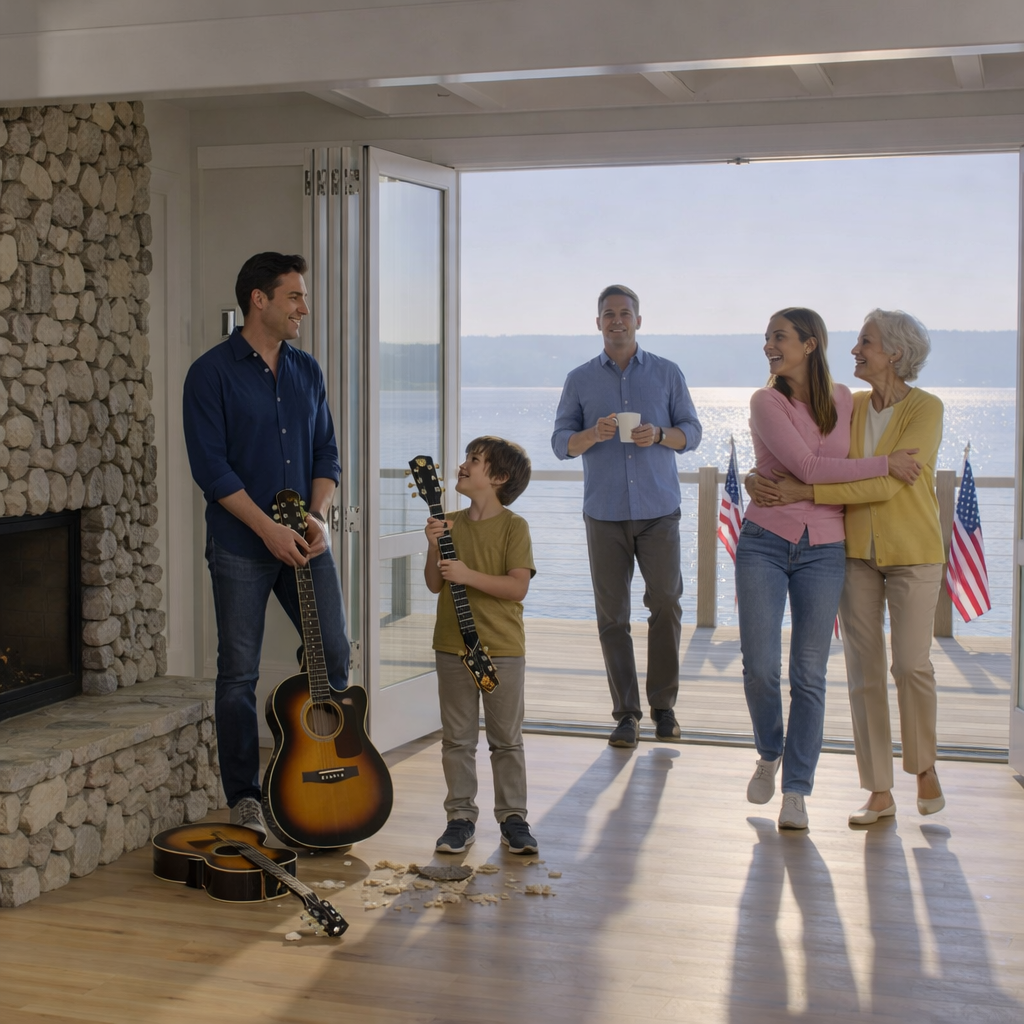
Labor Day morning at my parents’ lakehouse always had the same rhythm.
The house sat back from the water on a gentle rise, cedar siding silvered by years of sun and storms. The screened porch smelled like charcoal and citronella and the faint sweetness of lake air, a damp, green smell that clung to your skin. Inside, ceiling fans clicked at the same tempo they always had, pushing around air that never quite cooled because the windows were open and the day was already warming.
I’d arrived the night before with my truck packed like I was moving in. Clothes, groceries, a box of recording notes I shouldn’t have been thinking about, and my guitar case, the one I handled like it contained something alive.
Because it did, in a way.
My 1975 Gibson Hummingbird.
Every time I unlatched the case, I felt the same quiet pulse of gratitude and disbelief, like I’d somehow tricked the universe into letting me hold something too beautiful to belong to me. The sunburst finish caught light differently depending on the hour. In the early morning it looked like honey, amber and burnt sugar, the grain of the spruce top shimmering under the lacquer. By late afternoon it deepened into something darker and warmer, like the last glow of a campfire.
I’d saved for five years. Not in a romantic way, not with some inspiring montage. I saved in the blunt, boring way real saving happens. Turning down dinners, skipping trips, taking extra sessions when my hands were tired and my ears rang. Saying no to gear I wanted because I wanted that one thing more. Eight thousand dollars felt like a mountain when you’re building it out of small, disciplined sacrifices.
And it wasn’t just a purchase. It was part of my work, part of my identity in the most practical sense. I’d used it on more than forty recording sessions. You could hear it in tracks that people streamed without thinking, in background textures that made a song feel warm and human.
I could tell you the difference between the Hummingbird’s voice and anything else in a blind test. It had a clarity and a soft punch, a feathered brightness. When I played it, it felt like the guitar knew what I meant before my fingers did.
That morning I took it out to the deck facing the water. The lake was calm, a sheet of glass with a light mist hovering above it. Somewhere across the inlet, a fishing boat’s motor purred low, then faded. Birds called from the trees like they were arguing about something important.
I sat down, set the guitar on my knee, and tuned by ear the way I always did when I could. The strings were cool under my fingertips. The wood warmed slowly against my forearm. The sun came up behind the treeline, making the finish flash and glow.
It was one of those rare moments when I wasn’t thinking about my phone or my next gig or my bank account. I was just… there. Present. Quiet. Content.
Then I heard it.
A sharp, sickening crack.
Not a door. Not a branch. Not the deck settling.
Wood splitting.
My body reacted before my brain finished forming the thought. I stood so fast the chair scraped the deck boards. My stomach turned cold, an instant drop like a missed stair.
I ran inside.
The lakehouse always echoed in strange ways, sound bouncing off stone and wood and glass. I could hear my boots thudding on the floor, the screen door slapping shut behind me. The living room came into view in a blur.
Tyler stood there.
My nephew, nine years old, small for his age but wiry and restless, the kind of kid who always looked like he was holding in a laugh. He was in the middle of the living room, in front of the stone fireplace. He held my guitar by the neck with both hands, like it was a toy sword.
The body was smashed against the stone.
The bridge was ripped clean off.
The spruce top, that beautiful shimmering surface, was split down the middle like someone had taken an axe to it.
Strings hung in tangled loops, a spiderweb of metal catching light and trembling slightly, as if even the wreckage still remembered vibration.
For a second I couldn’t breathe.
My mind refused the image. It tried to turn it into something else. A dream. A prank. A hallucination caused by stress and lack of sleep.
Then Tyler looked at me and laughed.
It wasn’t a nervous giggle. It was bright, careless amusement.
“It broke,” he said, and lifted the neck slightly as if to show me proof. “Your guitar was fake.”
The room felt like it tilted.
My hands started shaking, not dramatically, just an uncontrollable tremor that made my fingers twitch as if they wanted to grab and fix and rewind time. Heat rushed into my face, then drained, leaving me cold and lightheaded.
“Tyler,” I managed, and my voice didn’t sound like mine. It sounded thin. Strained. “Why did you do this?”
He stood proud, chin up, shoulders squared. No fear. No apology. His eyes were bright, almost excited, like he’d completed a mission and expected applause.
Behind him, in the doorway, Derek stood frozen.
My brother-in-law.
Forty years old. Tall, broad-shouldered, always carrying himself with the easy confidence of a man who liked being the loudest voice in a room. He held a coffee cup halfway to his mouth. The steam rose in a thin curl. His face was white as paper.
He didn’t move. He didn’t speak.
The silence filled the living room, heavy and buzzing.
I knelt down and picked up the pieces of my guitar like I was gathering something fragile off a battlefield. The lacquered wood was splintered and sharp. A sliver bit into my thumb and I didn’t even feel it at first. The smell hit me, raw wood exposed, a clean, almost sweet scent that should have been beautiful and was suddenly obscene.
Eight thousand dollars in splinters.
Five years of saving.
Forty sessions.
Something irreplaceable.
I looked up at Tyler again, because I needed to make sense of it, and said, softer now, as if quietness could reach him, “Buddy… why?”
Tyler shrugged, still smiling. “Derek said real Gibsons are super tough. So I wanted to test if yours was real.”
My head snapped toward Derek.
He flinched like the words physically struck him.
“You told him what?” I said.
Derek’s face flushed red so fast it looked like a wave of heat moving under his skin. His mouth opened. Closed. Opened again.
“I didn’t tell him to… do that,” he stammered. “I just said, you know, craftsmanship. Durability. Like, real quality control. Those things are built to last.”
Tyler piped up immediately, eager. “You said Uncle Marcus probably has a cheap one. You said it at breakfast. You said he wastes money on fake stuff.”
Derek’s eyes widened, pleading, like he wanted Tyler to stop talking.
Tyler kept going, unstoppable. “You did. You said it this morning when I asked about guitars.”
I stared at Derek.
There are moments when your brain makes a clean decision: this is a person I do not recognize anymore. This is someone who just crossed a line so far it rearranged how you see them.
My guitar wasn’t just expensive. It was vintage. 1975. The kind of instrument you don’t simply replace with a trip to a store. It had history in its wood. It had a life. It had become part of the sound I built my work on.
And now it was broken in a way that couldn’t be undone. A split top is a death sentence. A ripped bridge isn’t a simple repair when the whole structure is compromised. You can patch, you can mend, but it will never be the same guitar again. The resonance changes. The integrity changes. The voice is gone.
The commotion drew footsteps.
Claire rushed in first.
My sister, thirty-eight, hair pulled into a messy knot, wearing one of my mom’s lakehouse sweatshirts like she belonged there in a way I never quite did. She took in the scene in a single scan: Tyler in the center of the room, my hands full of guitar fragments.
Tyler’s face shifted instantly.
Crocodile tears appeared like a magic trick. He threw his arms up and ran to her, and Claire scooped him into her arms like she was rescuing him from danger.
“What did you do to my son?” she demanded, eyes snapping to me.
I blinked, stunned by the speed of it. My mouth opened, then closed again. I held up the shattered body of the guitar. Bits of wood fell from it like dead leaves.
“He destroyed this,” I said. “Derek told him to test it.”
Claire looked at the guitar and for a moment something like shock flickered across her face. Then her expression hardened.
“He’s nine, Marcus,” she said, squeezing Tyler tighter as if I might attack him. “He didn’t know it was expensive.”
“Eight thousand dollars,” I said. The number came out flat, like a statement of fact, because if I let emotion into my voice, I wasn’t sure what would happen.
Claire gasped, and I saw the calculation happen behind her eyes. Eight thousand wasn’t just “a lot.” It was a category. It was a thing you could weaponize in a conversation. Her shock turned to anger.
“You spent $8,000 on a guitar?” she said, like the crime was mine.
“It’s vintage,” I said, trying to keep my voice steady. “1975. Worth more now. I use it professionally.”
Derek stepped forward, suddenly trying to play peacemaker, which made something inside me twist. “Look, I’ll pay for repairs,” he said quickly. “We can… take it somewhere. I’m sure it’s fixable.”
“It’s not,” I said. My voice cracked on the last word. I swallowed and tried again. “The top is split. The bridge is gone. This isn’t a scratch. It’s destroyed.”
More footsteps.
My mother, Barbara, appeared in the doorway like a general arriving at a crisis. Sixty-two, always put together, always convinced she could smooth any conflict with the right tone of voice.
She saw Tyler crying in Claire’s arms and made her choice instantly.
“Marcus,” she said sharply, “stop scaring the boy.”
My father, Richard, came next. Sixty-four, still broad in the chest, the kind of man who’d spent his life assuming problems could be solved by speaking firmly enough.
He looked at the guitar pieces on the floor. Looked at me. Looked at Tyler.
His face tightened, like he was annoyed at the inconvenience.
“It’s just a guitar, son,” he said. “You can get another one.”
That sentence hung in the room like smoke.
Just a guitar.
Get another one.
I felt something inside me go very still. Like a door closing.
Nobody asked if I was okay.
Nobody scolded Tyler.
Nobody told Derek to apologize.
All the concern flowed in one direction, toward the child who had just destroyed something I’d sacrificed years to own.
Claire shifted her stance so her body was between me and Tyler like she was physically shielding him. “Tyler’s a child,” she said, voice rising, defensive now. “He doesn’t understand the difference between a $200 guitar and an $8,000 one.”
“Then teach him not to destroy other people’s property,” I said.
Claire’s eyes flashed. “He made a mistake.”
“Derek made the mistake,” I said. “Tyler just followed instructions.”
Barbara stepped forward, her hands out in that familiar calming gesture, as if she could press the air into stillness. “Marcus,” she said, “you’re being unreasonable.”
Richard crossed his arms. The judge. The verdict already decided. “It’s replaceable,” he said. “Family isn’t.”
The words were meant to shut me down. To make me the villain if I pushed back. To force me into the role they’d assigned me: the one who compromises, the one who keeps the peace, the one who swallows anger so everyone else can stay comfortable.
I looked at each of them.
My sister, angry at my spending.
My mother, scolding me for “scaring” a child.
My father, dismissing my loss.
My brother-in-law, whose pride had planted this whole disaster.
My nephew, whose tears came and went like a faucet.
I felt completely alone.
Claire’s voice turned sharp again. “You’re supposed to forgive,” she said. “He’s just a child.”
Not one of them said, We’ll replace it.
Not one of them said, We’ll pay you back.
Not one of them said, Derek, what the hell were you thinking?
They wanted forgiveness as a shortcut. Forgiveness as an eraser. Forgiveness as a way to avoid the uncomfortable work of accountability.
My chest felt tight, like I couldn’t expand my ribs all the way. I knew if I spoke too much, the control I was holding onto would slip. I didn’t want to scream. I didn’t want to cry in front of them. I didn’t want to beg for empathy.
So I did something else.
I nodded slowly.
Not a dramatic nod. Not a sarcastic one. Just a small, quiet motion.
“Okay,” I said.
Then I turned around and walked away, carrying my guitar’s broken body like an injured animal.
Behind me, I heard Barbara exhale, relieved. I heard Claire coo something to Tyler, soothing him like he was the victim. I heard Richard mutter, “Good,” like he’d won.
They thought it was over.
They thought I’d accepted my assigned role.
They had no idea what I was doing inside my own head.
I moved through the house like I was underwater. The sounds of the lakehouse muffled, distant. The clink of dishes. The whirr of fans. Someone turning on a faucet. Life continuing as if nothing had happened.
At the entryway, there was a decorative wooden bowl on the table, full of keys. It was always there at the lakehouse, a communal drop zone for the people who felt entitled to treat the place like a resort.
My parents’ keys.
Claire’s keys.
Derek’s keys.
Derek’s key fob sat on top, glossy black with the three-pointed star logo.
Mercedes-Benz.
I picked it up.
It was heavier than I expected. Cold metal in my palm. The weight had a strange satisfaction to it, like holding a truth no one else wanted to acknowledge.
Through the front window I could see the car parked near the boat ramp.
Black Mercedes AMG GT. Sleek, low, the kind of vehicle designed to look expensive even when standing still. The plate read DR KFU NDS, a joke Derek had been proud of, a little wink at his supposed brilliance.
He bragged about that car constantly. Talked about horsepower and leather and prestige like it was proof of worth. It was his trophy, his shield, the thing he used to say, Look at me, I’m still winning.
I walked outside, not rushing, just observing.
The boat ramp sloped down toward the water, gravel packed into a smooth incline. No barriers. No posts. Nothing to stop a vehicle from rolling straight into the lake if it had momentum.
The water by the ramp was deep. I’d swum there as a kid, dove down until my ears hurt, and still never touched the bottom. Depth markers along the dock showed twenty feet.
Deep enough.
The Mercedes sat about thirty feet from the ramp edge.
A natural roll path.
I scanned the house for cameras. My parents weren’t the surveillance type. There were none pointed at the ramp.
I turned back toward the windows. Inside, Tyler was already laughing again, running around with a toy, bouncing off furniture, as if he hadn’t just shattered something precious.
No consequences.
No lesson.
Derek had started this, and yet the entire household had rallied to protect him from discomfort by putting the burden on me.
In that moment, something in me settled.
Not rage, exactly. Rage felt too hot, too chaotic.
This was colder.
Clearer.
A decision hardening like concrete.
The Labor Day barbecue went on as planned that evening. That was the surreal part, the way families can stage normalcy like a performance even when something inside them has ruptured.
Richard grilled steaks on the back patio like he always did, tongs clicking, smoke rising in a steady stream. Barbara set the table with her “good” dishes, the ones she saved for holidays. The lake glowed gold in the late light, the surface rippling when a breeze passed.
Tyler ran around with a water gun, shrieking with delight, spraying whoever wandered into range. Claire laughed and called him “my energetic boy, so full of life,” as if destruction was just enthusiasm with bad timing.
I stood alone by the railing, watching the water, feeling the absence of the guitar like a missing limb.
Derek came up beside me, trying to sound casual, trying to slide past what he’d done with the kind of charm men like him relied on.
“Hey,” he said, clearing his throat. “Look… about earlier. I can write you a check. Ten grand. More than the guitar cost. Let’s just… put it behind us.”
I didn’t look at him. My fingers gripped the railing until the wood pressed into my skin.
“You can’t make this right,” I said quietly.
He scoffed, offended. “Money makes it right.”
“Not this,” I said. “Some things don’t get fixed that way.”
He stood there for a moment, waiting for me to soften. When I didn’t, he walked away, frustrated.
Dinner began. Everyone gathered around the table with forced cheerfulness, laughing too loudly at jokes that weren’t funny, passing plates as if nothing was wrong.
Richard looked across at me. “You’re being childish about this,” he said.
I met his eyes. “Am I?”
Barbara set down her fork, her voice gentle but firm in the way she used when she wanted to control a situation without seeming controlling. “We’re family,” she said. “Let it go.”
The word let landed like a command.
I kept my voice level. “You’re right,” I said. “Family should forgive each other.”
Claire’s shoulders visibly relaxed. She smiled at me like she’d won. “Thank you,” she said. “That’s mature of you.”
I didn’t smile back. I ate in silence, mechanically, tasting almost nothing. I watched them all. The way Derek leaned back in his chair like the world owed him comfort. The way Claire stroked Tyler’s hair and told him he was “fine.” The way my parents pretended they were doing the right thing by smoothing over the problem.
My calmness should have frightened them.
It didn’t.
At 6:15 the next morning, the house was still asleep. The air outside had that cool, damp edge that comes before sunrise. Dew clung to the grass. The lake sat perfectly still, mist rising like breath.
I went to the entry table.
Derek’s keys were where he’d left them.
Of course they were.
I slipped them into my pocket and stepped outside. The screen door creaked softly. Somewhere in the trees, a bird made a single sharp call, then went quiet.
The Mercedes waited near the ramp.
I walked up to it and unlocked the door. The car beeped softly, an expensive little chirp that felt absurd in the stillness.
I slid into the driver’s seat.
Cream leather, immaculate. It smelled like money, like designer cologne and polished surfaces. The dashboard glowed faintly as the car recognized the key. The interior felt insulated from the world, like a sealed capsule.
I didn’t start the engine.
I shifted the transmission into neutral.
My heart beat steadily. Not wildly. Not frantically. A controlled rhythm. My hands didn’t shake now.
I opened the door, stepped out, left it ajar, and leaned back in to release the parking brake.
There was a soft click.
That was all it took.
At first, the Mercedes didn’t move. Then gravity began doing what gravity always does.
The car rolled slowly, tires crunching on gravel.
Then it picked up speed.
The incline guided it perfectly, like a path designed for exactly this.
Gravel sprayed in small arcs behind the tires. The open driver’s door wobbled slightly, then swung wider as the car accelerated. The mist over the water shifted as if it sensed what was coming.
I stepped back, arms folding across my chest.
And I watched.
The Mercedes hit the edge of the ramp and nosed down.
For one split second, it seemed to hover, the front dipping toward the lake like a bow.
Then it plunged.
The splash was enormous, a violent burst of water that shattered the morning silence and echoed across the lake. Ripples exploded outward, slapping the dock, the shoreline, the rocks.
The car sank front-first.
The tail rose briefly, like a hand reaching up.
Through the open windows, I could see the pale interior. The leather. The seats that Derek loved to brag about. Then the water swallowed them.
Bubbles streamed up in frantic bursts.
In less than thirty seconds, it was gone.
The lake closed over it, smoothing itself as if it had never been disturbed.
A moment later I heard the sliding door on the deck open.
Footsteps.
Derek appeared in pajamas, holding his coffee mug.
He saw me standing near the ramp.
He saw the water still churning. The last bubbles. The widening rings of ripples.
He stared, not understanding, his face blank like his brain hadn’t caught up.
Then his coffee mug slipped from his hand and shattered on the deck behind him.
The brown liquid spread slowly across the wood.
A sound came out of him, half breath, half wail.
Then he screamed.
It was an animal sound. Pure shock and horror.
The house woke up instantly. Lights flicked on. Doors opened. Voices called.
Derek ran down toward the ramp, slipping a little on the gravel. He reached the edge and leaned forward like he might somehow grab the car through the water.
Too late.
Nothing to save.
He stood there panting, staring at the bubbles fading.
Then he turned toward me, his face twisted into disbelief and fury.
“What did you do?” he shouted.
I didn’t raise my voice.
“I released the brake,” I said. “Physics did the rest.”
His mouth opened like he couldn’t believe the words.
“My car,” he choked out. “My… car.”
I met his eyes and used the same dismissive tone my father had used on me, the same casual cruelty.
“It’s just a car, Derek,” I said. “You can buy another one.”
For a second, the only sound was the lake water lapping at the ramp and Derek’s ragged breathing.
Then he lunged at me, hands reaching like he wanted to grab me by the shirt and shake answers out of me.
I stepped to the side easily.
He stumbled forward into the gravel, caught himself, then sprang back up, fists clenched, face red.
Claire came running out next, robe pulled tight around her. Her hair was wild from sleep. She looked at the lake, then at Derek, then at me, and her face crumpled in horror.
“Where’s the Mercedes?” she cried.
I pointed down at the water. “Right there.”
Her eyes widened like she couldn’t comprehend it. “You pushed his car into the lake.”
“I didn’t push it,” I said. “Gravity did. I just released the brake.”
Barbara and Richard arrived moments later, both in robes, hair disheveled.
Richard’s voice thundered across the ramp. “Marcus, have you lost your mind? What the hell is wrong with you?”
Barbara’s hands flew to her mouth. “Oh my God.”
I turned to them slowly.
Yesterday, they had spoken as if my loss didn’t matter. As if my feelings were an inconvenience. As if forgiveness was something they could demand from me to protect the people they favored.
Now they wanted outrage.
Now they wanted consequences.
I kept my voice calm. “Yesterday, Tyler destroyed something I saved years to buy,” I said. “Something I use professionally. You told me it was just a guitar. Get another one. You told me family forgives. You told me I was being childish for being upset.”
I gestured toward the lake, toward the last bubbles dissolving into still water.
“So I let his car go,” I said. “I applied your lesson. We’re even now.”
Silence fell.
Not peaceful silence. Stunned silence.
Derek fumbled for his phone, hands shaking so hard he nearly dropped it. “I’m calling the police,” he snapped.
I didn’t blink.
“Go ahead,” I said.
He froze mid-motion.
I continued, measured, almost conversational. “When they come, I’ll file a report about Tyler destroying my $8,000 guitar. I’ll explain how you told a nine-year-old to test whether it was fake. How you incited a minor to commit property destruction.”
Claire’s face drained of color so quickly it looked like someone had wiped it clean.
Derek swallowed, his Adam’s apple bobbing.
I let the next part land carefully. “That’s not a cute parenting moment,” I said. “That’s an adult manipulating a child into committing a crime. You want law enforcement involved? Fine. But you may not like where that goes.”
Derek’s phone hovered in his hand like a weapon he wasn’t sure he could use.
Claire grabbed it from him, suddenly frantic. “Don’t call,” she hissed. “Please don’t call.”
Derek stared at her, disbelieving. “He sank my car.”
Claire’s voice cracked with panic. “And you told Tyler to break his guitar!”
Richard stepped forward, palms out, trying to regain control. “Enough,” he barked. “Enough! Everyone calm down.”
I looked at him. “I am calm,” I said.
And I was.
That’s what shocked them most.
They’d expected anger. They’d expected drama. They’d expected me to explode and prove their narrative about me being unreasonable.
Instead I stood there steady, mirroring their own logic back at them.
I walked toward my truck, which I’d parked near the side of the driveway. I opened the back door and reached inside for my guitar case. The case felt heavier than it should have with the broken instrument inside, like grief had weight.
Barbara followed me, her slippers crunching on gravel. “Marcus,” she said, voice trembling. “Where are you going?”
“Home,” I said.
“Please,” she whispered, as if the word itself could undo what had happened. “Please don’t do this.”
I closed the truck door gently, careful with the case.
“Thanks for the lesson,” I said.
She blinked, confused, eyes wet. “What lesson?”
“The one you taught me,” I said. “About how family handles expensive property destruction.”
Richard’s voice cut in, hard. “If you leave now, you’re choosing to end this family.”
I turned and met his eyes, really met them. “No,” I said quietly. “You chose yesterday when you sided with Tyler over me. When you dismissed my feelings. When you told me it was just a guitar.”
I climbed into the driver’s seat. The engine started with a low rumble. The sound felt grounding, real.
Behind me, Claire sobbed, and her words came out in a broken rush. “We still owe eighty-seven thousand on that car loan!”
I backed out slowly.
“It’s just money,” I said out the window, keeping my tone even. “You can earn more. That’s what you told me, right?”
Then I drove down the long driveway, leaving them standing at the edge of the lake, staring at the water that now held Derek’s pride on the bottom.
Two hours later I was back in Nashville. The city felt loud after the lake, full of sirens and traffic hum and the constant murmur of people living their lives. I made coffee, sat on my porch, and let the quiet of my own space settle around me like a blanket.
My phone wouldn’t stop ringing.
Claire.
Barbara.
Richard.
Derek.
Claire again.
I stared at the screen until the numbers blurred, then I blocked them one by one. Each block felt like placing a stone in a wall.
An unknown number called.
I answered out of curiosity.
Derek’s voice came through, shaking, trying to hold onto authority he no longer had. “We’re getting it out,” he said.
“Getting what out?” I asked, though I knew.
“The car,” he said. “I called a tow company. They have a crane.”
“How much is that costing you?” I asked.
A pause. “Four thousand five hundred for the crane. Eight hundred for the tow.”
A laugh escaped me, short and involuntary. Not joy. Not cruelty. Just disbelief at the predictability of it all.
“What’s funny?” Derek snapped.
“You left the windows open,” I said. “Remember? I saw them before it rolled.”
Silence.
I continued, calm, like explaining something obvious. “Water damage. Flooded engine. Every circuit board. That interior. Even if you pull it out, it’s totaled. You’re spending five grand to recover a dead car.”
His voice cracked. “You knew that?”
“Yes,” I said.
Then I hung up.
By afternoon, texts started coming through from blocked numbers anyway, slipping around in different forms, like water seeping under a door.
Claire: Insurance denied the claim.
Claire: They said intentional submersion isn’t covered.
Claire: Derek still owes $87,000.
Claire: The bank wants payments on a car that’s ruined.
Claire: We’re ruined.
Claire: Marcus, you have to help fix this.
I read them, felt the echo of yesterday in each one. The way they’d wanted my forgiveness to erase consequences. The way they now wanted my help to absorb consequences they’d brought on themselves.
I deleted the thread and went to work.
I had a recording session at three. A singer-songwriter who needed acoustic textures laid down clean. The studio lights were dim and warm. The air smelled like cables and coffee and wood. When I sat down with another guitar, not my Hummingbird, my hands hesitated for half a beat, grief flaring.
Then I played anyway.
Because music doesn’t wait for your personal disasters to resolve. It asks you to show up.
That evening, I checked my phone and saw the family group chat exploding. Message after message, extended relatives pouring in like a jury that had only heard one side.
Aunt Linda: Marcus destroyed Derek’s car over a guitar. Unforgivable.
Uncle Tom: A $100,000 car over a guitar. He’s lost his mind.
Then cousin Sarah, unexpectedly steady: Tyler destroyed Marcus’ $8,000 guitar first. Derek told him to do it.
Cousin Mike: Derek’s always been an asshole. About time someone checked him.
Barbara: Everyone stop. We need to heal as a family.
Claire: Heal? Marcus destroyed our lives.
Cousin Sarah: You mean like Tyler destroyed Marcus’ guitar?
Uncle Tom: A guitar is not the same as a $100,000 car.
Cousin Mike: Then maybe teach your kid not to smash expensive stuff.
Aunt Linda tagged me directly: You’re tearing this family apart.
I watched the messages scroll, my thumb moving slowly. It was strange, seeing my life turned into a debate for entertainment.
I typed one response.
“I didn’t tear anything. You chose sides yesterday.”
Then I muted the chat.
The next morning an email arrived at 7:42 a.m.
Subject: Intent to Sue — Property Damage.
Derek’s attorney. Louisville.
The demand letter read like an insult dressed up in legal language. Replacement value. Emotional distress. Lost work time. A number at the bottom: $123,000.
I forwarded it to my attorney, Joel Ramos in Nashville.
Joel called ten minutes later, his voice amused. “This is incredible,” he said. “They have no case. Also, it’s going to be very fun to respond.”
He explained it in blunt terms. “You didn’t drive the car. You released a parking brake. The car rolled. Plus, your nephew destroyed your guitar first, and Derek’s involvement is a problem for them. If they sue, we counterclaim. We’ll ask for the guitar value, plus damages. It’ll get ugly for them.”
“Do it,” I said.
Day two after that, a knock came on my studio door while I was mixing tracks. The studio hallway smelled like stale coffee and dust. When I opened the door, Claire stood there with Tyler beside her.
Tyler held a folded piece of paper. He wouldn’t look up.
Claire’s eyes were red and puffy. Her voice had that tight edge of someone forcing politeness through rage. “Tyler has something to say,” she said.
Tyler unfolded the paper and read in a monotone, clearly rehearsed.
“Dear Uncle Marcus, I’m sorry I broke your guitar. I didn’t know it was expensive. I promise to be more careful. Please forgive me. Love, Tyler.”
He folded it back up and looked at Claire. “Can we go now?”
My chest tightened.
I looked at him carefully, trying to see past the performance. “Tyler,” I said, gentle, “do you know why what you did was wrong?”
He shrugged. “Because it was expensive.”
“No,” I said. “Because it wasn’t yours. Price doesn’t matter. You don’t destroy other people’s property.”
Tyler’s brow furrowed like he was hearing this idea for the first time. “I guess.”
“Do you feel bad about breaking it?” I asked.
He glanced at Claire, then blurted the truth without meaning to. “Derek said, ‘You just buy a new one.’”
Claire’s face snapped tight. “We’re not doing this,” she cut in. “He apologized. Drop the countersuit.”
“That wasn’t an apology,” I said quietly. “That was a script.”
Claire’s nostrils flared. “He’s nine.”
“Then teach him,” I said. “That’s your job.”
Claire grabbed Tyler’s hand and turned, yanking him away. The studio door slammed so hard the glass rattled. Tyler looked back once over his shoulder, confused, his face small in the hallway light.
I stood there for a moment after they left, my heart heavy in a different way. Tyler wasn’t a monster. He was a kid being shaped by adults who didn’t want to face themselves.
Three days later, Joel emailed me discovery documents. Court-ordered financial disclosures were coming, and Joel had done a quick summary of Derek’s financial situation based on early filings.
It was worse than I expected.
Mercedes loan: $87,000 remaining.
Home equity loan.
Credit card debt.
Personal loans.
Derek wasn’t standing on solid ground. He’d been balancing on appearances. The Mercedes wasn’t proof of success, it was a mask.
Joel’s note was simple: “He was drowning long before you sank the car.”
A certified letter arrived from my parents soon after, on formal letterhead like they were a corporation instead of the people who’d raised me.
They told me they were ashamed.
They told me Derek made a mistake. Tyler was a child.
They demanded I drop the lawsuit.
They demanded I pay half the car loan. $43,500.
They demanded I apologize to Tyler for scaring him.
They told me I wasn’t welcome at Thanksgiving or Christmas if I refused.
No love at the bottom.
Just their names, cold and official.
I read it twice, folded it neatly, and put it in a drawer without replying.
That same week, the story spilled into the outside world in a way I hadn’t expected.
A musician friend posted a photo of my smashed Gibson on social media, a shot he must’ve taken at the lakehouse. The caption was blunt and sympathetic. The comments poured in from people who understood what instruments mean to musicians. Not as toys. As tools. As partners. As a voice.
Studios I’d worked with emailed support. More session offers. More work.
My reputation didn’t collapse.
It held.
One week after the lakehouse, Derek called again, his voice different. Not angry. Not triumphant. Broken.
“Marcus,” he said quietly, and I could hear he’d been crying. “I messed up. I shouldn’t have said what I said about your guitar. Tyler shouldn’t have broken it. I’m sorry.”
I listened, letting the words land.
Then he rushed on, panic spilling out. “Can you drop the lawsuit? Please. We’re going to lose the house. Foreclosure in sixty days. Claire’s parents won’t help. Mine won’t give more. We’re drowning.”
I looked out at my porch, at the afternoon light on the street, at ordinary life continuing.
“You should have thought about that before you told a child to destroy my property,” I said.
He sobbed softly. “I’ll pay for it. I’ll get you a new one. Just drop the suit.”
“You can’t replace it,” I said. “It was vintage. Irreplaceable. Remember? You and everyone else told me to just get another one.”
Then I hung up.
That night, at 11 p.m., my doorbell rang.
Claire.
Mascara streaked down her cheeks. Her face was swollen from crying. She looked smaller than I remembered, stripped of the armor she’d worn at the lakehouse.
I let her in because I didn’t want her crying in the hallway.
She sat on my couch and shook like she was cold, though the apartment was warm.
“Marcus,” she said, voice breaking, “please. I’m begging you.”
I stayed standing.
“We’re losing the house,” she said. “Derek’s job is at risk. He can’t commute without a car. Tyler keeps asking why Uncle Marcus hates him.”
“I don’t hate Tyler,” I said. “I hate what you all did. I hate that nobody taught him consequences.”
Claire wiped her face with the back of her hand, smearing tears. “What do you want?” she whispered. “What will make it right?”
I took a breath, feeling the ache behind my ribs.
“I wanted you to care,” I said simply. “Before this. I wanted you to say you were wrong to dismiss me. Wrong to protect Derek. Wrong to treat my work like a hobby. I wanted an apology when it mattered, not when you’re afraid of losing everything.”
Her mouth opened, then closed. She looked like she’d been slapped with a truth she’d tried hard not to see.
“I’m apologizing now,” she whispered.
“Now it’s panic,” I said. “Not remorse.”
Claire stood suddenly, rage flashing through grief. “You’re going to destroy us.”
I met her eyes. “No. Derek did. I just held up a mirror.”
She left, slamming the door behind her.
Two weeks after the lakehouse, attorneys negotiated a settlement.
Derek dropped his suit.
I dropped my countersuit.
Derek agreed to pay me $8,000 in twelve monthly installments.
He and Claire signed an affidavit admitting Derek instigated Tyler.
Tyler wrote me a letter, unscripted.
A mutual no-contact order for two years.
No criminal charges. No admission of guilt on the car.
Clean break.
Ten days later, Tyler’s letter arrived in the mail. His handwriting was uneven, the words pressed hard into the page.
He told me he broke the guitar because Derek said it was fake.
He said Mom said they might move because Derek’s car sank.
He said Derek said it was my fault, and Mom said it was his fault, and he didn’t know who was right.
He said he was sorry.
He asked if we could still have Christmas together.
I read it three times.
I didn’t write back. The agreement said no contact.
But I kept the letter.
Somewhere in that messy honesty was the first real accountability anyone in that family had touched.
Weeks later, in the cold Nashville air of early winter, I walked into Carter Vintage Guitars. The shop smelled like polished wood and old strings and money. Walls lined with instruments that carried decades in their grain.
A salesman recognized me. “We have a ’74 Hummingbird,” he said, almost reverent. “Close to what you had.”
I shook my head.
“No,” I said. “I’m looking for something different.”
I picked up a Martin D-28. The tone was brighter, more cutting, built to slice through a mix differently than the Gibson ever had. It didn’t feel like my old guitar. It wasn’t supposed to.
It felt like a new chapter.
“I’ll take it,” I said.
That night I played until my fingers ached. The sound was different, the technique slightly altered. My muscle memory kept reaching for the warmth of the Hummingbird and finding clarity instead.
Some things don’t come back.
You learn a new language.
Months passed.
Cousin Sarah kept me updated in small, careful messages. Derek lost his job. Claire got a job for the first time in twelve years. Their house went on the market. Tyler got suspended twice for fighting. A counselor said he was processing family trauma and blaming himself.
I sat with that for a long time.
I started seeing a therapist in Nashville, a quiet office where the air smelled faintly of tea and clean paper. On the third session, she asked me, “Do you regret what you did?”
“No,” I said.
“Are you happy about the outcome?”
“No,” I said again, surprised by how quickly it came.
She nodded. “Both can be true.”
That was the beginning of peace.
Later, when Sarah forwarded me an email Claire had sent to extended family, I read the line that mattered most: “Did I fail my son by siding with my husband over my brother?”
For the first time, Claire sounded like someone looking in the mirror.
I didn’t break the no-contact order.
But I did buy a child-size acoustic guitar, simple and sturdy. I shipped it anonymously to Tyler with a note that said only: “Music heals. Keep playing. Someone who cares.”
No name.
No invitation back.
Just a small lifeline.
More months passed.
Claire filed for divorce. Derek fought it. Tyler got caught in the middle again. Derek posted bitter little messages about betrayal and materialism, still unable to admit fault.
I moved on with my life in ways that felt both triumphant and strangely quiet. My music career grew. More session work. More recognition. I released an instrumental project. Streams climbed. People reached out. I built a chosen family of friends in Nashville who showed up for me in a way my blood relatives hadn’t.
My mother came to my new house one day, standing on the porch with tears in her eyes. She said she’d been wrong. She asked for forgiveness. I told her I forgave her, but forgiveness wasn’t trust.
My father had a heart attack, minor, and I visited him in the hospital. He apologized. He asked if we could fix things. I told him we could try, slowly. He seemed to understand what slowly meant.
Eventually, Claire asked if Tyler could see me.
The two-year no-contact order still mattered, but the settlement also had limits and loopholes in its reality. Claire arranged it carefully, just a drop-off, just a short visit, no legal entanglements, no drama.
Tyler came to my porch holding the child-size guitar.
He looked older, his face more serious. His eyes held something heavier.
“Thank you for the guitar,” he said quietly.
I studied him. “How do you know it was me?”
He shrugged. “You always say music heals.”
We sat on the porch and played. His fingers struggled on new chords, then found them. He listened when I corrected him. He concentrated with the fierce intensity of a kid trying to do something right.
After a while he said, “I’m sorry I broke your guitar.”
I nodded. “I know.”
He swallowed. “I know why it was wrong now. Because it wasn’t mine. And because Derek told me to do it and I should have said no.”
Something loosened in my chest.
“That’s right,” I said.
We played for an hour. When Claire came to pick him up, she didn’t step out of the car. She just waved, cautious, respectful.
Tyler waved back, smiling.
I watched them drive away and felt something close to hope.
A year after the lakehouse, my parents invited me to Thanksgiving. Claire would be there. Derek would not. That line was firm. A boundary, finally, where one had never existed.
When I hung up the phone after accepting, I stood in my kitchen for a long time, listening to the city outside my window.
The lakehouse had been sold. Too many bad memories, Sarah said.
A dive team later found the Mercedes corroded beyond recognition. The insurance company didn’t want it. Derek didn’t want it. The tow costs outweighed the scrap value. The car stayed underwater.
Some things should stay buried.
On the next Labor Day weekend, I wasn’t at my parents’ lakehouse. I was at a rented place with friends and Emma, the woman I’d started building a life with. We sat on a different deck under different stars, laughter spilling from the kitchen, the sound of someone flipping burgers, the clink of bottles.
I held my Martin and played a piece I’d written after everything happened, a song I called “Underwater.” The notes drifted out over the dark lake, soft and clear.
When I finished, my friends clapped. Emma kissed my cheek.
My phone buzzed with a message from my mother: Thinking of you today. Miss you.
I stared at it, then typed back: Miss you too, Mom.
It wasn’t a reunion.
It wasn’t a perfect ending.
It was something quieter.
Accountability had cost all of us. It had cracked the family open. It had exposed rot that had been there for years, hidden under polite holiday routines and forced smiles.
Derek lost his mask. Claire lost her marriage but found a way to become a better mother. Tyler learned the difference between forgiveness and permission. My parents learned that “keeping the peace” can be another way of choosing a side.
And me?
I lost a guitar I will always miss. I lost a version of my family I’d clung to in my head.
But I gained something I didn’t know I needed until I had it.
A boundary.
A life where my work mattered.
A space where my voice didn’t get dismissed as “just a guitar.”
When people ask me now if I regret what happened, I tell them the truth.
I regret that it was necessary.
But I don’t regret refusing to be the one who always forgives while everyone else avoids accountability.
Sometimes the only way to teach people the weight of what they’ve done is to let them feel it.
And sometimes, to save yourself, you have to let something sink.
-

James Carter is a writer with a long-standing interest in real-life stories, culture, and the small moments that shape everyday life. He focuses on clear, engaging storytelling and prefers a straightforward style that puts the reader first. When he’s not writing, James enjoys spending time outdoors, following current events, and exploring how ordinary experiences can reveal deeper meaning.
The last school bus coughed out a ribbon of exhaust and disappeared around the corner, its yellow tail lights shrinking into the early November dark. Drew Leon stood on the curb outside Pinewood High with his hands in his coat pockets, watching the parking lot empty out until it was only his Civic and a few teacher cars left behind.
The building was settling into its evening hush. Somewhere inside, the janitor’s keys clinked like distant wind chimes, a soft metallic rhythm moving down a hallway. The air had that cold, leaf-burned smell of late fall. A week ago, the maples lining the campus road had looked like fire. Now they were stripped, branches scribbling against the gray sky.
Drew should have gone home an hour earlier. But he’d stayed after dismissal, grading tenth grade essays about revolutions and the myth of inevitability. He always told his students history wasn’t a straight line, that it was made of choices. Small ones. Ordinary ones. A person deciding to stand up in a room where no one expected them to.
He had no idea that in two days he would walk into his in-laws’ Thanksgiving uninvited and make a choice so sharp it would split his life clean in half.
He had no idea that, fifteen feet from a table set for twenty-three, his six-year-old daughter would be in a kitchen corner with a turkey bone in her hands, scraping the last bits of meat with her tiny teeth because she was hungry.
He didn’t know any of that yet.
He just knew the light in the teacher’s lounge had been too bright, his classroom too quiet, and that the routine of red pen marks helped him breathe when the rest of his life felt like it was tilting.
He climbed into his aging Honda Civic, the fabric seat worn smooth at the driver’s side, and turned the key. The engine sputtered, then caught. Heat wheezed from the vents with a faint smell of dust. He pulled out slowly, tires crunching gravel, and headed toward the small craftsman house he’d bought before Sophie was born.
Before Miranda’s family had started looking at him like he was a temporary inconvenience.
Before Miranda had started looking at him that way too.
When he got home, the porch light was off. The living room windows were dark, the house holding its breath. Drew let himself in and stood for a moment in the entryway, listening. No cartoons. No small footsteps. No Sophie voice announcing, Daddy, I have a question.
Just silence and the faint hum of the refrigerator.
Miranda’s BMW wasn’t in the driveway again.
He walked into the kitchen and found the note on the counter, written in Miranda’s neat handwriting as if she were leaving instructions for a sitter.
Took Sophie to Mother’s for dinner. Leftover meatloaf in fridge.
The paper was crisp beneath his fingers. He stared at it long enough that his eyes began to sting, then folded it once, slowly, like he was handling something fragile, and crushed it in his palm. He didn’t throw it away. He stood there with it balled up in his fist, feeling the heat rise in his chest, that familiar mixture of hurt and anger that had become the background noise of his marriage.
They had not started like this.
Eight years ago, at a charity fundraiser, Miranda Turner had been warm. She’d laughed openly, head tipped back, when he told a story about accidentally teaching the French Revolution instead of the American Revolution to a class of bewildered freshmen. She’d listened when he spoke about why he loved history, about how it wasn’t dates and battles but people making impossible choices.
She’d told him his eyes lit up when he talked about teaching. She’d touched his arm when she said it, her fingers light, as if surprised by her own impulse.
Her parents had been polite at the wedding, which was its own kind of warning. Margaret Turner, in cream and pearls, smiling with her lips but not her eyes. Carl Turner, looming in a dark suit, shaking Drew’s hand as though he were accepting something he couldn’t return.
Turner and Associates was a name that sat on half the city skyline, stamped invisibly into steel and glass. Carl was the kind of man who could make a phone call and shift a zoning line. Margaret was older money, the kind that arrived by inheritance and stayed by arrangement.
Drew had been, to them, a phase. A teacher. A state university degree. A craftsman house on a quiet street. Miranda marrying him was, in Margaret’s carefully phrased language, “romantic.”
Seven years later, romantic had been replaced by inadequate.
He warmed the leftover meatloaf, the microwave light turning the kitchen dim and blue. He ate standing at the counter because sitting alone at the table felt like something his body couldn’t handle. The meatloaf tasted like salt and resignation. When he was done, he rinsed his plate and drifted to the dining table where Sophie’s drawings lay scattered like evidence of a happier world.
Stick figures. Bright colors. A tall figure with messy brown hair labeled Daddy. A small figure with pigtails labeled Sophie. A third figure with yellow crayon hair labeled Mommy.
They were holding hands.
At the top, in Sophie’s six-year-old scrawl, was a title: My Family.
Drew swallowed hard. His throat felt thick, like he’d been breathing smoke.
His phone buzzed.
Miranda: staying at Mother’s tonight. Sophie too. See you tomorrow.
The message sat on the screen like a closed door.
He typed back, thumbs stiff.
Okay. Tell Sophie I love her.
Three dots appeared, then vanished.
No response came.
Drew set the phone down and stared at the kitchen wall as if it might offer a way out. The refrigerator hummed. Somewhere outside, a car passed, tires hissing on the damp road.
He walked to his home office, the converted bedroom lined with books and paper stacks. His laptop was open to a document he’d been nursing for three years. A manuscript about ordinary people who changed history through small acts of defiance.
His agent had called it promising. Needing work. The advance had been modest, and Margaret Turner had laughed when she heard the number.
“Forty thousand? Darling, we spend that on a weekend in Aspen.”
Drew tried to write anyway. He sat. He placed his hands on the keyboard. He stared at the blinking cursor until it felt like it was blinking inside his skull.
Nothing came.
Instead, he pulled open his desk drawer and took out the papers he kept meaning to organize and never did. Credit card statements. All in Miranda’s name. Charges at restaurants he’d never been to. Shopping trips to boutiques that made his stomach twist. Spa visits that appeared weekly, as regular as his paycheck.
When he’d asked about it a month ago, Miranda had snapped, eyes flashing.
“My parents give me an allowance. It’s family money. You wouldn’t understand.”
It wasn’t just the money. It was the way they wielded it.
Margaret Turner could make you feel small while smiling. Carl could erase you with a glance, his attention sliding away as if your existence was an interruption. At family gatherings he rarely got Drew’s name right. Dean. Dave. Something close enough to be insulting.
Austin Turner, Miranda’s younger brother, did it with a grin and a casual cruelty.
“So when are you getting a real job?”
Drew had endured it because Sophie was there. Because Sophie would press her warm hand into his and whisper, Daddy, can we go soon? Because she still looked at him like he was safe.
He had told himself love could outlast contempt.
Now he wasn’t sure.
The next afternoon, Drew drove to Blackwood Hills to pick Sophie up from the Turner estate. The houses up there didn’t have numbers. They had names etched into stone at the end of winding drives.
The gate code had been changed again. He sat in his car in the drizzle, staring at the keypad like it had personally rejected him. He pressed the intercom.
“It’s Drew. I’m here for Sophie.”
A pause. Then Margaret’s voice, cool and unhurried, like she had all the time in the world.
“She’s not ready yet.”
“I’m fifteen minutes early,” Drew said. “I can wait.”
Another pause. The gate buzzed, and the wrought iron swung open.
He drove up the drive and parked by the fountain where water trickled over sculpted stone. The air smelled like wet cedar. The house was huge, lights glowing softly behind tall windows. Drew stepped out and stood by the car, hands shoved into his pockets, feeling like he was waiting outside a club he wasn’t dressed for.
Twenty minutes later, Sophie burst through the front door. Her backpack bounced against her shoulders. She ran down the steps and slammed into him with all the force of a child who hasn’t learned to ration love.
“Daddy!” she squealed, arms wrapping his waist.
Drew lifted her, kissed the top of her head. She smelled like lavender soap and something sweet, maybe the expensive lotion Margaret kept in guest bathrooms.
“Hi, hurricane,” he murmured.
Sophie pulled back, face serious for a moment.
“Grandma bought me new shoes,” she said, lowering her voice as if it were a confession. “But they pinch. And Mom says I have to wear them anyway. And I told them I wanted my sneakers, but Grandma said my sneakers are…” She searched for the word. “Embarrassing.”
Drew’s jaw tightened.
“Do your toes hurt?”
Sophie nodded. “A little.”
“Then we’ll take them off in the car,” he promised. “You can wear what feels good.”
Margaret appeared in the doorway as if summoned by their warmth. She stood framed by the foyer light, immaculate in cream cashmere, hair perfect, face perfect, an expression that suggested the world should behave.
“Drew,” she said, as if it were a courtesy. “Miranda is staying for dinner again.”
“I gathered,” Drew said.
Margaret’s gaze flicked over Sophie’s backpack, the worn seams, the little dinosaur keychain Drew had bought her at the museum gift shop. Drew could feel Margaret cataloging everything, silently assigning value.
“She needs support right now,” Margaret said. “This situation is very stressful for her.”
Drew kept his voice even. “What situation?”
Margaret’s smile sharpened.
“Marriage can be difficult when one partner has limited means. It creates… tension.”
Sophie slid down from Drew’s arms and tugged his hand, oblivious to the invisible knives in the air.
Drew nodded once, refusing to react the way Margaret expected, and led Sophie to the car.
As soon as she was buckled in, she kicked off the new shoes with a relieved little groan and wiggled her socked toes.
“Thank you,” she whispered, like he’d rescued her from something enormous.
On the drive home, Sophie talked about everything and nothing.
“Mrs. Chun says we’re learning about hamsters,” she announced. “And we have one! His name is Alexander the Great.”
Drew laughed despite himself. “That’s a bold name for a hamster.”
“I told her you said Alexander conquered lots of places,” Sophie said proudly. “So I said our hamster should conquer his cage.”
Drew’s chest warmed. “That’s brilliant.”
Sophie stared out the window for a moment, her reflection faint on the glass.
“Daddy,” she said softly. “Grandma says I should call you ‘Dad’ now because I’m getting too old for ‘Daddy.’”
“You can call me whatever you want,” Drew said, eyes on the road, voice careful. “Whatever feels right to you.”
Sophie considered that, then nodded. “Okay.”
A pause.
“Daddy,” she said again, quieter. “You know I can tell you things, right?”
Drew’s grip tightened on the steering wheel. “Always.”
“I know,” she whispered.
Something in the way she said it made his stomach clench.
That night, Drew made Sophie spaghetti with meat sauce, extra garlic bread the way she liked. The kitchen filled with the smell of simmering tomatoes and butter. Sophie sat at the small table swinging her legs, talking with her mouth half full.
“Mrs. Chun says we’re going to do a Thanksgiving picture,” she said. “I’m gonna draw a turkey and also you.”
“I’m honored,” Drew said, sliding a napkin toward her.
After dinner, they built a fort in the living room with couch cushions and blankets, the lamp casting a cozy pool of light like a campfire. Drew read three chapters of The Chronicles of Narnia, doing different voices until Sophie giggled so hard she snorted.
She fell asleep against his shoulder before the third chapter ended, her breathing deepening, her hand still curled around the stuffed elephant she’d named Ellie.
Drew carried her upstairs, her body warm and heavy in his arms. He tucked her in, smoothed her hair, and stood in the doorway for a long moment, watching her sleep as if he could memorize safety.
When he closed the door, headlights swept across the living room wall.
Miranda was home.
She came in quietly, designer heels in hand, the entryway light catching the shine of her hair and the flawless makeup that never seemed to smudge. She looked like someone who lived a life that didn’t include sticky spaghetti fingers and blanket forts.
“She just fell asleep,” Drew said, following her into the kitchen.
Miranda poured herself a glass of white wine from a bottle Drew hadn’t bought. The sound of liquid hitting glass was loud in the quiet house.
“We need to talk about Thanksgiving,” Drew said.
Miranda took a sip without looking at him. “What about it?”
“Your mother hasn’t given me a time,” Drew said. “What should I bring?”
The tiniest pause. Miranda set her glass down and leaned her hip against the counter as if bracing.
“Mother thought,” she began, “it might be better if it was just family this year.”
Drew stared at her. “I am your husband.”
“You know what I mean,” Miranda said, impatience creeping in. “Extended family. There’s already twenty-three people coming. The table’s full.”
“Sophie’s going,” Drew said, because it wasn’t a question.
Miranda’s eyes flickered. “Sophie is a Turner.”
The words landed like a slap.
“So what am I?” Drew asked, voice low. “An accessory? A mistake?”
Miranda’s mouth tightened. She lifted the wine again.
“This isn’t easy for me either,” she said, a brittle edge to her tone. “Do you know what it’s like hearing my mother compare me to Charlotte, and how her husband just made partner? Do you know what it’s like listening to everyone talk about Darren Proctor’s tech company being worth fifty million dollars, and then looking at us and realizing we can’t even take Sophie to Europe for the summer?”
“I don’t care about Charlotte’s husband,” Drew said.
“Well maybe you should,” Miranda snapped. “Maybe you should care that I’m tired of making excuses. Why Sophie goes to public school. Why we can’t join the club. Why you’re still teaching the same classes you taught when we met, like being content is some kind of moral achievement.”
Drew felt something inside him crack, not dramatic, just final. Like a thread snapping in the dark.
“I love teaching,” he said. “I love our daughter. I thought I loved you.”
Miranda flinched. “Don’t be dramatic.”
“Then don’t uninvite me,” Drew said, voice steady but shaking underneath. “That’s my daughter. I’m her father.”
“It’s Mother’s house,” Miranda said. “Her rules.”
“Then Sophie and I will have Thanksgiving here,” Drew said. “Together.”
Miranda let out a bitter laugh. “You can’t afford the kind of meal she’s used to.”
Drew blinked. “She’s six. She doesn’t care if a turkey costs two hundred dollars.”
“That’s exactly the problem,” Miranda said, eyes shining with something that looked like anger and fear. “You don’t understand what she deserves. What I deserve.”
She picked up her wine and walked out, closing the bedroom door with a clean, decisive click.
Drew stood alone in the kitchen, the refrigerator covered in Sophie’s drawings, the air still holding the ghost of spaghetti and garlic. He stared at the closed door, then at the stairs where Sophie slept, and something hard settled into place.
He walked to his office, opened a new document, and titled it Notes.
Then he started typing everything he could remember.
Things he’d overheard at Turners’ dinners. Snatches of conversation about zoning, environmental regulations, deals that sounded too easy. Carl’s cold eyes when someone mentioned the EPA. Margaret’s casual disdain for rules that applied to “ordinary people.”
He didn’t know exactly why he was doing it. Not yet.
He just knew he was done being unarmed.
The week before Thanksgiving, the changes grew louder.
Sophie came home from Blackwood Hills with new clothes, expensive dresses with tags from boutiques Drew recognized from the historic district. She dragged a garment bag into the living room like it was a trophy and then stood there looking uncertain, as if she didn’t know whether to be happy.
“Grandma says my Target clothes are embarrassing,” Sophie said one evening, voice small.
Drew crouched in front of her, heart sinking. “Your clothes are fine. You’re fine. You’re more than fine.”
Sophie picked at the zipper. “Grandma says people judge you by what you wear.”
“Some people do,” Drew admitted, because lying to her felt worse. “But the people worth knowing care about who you are. Not the label inside your shirt.”
Sophie’s shoulders relaxed a fraction. “I like my comfy clothes,” she murmured.
The next day Miranda arrived to pick Sophie up dressed in velvet and shiny shoes that looked like they belonged in a display case. Sophie walked like she was trying not to crease anything.
“Mother’s taking her to the club for lunch,” Miranda said briskly when Drew asked. “She needs to look presentable.”
“She’s six,” Drew said.
“Exactly,” Miranda said, already turning away. “This is when habits form.”
Drew watched his daughter climb into the BMW, stiff in fabric that wasn’t made for playgrounds. He watched the car pull away, and his mind kept flashing to his students, to the way they asked him if revolutions still happened.
Different kinds, he always said.
Sometimes revolution is one person refusing to accept injustice.
After school, instead of going home, Drew drove downtown to the Turner and Associates tower, all steel and glass and mirrored sky. He’d never gone there before. The very idea had always felt like stepping into someone else’s world.
The lobby smelled like polished stone and expensive perfume. A receptionist looked up with practiced politeness.
“Can I help you?”
“I’m here to see Carl Turner,” Drew said. “I’m his son-in-law.”
Her expression shifted, subtle, almost imperceptible. “Do you have an appointment?”
“No,” Drew said, and felt the absurdity of needing permission to speak to his child’s grandfather. “But it’s about his granddaughter.”
The receptionist hesitated, then spoke into her headset. After a moment, she gestured toward the elevators.
“Twentieth floor,” she said. “His assistant will meet you.”
The elevator ride felt like a slow climb into enemy territory. When the doors opened, Drew stepped into a hallway that could have been a hotel. Marble. Mahogany. Silence that seemed paid for.
Carl’s assistant, Joan Elliot, guided him into a corner office with floor-to-ceiling windows. The city sprawled below like something Carl owned.
Carl Turner sat behind a desk the size of Drew’s kitchen table. He didn’t stand. He wore a navy suit that probably cost more than Drew’s mortgage payment.
“Drew,” Carl said, voice smooth, as if this was a minor inconvenience. “This is unexpected.”
“I won’t take much of your time,” Drew said.
He remained standing. He refused to take the visitor’s chair and become smaller.
“I want to know why I’m not invited to Thanksgiving.”
Carl’s expression didn’t change. “That’s Margaret’s domain.”
“This isn’t a seating chart,” Drew said. “This is my family.”
Carl leaned back slightly, like a man settling in to teach a lesson.
“You’ve been married to my daughter for seven years,” he said. “In that time, what have you contributed to the Turner legacy?”
Drew held his gaze. “I’m a good father. I’m a good husband. I have a career I’m proud of.”
“A career,” Carl repeated, faint amusement in his voice. “You make forty-eight thousand dollars teaching children who mostly don’t care. You live in a house worth less than my wife’s car. You have no connections, no prospects, no ambition.”
“My life is not a résumé,” Drew said, teeth clenched.
Carl’s eyes were calm. “Mediocrity is contagious. Miranda is starting to see that.”
Drew felt heat climb his neck. “You don’t get to talk about my marriage like it’s a stock portfolio.”
“History is written by victors,” Carl said, voice almost gentle. “And victors are rarely high school teachers.”
Drew turned to leave. At the door he stopped, hand on the frame, because he couldn’t let it sit unchallenged.
“I teach about empires,” Drew said. “I teach about people who built everything on money and contempt. Every one of them collapsed.”
Carl’s mouth twitched. “Empires fall when they’re weak.”
“No,” Drew said quietly. “They fall when they forget what matters.”
He walked out before his anger could turn him into someone he didn’t recognize.
In the parking garage, he sat in his Civic for ten minutes with both hands gripping the steering wheel, breathing hard. Then he pulled out his phone and called his oldest friend, Glenn Davies.
Glenn answered on the second ring. “Drew? What’s up?”
“I need a favor,” Drew said. His voice sounded strange to his own ears, like metal being bent.
“Anything.”
“I need you to look into Turner and Associates,” Drew said. “Quietly. Irregularities. Lawsuits. Anything that smells wrong.”
Glenn was silent for a beat. “This is about Miranda’s family.”
“Yeah.”
“This could get messy,” Glenn said.
“It’s already messy,” Drew said. “I just want to know what I’m dealing with.”
Glenn sighed, long and low. “All right. Give me a week.”
Thanksgiving morning arrived cold and gray, rain tapping the windows like impatient fingers. Drew woke at six in the guest room, fully alert, his mind already running through possibilities.
Miranda was gone. Her car wasn’t in the driveway. The house felt hollow, like it had been evacuated.
Drew showered, dressed in his best charcoal suit, the one he wore to parent teacher conferences and funerals. He made coffee he barely tasted, staring out at the wet street as though he could see the future in the rain.
His phone buzzed with a message from Glenn.
Happy Thanksgiving. I’ve got more info. Turner’s in deeper trouble than I thought.
Drew’s stomach tightened.
Glenn’s message continued in pieces, each one heavier than the last.
EPA investigation for illegal dumping.
Sealed lawsuit from 2019. Bookkeeping fraud. Settled quietly.
Turner would have gone bankrupt in 2008 without a bailout from Margaret’s father. Carl has been coasting on her money.
They’re pushing a huge Riverside redevelopment. They already bought properties betting the zoning changes. Vote is next month. If it fails, they’re overextended.
Drew read it twice, then a third time, the way he read student essays when he wanted to be sure he wasn’t missing something. His coffee sat cooling in his hands.
So that was the pressure point. Money and reputation, braided together.
He set his cup down.
At 9:30, Drew drove to Blackwood Hills.
The Turner gate intercom crackled when he pressed it. This time the silence was longer, the kind meant to make him sweat. Finally Margaret’s voice came through, crisp and furious.
“I told you not to come.”
“I’m here to see my daughter,” Drew said.
“You are trespassing. I will call the police.”
“Go ahead,” Drew said, steady. “But unless you have a court order, you’re blocking a father from his child on a holiday. I spoke to an attorney. That won’t look good.”
There was a pause. Drew could almost picture Margaret’s eyes narrowing.
Then the gate buzzed, and it opened.
Drew parked behind a row of luxury cars lined up like trophies. He recognized Austin’s red Corvette and a sleek Tesla, a Mercedes, a Porsche. Vehicles that looked like they belonged in a magazine spread.
He walked to the front door and rang the bell.
Miranda opened it.
Her face was pale, her eyes rimmed red, and for a moment she looked like the woman Drew had married, the one who used to laugh freely. Then her gaze flicked over his suit and her expression hardened into worry.
“Drew,” she whispered. “Please don’t do this.”
“Where’s Sophie?” Drew asked.
Miranda swallowed. “Inside.”
“Then I’m coming in,” Drew said.
He stepped past her into the marble foyer. The house smelled like roasted turkey and wine and something floral, expensive and heavy. Voices drifted from the formal dining room, laughter and clinking crystal, the warm roar of a crowd.
Drew followed the sound.
The dining room was exactly as he imagined. A long table set with china and silver, candles flickering in crystal holders. Twenty-three people sat around it, shoulders turned toward each other in comfortable intimacy. Conversations overlapped, easy and careless.
Carl sat at the head of the table. Margaret opposite him, posture flawless. Austin was there with his wife. Cousins Drew barely remembered, uncles, aunts, in-laws, spouses. Faces that turned toward Drew with surprise and irritation, like he’d tracked mud into a clean room.
Everyone looked up.
Everyone except Sophie.
Drew’s blood went cold.
He scanned the chairs. He counted quickly without meaning to. He saw empty plates for seconds, half-filled wineglasses, napkins tucked in laps. He saw no small chair, no child’s plate, no Sophie.
“Where is my daughter?” Drew asked.
Margaret set down her fork with deliberate care.
“Sophie was being fussy,” she said calmly. “She’s in the kitchen.”
“With Joan,” Margaret added, as if offering a kindness. “She was disrupting the meal.”
The room’s noise died. Twenty-three sets of eyes pinned him, waiting for him to shrink.
Drew didn’t.
He turned and walked through the butler’s pantry, past trays and serving utensils, toward the kitchen.
The kitchen was huge, gleaming, stainless steel and stone. It should have been busy. It should have held the comforting chaos of cooking. Instead, it felt abandoned, like the party had moved on without it.
Joan Elliot stood at the sink, washing dishes with rigid hands.
And in the far corner, near the trash can, Sophie sat on the floor.
She wore the velvet dress, now smudged at the hem. Her cheeks were streaked with dried tears. In her hands, she held a turkey bone, picked clean except for ragged strings of meat. She gnawed at it with small, desperate bites, eyes dull with the kind of hunger that makes a child too quiet.
Drew’s body reacted before his mind did. A sound tore out of him, low and raw.
Sophie looked up. For a heartbeat she froze, eyes widening as if she wasn’t sure he was real.
Then her face crumpled.
“Daddy,” she sobbed, and it wasn’t just a word. It was a plea.
Drew crossed the kitchen in three strides, dropped to his knees, and swept her into his arms. Her body shook against him. She clung to his suit jacket like it was the only solid thing in the world.
“It’s okay,” he whispered, voice breaking. “I’ve got you. I’ve got you.”
Sophie’s breath hitched. “They said I couldn’t sit with everyone because my dress got dirty,” she cried into his neck. “And I was hungry. And they said there weren’t enough seats.”
Drew’s eyes lifted to Joan.
Joan’s face was drained of color, her hands still wet from dishwater. “Mr. Leon,” she whispered, voice trembling. “I… I was told to keep her here. I thought… I thought they’d bring her a plate.”
Drew’s jaw clenched so hard it hurt.
He stood with Sophie in his arms and walked back through the pantry, into the dining room.
Twenty-three relatives sat there with full plates, forks in midair, mouths half open. The room smelled rich and warm, like comfort that had been stolen.
Miranda stood near her chair, one hand pressed to her mouth. Her eyes flicked to Sophie’s tear-streaked face, then to Drew, horror dawning.
Margaret’s expression remained composed, like she could outrun reality with manners.
Drew walked to the head of the table, Sophie’s arms locked around his neck. He felt her warm tears soaking his collar. He looked Margaret Turner straight in the eye.
The six quiet words came out steady, almost soft.
“You’ll never see her again. Ever.”
Margaret’s fork slipped from her fingers and clattered onto her plate, loud as a gunshot in the silent room.
Miranda made a broken sound and started crying, shoulders shaking.
Carl half rose from his chair, face tightening. “Now listen here, Drew,” he began.
Drew didn’t answer. He didn’t argue. He didn’t negotiate.
He turned and walked out, Sophie clinging to him like a lifeline.
Behind him, the room erupted. Voices rose, overlapping, sharp. Miranda sobbing. Margaret’s voice cutting through with outrage. Someone saying, This is ridiculous. Someone else calling his name.
He didn’t look back.
Outside, rain hit his face cold and clean. He strapped Sophie into the backseat of his Civic with shaking hands, careful and gentle as if she were made of glass.
Sophie’s breath was still uneven. Her eyes were red, wide, fixed on him like she was afraid he would disappear.
“Daddy,” she whispered, voice trembling, “I’m sorry. I ruined Thanksgiving.”
Drew swallowed hard, reaching back to squeeze her hand.
“No,” he said, and he meant it with every piece of him. “You didn’t ruin anything. They did.”
He drove away from the mansion, tires hissing on the wet road, his heart pounding as if it wanted out.
At a grocery store that was miraculously open, he bought mac and cheese, chocolate milk, and a small pumpkin pie. The fluorescent lights made everything look tired. Sophie stayed close to him, still in her dress, small fingers gripping his sleeve.
Back home, he helped her change into sweatpants and her favorite dinosaur shirt. She sighed when she got out of the velvet, like shedding a skin.
They made mac and cheese together. Sophie stood on a step stool, stirring carefully, concentrating so hard her tongue peeked out at the corner of her mouth.
The kitchen smelled like butter and cheese and relief.
They ate in the living room and watched Moana. Sophie leaned into Drew’s side, still seeking contact, still proving to herself that he was there.
She fell asleep before Maui finished his first song.
Drew carried her to bed and tucked her in. Her stuffed elephant was under one arm. Tears still marked her cheeks in faint tracks. Drew sat on the edge of the bed longer than usual, watching her breathe.
He felt fury surge again, hot and nauseating.
Not just because they had excluded her.
Because they had let her be hungry.
Because twenty-three adults had sat at a table and eaten while his child was on the floor by a trash can.
When Drew finally left her room, he went straight to his office and opened his laptop.
This time, the words came.
He wrote about neglect, about cruelty dressed up as etiquette. He wrote about wealth and power and the damage it did when it was never checked. He wrote about Carl Turner’s empire, and how empires always tried to make their victims feel small.
Then he started making calls.
First, Cody McConnell, the lawyer friend who’d helped him with the house years ago. Drew left a message so tight it sounded like it had been carved.
“I need to file for divorce and full custody. Grounds are child neglect and endangerment. Call me back.”
Then Glenn.
“I need everything,” Drew said when Glenn picked up. “Every lawsuit. Every EPA issue. Every settlement. I don’t care how you find it. I want the full picture.”
Glenn’s voice was quiet. “Drew, you sure?”
Drew stared at the blank wall, seeing Sophie on the kitchen floor like a photograph burned into his eyes.
“Yes,” he said. “I’m sure.”
Then he called Kingston, his literary agent.
“You remember that idea about corruption in real estate,” Drew said. “I’m writing it. And I have a family to profile.”
Finally, he called a producer whose number he’d saved months ago from a local investigative journalism show.
“This is Drew Leon,” he said. “I have a story. Prominent family. Fraud allegations. Environmental crimes. And child abuse, in plain sight.”
There was a pause on the other end, the sound of a pen clicking.
“Are you serious?” the producer asked.
“I’m serious,” Drew said. “And I have proof.”
Two weeks passed like a held breath.
Miranda didn’t come home. When she did appear, it was briefly, to collect clothes or Sophie’s things, always with a stiffness that suggested she was braced for war. Sophie asked about her mother in the softest voice, careful as if words could break the world.
Drew answered honestly without poisoning her.
“Mommy loves you,” he said. “She’s confused right now. Adults get confused too.”
Sophie accepted that because she had to.
Drew moved through his days like a man balancing a glass of water in an earthquake. He taught classes, smiled at students, made dinner, helped with homework, read bedtime stories. Then after Sophie fell asleep, he worked. He compiled documents. He answered reporter questions through Cody. He wrote. He triple-checked details, because if he was going to pull the Turner name into light, it had to be done with facts, not rage.
On day thirteen after Thanksgiving, his phone started ringing at seven in the morning while he was at school, setting up a lesson on civic power.
He kept it on silent in his desk drawer, but the vibration was relentless, a frantic insect trapped under wood. When lunch period came, he pulled it out and saw the screen packed with missed calls.
Miranda. Margaret. Carl. Austin. Unknown numbers.
Fifty-five missed calls.
Twenty-three voicemails.
Drew sat alone in his classroom, the faint smell of dry erase markers and old paper around him, and listened.
Miranda’s first voicemail was pleading. “Drew, please call me back. Please. It’s about Sophie and… everything.”
The second was more panicked. “There are reporters. There are news vans outside my parents’ house. What is happening?”
By the fifth, her voice cracked into something raw. “Please tell me this wasn’t you.”
Margaret’s voicemail was venom wrapped in control. “This is slander. We will sue you into the ground. You will lose your house. You will lose your job. You will lose your child.”
Carl’s voicemail was the one that made Drew’s skin go cold.
“Drew,” Carl said, the confidence stripped away, “I underestimated you. That was foolish. Call me. We can negotiate.”
Drew deleted them all without replying.
Then he opened his laptop and watched the morning news.
Channel 7 ran the segment during their Sunrise broadcast, graphics flashing TURNER & ASSOCIATES UNDER FIRE in bold letters. The anchor’s voice was crisp, the kind people used when they didn’t yet grasp how heavy something was.
The investigative reporter, Violet Schaefer, appeared on screen with files in her hands and a set to her jaw.
She outlined the EPA investigation and the lawsuits. She spoke about alleged illegal dumping at construction sites, about falsified environmental impact reports, about subcontractors claiming they’d been defrauded. She said Turner and Associates had survived 2008 only because of a bailout, despite Carl Turner’s image as a self-made titan.
Then the story pivoted.
The camera showed the Turner mansion exterior, reporters clustered behind police tape.
Violet’s voice lowered. “In addition to business allegations, sources close to the family provided evidence of child neglect.”
Joan Elliot’s face appeared, lit by studio lights, eyes tired with guilt.
“I watched a six-year-old eat scraps from a trash can,” Joan said. “Her grandmother hosted a lavish meal fifteen feet away. When I questioned it, Mrs. Turner said the child needed to learn her place.”
The segment cut to photos Drew had taken on Thanksgiving night. Sophie’s tear-streaked face. The smudged velvet hem. Drew had nearly vomited when he handed them over, but he’d looked at his daughter and promised himself he would not let anyone erase what happened.
The news didn’t treat it like a private family matter.
It treated it like what it was.
A wealthy family scandal. Child neglect. Corruption. Abuse of power.
A story that spread like wildfire.
Cody McConnell called.
“You seeing this?” Cody asked.
“I’m seeing it,” Drew said.
“It’s already national,” Cody said. “Major outlets picked it up. Your in-laws are in full damage control. Miranda’s lawyer called me. They want to settle the divorce quietly.”
Drew’s voice was steady. “No.”
A pause. “No?”
“I want primary custody,” Drew said. “I want supervised visitation until Miranda proves she can put Sophie first. No contact with the Turners. And I want child support. If money is what matters to them, then money will take care of Sophie.”
Cody exhaled. “All right. I’ll draft it. Be ready. They’ll fight.”
That afternoon, Drew picked Sophie up from school. She ran out with her backpack bouncing, hair messy from playground wind.
“Daddy!” she called, bright. “Mrs. Chun said I got all my spelling words right!”
“That’s amazing,” Drew said, smiling so she could see it. He knelt for a hug, holding her longer than usual.
Sophie pulled back, eyes searching his face. Children notice the air shifting even when adults pretend it isn’t.
“Daddy,” she asked cautiously, “why are people on TV talking about Grandma?”
Drew’s chest tightened. He guided her to the car gently.
“Some grown-ups made bad choices,” he said carefully. “And now people are talking about it because it needs to be fixed.”
Sophie chewed on her bottom lip. “Am I in trouble?”
“No,” Drew said immediately. “Never. You did nothing wrong.”
Sophie nodded, absorbing it. Then, like a child insisting life could still be normal, she said, “Can we get ice cream to celebrate spelling?”
Drew’s throat ached. “Yes,” he said. “We can.”
At the ice cream shop, Sophie chose strawberry and ate with slow seriousness, as if she were negotiating with the world.
Halfway through, she asked, “Will I see Grammy again?”
Drew’s hand tightened around his cup.
“I don’t know,” he admitted. “Not for a while.”
Sophie stared into her ice cream. “She didn’t hit me,” she said, voice small. “Some kids said she hurt me but she didn’t hit me.”
“There are different kinds of hurt,” Drew said quietly. “Sometimes people hurt you by making you feel unwanted. Or by not taking care of you.”
Sophie’s eyes filled. She blinked fast, trying to keep tears in.
“That makes me sad,” she whispered.
“Me too,” Drew said, reaching across the table to hold her hand.
Sophie squeezed back. “But I have you,” she said, like she was stating a fact. “So it’s okay.”
When they got home, Miranda’s BMW was parked in the driveway.
Sophie froze. Drew felt her body tense beside him.
“Is Mommy mad?” Sophie whispered.
“Mommy’s upset,” Drew said. “But not at you.”
Miranda sat on the front steps, coat open, hair slightly disheveled. She looked smaller than Drew remembered, like the image she’d worn for years had cracked.
“Sophie,” Miranda breathed.
Sophie hesitated, then ran to her mother. Miranda scooped her up and pressed her face into Sophie’s hair, sobbing. Sophie patted her awkwardly, a child trying to comfort an adult.
Drew opened the door and stepped aside.
Inside, Miranda set Sophie down in the living room with cartoons and a blanket. Sophie curled up immediately, relief softening her shoulders.
In the kitchen, Miranda leaned against the counter as if her legs couldn’t hold her.
“They’re calling me an unfit mother,” she whispered.
Drew looked at her. “Were you in the kitchen that day?”
Miranda’s mouth trembled. “No.”
“You didn’t check on her once,” Drew said softly.
“I didn’t know,” Miranda said, voice cracking. “Mother told me Sophie was in the kitchen because she spilled. She said Joan was helping. I didn’t know she was… I didn’t know she was eating from the trash.”
Drew made hot chocolate with steady hands, the familiar motions anchoring him. He slid Sophie’s favorite mug onto a tray.
“What do you want, Miranda?” he asked.
Miranda’s eyes flashed. “Did you do this? The news, the investigation, the… the vans outside my parents’ house. Was it you?”
Drew met her gaze. “Yes.”
Miranda’s breath hitched. “Why?”
“Because Sophie was hungry,” Drew said. “Because your mother threatened to call the police on me for showing up to see my daughter. Because your father sat at a table while our child ate scraps.”
Miranda’s shoulders folded inward. “They could go to prison,” she whispered, as if she couldn’t make the words fit.
“Yes,” Drew said.
She stared at him like she was seeing him for the first time. “You’re not who I thought you were.”
“I’m who I’ve always been,” Drew said, voice low. “You just stopped valuing it.”
Miranda sank into a chair, face in her hands. “I don’t know how to do this without them,” she whispered. “They’re all I’ve ever known.”
Drew’s anger flickered, replaced by something tired.
“Then learn,” he said. “For Sophie.”
Cody filed the custody paperwork. The Turner lawyer tried threats and money. A woman in sharp heels appeared at Pinewood High and offered Drew half a million dollars to recant. Drew told her to get out of his classroom.
The bribe attempt became another documented fact.
The Turners were desperate.
And desperate people made mistakes.
Carl Turner called Drew directly a week later, asking to meet in public. Drew agreed once, not out of mercy but because he needed to see what kind of enemy he was facing now.
At a downtown coffee shop with mismatched chairs, Carl looked tired, his suit replaced by something ordinary. His hands shook slightly when he wrapped them around his coffee.
“I owe you an apology,” Carl said.
“It doesn’t fix anything,” Drew replied.
“I know,” Carl said. He swallowed. “The Riverside vote was moved up. Tomorrow night.”
Drew’s eyes narrowed. Glenn had told him the same thing. Carl’s voice was tight, as if he were speaking through a narrowed tunnel.
“If it fails, we go bankrupt,” Carl admitted. “Everything collapses.”
Drew leaned forward. “And?”
Carl’s eyes lifted, and for the first time Drew saw fear that wasn’t about reputation. It was about emptiness.
“I’m terrified,” Carl said quietly. “Not of losing money. Of losing time. Of my granddaughter never knowing I realized I was wrong.”
Drew’s jaw clenched. “You don’t get to put that on her.”
Carl nodded, as if accepting the blow. “You’re right.”
He stood and left without another word, leaving Drew with the stale smell of coffee and the knowledge that the pressure point Glenn had found was real.
That night, Drew called every Riverside contact Glenn could give him. He called environmental groups. He called local leaders. He called parents. He called the investigative show and asked them to announce the zoning meeting on air.
He called former students, the ones who had gone into activism and journalism and community work. He asked them to spread the word.
Drew did what he’d always told his students history was made of.
He mobilized ordinary people.
The next evening, the municipal building’s third-floor conference room was packed. Two hundred bodies in a space built for fifty. People lined the walls, stood in the hallway, sat on the floor. The air smelled like wet coats and determination. Voices murmured like a low engine.
Drew stood near the back with Sophie’s hand in his. He had hesitated about bringing her, but he wanted the board to see a child, not an abstract statistic. He wanted them to remember who lived downstream from corruption.
Sophie wore her dinosaur shirt, hair in pigtails, eyes wide at the crowd.
“Is this like school?” she whispered.
“Kind of,” Drew said. “It’s grown-ups using their voices.”
The zoning board members filed in, seven of them, faces tight. Chester Low, the chair, banged a gavel, trying to impose order on a room full of people who had been ignored too long.
Turner’s lawyer presented polished slides about job creation and tax revenue. The crowd listened in strained silence, the kind that comes before a storm.
Then Chester Low asked for public comment.
Hands rose everywhere.
An elderly woman spoke about her family store that had been on the same corner for forty years. A young father spoke about the community center that kept his daughter safe after school. A teacher spoke about students who would be displaced from their homes.
When someone mentioned Turner and Associates being under investigation, murmurs rippled through the room.
Drew stepped to the microphone when his turn came. He felt the weight of every eye. He felt Sophie’s hand in his, steady.
“My name is Drew Leon,” he said. “I’m a high school history teacher.”
He paused, letting that land, because he knew what people assumed about teachers. Small salaries. Small influence.
“And I’m a father,” he added, voice firm.
He held up a folder thick with documents.
“I’ve researched Turner and Associates’ development history,” Drew said. “Promises of community benefits that didn’t materialize. Environmental protections ignored. Affordable housing commitments that evaporated.”
He handed copies to board members, one by one, meeting their eyes.
“This neighborhood is not an obstacle,” Drew said. “It’s people. It’s families.”
“You have the power to protect them.”
“Use it.”
When Drew stepped away, the room erupted in applause so loud the gavel couldn’t compete.
During the recess, Sophie tugged his sleeve. “Daddy,” she whispered, “are we helping them?”
“Yes,” Drew whispered back. “We are.”
When the board returned, Chester Low looked grim, sweat glinting at his temple.
“Due to public testimony and the need for additional environmental review,” he announced, “this board will postpone the vote for sixty days.”
It wasn’t a full rejection.
But it was a delay.
And in the Turner family’s financial state, a delay was a crack in the dam.
The room exploded into cheers. People hugged. Someone wiped their eyes. Drew felt Sophie jump with excitement.
“Did we win?” Sophie asked.
Drew lifted her into his arms. “Yes,” he said, voice thick. “We won.”
Outside, reporters swarmed. Microphones pressed toward Drew. Cameras flashed.
Drew kept his answers tight.
“I’m satisfied democracy worked,” he said. “Ordinary people stood up, and power listened.”
Later that night, Glenn called.
“Turner and Associates filed for bankruptcy,” Glenn said. “An hour ago.”
Drew closed his eyes, exhaling slowly.
“What about the criminal charges?” he asked.
“Carl’s negotiating a plea,” Glenn said. “EPA and fraud charges are moving. Margaret’s facing massive civil penalties. The mansion will be on the market soon. It’s all unraveling.”
Drew looked down the hallway toward Sophie’s room, where the night light cast a soft glow under the door.
He didn’t feel triumph.
He felt exhausted. And steady. Like a man who had carried something heavy for too long and finally put it down.
Miranda’s lawyers sent an agreement soon after.
Primary custody to Drew. Supervised visitation. Child support. No contact between Sophie and Margaret or Carl until therapy and court conditions were met.
A note came with it in Miranda’s handwriting, trembling and honest.
You were right. I want to learn how to be the mother Sophie deserves.
Drew signed.
On December 20th, Carl Turner accepted a plea deal. Six years in federal prison for environmental crimes and fraud. Margaret avoided criminal charges but faced civil penalties that gutted what remained of their fortune.
Turner and Associates assets were liquidated. The empire Carl had worn like armor became numbers on a page, then vanished.
Christmas morning arrived in Drew’s small craftsman house with soft light and quiet joy. Sophie tore into wrapping paper in pajamas, squealing over dinosaur books and a microscope Drew had saved for. Her laughter filled the rooms the way it used to.
Miranda visited briefly, her first time without supervision, cautious and tender. She looked at Sophie like she was trying to relearn how to love without permission from her mother.
“Thank you,” Miranda whispered to Drew in the kitchen, voice small. “For not making me the villain.”
“You’re not,” Drew said. “But you have to choose her. Every day.”
Miranda nodded, tears shining.
Later that night, after Sophie fell asleep clutching her stuffed elephant, Drew sat at his desk, the manuscript open. Kingston had called with an offer from a major publisher. A six-figure advance. They wanted the book fast.
Drew stared at the blinking cursor.
He thought about Thanksgiving. About the sound of a fork dropping onto china. About Sophie’s arms around his neck. About the table of twenty-three adults eating while his daughter sat on the floor.
He began to write, not with rage now, but with precision. With truth.
Near midnight on New Year’s Eve, fireworks cracked in the distance, muffled by winter air. Drew stepped onto the porch, cold biting his cheeks, and watched colors bloom and fade against the dark.
His phone buzzed with a text from an unknown number.
This is Carl Turner. I read what was written. It was fairer than we deserve. Thank you for protecting Sophie.
Drew read it twice.
He deleted it.
Some bridges did not deserve rebuilding.
Inside, the house was warm. Sophie breathed softly upstairs. The refrigerator hummed. The world, for once, felt quiet.
Drew went back to his desk and kept writing.
Because history wasn’t written only by victors.
Sometimes it was written by a father who refused to let his child learn her place on a kitchen floor.
-

Andrew Collins is a contributor who enjoys writing about everyday topics, people, and ideas that spark curiosity. His approach is simple and conversational, aiming to make stories easy to read and relatable. Outside of writing, Andrew follows current trends, enjoys long walks, and likes turning small observations into meaningful stories.