MILLIONS EVENTUALLY KNEW MARTY ROBBINS THROUGH SONGS ABOUT MEN WHO RODE TOWARD DEATH. BUT IN REAL LIFE, HE KEPT RACING STOCK CARS UNTIL ONE MONTH BEFORE HIS OWN. In “El Paso,” a cowboy rides back toward the woman he loves even though he knows armed men are waiting. Marty sang that final ride with such calm that listeners could almost forget how frightened the man should have been. Perhaps that was because Marty understood the pull of danger himself. Away from country music, he spent years racing stock cars, competing against professional drivers on tracks where one mistake could change everything. Even a serious heart attack and bypass surgery did not permanently keep him away. He returned to racing because speed was not a publicity stunt for him. It was another part of who he was. In November 1982, at 57, Marty competed in what became his final NASCAR race. On December 8, following another heart attack, he died. The man who wrote so many endings never seemed interested in living cautiously. He sang about riders moving toward the inevitable, then spent his own life pressing the accelerator. Maybe Marty Robbins understood those men because he was never standing safely outside their stories. – Country Music
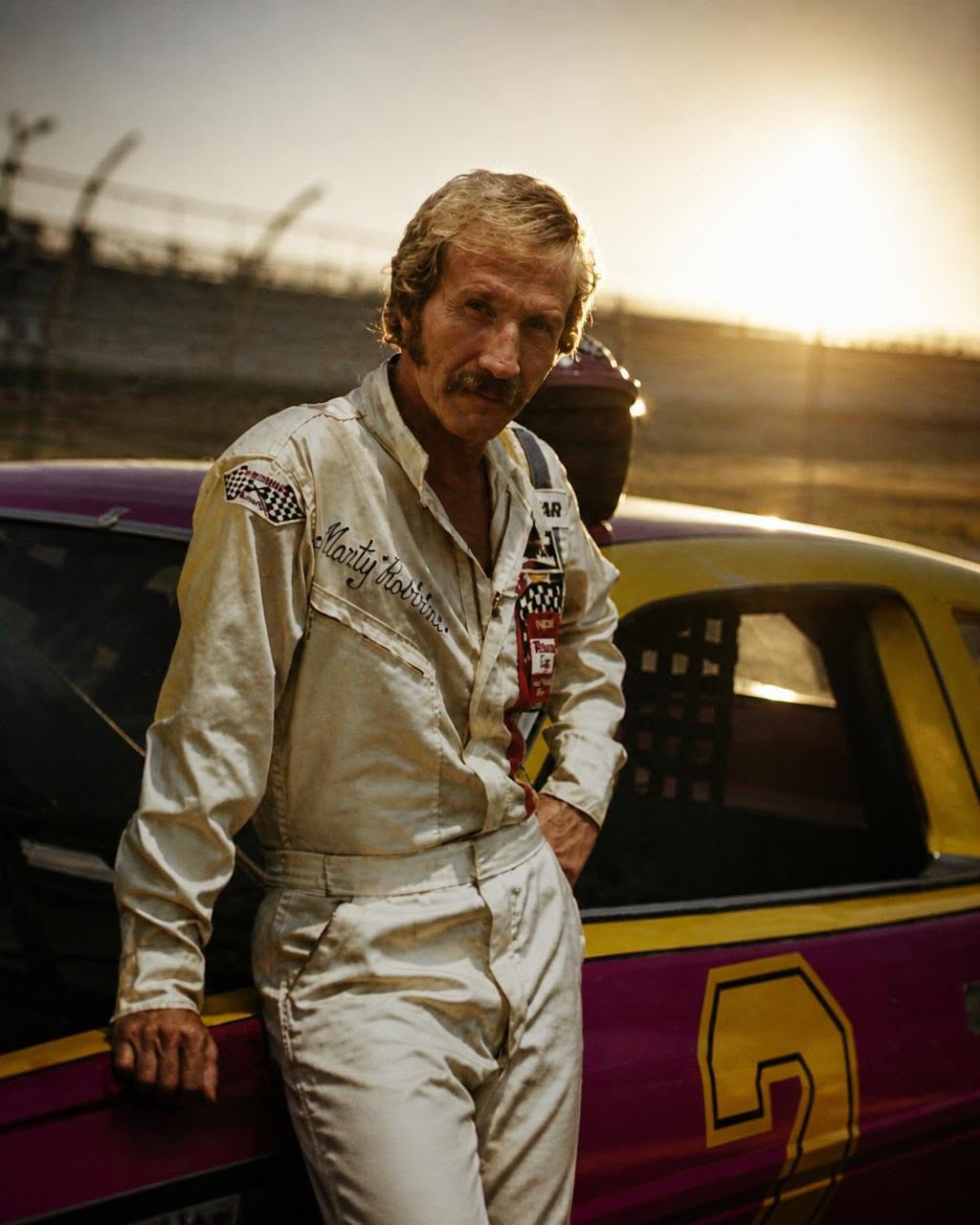
Marty Robbins, the Voice of the Last Ride
Millions came to know Marty Robbins through songs about men who rode toward danger, even when the ending seemed already decided. In El Paso, his calm, steady delivery made the cowboy’s return feel almost inevitable. The song carried risk, love, and fate in the same breath, and Marty Robbins sang it like he understood all three.
That feeling was not just performance. Away from the microphone, Marty Robbins lived with a real attraction to speed. He was deeply involved in stock car racing and competed in NASCAR events, putting himself on tracks where every lap demanded nerve, timing, and trust in the machine beneath him. Music made him famous, but racing gave him another stage entirely.
He did not treat racing like a hobby for photo opportunities. Marty Robbins kept returning to the driver’s seat even after serious health problems. He suffered heart trouble over the years, including major surgery, yet he still came back to the sport that had captured him. To fans, that only made the contrast more striking: the man who sang about danger on horseback was also chasing speed on asphalt.
A life lived at full throttle
Marty Robbins’ racing career became part of the larger story people told about him. He entered 35 career NASCAR Grand National Series races and earned six top-10 finishes. For a singer with a packed touring schedule, that was no casual side note. It was proof that he was willing to test himself in a world where talent alone was never enough.
His final NASCAR race came on November 7, 1982, in the Atlanta Journal 500. Just one month later, on December 8, 1982, Marty Robbins died at age 57 after another heart attack. The timing gives his story a hard edge. He did not drift away from racing quietly. He was still competing near the end, still choosing motion over caution.
He sang about men heading toward the inevitable, then spent his own life refusing to stand still.
Why the songs still matter
Part of Marty Robbins’ greatness came from the way he made danger feel human. His western ballads were not just stories of gunfire and dust. They were songs about longing, fear, loyalty, and the terrible pull of what a person loves most. That is why El Paso endures. It is dramatic, but it is also tender.
Knowing about Marty Robbins’ racing life adds another layer to that voice. He was not singing from a distance. He had his own relationship with risk, and perhaps that is why his performances felt so believable. The cowboy in the song and the driver on the track were both chasing something larger than safety.
In the end, Marty Robbins left behind more than hit records and racing statistics. He left a portrait of a man who kept moving, even when the road was dangerous. That combination of music, courage, and stubborn momentum is what makes his story still feel alive.
Post navigation
When people talk about Ben Haggard, they often start with the same skeptical question: is this a tribute, or is this inheritance? It is an easy question to ask and a harder one to answer. Ben Haggard plays his father’s songs, on his father’s bus, with his father’s band, using his father’s guitar. To some listeners, that sounds like a legacy act built on memory alone. But the story inside that reputation is more complicated, and more human, than the criticism suggests.
Merle Haggard did not raise a son who drifted into the role by accident. By the time Merle Haggard realized how well Ben Haggard could play, the music had already been forming in private. One night, Merle Haggard heard Ben Haggard practicing through a bedroom door and asked how he had learned to play like that. Theresa Ann Haggard’s answer was simple: Ben Haggard had been watching Merle Haggard. That detail matters, because it changes the story from imitation to apprenticeship.
A Seat Earned, Not Handed Down
Ben Haggard was not given a free pass into the band. He played in Merle Haggard and The Strangers as a teenager and stayed in that lead guitar seat for years while Merle Haggard was still alive. That kind of pressure can crush a musician, but it can also sharpen one. Night after night, Ben Haggard had to prove that the famous last name was not the only reason he was standing there.
The criticism never fully disappears. A son performing his father’s catalog will always invite comparison, and comparison can be brutal. Yet there is another truth underneath the noise: Ben Haggard is not pretending to be anyone else. He is carrying the songs forward with the tools Merle Haggard left behind, and that includes more than a guitar. It includes a road life, a bandstand, and a set of expectations that most musicians never face.
The Message Left Behind
On April 6, 2016, Merle Haggard died on his 79th birthday. In the stories that followed, one instruction kept returning to the surface. Merle Haggard had reportedly told Ben Haggard that he would be an idiot not to take the guitar, the bus, and the songs, and keep playing them as long as he could. The message was blunt, which made it sound like Merle Haggard: no mystery, no soft landing, just the work.
Merle Haggard also gave Ben Haggard another piece of advice while he was growing up: you’ve got to create your own thunder. That line may be the key to understanding why Ben Haggard’s story lands differently than a simple tribute act. Ben Haggard was asked to preserve a tradition, but he was also challenged to become his own player inside it.
Ben Haggard did not just inherit a stage. He inherited a responsibility.
Maybe that is why the debate around Ben Haggard never feels complete. The songs belong to Merle Haggard, but the performance belongs to the moment. Every night, Ben Haggard stands in a shadow that is impossible to ignore, and still he keeps going. That is not just nostalgia. It is a son answering a father’s command, one song at a time.