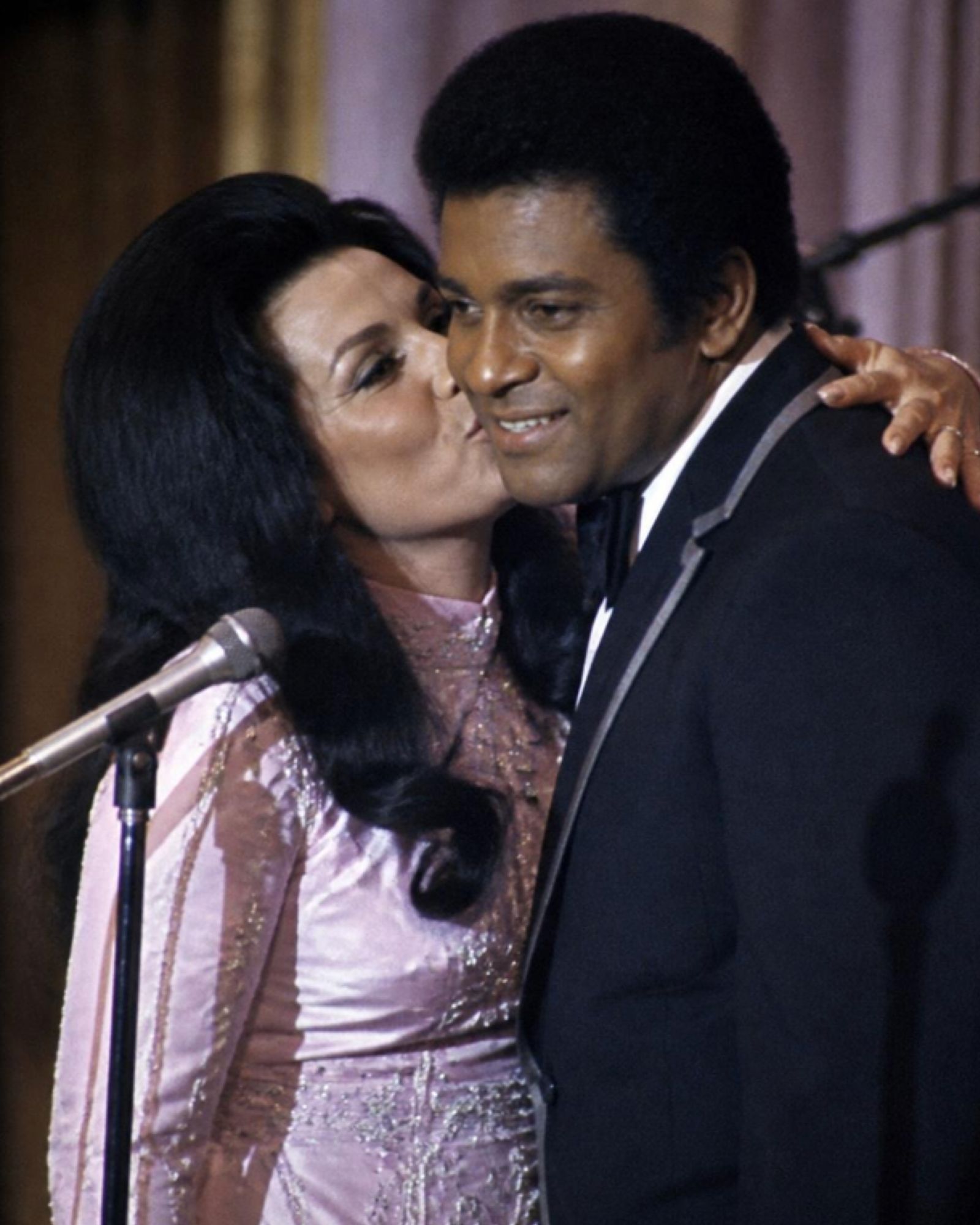
LORETTA LYNN WAS WARNED THAT ONE KISS ON CAMERA COULD END HER CAREER IN COUNTRY MUSIC. SHE DID IT ANYWAY. She told this one on herself, years later, in Coal Miner’s Daughter. Her daddy, she wrote, was color-blind two ways: he couldn’t tell certain shades apart, and he couldn’t see color in people either. So when the folks around her explained that kissing Charley Pride on national television would hurt her standing with country fans, it didn’t land as advice. It made her mad. She already knew the story of a girl singer whose career got wrecked down South over one small peck on camera with a Black friend. October 16, 1972, the Ryman. Pride was presenting Female Vocalist of the Year, a year after becoming the first Black artist to win the CMA’s Entertainer of the Year. When Loretta’s name was called, she made sure to give him a big hug and a kiss, right on camera, no hesitation. Nobody canceled her. And if they had, she said, she’d have gone home to her babies and “canned some string beans and the heck with them all.” A few hours later, on that same stage, they named her Entertainer of the Year, over Merle Haggard, Freddie Hart, Jerry Reed, and Pride himself. First woman ever to win it. The room that told her to keep her distance handed her the biggest trophy in the genre before the night was out. – Country Music
According to Loretta Lynn, somebody once tried to warn her that one kiss on camera could damage her standing with country music fans. The story appears in Coal Miner’s Daughter, the 1976 memoir she wrote with George Vecsey, and it says as much about Loretta Lynn’s character as it does about the era she lived in.
She wrote that her father was “color-blind” in two ways: he could not tell certain shades apart, and he could not see color in people either. That upbringing mattered. So when people around her suggested that showing affection toward Charley Pride on national television might cause trouble, Loretta Lynn did not hear a practical warning. She heard an insult.
The moment came on October 16, 1972, at the Ryman Auditorium in Nashville. Charley Pride was presenting Female Vocalist of the Year at the CMA Awards. When Loretta Lynn’s name was announced, she walked up, hugged Charley Pride, and kissed him on camera. There was no hesitation, and no apology.
As Loretta Lynn later told it, nothing terrible happened. No flood of cancellations arrived. No career collapse followed. Her response, in her own plainspoken style, was that if anyone had pulled her show, she would have gone home to her children, canned string beans, and gone on with life anyway. That line has lasted because it sounds exactly like Loretta Lynn: direct, stubborn, and unafraid to sound unsentimental.
The same evening turned into one of the biggest of Loretta Lynn’s career. She won Female Vocalist of the Year, Vocal Duo of the Year with Conway Twitty, and Entertainer of the Year. That last award made her the first woman ever to win CMA Entertainer of the Year. The same industry that had supposedly wanted her to keep her distance ended up putting the night’s highest honor in her hands.
There is also an important detail that gets repeated incorrectly online: Charley Pride was CMA Entertainer of the Year in 1971, not 1972. That matters, because it places the story in its proper historical frame and keeps the timeline honest. Pride was already a major figure by the time he stood there presenting the award.
What Loretta Lynn was really saying
Underneath the famous kiss was a deeper point. Loretta Lynn was not merely acting on impulse. She was rejecting the idea that respectability should be measured by racial boundaries other people tried to impose on her. The story, told in her own memoir, shows a woman who understood how prejudice worked and refused to help it.
If they had canceled her, she would have gone home to her babies and kept living.
That is why the anecdote still matters. It is not only about a television moment or a risky gesture. It is about a performer who understood that dignity is sometimes a decision made in public, with the cameras rolling. And in Loretta Lynn’s case, that decision was simple: she would not be told whom she could embrace.
Years later, the story still feels vivid because it carries both defiance and grace. Loretta Lynn did not give a speech. She gave a kiss. Then she kept moving, and country music had no choice but to follow.
Long before “Daddy’s Hands” became one of country music’s most beloved Father’s Day songs, it was already out in the world in a quieter, less noticed form. The Whites — Buck White and his daughters Sharon and Cheryl — recorded it for their 1985 album Whole New World. It sat there as an album track, not pushed as a single, heard by far fewer people than the song would later reach in Holly Dunn’s voice.
That detail matters, because “Daddy’s Hands” was never written with charts in mind. Holly Dunn wrote it as a Father’s Day gift for her father, a Church of Christ preacher in San Antonio. In later retellings, she described the song as something she meant to give, not promote. It was personal first, and public only by accident.
A song that found its way back home
When Holly Dunn recorded the song herself, she began taking it on the road. Night after night, she noticed the same thing: people were crying. She said she would look over at her band, trying to understand what was happening in the room. The reaction was so strong that she eventually went to her label and asked for it to be released as a single because, as she put it, something was really happening with the song.
That instinct changed everything. Released in August 1986, “Daddy’s Hands” climbed to No. 7 on the Billboard Hot Country chart and stayed there for six months. The song also brought Holly Dunn two Grammy nominations the following year. For a song that began as a family gift, the public response was enormous.
Why the song lasted
Part of the power was in its honesty. Holly Dunn did not write a generic tribute. She wrote from the center of her own life: a preacher father, a creative mother, and a household built on discipline, faith, and affection. The song felt specific, but listeners recognized themselves in it. Parents, children, and anyone who had ever felt protected by a steady presence heard something familiar in it.
“I tapped into a well of emotion.”
That emotional truth is what gave the song its second life. The words did not change from the earlier recording to the hit version. What changed was Holly Dunn herself, standing in front of audiences and turning a private memory into a shared experience.
The quiet beginning and the lasting echo
The Whites’ version remained an overlooked album cut, but Holly Dunn’s recording turned the song into something bigger than either family or format. It became a staple of June listening, a song people returned to when they wanted to remember the shape of a loving father’s life in small, ordinary gestures.
Holly Dunn later said listeners seemed to want songs about families that were stable and loving. “Daddy’s Hands” gave them exactly that. It was not flashy, and it was not written to chase a hit. It was written for one man in San Antonio, then carried far beyond him by a daughter who finally realized the room was crying for a reason.
Holly Dunn died in 2016 at age 59, but “Daddy’s Hands” still survives as one of those rare songs that feels personal no matter how many times it is heard. It began as a gift. It became a memory shared by millions.