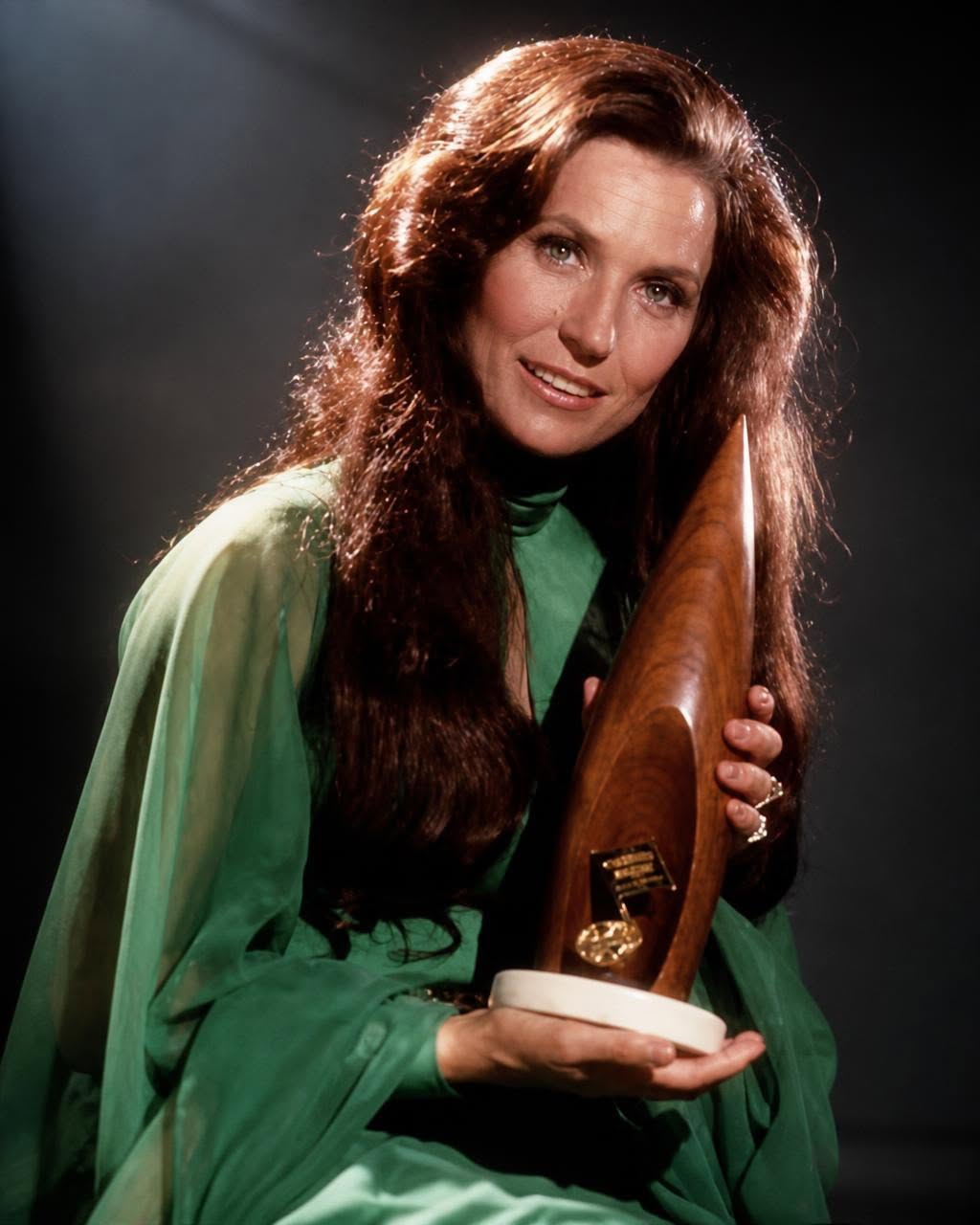
LORETTA LYNN SIGNED HER FIRST RECORDING CONTRACT IN 1960. SEVEN YEARS LATER, SHE BECAME THE FIRST WOMAN EVER NAMED CMA FEMALE VOCALIST OF THE YEAR. When Loretta Lynn entered music, she was already a wife and mother raising a family in Washington state. She had taught herself to play a guitar her husband bought for her and begun singing in local taverns and community halls. In February 1960, Loretta signed her first recording contract with the small Zero Records label. There was no powerful Nashville company waiting to make her famous. Loretta and her husband drove from town to town, carrying copies of “I’m a Honky Tonk Girl” into radio stations and asking disc jockeys to play it. They slept cheaply, saved every dollar and promoted the record themselves. Slowly, country music began listening. Loretta joined the Grand Ole Opry in 1962. She sang about marriage, motherhood, poverty and unfaithful husbands with a honesty many women recognized from their own lives. Then came October 1967. At the first CMA Awards ceremony, Loretta was named Female Vocalist of the Year—the first woman ever to receive the honor. Seven years earlier, she had been walking into radio stations with her own record under her arm. Now country music was placing its highest female vocal award in her hands. – Country Music
Loretta Lynn and the Long Road from a Hand-Me-Down Guitar to Country Music History
Before Loretta Lynn became a legend, she was a wife, a mother, and a young woman trying to make a life in Washington state. She was not arriving in music with a polished industry machine behind her. She was learning as she went, teaching herself guitar after her husband bought one for her, and singing wherever she could be heard.
A first contract, and no guarantee
On February 1, 1960, Loretta Lynn signed her first recording contract with Zero Records. It was a small beginning, but it changed everything. Her first single, “I’m a Honky Tonk Girl,” did not come with a big publicity campaign or a powerful Nashville push. Loretta Lynn and her husband did the hard work themselves, carrying records from station to station and asking disc jockeys to play them.
They traveled town to town, spent carefully, and lived with the kind of determination that does not make headlines at first. There was nothing glamorous about the road Loretta Lynn chose. Yet that road was exactly where her story took shape.
Why listeners heard her differently
What made Loretta Lynn stand out was not just the sound of her voice. It was the honesty in what she sang about. Her songs spoke about marriage, motherhood, poverty, and the disappointments that often stayed hidden in other records of the day. Women heard their own lives in her words. That connection gave her music a force that could not be manufactured.
In 1962, Loretta Lynn joined the Grand Ole Opry, a major step that confirmed what many listeners already knew: she was becoming one of country music’s most important new voices.
“I was the first to ever go into Nashville, singin’ it like the women lived it.”
The honor that marked a turning point
Then came October 1967, when the Country Music Association held its first awards ceremony. Loretta Lynn was named Female Vocalist of the Year, becoming the first woman ever to receive the honor. The moment mattered not only because it celebrated her success, but because it recognized what she had already proven: a woman could lead country music on her own terms.
Seven years earlier, Loretta Lynn had been walking into radio stations with her own record under her arm. By 1967, country music was placing one of its highest honors for female artists in her hands. The distance between those two moments tells the whole story. It was a journey built on work, nerve, and a voice that refused to soften itself for anyone.
A legacy that still feels personal
Loretta Lynn’s rise was never just about fame. It was about recognition for ordinary struggles that had long gone unsung. That is why her story still feels close to people today. She did not start with privilege. She started with persistence. And she kept going until the industry had no choice but to listen.
That is what makes Loretta Lynn’s early career so powerful: not the speed of the success, but the courage it took to earn it one town, one record, and one honest song at a time.
On a Friday in San Antonio, Johnny Rodriguez died in hospice care at the age of 73. The news did not arrive with a public farewell or a big formal service. Instead, it moved through family messages and phone screens, the modern way grief often travels now. His daughter, Aubry, shared that he had gone peacefully with family around him, and the tributes followed in the same quiet, immediate way.
For many fans, the sadness came with a second feeling: disbelief at how far his story had traveled, and how little of it still feels fully recognized. Johnny Rodriguez was born into a large family in Sabinal, Texas, and grew up in a home where music and hard work were part of everyday life. He did not arrive in country music through a polished industry pipeline. He arrived through hunger, talent, and luck that sounded almost like fiction. A Texas Ranger reportedly heard him singing while he was jailed as a teenager, and that moment helped set his future in motion.
A life that began far from Nashville
Johnny Rodriguez’s rise was remarkable because it came from so little formal access. He learned to sing in church, carried that sound into his early years, and eventually made his way to Nashville. From there, he went on to become one of the most visible Mexican-American voices in mainstream country music, earning six No. 1 hits and a place in the genre’s history that still deserves more attention than it has sometimes received.
That history matters because Johnny Rodriguez opened a door for singers who could see themselves in him. His success proved that a South Texas kid with a different background could stand beside the biggest names in country and belong there. That was not a small cultural shift; it was a signal to a whole generation.
The farewell happened online
There was no widely announced public funeral, no line outside a chapel, and no stage crowded with formal speeches. Instead, the goodbye moved through tribute posts and stories. Singer Sammy Arriaga said Johnny Rodriguez had given him courage as a country artist with Latino roots, and George Strait also offered a tribute in an Instagram story, recalling how Johnny Rodriguez’s success made him believe there might be room for a Texas singer like himself.
That detail says a lot about the times we live in. The deepest goodbyes are not always delivered from a podium anymore. Sometimes they appear briefly on a screen, then vanish. But even when the posts disappear, the impact stays.
What remains
Johnny Rodriguez did not just have a career. He had an opening act for other people’s dreams.
His death closes a chapter, but not the story. The songs remain. The influence remains. And for artists who came after him, the most important part may be that he showed up first and proved that the door could open.