IN 1991, A NEWSPAPER CALLED THEM “THE SAINT AND THE SINNER.” THEY WERE ON THE SAME TOUR BUS. Conway Twitty was the saint. He never drank. Never touched drugs. Kept his private life so quiet that even people in Nashville didn’t know much about him. George Jones was the sinner, and everybody knew it. The drinking. The drugs. The nights he simply didn’t show up. They called him “No-Show Jones” and he wore it like an old coat. Two men who had almost nothing in common. And still, there they were — same stages, same road, each singing his own set. Someone asked Conway why he kept touring with him. He said the contrast was the whole point. People got both sides of country music in one night. Then he said something that wasn’t about music at all. “We’re not real close friends… But George has been as close a friend as I’ve had in the music business over the years.” Conway died two years later. He was 59. That same year, George walked into a studio and sang “Hello Darlin’.” Conway’s song. – Country Music
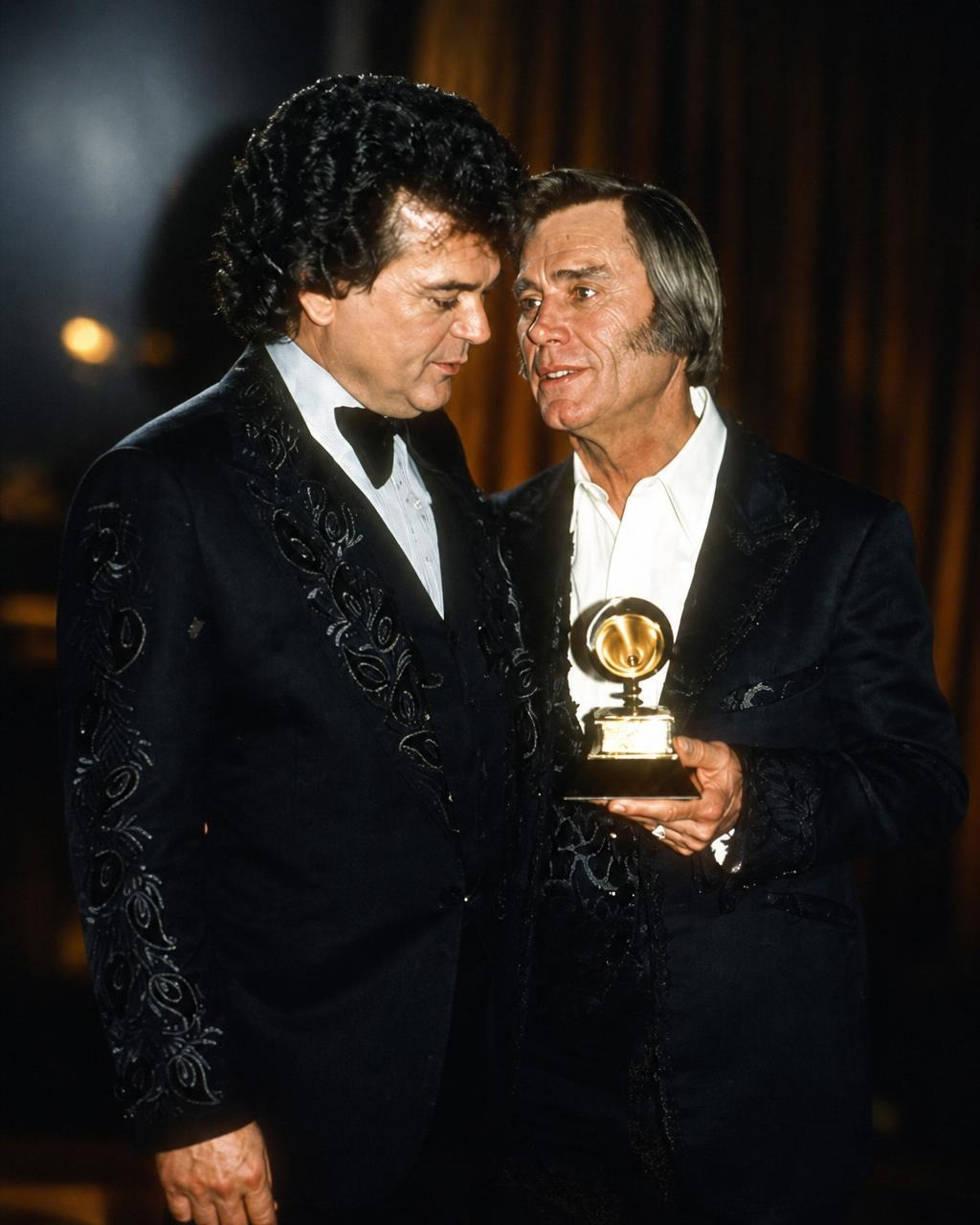
In country music, some pairings make sense only after you have lived with them for a while. Conway Twitty and George Jones were one of those pairings. On paper, they looked like opposites. Conway Twitty carried himself like the polished gentleman of the road, steady and private. George Jones was the unruly legend, famous for talent just as much as for the chaos that followed him.
By 1991, the contrast had become part of the story. A newspaper once framed them as “the saint and the sinner,” and the label stuck because it was so easy to understand. Conway Twitty did not build his image on scandal. George Jones, meanwhile, had already spent years fighting the reputation that came with missed shows, hard living, and the nickname that followed him everywhere.
And yet the two men kept ending up in the same orbit. They shared stages, shared long miles, and shared the strange fraternity that exists only on tour buses and backstage hallways. Country music has always been about contradiction, and Conway Twitty and George Jones seemed to prove it every night. One voice could sound smooth and controlled; the other could sound weathered, wounded, and utterly unforgettable.
When asked why he kept touring with George Jones, Conway Twitty answered with more insight than drama. He said the contrast was the whole point. Fans were getting both sides of country music in one night. That line says a lot about him. It was not just business, and it was not just tolerance. It was a recognition that greatness can come in more than one shape.
Then Conway Twitty said something even more revealing: “We’re not real close friends… But George has been as close a friend as I’ve had in the music business over the years.” It was a modest sentence, but it carried weight. In a world built on image, Conway Twitty admitted that respect can be deeper than closeness, and friendship can exist even when personalities do not match.
Conway Twitty died in 1993 at the age of 59. That loss changed the road for everyone who had traveled beside him. The following year, George Jones entered a studio and recorded “Hello Darlin’,” one of Conway Twitty’s signature songs. For a moment, the contrast that had defined them seemed to collapse into something softer: one man honoring another, not with speeches, but with a familiar song and a voice carrying memory.
That is why the story still lingers. It is not really about a saint and a sinner. It is about two artists who understood that country music contains both grace and wreckage, sometimes in the same life, sometimes on the same bus.
Post navigation
How Willie Nelson Turned Johnny Bush’s “Whiskey River” Into a Country Music Homecoming
For decades, Willie Nelson has opened his shows with a song written by a man Nashville once seemed unsure how to place. That song was “Whiskey River,” and the man behind it was Johnny Bush, a Texas singer with a powerful voice, a deep feel for classic country, and a career shaped as much by timing as by talent.
Johnny Bush first made his name keeping the beat, not standing in front of the microphone. He played drums for Ray Price’s Cherokee Cowboys and later worked in Willie Nelson’s band, the Record Men. In Nashville, though, success was never simple. Bush was often seen as too close to Ray Price’s style to be treated as a fresh new act, and that kind of label could slow a singer down before the public even got a chance to hear him.
Willie Nelson understood that problem. He had heard versions of it himself. So in 1967, he helped Johnny Bush get a start by paying for Bush’s first album on the small Stop label and giving him “You Ought to Hear Me Cry” to record. The record did not explode, but it opened a door. Later singles like “Undo the Right” and “You Gave Me a Mountain” performed better, and by 1972 RCA signed Johnny Bush. His first single for the label was a song he wrote himself: “Whiskey River.”
A song that found a second life
Willie Nelson recorded “Whiskey River” the next year for Shotgun Willie, and that is where the song’s destiny really changed. It became more than a single or an album track. It became an introduction, a ritual, a signal that a Willie Nelson concert had begun. Over time, fans came to associate the opening chords with the whole experience of seeing Willie Nelson live.
But Johnny Bush’s story took a painful turn just as his music should have been reaching wider audiences. His voice began to fail, and for years the reason was not fully understood. Doctors eventually identified the problem as spasmodic dysphonia, a neurological disorder that affects the muscles used for speaking and singing. RCA dropped Johnny Bush in 1974, and there were periods when he could barely speak, let alone perform the way he once had.
“The money it earned me saved me through the spasmodic dysphonia years.”
That is how Johnny Bush later described the gift of “Whiskey River.” The song did not erase hardship, but it gave him support when he needed it most. And in a business that can forget its own history, Willie Nelson kept the song alive night after night, year after year.
A quiet kind of loyalty
What makes this story endure is not just the hit record or the chart positions. It is the loyalty underneath them. Johnny Bush helped shape the sound around Willie Nelson. Willie Nelson, in turn, helped carry Johnny Bush’s name forward by making “Whiskey River” the first song audiences heard when he stepped onstage.
It is a reminder that country music often runs on memory as much as momentum. A song can begin as one singer’s struggle, then become another singer’s promise, and finally turn into a shared tradition. In the case of Johnny Bush and Willie Nelson, that tradition has lasted long enough to feel like part of American music itself.