“I Miss My Baby Every Day”: A Mother’s Search for Justice After a Night That Changed Everything. – Daily News

The courtroom was full, but it felt hollow.
Rows of benches were packed with family members, friends, and strangers who had come not out of curiosity, but out of grief. Some held photos. Some held hands. Some stared straight ahead, afraid that if they looked down, the weight of why they were there would finally crush them.
Kristen Williams sat quietly, her body still, her heart anything but.
Just weeks earlier, her daughter had been alive. Laughing. Planning. Existing in the ordinary way young people do when they believe tomorrow is promised.
Now, Kristen was watching two men stand before a judge, formally charged with murder in the shooting that took her daughter’s life.
“I hope they get what they need to get,” she said later, her voice steady in a way that only comes after crying has already done its worst. “I just want justice.”
Her daughter’s name was Cori Marie May Watts.

She was twenty-two years old.
To the court, Cori was listed as a victim.
To her mother, she was still a child.
“I miss my baby every day,” Kristen said. “Every single day.”
She spoke of Cori’s spirit — the way she showed up for people, the way she gave without keeping score.
“She had a beautiful soul,” Kristen said. “She would do anything for anybody.”
Now, that generosity had been met with violence.

The charges laid out in court were long and heavy. Sixteen counts each against the two defendants — assault with intent to murder, open murder, armed robbery, and weapons charges. The words stacked on top of each other, each one more severe than the last.
But for the families sitting in that room, no number of charges could equal the loss.
Two lives had been taken that December night.
Cori’s.
And Joshua Fondren Jr.’s, twenty-five, who died at the scene.
Others survived — but with injuries that would follow them long after the courtroom emptied. Even a child had been caught in the chaos, grazed by a bullet, old enough to remember fear but too young to understand why it happened.

When prosecutors spoke, they did so carefully, methodically. They talked about parole status. Criminal histories. Flight risk. Prior convictions.
Necessary details.
But behind every sentence was an unspoken truth: this violence did not happen in a vacuum.
The assistant prosecutor stood firm when defense attorneys requested bond.
“This case is egregious,” she said. “We have significant loss of life. Significant injuries. Minor children involved. This is not a situation where public safety can be ensured.”
One of the defendants had been on parole at the time of the shooting. The other carried a criminal history so extensive it was hard to comprehend someone so young accumulating so many prior offenses.
Bond was denied.
Twice.

The judge’s decisions landed quietly but firmly, like a door closing — not with satisfaction, but with finality.
In the gallery, no one cheered. No one smiled.
Justice, when it comes wrapped in tragedy, does not feel like victory.
It feels like survival.
Afterward, Kristen Williams stood outside the courthouse, winter air biting at her face. Cameras waited. Microphones hovered. But all she carried with her was the same ache she had woken up with every morning since the shooting.
“I’m very lost,” she said softly. “I’m very lost without her.”
She paused, gathering herself.

“But I know she’s looking down,” she added. “She’s keeping us strong.”
It was not certainty. It was hope — the fragile kind grief leaves you with when everything else has been taken.
Cori’s final moments replayed endlessly in her mother’s mind.
“Her last words were, ‘Please don’t kill me,’” Kristen said.
Words no parent should ever have to imagine.
Words that echo in the quiet hours, long after court proceedings end and headlines move on.
The shooting itself had been sudden and violent. What was supposed to be an ordinary night became irreversible in seconds. A robbery, according to court documents. Guns. Jewelry. Money. Lives reduced to transactions.

But Cori had not known the men accused of killing her. Her mother made that clear.
“She didn’t know them,” Kristen said. “She didn’t deserve this.”
No one did.
As investigators pieced together what happened, the community tried to do what communities do when tragedy hits close to home — they showed up.
Messages poured in. Prayers. Meals. Donations.
A GoFundMe was created to help cover funeral expenses, because even in grief, practical burdens don’t pause. Bills still come. Costs still exist. Loss does not exempt anyone from the realities of life.
And yet, people gave.
Because Cori mattered.
Because Joshua mattered.

Because families left behind deserve to grieve without drowning in logistics.
The prosecutor later explained that the defendants’ incarceration on parole violations had given authorities time — time to build a thorough case, time to gather evidence, time to ensure that charges were not rushed, but right.
It was a measured explanation, offered with professional calm.
But for Kristen, time felt different now.
Time was something that used to be full — filled with phone calls, plans, laughter, moments that felt ordinary.
Now, time was empty space.

She spoke of her daughter not as a victim, but as a presence that still lingered.
“She would help anybody,” she repeated. “Anybody.”
That was how she wanted Cori remembered — not for how she died, but for how she lived.
In the days following the arraignment, the families returned home to a new version of normal. One where bedrooms stayed untouched. Phones stayed silent. Chairs at tables remained empty.
The legal process would continue. Hearings in February. Motions. Arguments. A long road toward whatever justice could realistically mean.
But grief does not follow court calendars.
It does not wait for verdicts.
It settles in quietly and rearranges everything.

Kristen said some days were harder than others. Some days she felt numb. Some days she felt everything at once.
What kept her moving forward, she said, was the belief that Cori’s life mattered beyond the violence that ended it.
That her name would not be reduced to a case number.
That her story would be told with care.
Because behind every headline about charges and arraignments are people who loved deeply — and are now learning how to live with absence.
“I miss my baby every day,” Kristen said again.
And in those five words lived an entire universe of loss.
A mother without her daughter.

A family without its laughter.
A community marked by another wound.
Justice, if it comes, will come slowly.
But love — love remains immediate.
And in the quiet moments, when the courtroom is empty and the cameras are gone, that love is what carries families like Kristen Williams’ forward — one breath, one memory, one day at a time.
The room was never meant for mercy.
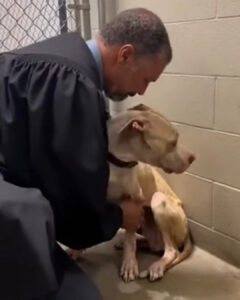
It was small and bare, the kind of place built for containment, not comfort. Cold concrete floors carried the faint smell of disinfectant, and fluorescent lights hummed overhead with a tired insistence. The walls had seen fear, confusion, and the quiet aftermath of cruelty. This was where broken animals waited—sometimes for healing, sometimes for an ending no one wanted to name.
Judge Wallace stepped inside wearing the same black robe he had worn for decades.
In court, that robe meant authority. It meant distance. It meant order imposed on chaos. From behind the bench, he had sentenced abusers, read reports thick with suffering, and spoken firmly about accountability. He believed in justice, deeply and without apology.
But nothing in his career had prepared him for Martin.
The pit bull lay pressed into the corner of the kennel, his body curved inward as if trying to disappear. His ribs rose sharply beneath stretched skin, each breath shallow and uneven. His legs were folded beneath him, not resting, but collapsed—too tired to hold weight, too worn down to expect relief.
Weeks earlier, Martin had been chained outside without food or water. No shelter. No kindness. Just heat, cold, hunger, and the slow erosion of hope. By the time animal control intervened, he was barely alive—more instinct than strength.
Shelter technicians had tried everything. Soft hands. Quiet voices. Slow feeding. But Martin did not respond. He stared through people, eyes dulled by the lesson cruelty teaches too well: don’t trust, don’t reach, don’t hope.
Judge Wallace read the file before he arrived.
He thought he was prepared.
He wasn’t.
Without hesitation, the judge lowered himself to the floor. His robe pooled around his knees, dark fabric stark against the pale concrete. It was an instinctive movement—no performance, no calculation. Just a man choosing to come down to the level of the pain in front of him.
“Hey… buddy,” he said quietly.
The words were simple. Unpolished. Human.
At first, there was no reaction.
Then—barely perceptible—Martin’s ears twitched.
The room froze.
Judge Wallace leaned closer, his voice thickening as emotion pressed past years of professional restraint.
“Martin,” he said softly. “I heard your story.”
Something shifted.
Martin lifted his head just a fraction, eyes focusing for the first time. His body trembled as he tried to move, muscles weak from starvation and neglect. Every inch forward looked like it cost him everything he had left.
Slowly, painfully, Martin crawled.
It wasn’t confidence. It wasn’t certainty. It was the fragile act of someone who had learned reaching out usually brought pain—but was trying anyway.
He crossed the short distance and collapsed into the judge’s lap.
No one breathed.
Martin’s bony frame pressed against the man in black robes, his head resting where a gavel usually would have been. He lifted his muzzle and licked Judge Wallace’s cheek—once, then again—small, tentative gestures, as if checking whether this was real.
Judge Wallace’s hand came down gently on Martin’s head.
“You’re safe now,” he whispered.
The words cracked.
Tears slid freely down his face, unguarded and unnoticed. He wrapped his arms around Martin, careful not to squeeze, careful not to hurt. The dog’s breathing was ragged but warm. Alive.
“It’s over,” the judge murmured. “It’s all right now.”
For a long moment, neither moved.
A shelter technician turned away, hand covering her mouth. Another wiped her eyes quickly, embarrassed by tears in a place where cruelty was usually the headline. But no one looked away for long.
Because something sacred was happening.
This wasn’t a courtroom. No verdict was being read. No sentence announced. And yet justice was unfolding—not written in law books, but felt in the body. Suffering was being witnessed. Power had knelt instead of towering above.
Martin’s body softened. The tension in his shoulders eased. His eyes fluttered, then opened again, as if afraid the moment might vanish if he stopped watching it.
“You’re not alone anymore,” Judge Wallace said softly. “I promise.”
Martin’s tail gave the faintest wag—slow, uncertain, but real.
The judge let out a shaky breath he hadn’t realized he’d been holding. He rested his forehead gently against Martin’s, eyes closed, grounding himself in the truth of the moment.
Around them, the shelter continued its quiet rhythm. Cages clinked. Footsteps echoed. Life moved forward.
But something had changed.
Martin had been brought here as evidence in an animal cruelty case—a living record of neglect. In that moment, he became something else.
A bridge.
Between law and mercy. Between authority and compassion. Between a man trained to remain impartial and a dog who had learned the world only brought pain.
Later, people would talk about the image: a judge on the floor, holding a starving pit bull. Some would call it unprofessional. Others would call it exactly what the world needs more of.
For Martin, none of that mattered.
What mattered was this: after weeks of being invisible, he had been seen. After weeks of hunger, he had been held. After weeks of learning humans cause pain, he learned—perhaps for the first time—that one could kneel, look him in the eyes, and choose kindness.
Judge Wallace stayed there longer than anyone expected. The cold seeped into his knees. The robe gathered dust. None of it mattered.
He had sentenced cruelty many times before.
But this—this was justice meeting pain face to face.
Long after he stood, long after the robe was brushed clean, the moment stayed with him. It followed him back to the courtroom, back to the bench, back into every case that crossed his desk.
Because sometimes justice isn’t about punishment.
Sometimes justice looks like a man in a black robe kneeling on cold concrete, holding a broken dog, and whispering words that mean more than any sentence ever could:
“You’re safe now.”