Heroic Horse Leads Companions to Safety Amid California Blaze. – Daily News
The fire came fast, faster than anyone expected.
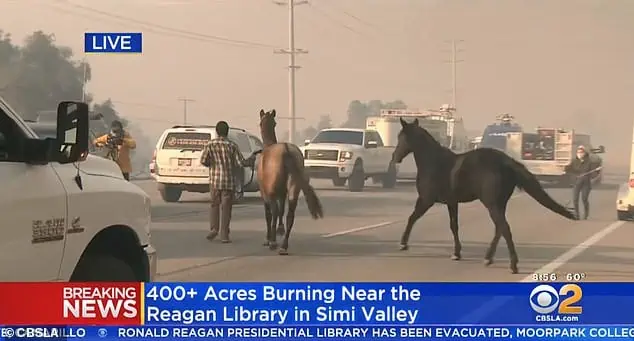
One moment the hills were dark and quiet, the kind of early morning calm that settles over ranch land before the day truly begins. The next, the sky glowed an angry orange, wind howling like something alive, carrying sparks that leapt from brush to fence to stable in seconds.
The Easy Fire did not creep forward.
It charged.
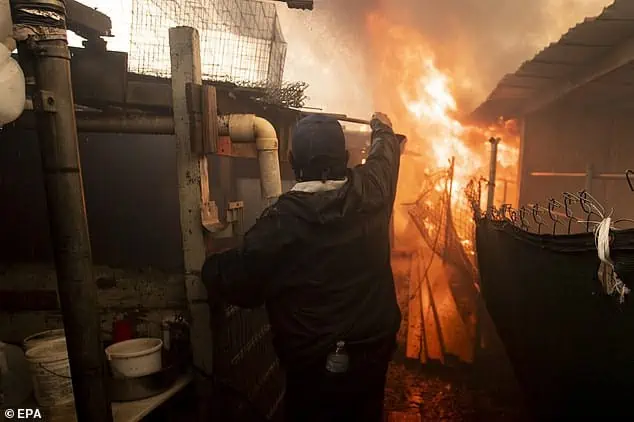
Flames tore through dry land with terrifying speed, driven by hurricane-force winds that bent trees and turned embers into weapons. Smoke thickened the air, stinging eyes and burning lungs, reducing the world to silhouettes and shadows.
And in the middle of it all—horses panicked.
Ranchers ran through heat and ash, shouting, coughing, hands waving wildly as they tried to free animals frozen by fear. Horses don’t understand fire the way humans do. They understand danger, noise, confusion. They understand the instinct to flee—but not always where to go.
Gates were opened. Fences rattled. Halters snapped against frantic hands.
Some horses bolted the moment they were released, hooves pounding the ground as if speed alone could save them. Others reared, eyes wide, muscles locked between terror and instinct. Smoke swallowed everything, turning familiar paths into chaos.
Then one horse reached the road.
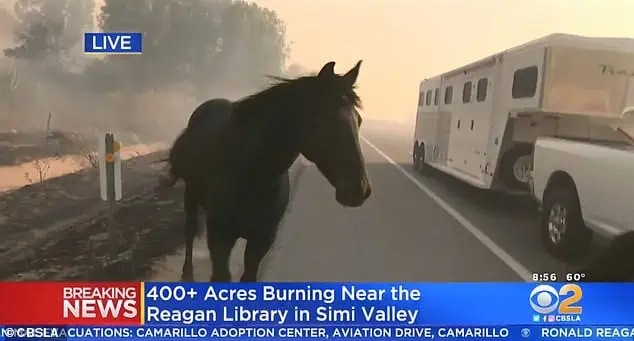
A tall black horse burst through the smoke and onto the highway, his coat dusted with ash, nostrils flaring, chest heaving. For a split second, it looked like he was safe. Ranchers shouted, arms raised, urging him forward, away from the inferno consuming the land behind them.
But the horse stopped.
He turned his head.
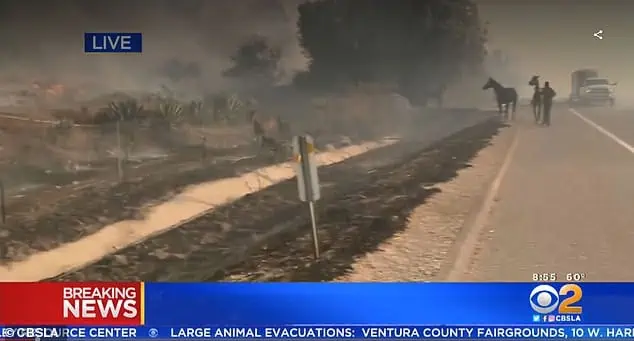
Behind him, beyond the wire fence and the rolling flames, his home burned. And inside that chaos—others were still trapped.
What happened next stunned everyone who witnessed it.
The black horse spun around.
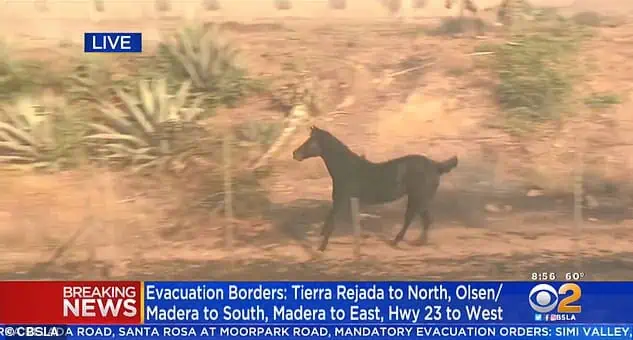
Not in panic.
Not in confusion.
With purpose.
He ran back toward the fire.
Through smoke so thick it swallowed his shape, he disappeared into the fenced ranch again, moving against every instinct for self-preservation. Flames licked the ground. Ash fell like black snow. Wind screamed through the valley.
And then—movement.
Out of the smoke emerged the black horse again.
But this time, he wasn’t alone.

A brown horse followed close behind, head low, legs pumping hard. And beside them, barely keeping pace, was a young colt—small, frightened, struggling to match the longer strides of the adults.
The black horse stayed between them and the fire.
He slowed when the colt lagged. He surged forward when the others hesitated. He guided them—not by force, but by presence—keeping them together, keeping them moving, leading them straight toward the open road and safety beyond.
Ranchers shouted again, but this time in disbelief.

People watching from vehicles froze, phones raised, hearts pounding as three horses burst onto the highway, hooves skidding on asphalt, smoke curling around their bodies.
They made it.
All three.
The black horse didn’t stop running until the others were clear of danger. Only then did he slow, sides heaving, head lifted high as if counting, checking, making sure everyone was there.
It was over.
For them.

Not every story that day ended that way.
Amid the chaos, a 28-year-old mare broke her front legs while trying to escape the flames. There was nothing anyone could do. She was euthanized on the spot, spared further suffering but lost to a fire that showed no mercy.
That loss hung heavy in the air, even as rescues continued and helicopters dropped water and fire retardant in desperate attempts to slow the blaze. The fire tore across more than a thousand acres in hours, threatening homes, landmarks, entire communities.
Horses were evacuated wherever possible—trailers lining roads, people guiding terrified animals through smoke-choked paths under police escort. Some ranchers had minutes. Others had seconds.
Through it all, that moment replayed again and again.
The black horse turning back.
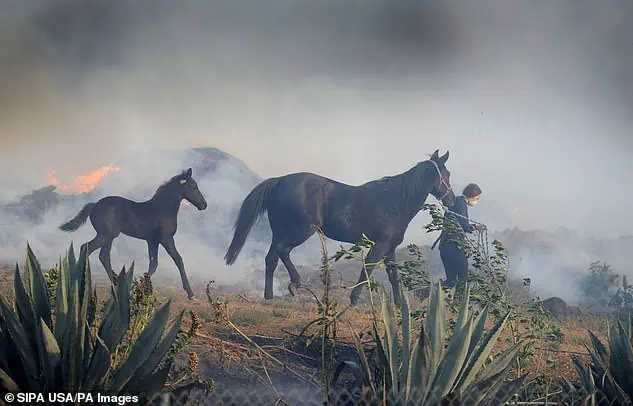
People struggled to explain what they had seen.
“Horses don’t do that,” some said.
“They panic. They run.”
But anyone who has lived with horses knows the truth is more complicated.
Horses are herd animals. Their survival has always depended on one another. They feel loss. They feel responsibility. They follow leaders—and sometimes, they become one.
That black horse didn’t know about acreage burned or wind speeds or evacuation orders. He didn’t know what climate change was doing to the land. He didn’t understand headlines or statistics.
He knew only this:
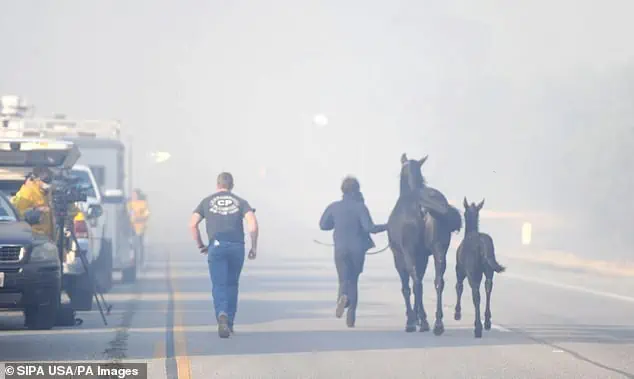
He was not leaving without the others.
Later, as the fire continued to rage across Southern California, more stories of rescue surfaced. Horses relocated in the dark. Owners sleeping in trucks beside temporary corrals. Volunteers working until exhaustion blurred their vision.
But the image that stayed with people—the one shared again and again—was that horse.
Running back into smoke.
Turning away from safety.
Choosing his family.

In a disaster defined by destruction, that single act cut through the horror.
It reminded people that courage does not always wear human form. That bravery can come on four legs, driven by instinct older than fire itself.
When the flames finally eased and the smoke thinned, ranchers returned to land that no longer looked like home. Fences were gone. Stables blackened. Trees reduced to skeletal outlines against a gray sky.
But some horses stood alive where moments before they might not have.
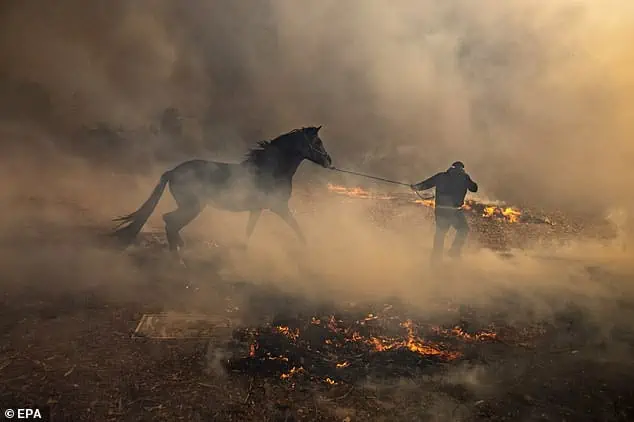
Because one of them refused to run alone.
In the aftermath, people would argue about preparation, about climate, about policy. They would count acres and losses and costs.
But for those who saw that video, who watched three horses emerge from an inferno because one turned back, the story carried a different meaning.
In the worst moments—when fear tells you to save yourself—there is still room for loyalty.

There is still room for leadership.
And sometimes, hope takes the shape of a black horse cutting through smoke, guiding the vulnerable to safety, proving that even in a world on fire, compassion can still find a way through the flames.
The night did not arrive with warning.
It came quietly, the way most evenings do in small communities—doors closing, lights flicking on, families settling into routines that feel safe simply because they are familiar. No one knew that within hours, Clay County would be changed forever.
By the time the sun rose the next morning, six lives were gone.
Among them was a child.
The first calls came in just before evening fully settled. Deputies rushed toward a home where something unthinkable had already happened. Inside were three men—family members—who would never walk out again. A father. A brother. An uncle. Their lives ended abruptly, without the chance to understand what was unfolding around them.
News traveled fast, but not fast enough to stop what came next.
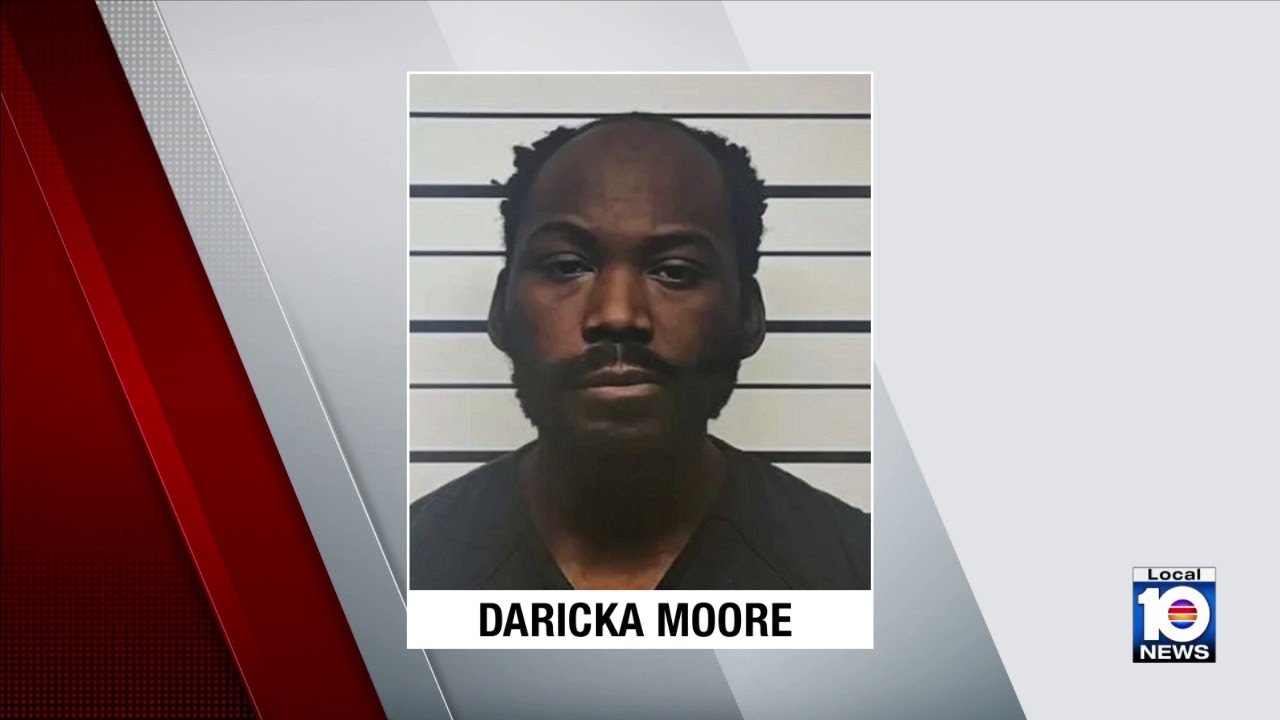
The suspect, a 24-year-old man later identified by authorities, fled the scene in a stolen truck. What followed was not a single act of violence, but a trail of terror that stretched across multiple homes and families—each stop leaving devastation in its wake.
At another house, children were inside.
A mother. Three young lives sharing a space that should have been safe. A place meant for laughter, bedtime routines, and quiet moments before sleep.
Instead, fear forced its way through the door.
Authorities later said the intruder broke in and chaos followed. In that house, a 7-year-old girl—full of life, known to her family as Mikiylia—was shot and killed. Her name would soon be spoken through tears, through disbelief, through the kind of grief that doesn’t yet know how to exist.
She was someone’s daughter. Someone’s cousin. A child who should have been worrying about homework, about toys left on the floor, about tomorrow.
Instead, her life ended in violence she could not understand.
Two other children were there, witnesses to something no child should ever see. One of them, according to investigators, had a weapon pressed to their head—an image so horrifying it leaves even seasoned officers struggling for words.
And then, for reasons no one yet understands, that child was spared.

That unanswered “why” will likely haunt this community for years.
The violence did not stop there.
The suspect continued on, driving again, carrying with him the damage already done. At another home, two more men were killed—both known, both loved. One of them was a pastor, a man whose life had been devoted to guiding others, offering comfort, faith, and stability.
In a single night, a family lost fathers and brothers. A congregation lost its shepherd. Children lost their sense of safety. A community lost its innocence.
By early morning hours, law enforcement tracked the suspect down and took him into custody. He was arrested without further injuries reported, charged with murder, with prosecutors indicating they would seek the most severe penalties allowed by law.
But no charge, no sentence, no courtroom decision can restore what was taken.
Six lives.
Six empty spaces where people once stood.
In the hours that followed, Clay County stood still. Schools prepared counselors. Churches opened their doors. Neighbors showed up with food, with hugs, with the kind of quiet presence that says, I don’t know what to say, but I’m here.
Because what do you say when something like this happens?
There is no script for telling a family their child is gone. No manual for explaining to siblings why one voice will never answer again. No way to rationalize how a normal night turned into a nightmare.
Sheriff’s officials admitted there were no prior warning signs that pointed clearly to what would happen. No known pattern. No alerts that might have stopped it. That reality only deepened the shock.
People searched for answers anyway.
Why this family?
Why these homes?
Why that child?
Questions hung in the air like smoke, unanswered and heavy.
At a press conference, officials spoke carefully, aware that every word carried weight. They acknowledged the brutality of the crimes. They acknowledged the grief. They acknowledged that the investigation would take time—and that some answers might never come.
What they could say, with certainty, was that this violence had left a scar.
In the days to come, vigils would be held. Candles would flicker against the dark. Names would be read aloud so they would not be forgotten. Stories would be shared—small details that matter more than headlines ever could.
A father who loved his family.
A brother who showed up when needed.
An uncle who made people laugh.
A pastor who prayed with others through their worst moments.
A little girl whose life was just beginning.
Mikiylia.
Seven years old.
Her name would become a symbol of everything lost, and everything that must still be protected.
Communities like Clay County are built on connections—on knowing who lives down the road, on trusting that doors can stay unlocked, on believing children are safe inside their homes. When violence breaks that trust, it doesn’t just take lives. It takes peace.
And yet, even in the darkness, people gathered.
They stood together not because they had answers, but because standing alone felt impossible. They held each other through shock and disbelief, through anger and sorrow, through the long night of realizing that nothing would ever feel quite the same again.
This was not just a crime story.
It was a human story.
A story about families who woke up to a world that had changed without their consent. About children who will grow up carrying memories they should never have had. About a community forced to confront grief on a scale it never expected.
The legal process will move forward. Court dates will be set. Charges will be argued. Words like “justice” and “punishment” will be spoken often.
But beyond the courtroom, there will be quieter battles.
Bedtime without a parent’s voice.
Holidays with empty chairs.
Birthdays that come and go with a space that can’t be filled.
Those are the parts no verdict can touch.
As Clay County mourns, one truth stands above all others: the people who were killed were more than victims. They were loved. They mattered. They were woven into the fabric of their families and their community.
And they will be remembered—not for how they died, but for who they were.
In the days ahead, this community will grieve, question, and search for meaning. It will struggle to reconcile how such violence could erupt without warning. And it will try, slowly, painfully, to heal.
But for now, there is only mourning.
Six lives lost.
One child gone too soon.
And a community forever changed by a single, devastating night.