Heartwarming Moments: Jimbo the Kodiak Bear Receives Extra Love. – Daily News
The video doesn’t begin with drama.

There is no roar. No spectacle. No reminder of how dangerous a Kodiak bear can be.
Instead, it opens on stillness.
A massive bear lowers his head slowly, deliberately, as if the weight of the world has finally become too much to hold up on his own. His fur is thick, dark, powerful—everything you would expect from an animal that weighs nearly 1,400 pounds and can stand more than 10 feet tall.
But his posture tells a different story.
Jimbo, a 24-year-old Kodiak bear, is tired.
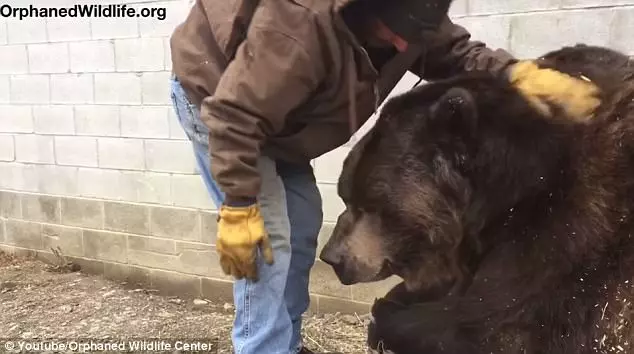
Not the kind of tired that comes from play or movement, but the quiet exhaustion that follows discomfort, illness, and long days when the body just doesn’t feel right. Earlier that week, Jimbo had been under the weather—restless, uneasy, not himself.
And on this day, he needed comfort.
So he went to the one place he knew he could find it.
Jim Kowalczik was already there.
Jim is not just a caretaker. He is Jimbo’s constant. The familiar presence who has been part of his life since he was a cub too injured to ever return to the wild. The human who learned Jimbo’s moods, his habits, the subtle shifts in his breathing that signaled something wasn’t right.
At the Orphaned Wildlife Center, love doesn’t arrive loudly. It arrives quietly, in routines, in patience, in hands that know when to be firm and when to be gentle.
Jimbo approached Jim slowly, lowering himself until his enormous head rested against Jim’s lap.
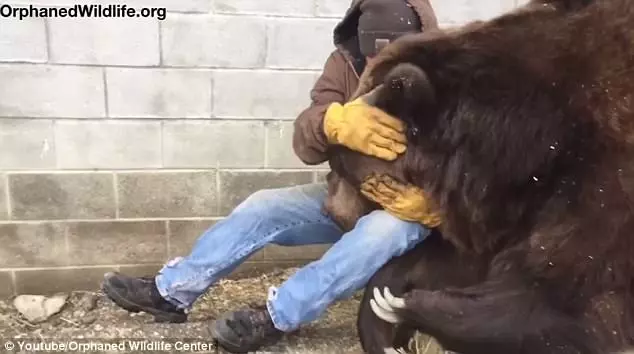
And Jim did not hesitate.
He wrapped his arms around the bear’s neck, pressing his cheek into thick fur, stroking along Jimbo’s jaw, his shoulder, the place behind his ear where Jimbo likes to be scratched. He whispered softly—words no one else needed to hear.
The kind of words you offer when you’re not trying to fix anything.
Only to be there.
For a moment that felt almost unreal, Jim placed his gloved hand gently into Jimbo’s mouth—a gesture that, out of context, would terrify most people. But this wasn’t recklessness. It was trust built over decades. A language understood by two beings who had spent a lifetime learning each other’s boundaries.
Jimbo didn’t clamp down.
He relaxed.
His eyes softened. His breathing slowed. His massive body leaned further into Jim’s presence, surrendering to the care without fear or tension.
In the background, the world faded.
There was no audience in Jimbo’s mind. No viral video. No millions of viewers waiting to react.
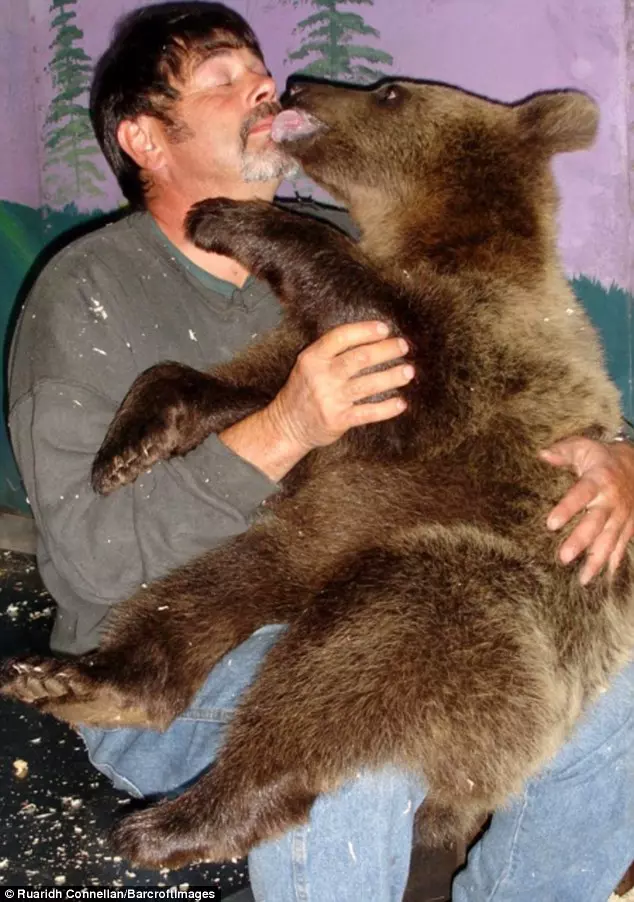
There was only a bear who didn’t feel well, and a human who knew exactly how to help.
The video was later titled simply:
“When Your Bear Had a Hard Day and Needs Some Extra Love.”
Within days, it spread across the internet, gathering more than a million views. People watched in disbelief, awe, and emotion. Many replayed it over and over, unable to reconcile the size and power of Jimbo with the tenderness of the moment unfolding on screen.
But for Jim and the Orphaned Wildlife Center, there was nothing unusual about it.
This is what care looks like when it is real.
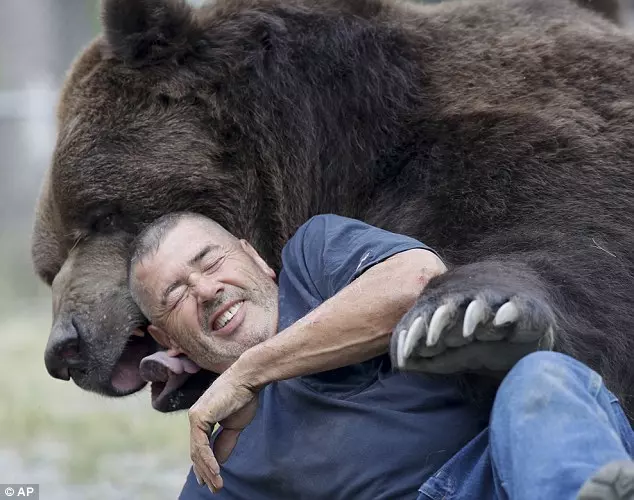
Jimbo has lived at the sanctuary since he was young. Early injuries made survival in the wild impossible, and from that moment on, his life followed a different path. Not one of captivity for entertainment, but one of protection—where his needs came before spectacle.
Jim and his wife, Susan, have built their lives around animals like Jimbo. Animals that can’t be released. Animals that require long-term commitment, specialized care, and an understanding that love doesn’t always look like distance.
Sometimes, love looks like sitting still while a 1,400-pound bear rests his head on your lap.
Sometimes, it looks like whispering to an animal who cannot understand the words but understands the intention.
On this particular day, Jimbo had just been checked by a veterinarian. The exam didn’t bring immediate answers—only the confirmation that something had made him uncomfortable, unsettled, off-balance.
So Jim did what he’s always done.
He stayed close.
He rubbed Jimbo’s neck, scratched gently under his chin, ran his hands through thick fur in slow, rhythmic motions. He let Jimbo lean, knowing that weight was not a burden—it was trust.
And Jimbo responded the only way he could.
He rested.
His massive head sank heavier into Jim’s lap. His body stilled. The restless energy faded, replaced by calm. By safety. By the quiet certainty that whatever he was feeling, he didn’t have to endure it alone.
The video ends without resolution.
No dramatic recovery. No triumphant moment.
Just a bear settling back down, receiving one last pat, one last gentle stroke, as if to say: That’s enough. I’m okay now.
For many who watched, the moment cracked something open.
It challenged assumptions about wild animals and human connection. It blurred lines people insist must remain rigid. It reminded viewers that care, when done responsibly, doesn’t erase an animal’s nature—it respects it.
Jimbo is still a Kodiak bear.
He is still powerful. Still dangerous in the wrong circumstances. Still deserving of boundaries and respect.
But he is also an individual.
One with preferences. With moods. With bad days.
And on his bad days, he is allowed comfort.
That truth—simple, profound—was what moved people the most.
Not because Jimbo was cuddled.
But because he was seen.
In a world that often treats animals as symbols, content, or cautionary tales, Jimbo was allowed to just be a living being having a hard moment.
And Jim was allowed to meet that moment with compassion instead of distance.
That is not recklessness.
That is responsibility carried for a lifetime.
As comments poured in, many people said the same thing in different words:
This is what real care looks like.
This is what trust looks like.
This is what devotion looks like.
And they were right.
Because heartwarming moments are not made by cameras.
They are made by years of showing up.
By learning when to step back and when to step closer.
By choosing patience over fear.
By understanding that love, when given wisely, does not weaken the wild—it protects it.
Jimbo didn’t need a performance.
He needed extra love.
And on that day, he received exactly what he needed.
The ride was supposed to be ordinary.

One of those quiet afternoons where the world feels wide and gentle, where the sound of hooves against sand and the steady rhythm of breathing make everything else fall away. Nicole Graham had done this countless times before—riding along the coast, her daughter Paris nearby, the sea stretching out like a familiar companion rather than a threat.
Astro had carried her through years of shows, training, and long days that ended with tired muscles and quiet pride. At 18 years old, the massive showhorse knew this landscape well. He trusted Nicole completely.
That trust was about to be tested.
It happened in seconds.
One moment Astro stepped forward, and the next his movement stopped short—too abruptly, too unnaturally. His legs sank, not into sand, but into something far more dangerous. Mud. Thick, suctioning, relentless. The kind that doesn’t let go once it takes hold.
Nicole felt the shift immediately.

Astro struggled, muscles tensing as instinct told him to pull free. But every movement only dragged him lower. The mud crept past his knees, then higher, gripping him like invisible hands.
Before fear could fully form, Nicole’s first thought wasn’t herself.
It was Paris.
Her daughter’s horse had begun to sink as well. Nicole forced herself to move, tearing free from the mud with effort that burned through her legs. She reached Paris, helped her dismount, helped the horse scramble back toward firmer ground.
Paris was safe.
Astro was not.

By the time Nicole turned back, her horse was trapped up to his belly. His breathing had changed—faster now, shallow with panic. Nicole rushed back to him without hesitation, sinking into the mud again as she grabbed hold of his neck, trying desperately to pull him free.
The mud swallowed her legs instantly.
It was like quicksand.
The more she struggled, the deeper she sank. The realization hit her all at once: she could not save him by force. And the tide—slow, inevitable—was coming in.
Paris ran for help.

Nicole stayed.
She wrapped her arms around Astro’s neck, pressing her body against his massive chest, feeling the tremble beneath his skin. The mud held them both fast, cold and unyielding. Astro tried to move again, eyes wide, fear rolling through him in waves.
“It’s okay,” Nicole whispered, though her heart was pounding so hard it felt like it might tear her apart. “I’m here. I’ve got you.”
Minutes stretched into something unbearable.
The water crept closer.
Nicole knew the reality. An animal of Astro’s size—nearly 1,100 pounds—could easily panic, thrash, break bones, or drown if the tide reached him first. Horses are not meant to lie down like this. They are prey animals. Being trapped triggers terror at a primal level.
So Nicole did the only thing she could.
She became still.

She held Astro’s neck firmly but gently, keeping his head upright, speaking to him constantly. Her voice never wavered, even when her arms began to shake, even when fear clawed at her chest.
“I’m not leaving,” she told him again and again. “You’re not alone.”
Time lost meaning.
The sun moved. The water inched forward. Astro’s strength began to fail. His muscles quivered with exhaustion, his head growing heavier against Nicole’s shoulder. She could feel his weight sagging, feel how close he was to giving up.
And still, she stayed.

She thought of Paris. Of what it would mean for her daughter to watch this end badly. Of how horses aren’t just animals to people like her—they’re family, partners, beings you give your life to protect.
Nicole had owned and cared for horses her entire life. She understood them deeply. And she knew Astro was fighting—not just for himself, but because she was there.
Then, finally, hope appeared on the horizon.
A cloud of dust.
The rescue team.
Fire crews arrived first, followed by a veterinarian, farmers, equipment—everyone moving fast, knowing exactly how little time remained. The tide was now dangerously close. There was no margin for error.
They tried everything.

Hoses to loosen the mud. A winch. A tractor pulling carefully, inch by inch. Astro cried out, exhausted, his body trembling as the mud refused to release him. Each failed attempt felt like another second stolen by the sea.
A helicopter stood ready as a last resort.
Nicole never let go.
She stayed pressed against Astro, whispering into his ear, keeping him calm while chaos unfolded around them. She could barely feel her legs anymore. The mud had numbed everything below her waist. But she didn’t move.
Veterinarian Stacey Sullivan made a critical decision.
Astro needed to be sedated.
It was risky—but necessary. His panic and exhaustion were working against the rescue. As the sedative took effect, Astro’s body finally relaxed, his head sagging fully into Nicole’s arms.

“He wants to live,” the vet would later say. “And he knew she was there.”
With Astro sedated, the team tried again.
The tractor pulled.
The mud resisted—then shifted.
Slowly, impossibly, Astro began to move.
The suction broke.
With one final, collective effort, they dragged him free just minutes before the rising tide would have reached his chest. Astro collapsed onto firmer ground, completely spent, his body coated in thick mud, sides heaving.
Nicole was pulled free moments later.
She dropped beside him immediately, hands shaking as she stroked his face, tears finally spilling freely. Astro lay still, breathing, alive.
Saved.
As the sedation wore off, Astro struggled to his feet with help, legs unsteady but holding. Nicole stood beside him, one hand on his neck, grounding him as the nightmare finally loosened its grip.
The beach was quiet again.
The danger had passed.
Later, Nicole would say the hardest part wasn’t the fear for herself.
It was watching Astro fight so hard, trusting her completely, while the world threatened to take him away.
Rescuers praised her unwavering presence. The veterinarian said plainly: without Nicole staying calm and keeping Astro steady, he likely would not have survived.
That afternoon changed nothing—and everything.
The coast would still be there. Horses would still run. Life would move on.
But Nicole and Astro would always carry this moment with them.
A moment where love outweighed fear.
Where a mother stayed when she could have fled.
Where a bond proved stronger than mud, stronger than panic, stronger than the rising tide.
And because she refused to let go, Astro walked away—alive.