HE WROTE THE GAMBLER. THEN, ONE MONTH AFTER HE DIED, AN ARENA FULL OF COUNTRY STARS SANG IT BACK TO HIM. At the ACM Awards in Las Vegas, Shania Twain brought Blake Shelton to the stage. But the moment quickly became bigger than Blake. He started singing “The Gambler” — the song Don Schlitz wrote when he was still a young songwriter trying to find his place in Nashville. Don passed away on April 16, 2026, at 73, after a sudden illness. One month later, his words were alive again inside the MGM Grand Garden Arena. By the chorus, it was no longer just a performance. Chris Stapleton was singing. Little Big Town was singing. Shania was singing. Thousands of voices joined in, like country music itself was saying thank you. Don Schlitz gave other people their signature songs: “The Gambler,” “Forever and Ever, Amen,” “When You Say Nothing at All.” He spent his life writing lines that made legends sound human. And that night, his greatest lesson came back one more time: You never know when a song becomes goodbye. – Country Music
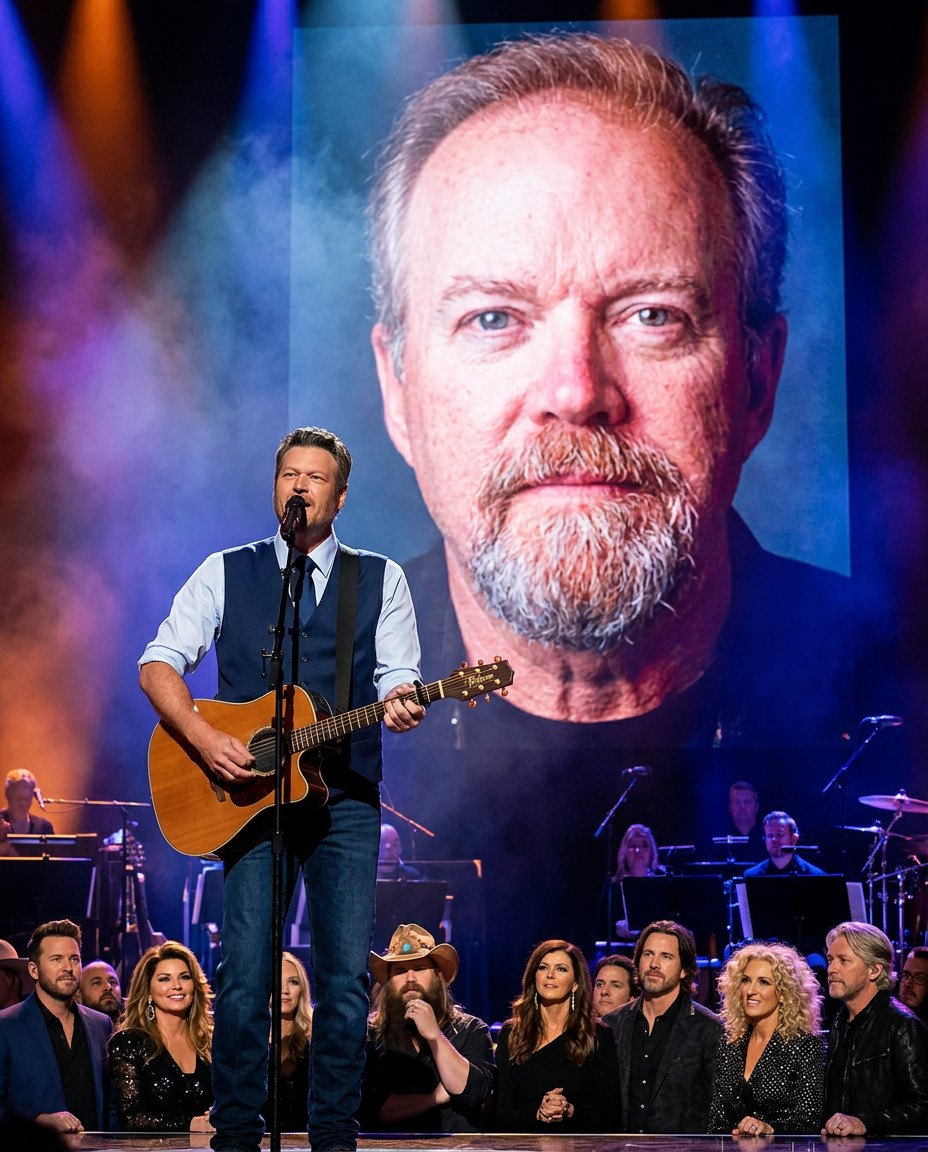
There are some songs that never really leave country music. They move from one voice to another, from one generation to the next, until they feel less like performances and more like shared memory. “The Gambler” is one of those songs. And at the ACM Awards in Las Vegas, that truth came rushing back in a way few people in the room will ever forget.
Shania Twain stepped out onstage and brought Blake Shelton with her, setting up what seemed like a classic awards-show moment: a big stage, a beloved hit, and a room full of country stars ready to sing along. But the moment quickly became something bigger than Blake Shelton, bigger than the medley, and bigger than the television lights bouncing off the MGM Grand Garden Arena.
Blake Shelton began singing “The Gambler,” the song Don Schlitz wrote when he was still a young songwriter trying to find his place in Nashville. The crowd recognized it immediately. Of course they did. The opening line alone can make a room lean forward. It is one of those songs that seems to belong to everybody, even though it came from one person’s pen.
Don Schlitz passed away on April 16, 2026, at 73, after a sudden illness. One month later, his words were back in the air, sung by voices that had lived with them for years. That timing made the tribute feel especially personal. This was not just a celebration of a great writer’s career. It was a farewell carried by the music itself.
A Song That Outlived the Moment It Was Written For
Don Schlitz had a gift that many songwriters spend a lifetime chasing. He could write lines that sounded simple, but carried a whole life inside them. He wrote songs that let other artists sound honest, vulnerable, and familiar all at once. “The Gambler” became a standard. “Forever and Ever, Amen” became a wedding-song anthem. “When You Say Nothing at All” became one of those songs people turn to when words are not enough.
That was Don Schlitz’s magic. He did not just write hits. He wrote emotional frameworks other artists could step into. He gave them songs that felt like they had always existed.
You never know when a song becomes goodbye.
That idea hovered over the tribute all night. Country music is full of celebration, but it also knows how to make room for grief. It knows that applause and tears can live in the same moment. And when “The Gambler” started to spread across the arena, that mixture of joy and loss became impossible to miss.
When the Chorus Became a Choir
By the chorus, it was no longer just Blake Shelton singing. Chris Stapleton joined in. Little Big Town joined in. Shania Twain sang too, and then the crowd became part of it, thousands of voices lifting the song higher and higher. It felt less like a tribute performance and more like country music itself had stepped forward to say thank you.
That is what made the moment so powerful. The performance did not try to outshine Don Schlitz’s writing. It honored it. The singers did not need to reinvent the song to make it matter. They simply let it do what it has always done: connect strangers through a few plainspoken lines that somehow understand the human condition.
In the middle of a flashy awards show in Las Vegas, the room paused for something rare and sincere. A song written by a young Nashville dreamer decades earlier had come back around in a way that felt almost spiritual. The audience did not just hear it. They felt it.
The Kind of Legacy Songwriters Hope For
Every songwriter hopes for success, but the deepest hope is different. It is to write something that lasts long after the writer is gone. Don Schlitz achieved that. He wrote songs that became part of country music’s emotional language, songs other artists could carry on stage and make new again.
That is why the ACM Awards tribute landed so hard. It reminded everyone that a songwriter’s voice can echo through many singers, many moments, and many years. Don Schlitz may have left the world, but his words were still working. They were still bringing people together. They were still giving artists a way to honor the past while standing in the present.
And as the final chorus rang through the MGM Grand Garden Arena, it was clear that the tribute had become more than a performance. It was a living thank-you note. A hall full of country stars sang back the song that helped define the genre, and in doing so, they made sure Don Schlitz was not remembered only with applause, but with song.
That may be the most fitting goodbye of all. A writer who spent his life giving others the perfect words was sent off with his own words, sung by the people who knew exactly what they meant.
Post navigation
In August 1986, in a small town in Alabama, life changed in a single night. What had begun as a family crisis ended in tragedy, and by morning, two sisters had lost both parents. Shelby Lynne was 17. Allison Moorer was 14. They were old enough to understand that something was wrong, but too young to understand how completely their world was about to fall apart.
Their mother had tried to leave. She took the girls and ran, hoping to create distance from the violence and fear that had been building around them. But their father found them. He was drunk. He had a gun. And in one devastating sequence of events, he shot their mother and then turned the gun on himself. The girls survived, but the family they had known was gone forever.
A Night That Left No One Standing
People often talk about heartbreak in songs, but this was something far beyond heartbreak. It was loss on a level that does not fit neatly into words. Shelby Lynne and Allison Moorer did not just lose their parents. They lost safety, trust, and the idea that home could protect them. From that moment on, everything they understood about life had to be rebuilt from the ground up.
For years, Shelby Lynne carried that history privately. She became known for her voice, her emotional depth, and the intensity she brought to every recording. But behind the music was a quiet grief that never fully disappeared. Some stories are so heavy that speaking about them feels impossible. Instead, they settle into the body, into memory, into art.
Some of the deepest wounds never announce themselves. They live in silence until a song gives them a voice.
Why Shelby Lynne Chose the Darkest Perspective
Then came the surprise. On Revelation Road, Shelby Lynne included a song called “Heaven’s Only Days Down the Road”, and she wrote it from her father’s point of view. Not from the point of view of the daughter who survived. Not from the perspective of the children left behind. She stepped into the mind of the man who caused the destruction.
That choice stunned listeners who knew the backstory. Why would someone write from the perspective of the person who destroyed her family? The answer seems to live in the strange power of storytelling. Sometimes, understanding darkness does not mean forgiving it. Sometimes, it means confronting it so directly that it can no longer hide inside memory.
The song does not feel sensational. It feels haunted. It carries the weight of confusion, rage, and self-destruction. By writing it, Shelby Lynne did something deeply human: she transformed pain into perspective. She did not erase what happened. She examined it.
The Silence Before the Song
For many years, Shelby Lynne rarely spoke publicly about the tragedy. That silence was not denial. It was survival. Some experiences are too painful to unpack in public, especially when the public expects neat explanations. Music became the safer language. Through album after album, Shelby Lynne gave listeners emotion without always giving them the whole story.
That is part of what makes her work so affecting. Even when the details were hidden, the feeling was there. The sadness, the distance, the resilience. Listeners may not have known exactly where it came from, but they could hear that it came from somewhere real.
A Song Few People Heard, But Few Forget
Revelation Road did not become famous for one big hit, and “Heaven’s Only Days Down the Road” remains one of those songs that many fans never discover. But for those who do hear it, the track carries unusual power. It is not loud about its pain. It does not ask for attention. It simply stands there, honest and unsettling, like a door left open into a memory no one wanted.
That quietness may be what makes it so unforgettable. In country music, stories of loss are common. But this one is different because it is not only about tragedy. It is about inheritance, survival, and the strange courage it takes to look directly at the worst thing that ever happened to you and turn it into art.
The Real Story Behind the Darkness
The real story behind one of country music’s darkest songs is not just the night in Alabama. It is everything that came after. It is Shelby Lynne and Allison Moorer growing up with a history that most people could never imagine. It is the decision to keep living, keep singing, and keep telling the truth in fragments when the full truth was too heavy to hold all at once.
“Heaven’s Only Days Down the Road” is not a simple song, and Shelby Lynne’s life is not a simple story. But maybe that is why the music matters. It reminds us that some wounds never disappear, yet art can still turn them into something that speaks. Not to erase the past, but to survive it.
In the end, Shelby Lynne did not just sing about pain. She reached into the darkest room of her own history and brought back a song.