“HE WAS 17 WHEN HE WATCHED HIS BROTHER RECORD IT. 49 YEARS LATER, HE FINALLY SANG IT HIMSELF.” David Frizzell was 17 when he stood in a Nashville studio watching his brother Lefty record “Long Black Veil” in 1959. A song about a man who chose death over revealing he’d been with his best friend’s wife. It hit #6 on Billboard. But David didn’t sing that song himself for almost 50 years. Lefty died in 1975. And David carried that song with him for decades — the memory of that studio, the quiet after the last note, his brother’s voice still in the room. Then in 2008, for his album Frizzell & Friends, David finally stepped up to the microphone. And the man standing next to him was Gene Watson. Two voices singing a song that started in a Nashville studio almost 50 years earlier, when David was just a kid standing right there. In 2019, the Library of Congress preserved Lefty’s original recording for good. – Country Music
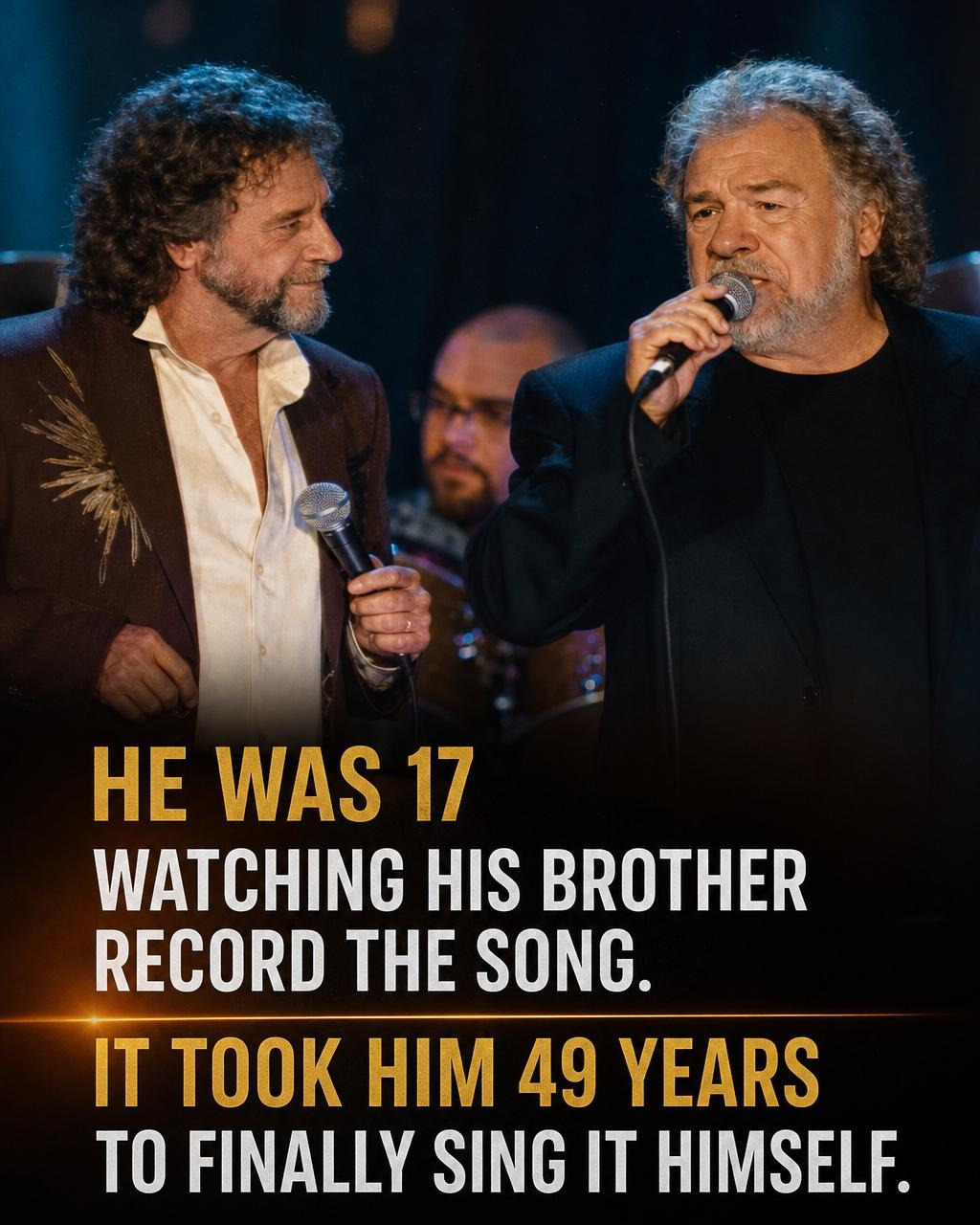
In 1959, David Frizzell was only 17 years old when he stood in a Nashville studio and watched his brother, Lefty Frizzell, record a song that would stay alive for generations. The title was “Long Black Veil”, and the moment did not feel ordinary, even then. The room was quiet, the microphones were ready, and David was close enough to feel the weight of what was happening.
Lefty Frizzell had a gift for turning a song into something deeply human. When he sang “Long Black Veil,” he brought out the sorrow, the secrecy, and the heartbreak at the center of the story. The song told of a man who chooses silence over confession, even at the cost of his own life. It was a dramatic ballad, but in Lefty Frizzell’s hands, it felt honest and personal. The recording rose to #6 on Billboard, and its impact lasted far beyond that first chart run.
A Memory David Frizzell Never Let Go Of
For David Frizzell, that session was more than a brother’s recording date. It became a memory he carried for decades. He remembered the studio, the focused faces, and the strange stillness that follows a final note. He remembered Lefty Frizzell’s voice hanging in the air, as if it had not fully left the room.
Lefty Frizzell died in 1975, but the song remained. For David Frizzell, “Long Black Veil” was tied to family, to youth, and to the early days of a career built in the shadow of a giant talent. Still, he did not rush to record it himself. Some songs feel too connected to a moment to be touched lightly.
Some songs are performed once and then carried in the heart for a lifetime.
Nearly 50 Years Later, David Frizzell Finally Sang It
In 2008, almost 50 years after watching Lefty Frizzell record the song, David Frizzell finally stepped up to the microphone and sang “Long Black Veil” himself. It appeared on his album Frizzell & Friends, and the recording brought the story full circle in a way that felt both personal and powerful.
David Frizzell was not alone. Standing beside him was Gene Watson, whose voice added a new layer of warmth and depth to the song. Together, they honored the original while making it their own. The performance did not erase the past. Instead, it embraced it.
For listeners, the duet carried something rare: the feeling of time folding in on itself. A song that began in a Nashville studio in 1959 returned nearly half a century later, sung by the brother who had once watched it being born.
Why the Song Still Matters
“Long Black Veil” remains powerful because it speaks to loyalty, regret, and the heavy cost of silence. But the story of David Frizzell and Lefty Frizzell gives it another meaning too. It is also a story about memory, family, and the way music can wait patiently until the right moment comes.
In 2019, the Library of Congress preserved Lefty Frizzell’s original recording, ensuring that the performance would remain protected for the future. That recognition confirmed what many country music fans already knew: this was not just a song. It was a piece of American music history.
And for David Frizzell, it was something even more intimate. It was a brother’s voice, a young man’s memory, and a song that took nearly 50 years to come home.
Post navigation
On May 9, Eric Church walked onto the stage at UNC Chapel Hill’s Kenan Stadium with no podium, no stack of notes, and no polished speech waiting in his pocket. In front of more than 7,100 graduates, he brought only himself and an acoustic guitar. What happened next felt less like a performance and more like a hard-earned moment of truth.
For eight months, Eric Church had been stressing over what to say. He knew the occasion mattered. He knew the graduates were expecting something memorable. But the more he tried to force the words, the more distant they felt. Then, one night, he stopped trying to outthink the moment and picked up his guitar instead. That simple shift changed everything.
A Speech Built on Six Strings
Eric Church explained that the answer had been sitting in front of him all along. Each string on the guitar became a pillar of life: faith, family, the right partner, ambition, community, and finally, protecting who you really are. It was a way of speaking that felt honest, personal, and grounded. Rather than offering a perfect speech, Eric Church gave the graduates something more useful: a framework for the messy, beautiful work of living.
“Every string will go out of tune,” Eric Church told the crowd, in spirit and meaning if not in exact polished form. “That’s not failure. That’s living.”
That line resonated because it did not pretend life stays neat. It acknowledged what people already know but rarely hear stated so clearly: things change, pressure builds, plans drift, and even the best intentions can fray. The real question is whether you notice when something is off and take time to listen.
Why the Moment Hit So Hard
What made the address unforgettable was not just the setting, or the fact that Eric Church is a major artist speaking to a packed stadium. It was the sincerity. He was not even a graduate. He was simply someone willing to stand there, admit he had struggled to find the right words, and then turn that struggle into something meaningful.
Instead of sounding like a celebrity delivering a scripted message, Eric Church sounded like a person thinking out loud in the best possible way. The graduates heard a reminder that adulthood is not about never losing your tune. It is about learning how to reset, realign, and keep going without losing yourself.
The Song That Closed the Night
By the end, Eric Church did what many people now say they will never forget: he sang “Carolina” to a stadium full of tears, cheers, and phones held high. The moment felt complete because it matched the tone of everything that came before it. The speech was not trying to impress. It was trying to connect.
Online, the response spread quickly. Millions watched the clip, and many called it one of the best commencement addresses ever. That reaction makes sense. In a world full of overproduced advice, Eric Church offered something rare: a message that was simple, human, and deeply felt.
Sometimes the best speech is the one you stop trying to write and finally allow yourself to hear.