He Stopped in the Fog — and Changed a Life Forever. – Daily News
The fog rolled in thick and low, the kind that swallows sound and distance until the world feels narrowed to whatever sits directly in front of you. On the rural highway outside Boise, headlights blurred into pale halos, and the road hummed with passing tires cutting through damp air.
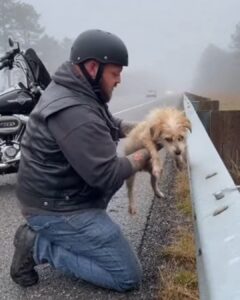
Logan was riding home when he heard it.
Not loud. Not clear.
Just a thin, broken whine that slipped through the rumble of his Harley and threaded itself straight into his chest.
He eased off the throttle.
Years on the road had taught him to notice small things — a change in wind, a flicker of movement on the shoulder, a sound that didn’t belong. This didn’t belong. He rolled to a stop, killed the engine, and let the sudden quiet settle.
The whine came again.
Logan swung his leg over the bike and stepped onto the gravel, boots crunching as he scanned the fog-soaked shoulder. Cars rushed past, close and fast, horns blaring in irritation at the stopped motorcycle. He ignored them.
Then he saw it.
Down in the ditch, half-hidden by mist and weeds, a small dog lay frozen against the guardrail divider. Its body was twisted at an unnatural angle, one front paw wedged tightly between the metal beam and the ground beneath it. The paw was swollen, raw, streaked with blood. The dog didn’t thrash. Didn’t bark.
It had already given up.
Logan’s stomach dropped.
“Hey… I see you,” he said quietly, lowering himself to one knee despite the traffic screaming past his back. His voice was steady, but something inside him cracked.
The dog lifted its head just slightly. Its fur was matted and dirty, eyes dulled not by aggression or fear, but by exhaustion — the look of an animal that had been waiting too long for help that never came.
Logan moved slowly, deliberately. His size alone could be terrifying — broad shoulders, tattooed arms, heavy boots — but he knew how to make himself smaller when it mattered.
“It’s okay,” he murmured. “I’m not going anywhere.”
The dog didn’t pull away. It didn’t lean in either. It simply stayed still, as if movement itself had become too risky to attempt.
Logan examined the guardrail. The paw was trapped tight, metal biting into flesh. Every passing car sent a vibration through the rail, likely sending pain shooting through the dog’s leg over and over again.
“How long you been here?” Logan whispered.
There was no answer. Just another weak whine, barely more than breath.
He planted his boots, braced himself, and grabbed the metal divider with both hands. The steel was cold and slick with moisture. He pulled once. Nothing.
“Okay,” he said softly. “We’ll do this together.”
He pulled again, harder this time. His knuckles scraped, skin splitting against the rough edge, but he didn’t let go. His arms shook with the effort.
“Easy, buddy,” he said through clenched teeth. “I’ve got you. Just hold on.”
The dog cried out — a short, sharp sound — and Logan froze instantly.
“I know,” he said, breathing hard. “I know it hurts. I won’t rush.”
He adjusted his grip, shifted his weight, and pulled again with everything he had. The metal groaned.
Then it gave.
The paw slipped free.
The dog collapsed instantly, its body sagging forward, momentum carrying it straight into Logan’s arms. Logan dropped to the gravel, wrapping his jacket around the shaking little frame without hesitation.
The dog trembled violently, breath coming in uneven gasps. Logan could feel its heart racing against his chest.
“It’s over,” he whispered, voice thick. “You’re not stuck anymore.”
The dog lifted its head weakly and, with an effort that looked like it cost everything, gave Logan a tiny lick against his leather vest.
That was all it took.
Logan swallowed hard, eyes burning. He pressed his forehead briefly against the dog’s matted fur, uncaring who might be watching now as a small crowd of slowed cars gathered.
“Nobody left you out here alone,” he said quietly. “Not today.”
He stood carefully, cradling the dog like something fragile and irreplaceable, and carried it back to his bike. He laid it gently across the seat, steadying its injured leg, then swung on his helmet and looked once more at the road.
“Hang on,” he said. “We’re going somewhere safe.”
The ride to the vet felt endless.
Every stoplight was torture. Every bump in the road made Logan glance down, murmuring reassurances. The dog stayed quiet, eyes half-lidded now, trusting in a way that felt undeserved and sacred all at once.
At the veterinary clinic, staff rushed out the moment they saw him pull in.
“What happened?” someone asked.
“Guardrail,” Logan said. “Been stuck awhile.”
They took the dog from his arms, but Logan stayed close, pacing the lobby, blood drying on his knuckles, helmet still tucked under one arm. He watched through the glass as the vet examined the swollen paw, gently cleaning the wound.
“She’s lucky you stopped,” the vet said later. “Another hour, maybe less… and we might’ve been talking about amputation. Or worse.”
Logan nodded, jaw tight.
“She gonna make it?”
“Yes,” the vet said with a small smile. “She’s a fighter.”
Logan looked through the window again. The dog lay on a soft blanket now, IV running, eyes closed but peaceful. No more fog. No more metal biting into bone.
“What’s her name?” the vet asked.
Logan hesitated.
“I don’t know,” he said. “But I’ll figure it out.”
He did more than that.
He came back the next day. And the next. Each time, the dog’s tail wagged a little stronger. That first weak lick turned into a full-body greeting. Trust bloomed where fear had lived.
By the time the bandages came off, Logan had already filled out the paperwork.
Some people asked why he’d taken on a dog he found on the side of the road. Why he’d changed his routine for a stranger with four legs and a broken paw.
Logan never had a complicated answer.
He just said, “I heard her.”
Because sometimes, rescue doesn’t look like sirens or flashing lights.
Sometimes it’s a man on a motorcycle who listens closely enough to hear a whine in the fog — and cares enough to stop.
And sometimes, that single choice turns a moment of despair into the beginning of forever.
The rain had been falling for hours before anyone realized the streets wouldn’t hold.
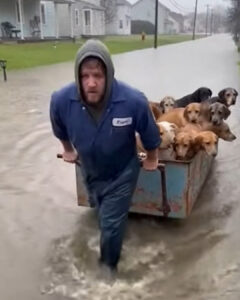
In the small Ohio town, water crept quietly at first—sliding over sidewalks, swallowing curbs, filling gutters until they disappeared. Then the wind rose, howling down empty streets, pushing the flood faster, harder, turning familiar blocks into moving rivers.
Most people had already fled.
Cars were gone from driveways. Porch lights flicked off one by one. Doors were locked, windows sealed, and the town pulled inward, each household trying to save what it could.
But Evan stayed.
Evan always stayed.
He was the town mechanic—the one with the grease-stained coveralls, the old garage that smelled like oil and rust, the man people nodded at but rarely stopped to talk to. He fixed engines. He worked late. He kept to himself.
And when the floodwaters came, he opened his garage door.
At first it was just one dog.
A soaked hound, ribs showing through wet fur, trembling in the doorway as rain hammered the pavement. Evan didn’t hesitate. He waved the dog in, grabbed an old towel, shut the door against the wind.
Then another came.
And another.
They appeared out of the storm like ghosts—small dogs, big dogs, old dogs, young ones—all driven by the same instinct: find shelter or disappear. They slipped under half-submerged fences, swam across flooded yards, followed the smell of warmth and oil and something steady.
By the time Evan realized how many had come, his garage was full.
Fourteen dogs.
Crowded together. Shaking. Whimpering softly. Some injured. Some too old to stand long. Some so frightened they pressed themselves against the walls as if trying to become invisible.
The water kept rising.
Evan checked his phone—emergency alerts blaring, evacuation orders flashing. The road out of town was already impassable. The garage floor was wet now, water seeping in, cold around his boots.
He looked at the dogs.
They looked back at him.
They didn’t bark.
They didn’t panic.
They just watched.
As if they already knew something about him the rest of the town didn’t.
“You came to me,” Evan said quietly, voice nearly lost to the wind rattling the door. “Guess that means I can’t leave you.”
He found the scrap cart behind the garage—the old metal one he used to haul engines and transmissions. Rusted. Heavy. Loud. He cursed under his breath as he dragged it inside, then lined it with old blankets, shop rags, anything dry he could find.
One by one, he lifted the dogs in.
Some resisted weakly. Some collapsed into the bedding the moment they were set down. One old hound licked his wrist, tongue slow and uncertain, as if asking permission to trust.
The cart groaned under the weight.
So did Evan’s shoulders.
He tied a rope around the handle, braced himself, and pushed the garage door open.
The flood hit him immediately.
Cold, fast-moving water surged around his legs, up past his knees, then higher. The wind shoved rain into his face, blurring his vision. The street was unrecognizable—no sidewalks, no driveways, just water and debris rushing past.
Neighbors watched from second-story windows.
Phones came out.
Someone shouted his name, muffled by the storm.
Evan leaned forward and pulled.
Each step was a fight.
The cart dragged hard against the current, metal scraping beneath the water. The dogs shifted, pressing closer together, eyes wide but strangely quiet. They didn’t thrash. They didn’t jump.
They trusted him.
“You came to me,” Evan muttered again, breath burning in his chest. “I got you. All of you.”
The water climbed to his thighs, then his waist. His coveralls soaked through, heavy as lead. His arms shook, muscles screaming with every step forward. Rain carved clean lines down his grease-streaked face.
Halfway up the flooded street, his boot slipped.
For one terrifying second, the cart lurched sideways, the rope jerking violently in his hands. Evan went down to one knee, water surging over him, the current threatening to take everything.
The dogs whimpered—soft, scared sounds that cut straight through him.
“No,” Evan growled, teeth clenched. He dug his boots into the pavement beneath the water, grabbed the cart with both hands, and hauled it upright.
“Not today.”
He pulled again.
And again.
The hill toward higher ground felt endless. Every step forward slid halfway back. The wind screamed. Debris bumped against his legs. Somewhere behind him, a siren wailed and then cut out.
But the dogs stayed still.
One pressed its head against another. A small brown mutt tucked itself beneath a larger hound’s chest. The old dog at the edge of the cart kept its eyes on Evan, never looking away.
They believed he would get them there.
When Evan’s arms started to fail, it was that look that kept him moving.
Finally, the water began to recede.
An inch.
Then another.
His boots found firmer ground. The cart rolled easier. The wind still howled, but the current weakened. Evan let out a broken laugh that turned into something dangerously close to a sob.
They crested the hill together.
On the far side, the water dropped quickly, pooling instead of rushing. Emergency lights flashed in the distance. People gathered on porches and driveways, staring.
Evan stopped.
The cart rattled once and went still.
Fourteen dogs lifted their heads.
Soaked.
Shivering.
Alive.
Evan leaned against the handle, chest heaving, hands numb, legs shaking so badly he had to lock his knees to stay upright. Someone ran toward him with blankets. Someone else started counting the dogs out loud.
Phones recorded.
Voices whispered.
Someone said his name like they were seeing it for the first time.
Later, they would say he was a hero.
Later, they would post the videos, share the photos, tell the story of the mechanic who waded back into floodwaters when everyone else was trying to escape.
But Evan didn’t hear any of that.
He was crouched beside the cart, running a shaking hand over wet fur, murmuring nonsense words meant only to calm.
“You’re okay,” he told them. “You’re all okay now.”
The old hound licked his wrist again.
Evan smiled—a small, tired smile that carried years of being overlooked, underestimated, and quietly steady.
He had never been the loud one.
Never the important one.
Never the one people looked to first.
But when the water rose and the forgotten needed someone to come back for them—
He did.
And that was enough.
Because sometimes, the measure of a person isn’t found in what they own or how they’re known—but in who they refuse to leave behind, even when the world is washing away.