HE HAD THE SAME VOICE, THE SAME LAST NAME, AND 500 SONGS WAITING FOR HIM — BUT NASHVILLE NEVER LEARNED HIS FIRST NAME. Ronny Robbins could sing “El Paso” so well that people closed their eyes and swore Marty was still alive. Same tone. Same phrasing. Same blood. But that was the trap. He tried his own career in the ’70s. Columbia signed him as “Marty Robbins Jr.” — not even his own name on his own record. By the ’80s, he walked away from chasing hits and gave his life to something quieter: keeping his father’s legacy breathing through Marty Robbins Enterprises. He sang on Larry’s Country Diner. He performed at Country’s Family Reunion. Always his father’s songs. Always his father’s shadow. Nashville calls that loyalty. But loyalty doesn’t get you a Wikipedia page longer than two paragraphs. So what costs more — spending a lifetime making sure the world remembers your father, or knowing the world will never remember you? – Country Music
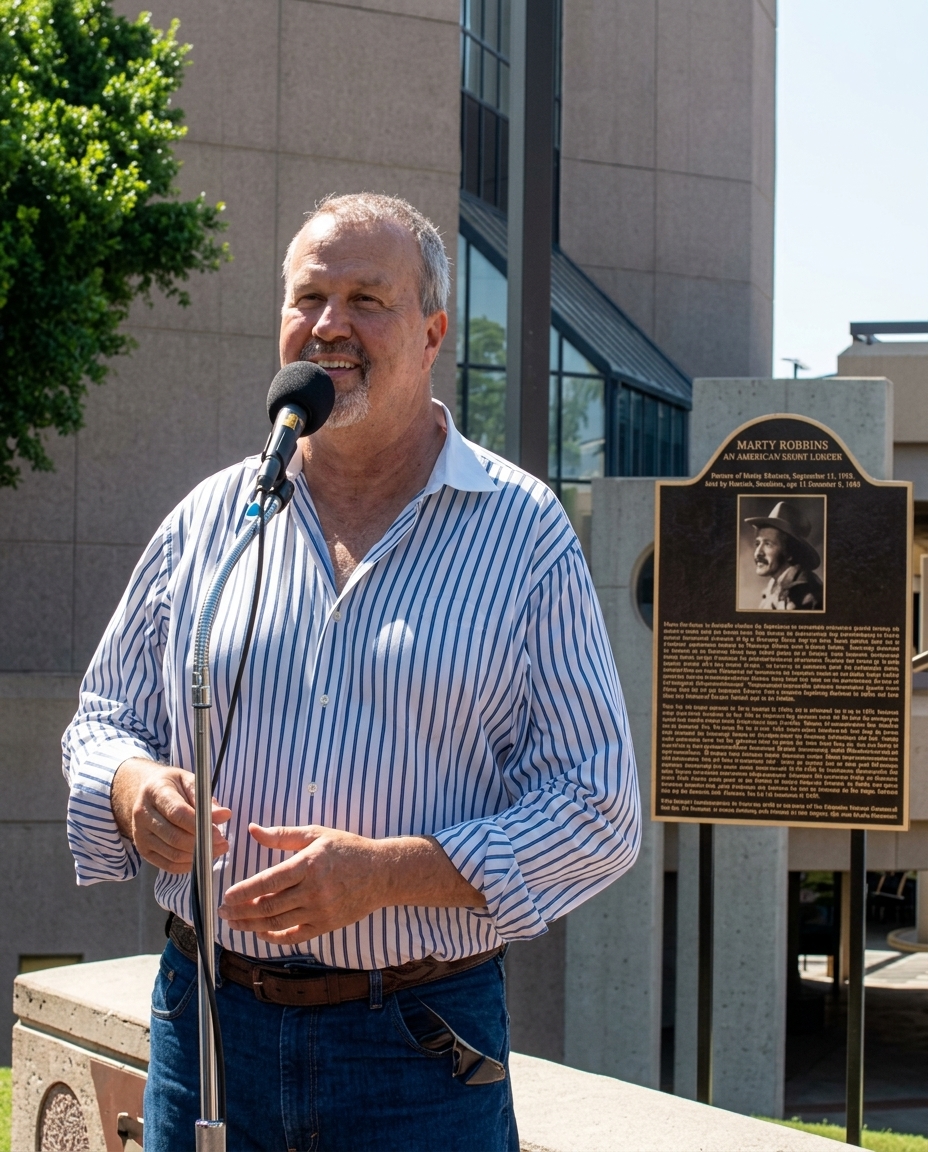
Some stories in country music are loud. They come with awards, headlines, comeback singles, and standing ovations. Others move more quietly, almost politely, as if they do not want to interrupt the legend standing in front of them. Ronny Robbins lived in that quieter kind of story.
Ronny Robbins had almost everything a singer could inherit. He had the same last name that opened doors in every corner of country music. He had the same bloodline that connected him to one of the genre’s most beloved voices. And, most haunting of all, Ronny Robbins had a voice that could stop a room cold because it sounded so much like Marty Robbins that listeners sometimes felt they had stepped backward in time.
That should have been a gift. In some ways, it was. But it was also the burden that shaped his whole career.
The Blessing That Became a Shadow
When people heard Ronny Robbins sing songs like “El Paso”, they did not just hear talent. They heard memory. The phrasing, the warmth, the familiar ache in the delivery — it all carried the unmistakable echo of Marty Robbins. For audiences who missed the original voice, Ronny Robbins could feel like a miracle. For Ronny Robbins himself, it may have felt more complicated.
Because once people decide what you remind them of, it becomes very hard to show them who you are.
Ronny Robbins did try to build something of his own. In the 1970s, Columbia signed him and introduced him as “Marty Robbins Jr.” That detail says almost everything. Even with a record deal in hand, even with a microphone in front of him, even with the chance to stand on his own feet, the industry still framed Ronny Robbins through somebody else’s name. It was not enough to be talented. It was not even enough to be family. He was marketed as an extension of a legend before Nashville ever gave him the space to become a man with his own identity.
A Different Kind of Life in Country Music
By the 1980s, Ronny Robbins stepped away from the chase that defines so many artists. No big push for radio dominance. No desperate sprint to stay relevant in a changing industry. Instead, Ronny Robbins turned toward something quieter, steadier, and maybe more demanding in the long run. Through Marty Robbins Enterprises, Ronny Robbins helped preserve the legacy that had shaped his life from the beginning.
That kind of work rarely gets celebrated the way hit records do. It is not flashy. It does not give the industry a dramatic headline. But it matters. Legacy does not survive on nostalgia alone. It survives because somebody shows up, year after year, and keeps the songs alive.
Ronny Robbins did that work. He performed on Larry’s Country Diner. He appeared on Country’s Family Reunion. He sang the songs people loved, the songs tied to Marty Robbins, the songs that still carried the weight of memory for generations of country fans. He became a living bridge between the old records and the people who still needed to hear them.
Nashville often praises loyalty when it is convenient. But loyalty and recognition are not always the same thing.
The Price of Keeping a Legend Alive
There is something deeply honorable in what Ronny Robbins chose. He did not spend his life trying to tear himself away from Marty Robbins. He did not reject the music, the history, or the family name. Ronny Robbins carried it. Protected it. Sang it. Kept it breathing.
But that kind of devotion comes with a quiet ache. When an artist spends decades making sure the world never forgets somebody else, the world can become strangely comfortable forgetting the artist standing right in front of it.
That may be the saddest part of Ronny Robbins’s story. Not failure. Not scandal. Not collapse. Just erasure by comparison. He was close enough to greatness to preserve it, but perhaps never far enough away to be seen clearly for himself.
And that leaves a question that feels bigger than one man or one family. What costs more in the end: spending a lifetime making sure the world remembers your father, or learning, year after year, that the world may never fully remember you?
Ronny Robbins may never have become a giant headline in Nashville history. But his life still tells a country music truth that deserves to be heard. Not every legacy is built by the person whose name goes on the marquee. Sometimes it is carried by the one who keeps showing up after the lights fade, singing the old songs with love, even when the room never quite learns who is holding the microphone.
And maybe that is exactly why Ronny Robbins should be remembered now — not just as Marty Robbins’s son, not just as the keeper of a famous catalog, but as a man who gave his own life to making sure country music never lost one of its most treasured voices.
Post navigation
Some legends never really disappear. They just wait for the right doorway back in.
Marty Robbins was never supposed to become a forgotten name. Not after 16 number-one hits. Not after more than 500 recorded songs. Not after 60 albums, two Grammy wins, and a career so wide it barely made sense in one lifetime. Marty Robbins was not just a country singer. Marty Robbins was a storyteller, a pop hitmaker, a western balladeer, and a man who climbed into a race car and pushed it to 170 miles per hour against real NASCAR competition.
That kind of life sounds too large to fade. And yet, somehow, it did.
A Career Too Big for One Box
Marty Robbins built a legacy that should have stayed in permanent rotation. “El Paso” was not just a hit. It was a cinematic song years before country music regularly thought in cinematic terms. It was long, detailed, dramatic, and unapologetically narrative. At a time when radio loved short records, Marty Robbins made audiences sit still and listen to a full story unfold.
Then there was “A White Sport Coat,” a song that moved with such easy crossover charm it reached far beyond traditional country listeners. “My Woman, My Woman, My Wife” carried a different kind of emotional weight and earned Marty Robbins a Grammy. He could sound tender, haunted, playful, or heroic depending on the song. He was not trapped inside one lane because Marty Robbins helped build several of them.
That is part of what made Marty Robbins special. Some artists become symbols of one sound. Marty Robbins became a symbol of range.
The Strange Silence That Followed
And still, time has a way of narrowing even the biggest lives.
By the late 2000s, Marty Robbins was still respected, but respect is not the same thing as presence. Older fans remembered. Historians remembered. Country traditionalists remembered. But a lot of younger listeners did not grow up hearing Marty Robbins as an active part of the culture. His name lived in record collections, tribute lists, and conversations about the past. For many people under 40, Marty Robbins had become a name they might recognize without truly knowing why.
That is the quiet tragedy of legacy. An artist can shape the road and still be overlooked by the traffic rushing over it.
It is hard to call someone forgotten when the work still exists. But it is just as hard to call them remembered when a whole generation has never really met them.
Then Came the Wasteland
In 2009, a strange thing happened. A video game called Fallout: New Vegas gave Marty Robbins an unexpected second life. Players wandering through a ruined, fictional desert heard “Big Iron” playing on an in-game radio station. For many of them, it was the first time they had ever heard Marty Robbins.
And somehow, it fit perfectly.
“Big Iron” already carried dust, danger, myth, and movement inside it. It sounded like an old story traveling through open country, but it also felt oddly modern in its confidence. Inside the world of Fallout: New Vegas, the song did not feel like a museum piece. It felt alive. Cool, even. A little mysterious. Suddenly millions of younger listeners were not being told Marty Robbins mattered. They were hearing why.
That is what made the moment so powerful. A song from 1959 did not survive because it was protected. It survived because it still worked.
A Legacy the Industry Could Not Hold Alone
There is something both beautiful and uncomfortable in that. Marty Robbins helped shape the musical world that came after him, yet it took a video game to reintroduce him to millions. Not a tribute campaign. Not a major industry revival. Not endless celebration from Nashville. A video game.
Maybe that says something about how music really lives. Not in plaques. Not in carefully controlled legacy language. Not only in award-show montages. Music lives where people unexpectedly feel it. Sometimes that happens in a car. Sometimes in a bar. And sometimes in a digital wasteland full of fictional danger and neon ruin.
Marty Robbins did not need reinvention. Marty Robbins needed rediscovery.
And once “Big Iron” found new ears, people started digging deeper. They found “El Paso.” They found the western albums. They found the heartbreak songs, the crossover hits, and the astonishing fact that one man could sound that comfortable doing all of it. The deeper they looked, the more unbelievable the original question became.
How had so many people let Marty Robbins slip that far from view in the first place?
Maybe the real lesson is this: true legends do not always stay visible, but they never stop being ready. Marty Robbins was still there, waiting in the grooves, waiting in the voice, waiting in the story. All it took was one unexpected opening for the world to remember that country music once had a giant who could sing anything, race anything, and leave behind a song strong enough to outlive the silence.