FOUR MONTHS AFTER HE LOST JUNE, JOHNNY CASH WAS BLIND, IN A WHEELCHAIR, AND DYING — YET HE RECORDED 60 SONGS. The last one was finished 22 days before he died. The Man in Black passed away on September 12, 2003, at age 71. The official cause was complications from diabetes. But those closest to him said the truth was simpler — he never recovered from losing June. June Carter Cash, his wife of 35 years, had died just four months earlier. By then Johnny had lost most of his vision and could barely walk. Yet before she died, June whispered something to him that he obeyed like a sacred command. He repeated her words to producer Rick Rubin days later: “You have to keep me working — because I will die if I don’t have something to do.” What followed was one of the most haunting recording sprees in music history. Sixty songs in four months. A final public performance where he read a tribute to June he had written minutes before walking onstage. And one last song — finished just 22 days before he died — about a doomed man whose dying words were “Nearer, my God, to Thee.” He wasn’t recording an album. He was saying goodbye. – Country Music
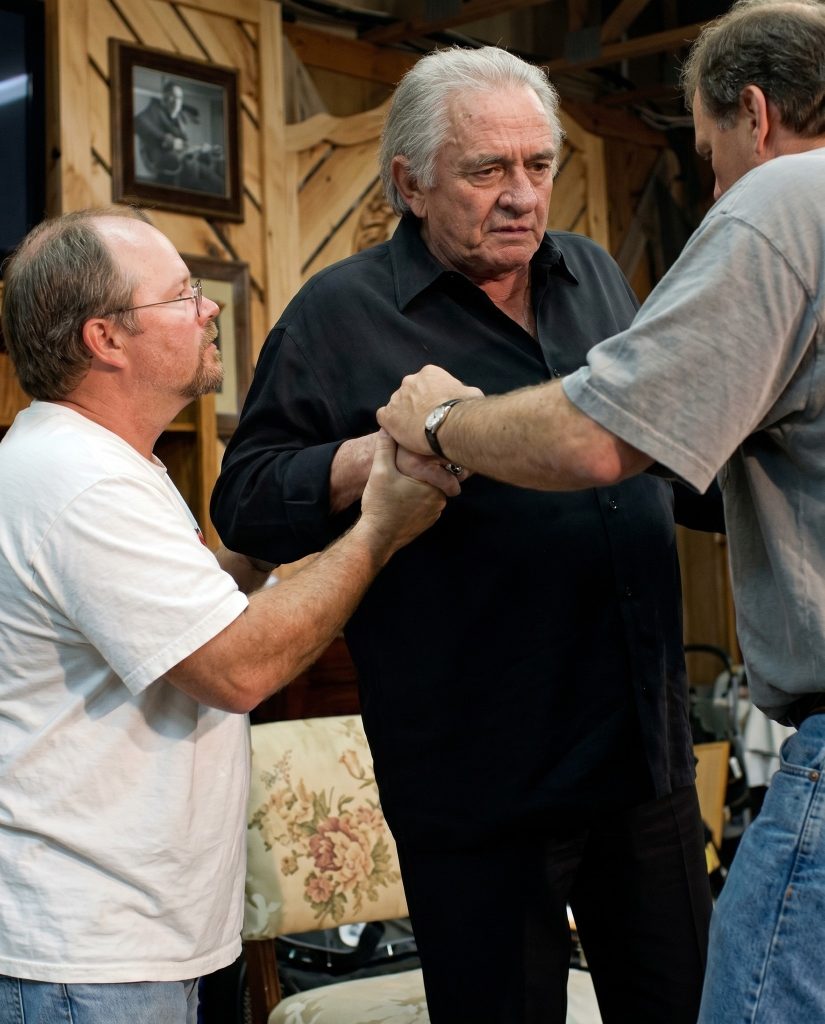
By the end of his life, Johnny Cash looked like a man walking through the last scene of a long and difficult story. He was weak, nearly blind, often confined to a wheelchair, and still carrying the weight of grief that had settled over him after the death of June Carter Cash. On September 12, 2003, at age 71, Johnny Cash died from complications of diabetes. But to the people who knew him best, the deeper truth was harder to measure. He never truly recovered from losing June.
June Carter Cash, his wife of 35 years, died in May 2003. Their marriage had been famous, tested, and deeply loved, and for Johnny, June was far more than a partner onstage or in life. She was the steady force that helped him endure the worst years and celebrate the best ones. When she was gone, something inside him seemed to change. Friends noticed the silence around him. The spark was still there, but it burned differently.
And yet, even in the middle of that heartbreak, Johnny Cash did what he had always done: he worked.
A Promise That Kept Him Going
Before June died, she said something to Johnny that he later repeated to producer Rick Rubin, almost like a sacred instruction: “You have to keep me working — because I will die if I don’t have something to do.”
It was a simple sentence, but it carried the force of a command. Johnny took it seriously. He had spent much of his life fighting demons, surviving failures, and rebuilding himself after collapse. But this time, the work was not about success, fame, or redemption. It was about survival. It was about staying connected to June, to purpose, and to life itself.
So he kept recording.
Sixty Songs in Four Months
What followed was one of the most haunting bursts of creativity in music history. In just four months, Johnny Cash recorded 60 songs. Not all of them were released at once, but the sheer volume of work was astonishing. By then, he was physically fragile and emotionally devastated, yet he kept showing up.
There is something unsettling and beautiful about that kind of endurance. Some artists chase inspiration when life feels easy. Johnny Cash found it in the middle of loss. Every session carried the feeling that he understood time was short, and maybe that knowledge sharpened everything. His voice, already famous for its depth and grit, now sounded even more exposed. Each line seemed to come from a man who knew exactly how much he had left to say.
He was not trying to sound young. He was not trying to hide the pain. He was simply telling the truth as plainly as he could.
The Last Public Performance
Johnny Cash made one of his final public appearances with a tribute to June that he had written just minutes before stepping onto the stage. That detail matters because it shows how close the grief still was. He did not polish it for days. He did not overthink it. He wrote it, then walked out and read it with the same courage that had marked much of his life.
He was saying goodbye in public, but he was doing it the only way he knew how — with honesty, restraint, and love.
The audience saw a legend. Behind the legend was a man who had lost the person who had anchored him for decades. The performance was not just a concert moment. It was part tribute, part confession, and part farewell.
The Final Song
Johnny Cash’s last recorded song was finished just 22 days before he died. It was “Like the 309,” a song about a doomed man and his final ride, with the striking line: “When he said, ‘Nearer, my God, to Thee,’ as he reached for the 309.”
It was not a random choice. By then, Johnny Cash seemed to know exactly what kind of ending he was approaching. The song did not sound like defeat. It sounded like acceptance. It sounded like a man standing at the edge of life, looking back without fear, and speaking with calm clarity.
He wasn’t just recording an album. He was leaving a record of what it means to keep going when everything inside you has already begun to break.
What He Left Behind
Johnny Cash’s final months were not easy, and they were not glamorous. But they were deeply human. He gave the world one last run of songs, one last public tribute to June, and one last example of what devotion can look like when it is tested by grief.
For fans, those final recordings carry a haunting power because they do not feel like a career move. They feel like a message. Johnny Cash was telling the world that love and work can hold a person together, even at the end.
And maybe that is why his final chapter still grips people so strongly. It is not only the sadness of it. It is the refusal to stop. Four months after losing June, Johnny Cash was nearly blind, in a wheelchair, and dying. Yet he kept singing. He kept recording. He kept his promise.
In the end, the Man in Black did not go quietly. He went out the way he lived for so much of his life — with pain, faith, and a voice that would not let go.
Post navigation
On July 10, 2016, Craig Morgan’s life changed in a way no parent should ever have to understand. He and his family were spending time on Kentucky Lake in Tennessee, trying to enjoy a summer day that had started like any other. His son, Jerry Greer, had just graduated high school. He had football behind him, college ahead of him, and a future that looked wide open.
Then everything stopped.
Jerry was tubing when he fell into the water. He was wearing a life jacket. Still, he did not come back up. What began as a rescue effort quickly became a family’s worst fear. Boats searched the water. Hours passed. The lake stayed calm on the surface, while his family lived through a storm that no one could see.
The Day That Split Life in Two
In moments like that, time changes shape. It does not move forward in a normal way. It stretches. It breaks. It repeats itself. For Craig Morgan and Karen, Jerry’s mother, the search was not just about where Jerry was. It was about the terrible possibility that life had already split into “before” and “after.”
The next day, Jerry’s body was found. The news spread quickly, but for the family, the world had already gone quiet. The kind of silence that follows loss is not peaceful. It is heavy. It fills every room. It sits at the dinner table. It stands in the doorway. It waits in the spaces where a voice should be.
“There are some losses that do not leave a family. They simply become part of the air they breathe.”
Grief Did Not Announce Itself and Leave
Craig Morgan did not immediately turn his pain into music. That would have been too simple, and grief is never simple. Instead, life kept going around the empty place Jerry left behind. Holidays came. Birthdays came. Family conversations kept Jerry’s name alive, because that is what love does. It refuses to let someone disappear just because the world moves on.
For nearly three years, the pain remained close. Not loud every second, but always present. The ache of losing a child does not ask permission. It arrives in ordinary moments, often when no one expects it. A quiet house. A memory. A date on the calendar. A song on the radio. A father does not stop being a father because the child is gone. That bond stays.
Craig and Karen carried Jerry with them in the way families do when words are not enough. They remembered him in stories, in shared laughter, in private moments that no camera ever sees. The grief did not erase the love. If anything, it sharpened it.
Then One Morning at 3:30 A.M., the Song Arrived
Nearly three years later, Craig Morgan woke up before dawn around 3:30 in the morning. He got out of bed and began to write. He was not chasing a hit. He was not planning a release. He was not trying to craft something for the radio. The song came from somewhere deeper than strategy. It felt like something he had been holding inside for too long.
The result was “The Father, My Son, and the Holy Ghost”—a song that sounded less like a polished single and more like a man telling the truth as plainly as he could. It was personal in a way that made releasing it feel almost impossible. Craig Morgan understood that once a song is shared, strangers can hear the most private parts of a life. That is a hard thing to do when the story already hurts.
At first, he did not even want to release it.
When a Private Song Reaches the World
Sometimes the songs that matter most are the ones nobody expects to hear. That is what made this story so powerful. The song did not arrive with a giant promotional machine behind it. It spread because people felt it. Because it was honest. Because it did not pretend grief can be neatly packaged.
Blake Shelton heard the song and began pushing people toward it, helping it reach listeners who recognized something real in it. Without the usual industry push, the song climbed the iTunes charts. Not because it sounded like a commercial smash. Because it sounded like a father who had no more polished words left and decided to sing anyway.
That is what connected people. Not perfection. Truth.
A Father’s Love Does Not End
Craig Morgan’s story is heartbreaking, but it is also deeply human. It reminds people that some songs are not written to be famous. They are written to survive the night. They are written because memory needs a place to live. They are written because love, even after loss, still wants to speak.
Jerry Greer’s life was cut short far too soon, but his name did not vanish. It remained in the hearts of his family, in the words they shared, and in the song Craig Morgan finally let the world hear. That song became more than music. It became a father’s way of carrying his son forward.
And sometimes, that is enough to move an entire room to silence.