Four Days Between Life and Death. – Daily News
The first call came as the sun was slipping toward the horizon.
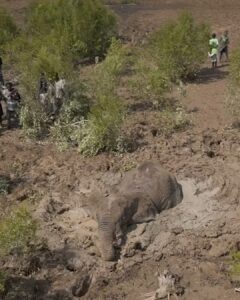
Two massive shapes were barely visible in the distance—dark silhouettes sunk deep into endless mudflats, hundreds of meters from solid ground. Two adult bull elephants. Trapped. Exhausted. Slowly losing the fight against a landscape that does not forgive mistakes.
By the time rescue teams arrived, daylight was already fading. The air was thick with humidity and urgency. Every step toward the bulls was heavy, each foot sinking into mud that pulled back like it had a will of its own. The elephants stood almost motionless, their legs locked in place, their weight pressing them deeper with every attempt to move.
Night was coming fast.
There would be no dramatic rescue that evening. No last-minute heroics. Only assessment, coordination, and a painful truth: they would have to survive the night on their own.
And no one could guarantee that they would.
Day One: Waiting in the Dark
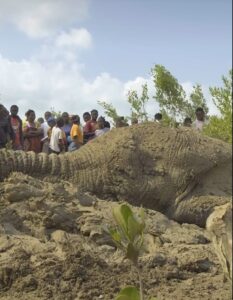
Working alongside wildlife authorities, the team studied the terrain, the tides, the elephants’ positions. The mudflats were deceptive—solid-looking from a distance, deadly up close. Moving heavy equipment in darkness would risk human lives and likely worsen the elephants’ condition.
So the hardest decision was made.
They would wait until morning.
As darkness fell, the two bulls remained stranded, their deep rumbles carrying across the flats—low, vibrating calls of stress and confusion. The team left knowing that time was no longer on their side.
Every hour mattered now.
Day Two: Loss
At first light, the rescue began.
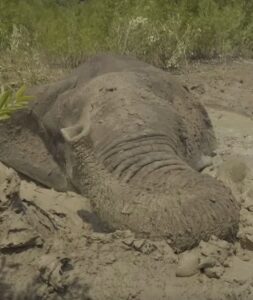
A bulldozer rumbled into position, its weight carefully guided across reinforced ground. Thick straps were prepared—strong enough, in theory, to move animals weighing several tons. Teams waded into the mud, digging around each elephant’s legs to relieve pressure and create space.
It was slow. Brutal. Exhausting.
The first bull was freed after hours of effort. For a brief moment, hope surged. But it faded almost instantly.
He was too weak.
Days of struggling in the mud had drained him beyond recovery. Even on solid ground, his body could not recover. He collapsed, his breathing shallow, his strength gone.
Shortly after, he died.
The silence that followed was heavy and absolute.
No one spoke. No one moved. This was the reality of rescue work that rarely makes headlines—the truth that not every effort ends in victory. That sometimes, despite everything, life slips away.
But there was no time to grieve.
The second bull was still trapped.
And he was deeper.
Day Three: Refusing to Leave
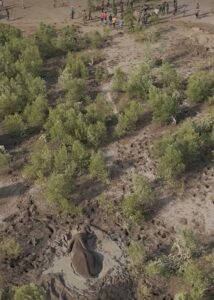
The straps snapped one by one under the immense strain of the second bull’s weight. The mud clung tighter. Every pull risked injury—to the elephant and to the people fighting for him.
Hours passed.
Then, finally, with stronger webbing straps and relentless coordination, the bulldozer pulled again.
This time, the earth released him.
The bull emerged coated in mud, his sides heaving, his eyes wide with fear and exhaustion. He was free—but he did not move.
Instead, he turned back.
Toward the place where his companion had fallen.
He refused to leave.
Elephants are known for their memory, their bonds, their grief. This bull stood rooted, despite exhaustion, despite freedom, as if abandoning his friend was something he simply could not do.
Rescuers gently guided him away, step by step, until he reached safer ground. Water was left for him. Space. Quiet. A chance to recover.
As night fell again, there was cautious relief.
Until the call came.
Late that night, word reached the team: the bull was trapped again.
Day Four: Racing the Tide
This time, the situation was worse.
The bull had wandered into a tidal creek and become stuck once more. The ground beneath him was unstable, and the tide was coming in.
If they failed now, he would drown.
There was no room for delay.
The team moved fast, administering IV fluids to strengthen him, stabilize his body, and buy precious minutes. The bulldozer returned. The straps were secured. Every calculation mattered.
They pulled.
And pulled.
One hundred meters.
One hundred fifty.
One hundred seventy.
Finally, the bull reached safety.
Barely thirty minutes later, the tide surged in, filling the creek completely. Water rushed over the mudflats, erasing all signs of the struggle that had taken place there.
Had the bull still been trapped, he would not have survived.
Freedom had come just in time.
But the mission wasn’t over yet.
Rescuers tracked him through the night, following his movement for 35 kilometers, ensuring he was far from danger, far from treacherous ground, far from the place that had nearly claimed his life—twice.
Only when he disappeared into safe territory did they stop.
Exhausted.
Mud-covered.
Emotionally spent.
But alive.
What Remains
Four days.
Four days of hope and heartbreak.
Of teamwork and loss.
Of a life saved—and one that could not be.
Rescue is not about guarantees. It is about showing up when the outcome is uncertain. It is about choosing to fight for life even when failure is possible.
One bull did not make it.
The other did.
And in that truth lies both sorrow and meaning.
Because sometimes, saving even one life is worth everything it takes.
In the wild, love is not always loud.
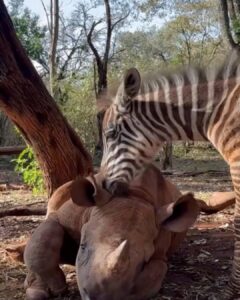
It does not always roar or trumpet or announce itself with dramatic displays. More often, it is quiet. It is patient. It is written in small, deliberate gestures that say, I see you. I am here. You are not alone.
For Little Notty, a young zebra whose life had already known loss far too early, love spoke through her teeth and her careful touch.
This was her language.
Notty should have been running beside her mother across open plains, learning the rhythms of survival, memorizing the scent and sound of the family she was born into. Zebra foals grow up wrapped in community. Mothers, aunts, sisters—all watching, protecting, guiding. Grooming one another. Standing shoulder to shoulder against the world.
But fate interrupted that story.
Notty’s mother fell from a cliff, her life ending in a moment no one could undo. And just like that, Notty’s world collapsed. The family she was meant to grow up in vanished overnight, leaving behind a small body with striped legs and a heart that still needed connection.
A week later, tragedy struck again.
Another baby was found alone—Tytan, a young rhinoceros calf. His mother, too, had fallen from a cliff. He was discovered frightened, vulnerable, and confused, standing in a world suddenly much too quiet.
Two babies.
Two losses.
One week apart.
Both rescued not because the world was kind—but because it had been cruel.
They were brought to the same nursery, a place designed not just to keep bodies alive, but to help broken beginnings mend. There, caregivers worked tirelessly to replace what had been lost: warmth, safety, consistency. Bottles replaced mothers. Gentle hands replaced protective flanks. Time replaced panic.
But there was something humans could never fully give.
Belonging.
That is where Notty stepped in.
From the moment she noticed Tytan, something inside her stirred. He was different—larger, heavier, rougher around the edges. His skin thick where hers was sleek. His horn budding where her stripes flowed. But loss has a way of erasing differences.
Notty understood grief.
She understood the ache of absence. And instinctively, she knew what to do with it.
In the wild, grooming is more than hygiene. It is trust. It is reassurance. It is how zebras say, You are part of me. I am part of you. Mothers groom foals. Friends groom friends. Family members groom one another as a way of weaving their bonds tighter, day after day.
Notty had lost her family.
But she had not lost her instinct to love.
So she offered it—to Tytan.
Caregivers first noticed her standing close to him, lingering where others moved on. She leaned her head toward his thick skin, gently nibbling, carefully scratching places he could never reach himself. The rhythm was slow and deliberate, a ritual older than memory.
Tytan responded immediately.
The massive little rhino, still so young and unsure, lowered himself to the ground, rolling slightly onto his side. His eyes softened. His breathing slowed. He let out a contented sigh that seemed far too big for a baby who had already known so much pain.
In that moment, he was no longer an orphan.
He was being cared for.
To an outsider, it might have looked unusual—a zebra grooming a rhino, two different species sharing a quiet space beneath the trees. But to those who watched closely, it was something deeply familiar.
It was family finding family.
Notty groomed him the way she might have groomed a sibling. She lingered at his ears, traced the curve of his neck, worked patiently along his back. She did not rush. She did not demand anything in return. She simply stayed.
And Tytan let her.
He trusted her with his still-healing heart.
As days passed, the bond deepened. Where Tytan went, Notty followed. Where Notty rested, Tytan settled nearby. When one grew anxious, the other remained calm enough for both. They learned the rhythms of nursery life side by side—feeding times, naps, quiet afternoons, long evenings when the world finally felt safe again.
They healed together.
Their caregivers often paused to watch, struck by the tenderness of it all. These babies had lost everything they were meant to have. And yet, somehow, they were building something new—something unexpected and profoundly beautiful.
Notty had turned grief into care.
Tytan had turned fear into trust.
In each other, they found what had been taken away.
There is something powerful about watching animals love without hesitation. They do not question whether they are allowed to. They do not wonder if it looks strange or breaks rules. They simply follow instinct—and instinct, when left untouched by fear or judgment, often leads straight to compassion.
For Notty, grooming Tytan was not a performance. It was not learned behavior. It was memory etched into her bones. Even without her mother beside her, she remembered how to love.
And for Tytan, receiving that love was a gift he did not know he needed until it arrived.
In a world that had already taken so much from them, they chose connection.
Today, they are often seen together—Notty carefully grooming her honorary zebra brother, Tytan resting contentedly beneath her attention. Two orphans. Two survivors. Two souls reminding everyone who witnesses them that healing does not always come from those who look like us.
Sometimes, it comes from someone who understands pain in the same quiet way.
Their story is not just about rescue. It is about resilience. About how love finds a way to reappear even after devastation. About how the instinct to care can survive loss—and even grow stronger because of it.
Notty lost her natal family.
But she did not lose her heart.
And Tytan, once alone in the world, found himself wrapped in a love language he did not speak—but understood perfectly.
In the shade of the nursery trees, where grief once lingered, a zebra and a rhino now share something rare.
Not just survival.
But belonging.