Charles Bronson: The Strength Behind the Toughness. – Daily News
Charles Bronson didn’t speak much. He didn’t need to. With a face chiseled from stone and eyes capable of silencing a room, he became the ultimate tough guy of Hollywood: The Magnificent Seven, The Great Escape, Death Wish. On screen, he was indestructible, the very embodiment of strength and endurance.

But behind that ironclad persona, there was something that would change his life forever—a woman. In the early 1960s, while Bronson was filming The Great Escape alongside Scottish actor David McCallum, McCallum brought his wife, Jill Ireland, to the set. Jill was English, elegant, serene—a dancer by training who had become an actress, her beauty matched only by her intellect.
It didn’t take long for Bronson to notice her. He turned to McCallum and, without hesitation, said, “I’m going to marry your wife.”
He wasn’t joking.

In the mid-1960s, both of their marriages ended. By 1968, Charles Bronson and Jill Ireland were married. They would remain together for the next 22 years. What they built was something rare in Hollywood—a true partnership. Jill appeared in 16 of Bronson’s films. Together, they brought their seven children—two from Jill’s previous marriage, three from Bronson’s, and two they had together—and traveled as a family to every film set. Family came first. Always.
There is a photograph from the early 1970s: the two of them walking through Paris. Bronson looks rugged and still, while Jill radiates a quiet joy. Hand in hand. Timeless.
Despite his fame for silence and intensity, Bronson softened beside her. Jill once joked, “I’m in so many of Charles Bronson’s films because no other actress wants to work with him.” But the truth was, there was no one else he wanted to work with.
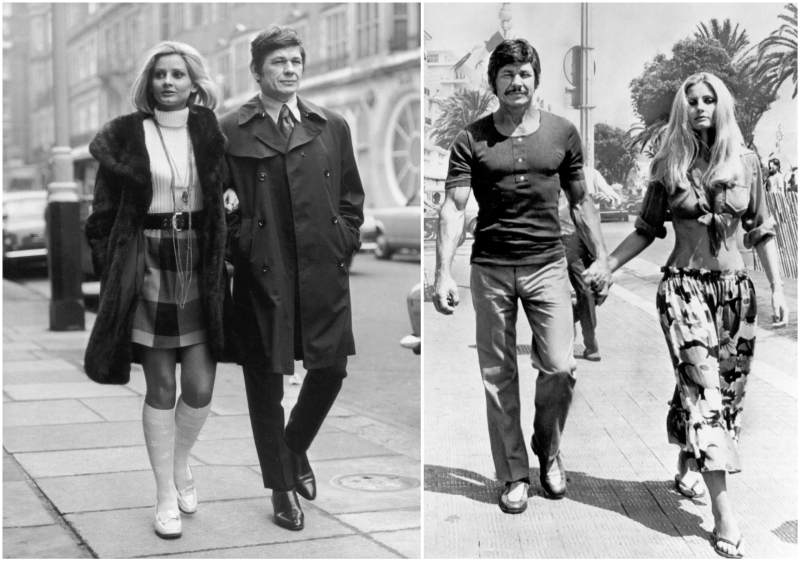
In 1984, Jill was diagnosed with breast cancer. She fought for six years, writing two books, testifying before the U.S. Congress, and becoming a spokesperson for the American Cancer Society. President Ronald Reagan personally presented her with the organization’s Courage Award.
On May 18, 1990, Jill Ireland passed away at 54 in their Malibu home. Charles Bronson was by her side. What he did afterward revealed the man behind the myth.
Jill was cremated, and Bronson had her ashes placed in a custom-made cane. He carried it with him everywhere. For the next thirteen years—through declining health, a third marriage, and into his final days—he never parted with it.
When Charles Bronson passed away in 2003, he was buried in Vermont.
With the cane.
With her.
Charles Bronson was not only the toughest man in Hollywood. He was a man who loved so deeply that losing her changed him forever. And sometimes, that kind of love is the greatest strength of all.

In 1992, Ralph Fiennes walked into the audition room for Schindler’s List quietly, almost unnoticed. At the time, he was a British actor with little recognition in Hollywood. With his educated demeanor, sinful voice, and kind expression, Fiennes didn’t look like the man who could embody the monstrous figure of Amon Göth, the infamous commander of the Plaszów concentration camp. But within minutes of reading his lines, the room changed.

Fiennes didn’t scream, nor did he overact. He didn’t have to. Instead, as soon as he started portraying Göth, there was an icy calm that settled into his performance, an almost silent violence that chilled the air. It wasn’t about loud, outward aggression. It was the way he captured evil with a calm, unshakable presence, a quiet malevolence that was more terrifying than anything exaggerated on screen.
Steven Spielberg, present in the room during the audition, stood frozen, his breath slowing. He didn’t clap, didn’t say a word. He simply walked out of the room, pale, only to return a few minutes later. “I think I’ve just encountered evil,” Spielberg remarked.
But Fiennes himself didn’t want the role. Even years after admitting to the process, he was candid: “I was scared of him. I didn’t want to get inside his mind. It was empty. And living in that void corrupts you.” Fiennes found the prospect of playing Göth terrifying. He knew he had to understand the true nature of this man who was capable of such atrocities, but he feared the emotional toll it would take. It was a void, a dark, hollow space within Göth’s character that, once entered, could consume a person.

Despite his hesitation, Fiennes threw himself into the role. He prepared by studying documentaries, interviews, biographies, and the details of the atrocities that had occurred during the Holocaust. He wasn’t interested in making a caricature of Göth—he wanted to show something far more disturbing: the banality of evil. Fiennes wanted to capture the true essence of the terror that could come from an ordinary man—someone who could drink coffee and calmly shoot people in the same breath, who could pet a dog one moment and then give the order to execute someone the next. This was the chilling realization Fiennes wanted to bring to life on screen.
Spielberg, deeply impressed by Fiennes’ dedication, ordered the costumers to replicate Göth’s original uniform with millimeter precision. Every detail, from the stitching to the buttons, had to be exact, adding to the authenticity of the portrayal. When Mila Pfefferberg, a Holocaust survivor, saw Fiennes on set in full costume, she fainted, bursting into tears. “It’s him,” she whispered, recognizing the embodiment of pure evil in front of her.
On set, Fiennes adopted a strange silence. He walked slowly, spoke very little, and mostly kept to himself. The air around him seemed to change every time he donned the uniform—colder, more tense. As one crew member put it, “When he comes in, even the birds stop singing.” His presence was so unsettling that it became almost unbearable for some of the people around him. The actor had gained nearly 30 pounds for the role, making Göth’s body feel heavier, more real. Fiennes wanted to ensure that Göth didn’t appear as a movie monster, but rather as an ordinary man—an ordinary man capable of extraordinary evil. And that, Fiennes realized, was the true horror: the ability to commit heinous acts while remaining deeply human.
Many of the cast and crew found it difficult to even look Fiennes in the eye while he was in character. His performance was so immersive, so unsettling, that it became almost impossible to separate the actor from the character he portrayed.
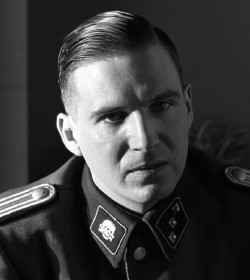
When Schindler’s List premiered in 1993, the audience was left breathless by Fiennes’ portrayal. His interpretation of Amon Göth was described as one of the most realistic and disturbing performances ever seen. It wasn’t the violence or the dramatization of his actions that left people shaken. It was the cold, emotionless way in which Fiennes brought the character to life. There was no screaming, no theatrical gestures. There was simply a man who followed orders, who killed without hesitation, who did all these things with a calmness that made it even more terrifying.
Fiennes was nominated for an Academy Award for his performance and won a BAFTA for Best Supporting Actor. But beyond the accolades, what lingered in the minds of audiences and critics alike was something else entirely: the chilling feeling of having seen evil’s face up close. Not the kind of evil that screams, the kind we associate with villains in films. No, Fiennes showed us the evil that is quiet, subtle, and most terrifying of all—the kind of evil that obeys, that acts without emotion, that comes from the most ordinary of people.

What Fiennes did in Schindler’s List was to make the face of evil human, too human. The kind of evil that we don’t want to acknowledge, the kind that we think exists only in the abstract or in history books. But it is real. It exists in people who look just like us, who speak like us, who live in our world. And that is why Ralph Fiennes’ portrayal of Amon Göth is unforgettable—because it forces us to confront something far more disturbing than a movie villain: the possibility that evil exists in all of us.