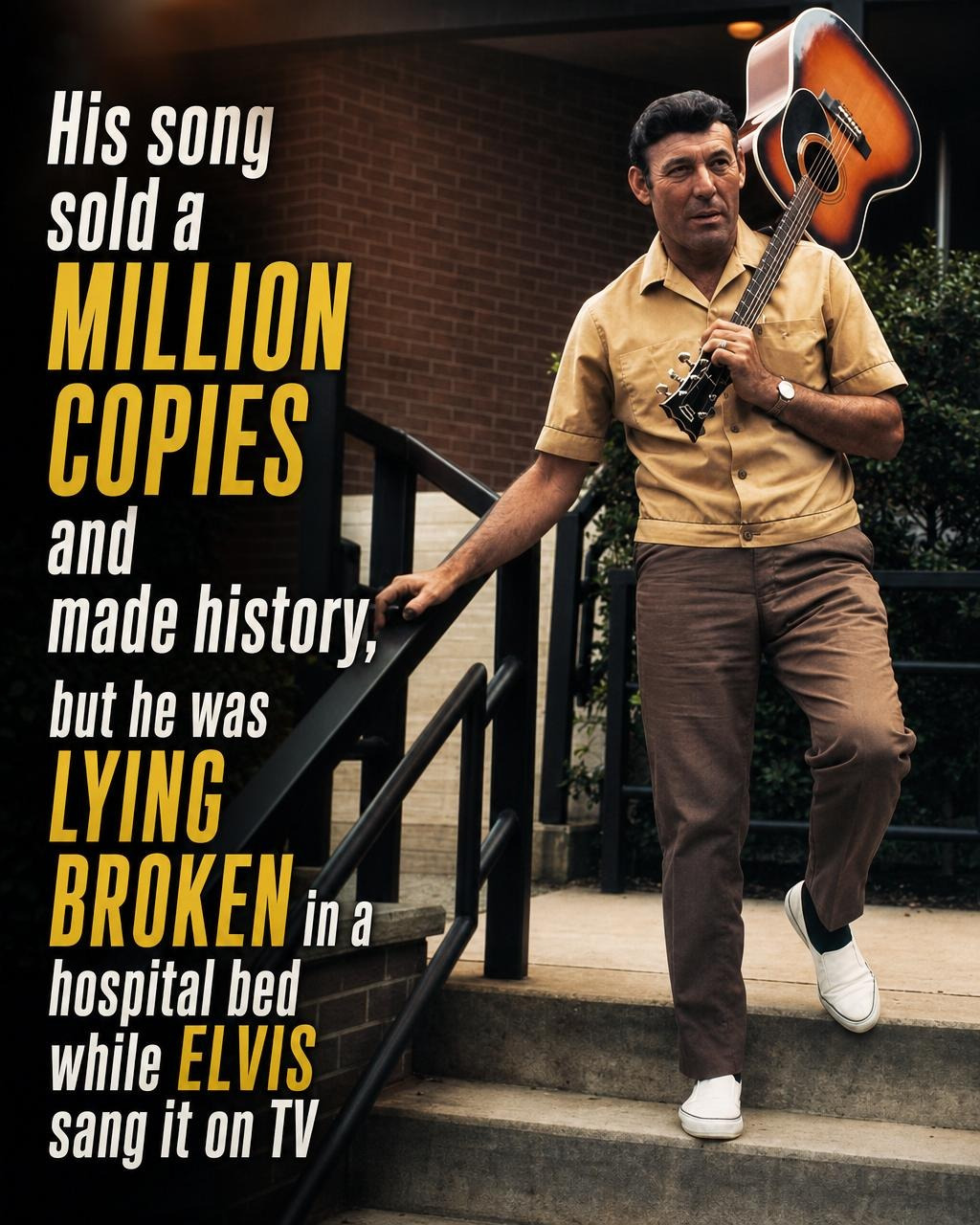
“BLUE SUEDE SHOES” SOLD 1 MILLION COPIES — BUT THE MAN WHO WROTE IT WAS LYING IN A HOSPITAL BED. Carl Perkins wrote “Blue Suede Shoes” after watching a guy at a dance yell at his girl for stepping on his new shoes. Cared more about the shoes than the pretty girl beside him. That song became the first Sun Records single to sell over a million copies. Hit #1 on both country and R&B, #2 on pop. No country artist had ever crossed over like that before. Sam Phillips had a plan — surprise Carl with a gold record on the Perry Como Show in New York. But what nobody knew yet was that Carl would never make it to that stage. On March 21, 1956, somewhere in Delaware, the driver fell asleep. The car slammed into a truck. Carl woke up a day later with three fractured vertebrae and a broken collarbone. His brother Jay was hurt even worse — injuries he’d never fully recover from. While Carl lay in that hospital bed, Elvis performed “Blue Suede Shoes” on national television. Three times that year. The song kept climbing the charts. The man who wrote it couldn’t even stand up. – Country Music
In the middle of 1950s America, when rock and roll still felt new and a little dangerous, one song changed everything. “Blue Suede Shoes” became the first Sun Records single to sell more than a million copies. It reached No. 1 on the country chart and the R&B chart, and No. 2 on the pop chart. For a country artist, that kind of crossover was almost unheard of.
But behind the success was a painful twist. While the song was climbing the charts, Carl Perkins was not standing under bright lights or celebrating on a stage. He was in a hospital bed, recovering from a serious car crash that nearly ended his rising career before it had fully begun.
How the Song Was Born
Carl Perkins wrote “Blue Suede Shoes” after watching a man at a dance get angry when someone stepped on his shoes. The moment stayed with him because of how much the man cared about the shoes, even more than the girl beside him. Carl turned that small scene into a song that was sharp, playful, and impossible to forget.
The lyrics captured something bigger than fashion. They reflected pride, attitude, and the new energy of rock and roll. The song felt fun, but it also had edge. That balance helped it spread fast, first through regional audiences, then across the country.
“Blue Suede Shoes” had the kind of simplicity that made it stick. People heard it once and remembered it.
A Career Ready to Explode
Sam Phillips, the founder of Sun Records, understood what the record could become. He had a plan to surprise Carl Perkins with a gold record during an appearance on the Perry Como Show in New York. It was the kind of moment that could have marked the start of a bigger national breakthrough.
Instead, fate took a brutal turn on March 21, 1956. Somewhere in Delaware, the driver of the car carrying Carl Perkins fell asleep. The vehicle slammed into a truck. Carl Perkins survived, but when he woke up a day later, he had three fractured vertebrae and a broken collarbone. His brother Jay Perkins was hurt even worse and would never fully recover from the crash.
The Song Went on Without Him
While Carl Perkins lay injured, the song he wrote kept moving forward. Elvis Presley performed “Blue Suede Shoes” on national television three times that year, giving the song even more exposure. For many listeners, the performances helped turn it into a rock and roll standard.
There was a strange kind of heartbreak in that moment. The writer of the song was confined to a hospital bed, unable to stand, while the world celebrated the music he had created. Success arrived, but it arrived without the man who made it possible.
A Legacy Built on Timing and Talent
Carl Perkins eventually returned to music, and his place in rock and roll history remained secure. “Blue Suede Shoes” was more than a hit. It was proof that a simple idea, written honestly and performed with attitude, could cross every boundary that radio had once tried to keep in place.
Even now, the story feels powerful because it holds both triumph and tragedy. A song about shoes became a milestone in American music, but the man who wrote it paid a heavy price just as the world was beginning to listen.
Carl Perkins gave rock and roll one of its most enduring anthems. The music went on to make history. His story reminds us that sometimes, the moment a dream comes true is also the moment life tests everything.
On Tuesday night on Jimmy Kimmel Live, The Chicks walked out dressed head to toe in red, and the moment carried more weight than a television performance usually does. Natalie Maines, Martie Maguire, and Emily Strayer did not just appear for nostalgia. They returned with purpose, stepped into the spotlight, and performed “Not Ready to Make Nice” with the kind of calm intensity that only comes from living through something unforgettable.
The song has always been more than a hit. It came from a storm. In 2003, Natalie Maines made a remark about a president during a performance in London, and the reaction in the United States was immediate and brutal. Country radio pulled The Chicks’ music, public criticism turned vicious, and the trio faced a wave of anger that went far beyond ordinary backlash. Death threats and public shaming followed, and the pressure would have broken a lot of artists. It did not break The Chicks.
Instead, they turned that experience into art. Taking the Long Way became the album that answered everything without sounding defensive. It was sharp, honest, and deeply human. When it arrived, it did not quietly fade away. It debuted at No. 1 on the Billboard 200, and then the music industry, which had once seemed ready to leave them behind, handed them its highest honors. The album won five Grammys, including Album of the Year, Record of the Year, and Song of the Year.
What once sounded like a shutdown became a statement of survival.
That is the part people often forget. The controversy was loud, but the comeback was louder in the long run. The Chicks did not chase approval. They kept making music, kept their identity intact, and let time do what time does best: reveal who was standing on principle and who was simply following a crowd.
Now, 20 years later, Natalie Maines, Martie Maguire, and Emily Strayer are bringing that album back to the stage. This fall, they will launch a full U.S. theater tour, performing Taking the Long Way from front to back each night. For longtime fans, it is a chance to hear the record in full again. For newer listeners, it is a reminder that some albums are not just collections of songs. They are chapters of a life.
There is something powerful about hearing “Not Ready to Make Nice” now, after all these years. The anger has aged into clarity. The hurt is still there, but so is strength. The red outfits on Jimmy Kimmel Live did not feel like costume. They felt like a signal: still here, still standing, still not ready to make nice.