Blue Cotton Work Shirts Stitched Together for a Spring Dance – America Focus
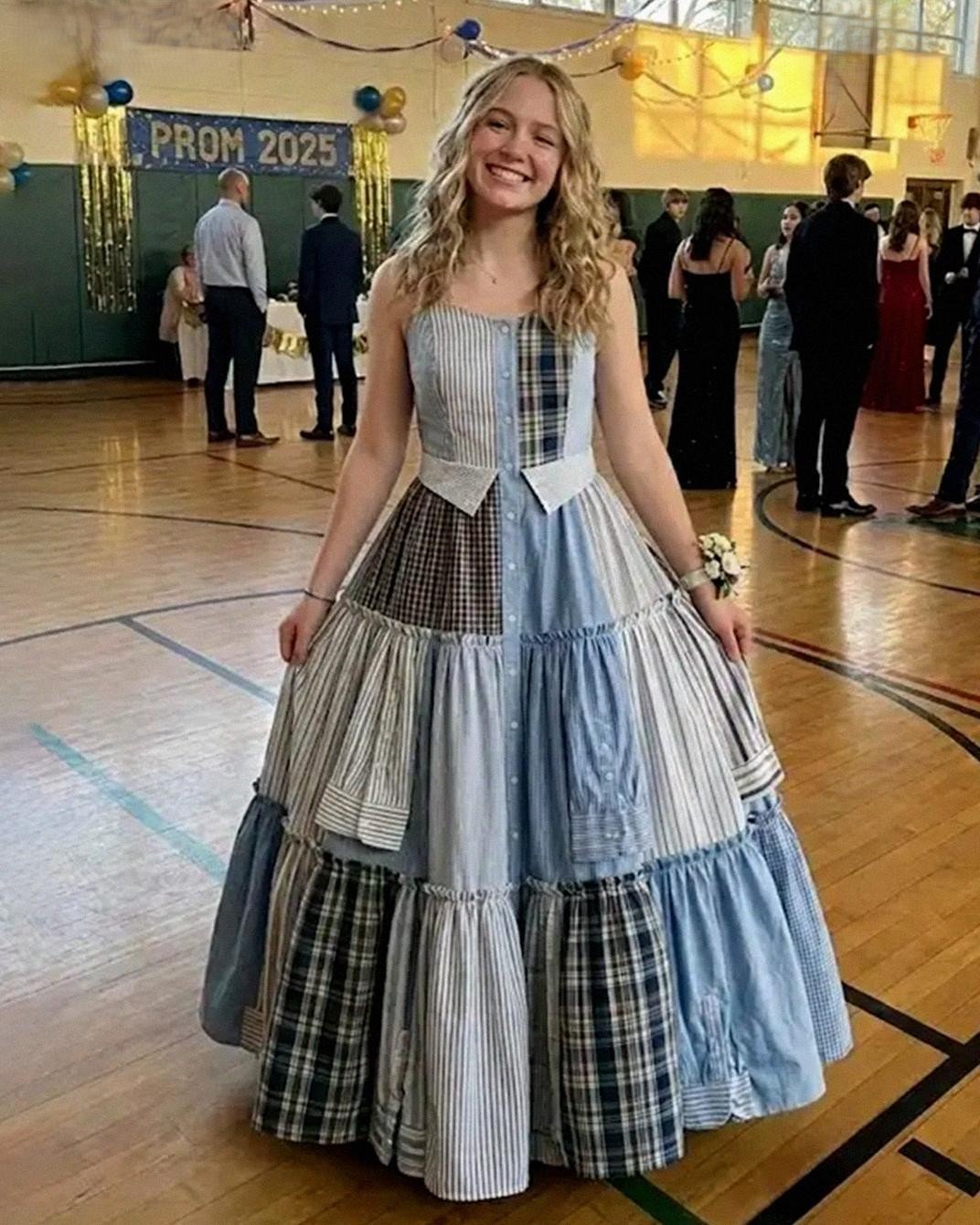
The sound of my father’s breathing was louder than the clanking of the steam radiators in the basement hallway. It had a dry, whistling rattle that did not belong in a man of fifty-four.
He pushed the wide dust mop over the red linoleum tiles, leaving a clean path through the gray winter grit. I sat on my heavy backpack near the boiler room door, watching the silver signet ring spin around my right pinky finger.
“I have swept these same tiles for twelve years, Nicole, and they still have plenty of shine left,” he said, his voice a low, raspy whisper.
He stopped and leaned his chest heavily against the top of the wooden broom handle. His face was the color of skim milk.
“Let me carry the bag, Dad,” I said, reaching for the nylon straps.
“No,” he said, coughing once into his blue handkerchief. “A senior preparing for college shouldn’t be hauling coal sacks.”
He swung the heavy bag onto his shoulder with a sharp grunt that made him wince.
We walked into his custodian closet, where the sharp smell of green floor wax and pine cleaner always hung thick in the air. He set my bag on a metal folding chair and reached into his vest pocket.
He pulled out his round silver pocket watch, but his hand came up empty of the heavy metal link that usually draped across his front.
“Well, look at that,” he murmured, turning the smooth metal casing over in his palm. “The chain is gone.”
“Where is it?” I asked.
He let out a dry chuckle, though his chest seemed to labor under the effort. “Must have slipped off while I was clearing the brush behind the athletic fields on Tuesday.”
He placed the chainless watch on his small wooden desk next to a jar of rusted screws.
At five o’clock, the bell in the main hallway rang three times, signaling the final lockup. Principal Bradley stood at the door of his office, adjusting his wire-rimmed spectacles as we walked toward the exit.
“Nicole,” Mr. Bradley said, his voice slow and measured. “Step in for a moment, please.”
-

Andrew Collins is a contributor who enjoys writing about everyday topics, people, and ideas that spark curiosity. His approach is simple and conversational, aiming to make stories easy to read and relatable. Outside of writing, Andrew follows current trends, enjoys long walks, and likes turning small observations into meaningful stories.
Post navigation
My father kept walking down the corridor, his boots dragging slightly on the concrete.
“Is Albert doing alright at home?” Mr. Bradley asked, looking down at a stack of maintenance schedules on his desk. “I can assign the gym floor to the night crew if he needs a lighter load.”
My fingers tightened around my signet ring, spinning it fast against my knuckle.
“He is perfectly strong,” I said. “He doesn’t need anyone taking his shifts.”
Mr. Bradley did not look up from his papers. “We want him here for a long time, Nicole.”
“He will be here,” I said, turning toward the door.
The walk home was six blocks through the damp Indiana dusk. My father walked half a step behind me, his breath coming in shallow, ragged puffs that rose like steam in the cold air.
The kitchen table at home was small enough that our knees touched when we sat down. A bowl of simple potato soup sat between us, the steam rising in thin gray curls under the yellow light of the ceiling fixture.
My father reached for the salt shaker, and his fingers trembled so hard the glass clicked against the ceramic pepper pot.
I watched the soup spill over the edge of his spoon, back into the bowl. I did not look at his face.
“The school board approved the weekend overtime shifts,” he said, his Midwestern drawl sounding thicker in the quiet room.
“You don’t need to work Saturdays,” I said. “We have enough.”
“We have what we need for today,” he said, setting the spoon down with a small clink. “But tomorrow costs more.”
“Then sell the watch,” I said, pointing to the empty pocket of his denim vest. “You don’t even have the chain anymore.”
He reached into his pocket and pulled out the bare silver watch, placing it gently on the oilcloth table.
-
Andrew Collins is a contributor who enjoys writing about everyday topics, people, and ideas that spark curiosity. His approach is simple and conversational, aiming to make stories easy to read and relatable. Outside of writing, Andrew follows current trends, enjoys long walks, and likes turning small observations into meaningful stories.
Post navigation
“The chain is gone, Nicole,” he said, his voice dropping even lower. “But the watch still keeps the hour.”
Nicole watches her father carefully place his chainless pocket watch into his worn denim vest pocket.
The morning after, I walked into the school foyer.
The yellow linoleum in the cafeteria entryway always had a dull sheen on Tuesday mornings, the fresh coat of pine-scented wax still tacky under my sneakers. I kept my chin tucked into the collar of my corduroy jacket, hoping to slip past the double doors unnoticed.
Gary, a senior whose father owned the three largest auto dealerships in the county, stood by the water fountain, jangling his heavy brass key fob. He stopped the metal clicking when I reached the threshold.
“Hey, Nicole,” Gary said, his voice carrying easily over the chatter of the morning crowd. “Did your dad spill the bucket on you this morning, or is that just your new perfume?”
Two boys near him laughed, their voices echoing off the concrete walls. I gripped my backpack straps and kept my eyes on the red fire extinguisher at the end of the hall, walking fast enough that the air cooled my face.
-
Andrew Collins is a contributor who enjoys writing about everyday topics, people, and ideas that spark curiosity. His approach is simple and conversational, aiming to make stories easy to read and relatable. Outside of writing, Andrew follows current trends, enjoys long walks, and likes turning small observations into meaningful stories.
The bell above the door of Clara’s shop chimed three times when I pushed it open that afternoon. The small room smelled of pressed steam and wool, a comforting heat that usually took the edge off the Indiana wind. Clara, my aunt, stood behind the counter with three silver safety pins pinned to her collar, her fingers smoothing a length of blue velvet.
“There is a plate of molasses cookies in the back, Nicole,” Clara said, not looking up from her shears. “Eat two. You look thin.”
“I am not hungry, Aunt Clara,” I said, setting my books on the scarred cutting table. “Did my father come by here today?”
Clara stopped her shears, the metal blades resting silent against the velvet. “He did. He spent twenty minutes asking about the bolt of silk brocade I keep in the back closet. The cream-colored one with the silver thread.”
I leaned against the counter. “We cannot afford brocade.”
“He wanted to know what three yards of it would run, plus the pattern fee,” Clara said, her voice dropping as she adjusted a pin on her collar. “He said a girl only has one senior spring dance, and she ought to look like she belongs there.”
-
Andrew Collins is a contributor who enjoys writing about everyday topics, people, and ideas that spark curiosity. His approach is simple and conversational, aiming to make stories easy to read and relatable. Outside of writing, Andrew follows current trends, enjoys long walks, and likes turning small observations into meaningful stories.
The spring formal was still five months away, in the middle of May, and my father had never once asked about my school events.
The neon sign of Miller’s Pharmacy buzzed with a low, wet hum as I stepped inside from the twilight. The air smelled of peppermint drops and rubbing alcohol. David, the clerk who graduated two years ahead of me, was wiping down the glass counter with a yellow cloth.
“The prescription for Albert is ready, Nicole,” David said, reaching under the counter before I could speak. “Mr. Miller filled it about an hour ago.”
He slid a thick brown paper bag across the counter, the paper stiff and heavy.
“That will be sixty-eight dollars and forty cents,” David said, his pencil poised over the ledger.
I stared at the black numbers on the small white receipt stapled to the top. My father’s weekly groceries rarely came to forty dollars, and his usual cough syrup was six.
“Is there a mistake?” I asked.
“That is the price for the new ones,” David said, looking down at his ledger. “The doctor wrote the order yesterday morning.”
-
Andrew Collins is a contributor who enjoys writing about everyday topics, people, and ideas that spark curiosity. His approach is simple and conversational, aiming to make stories easy to read and relatable. Outside of writing, Andrew follows current trends, enjoys long walks, and likes turning small observations into meaningful stories.
I pulled three crumpled twenty-dollar bills and a ten from my pocket, my fingers cold against the paper.
The wind from the north shook the loose kitchen window pane while the tea kettle began its low whistle. My father sat in the wooden chair by the radiator, his shoulders curved forward as he held a blue cotton handkerchief to his mouth. A dry, scraping cough shook his chest, a sound like gravel sliding down a metal chute.
He folded the blue cloth quickly, tucking it into his palm before I could see it, but his hand kept shaking.
I set the heavy brown prescription bag on the oilcloth table, right between the salt shaker and the empty bread box.
“Sixty-eight dollars, Dad,” I said. “For thirty pills.”
He did not look at the bag, keeping his hand flat over the blue handkerchief in his lap. “The doctor wants me to try something new for the winter cold, Nicole. It is nothing to worry about.”
“A winter cold does not cost sixty-eight dollars,” I said, my voice rising slightly before I caught myself. “And people do not buy silk brocade patterns when they are short on coal.”
-
Andrew Collins is a contributor who enjoys writing about everyday topics, people, and ideas that spark curiosity. His approach is simple and conversational, aiming to make stories easy to read and relatable. Outside of writing, Andrew follows current trends, enjoys long walks, and likes turning small observations into meaningful stories.
He looked up, his pale blue eyes clear under the yellow light of the ceiling bulb, his Midwestern drawl slow and deliberate.
“It is just a little dust in my lungs from the old coal heaters, nothing for you to fret over,” he said.
He reached out with his trembling hand to touch the paper bag, but his fingers slipped, sliding the heavy brown prescription bag across the table until it rested against the empty bread box.
At eight fifteen the next morning, Gary, a senior who always carried a heavy brass key fob, was kicking the bottom of locker 114. The metal door was jammed tight, the gray paint chipped where his heavy winter boots had repeatedly struck the latch.
The locker hallway was cold, with thin frost still clinging to the high windows near the ceiling.
Gary jangled his keys, cursing under his breath as several underclassmen squeezed past him to avoid the noise.
I stood near the drinking fountain with my strap tight over my shoulder, watching the heavy brass key fob swing in his hand.
-
Andrew Collins is a contributor who enjoys writing about everyday topics, people, and ideas that spark curiosity. His approach is simple and conversational, aiming to make stories easy to read and relatable. Outside of writing, Andrew follows current trends, enjoys long walks, and likes turning small observations into meaningful stories.
“My locker has been stuck since Tuesday,” Gary said, turning his glare toward me as if I were the one who had locked it. “Your dad is supposed to keep this place running, Nicole, but I guess he is too busy coughing down in the basement.”
Before I could reply, my father appeared from the basement stairwell, carrying his gray metal toolbox in one hand and his push broom in the other. He did not say a word to Gary, but he set the broom against the tiled wall and knelt on the cold floor.
“The latch is bent, Gary,” my father said, his voice a low, raspy whisper that sounded like dry leaves scraping across concrete.
“Then replace the whole thing,” Gary said, stepping back and crossing his arms. “My father paid the school activity fee three months ago, and I should not have to fight my locker every morning just to get my books.”
My father pulled a brand new brass hinge from his gray toolbox, his fingers moving slowly as he aligned the metal with the pre-drilled holes in the frame. I noticed his denim vest pocket was flat, the silver pocket watch sitting inside it without the weight of its usual silver chain.
-
Andrew Collins is a contributor who enjoys writing about everyday topics, people, and ideas that spark curiosity. His approach is simple and conversational, aiming to make stories easy to read and relatable. Outside of writing, Andrew follows current trends, enjoys long walks, and likes turning small observations into meaningful stories.
He tightened the final screw, tapped the metal with his small ball-peen hammer, and the door swung open on its new brass hinge with a soft, clean click.
Gary did not say thank you, grab his calculus book, or even look at my father before he walked away down the hall, his brass keys jingling with every stride.
My father stayed on his knees for a long moment, his hand resting on the metal toolbox before he slowly pushed himself up to stand.
“He does not have any manners, Dad,” I said, walking over to help him lift his broom.
“He is just in a hurry to get where he is going, Nicole,” he said, leaning heavily on the wooden broom handle for support when he thought I was not looking.
By three thirty that afternoon, the hallways had emptied out, leaving only the smell of fresh lemon wax and the distant clank of the steam radiators in the walls.
I found my father sitting in his green vinyl chair in the basement custodian office, his head tilted back against the cold concrete. On the wooden shelf behind him, three industrial-sized bottles of floor wax stood next to a yellowing calendar from three years ago.
-
Andrew Collins is a contributor who enjoys writing about everyday topics, people, and ideas that spark curiosity. His approach is simple and conversational, aiming to make stories easy to read and relatable. Outside of writing, Andrew follows current trends, enjoys long walks, and likes turning small observations into meaningful stories.
A faded green work shirt was draped over the back of the metal folding chair beside him, its cuffs frayed and the pocket missing its button.
“Why do you keep that old one down here, Dad?” I asked, pointing to the faded cotton.
He opened his eyes slowly, a faint smile softening his tired face as he looked at the fabric. “That is the shirt I wore my first day in this school, Nicole, back when the boiler still ran on coal.”
“It has a deep tear under the left pocket,” I said, stepping closer to touch the rough, clean cotton.
“A man has to know how to fix what is torn, Nicole, whether it is a sleeve or something else,” he said, his Midwestern drawl even slower than usual.
“You should let Clara patch it for you,” I said. “Her shop has the right green thread.”
He shook his head, his hand sliding over the faded green sleeve. “No, this one stays right here where it belongs.”
He reached for his broom, but he leaned heavily on the wooden handle before he took his first step toward the basement doorway.
-
Andrew Collins is a contributor who enjoys writing about everyday topics, people, and ideas that spark curiosity. His approach is simple and conversational, aiming to make stories easy to read and relatable. Outside of writing, Andrew follows current trends, enjoys long walks, and likes turning small observations into meaningful stories.