BEFORE DOLLY, BEFORE LORETTA — THERE WAS KITTY WELLS AND HER #1 HIT THAT CHANGED EVERYTHING. In 1952, Kitty Wells recorded “It Wasn’t God Who Made Honky Tonk Angels” — a direct response to Hank Thompson’s hit. Nobody saw it coming. That single made her the first woman ever to reach #1 on Billboard’s country singles chart. Her voice wasn’t pretty in the traditional sense. It was sad, honest, and cut straight through you. She sang about love and heartbreak from a woman’s perspective — and for working-class women across America, it felt like someone finally understood. But 1952 was just the beginning. What followed were nearly two decades of hits. “Paying for That Back Street Affair.” “Making Believe.” “Heartbreak USA.” One after another. The Country Music Hall of Fame honored her in 1976. The Grammy Lifetime Achievement Award came in 1991. Yet few people know what almost kept her from ever stepping into that recording studio in the first place — and the one quiet conversation that changed her mind. – Country Music
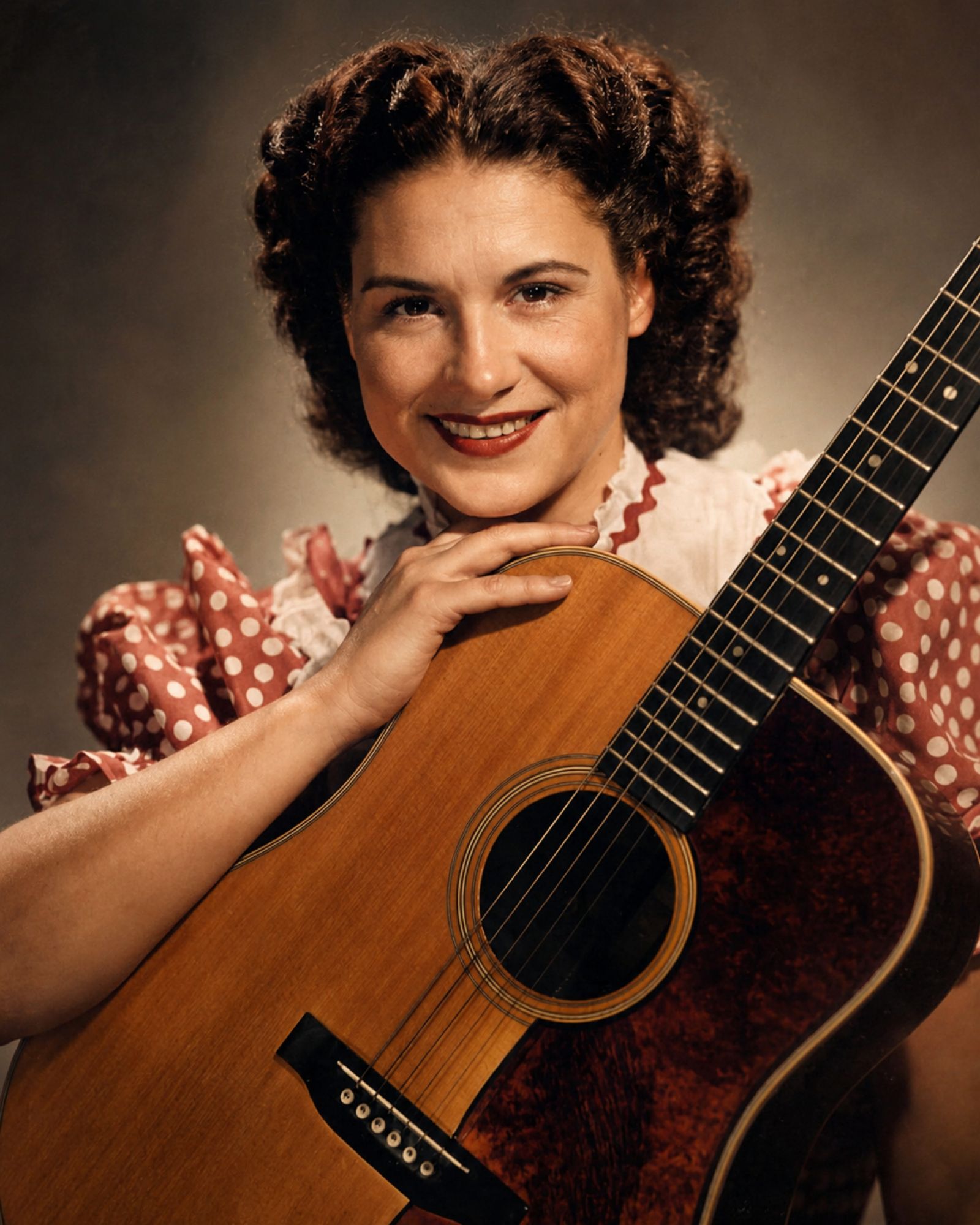
In the early 1950s, country music was still a world with strict rules. Men mostly told the stories. Men mostly got the hits. Men defined the heartbreak, the cheating, the pride, and the pain. Women sang too, of course, but usually from the sidelines. Then Kitty Wells stepped forward with a song that nobody expected to become a revolution.
The Record That No One Saw Coming
In 1952, Kitty Wells recorded “It Wasn’t God Who Made Honky Tonk Angels”, a sharp and unforgettable response to Hank Thompson’s hit “The Wild Side of Life.” The idea itself was bold. A woman answering back, not with anger for the sake of drama, but with a clear-eyed point of view that many listeners had been waiting to hear.
When the record was released, it did more than sell copies. It made history. Kitty Wells became the first woman ever to reach #1 on Billboard’s country singles chart. That achievement was not just a win for her career. It opened a door that had been locked for generations.
“It wasn’t a flashy voice, but it was honest. It sounded like real life.”
That honesty is what made Kitty Wells stand out. Her voice was not polished in the glossy, radio-ready way people often expected. It was sad, steady, and deeply human. She sang like someone who had lived through disappointment and was not afraid to tell the truth about it. For working-class women across America, that mattered. They heard themselves in her songs.
Why Kitty Wells Felt Different
Long before female country stars were celebrated as powerhouse icons, Kitty Wells was singing from a place that felt intimate and personal. She gave voice to women who had loved, lost, endured, and kept going. Her songs did not pretend heartbreak was glamorous. They treated it like something serious, something that shaped everyday life.
That was part of the magic. Kitty Wells did not just sing about love and sorrow. She sang about the consequences of love, the loneliness that follows betrayal, and the quiet strength it takes to survive it. In doing so, she helped change what country music could say and who it could say it for.
The Hits Kept Coming
What followed the success of “It Wasn’t God Who Made Honky Tonk Angels” was not a one-time moment. It was a long run of enduring songs that proved Kitty Wells was far more than a novelty or a lucky breakthrough. She became one of the defining voices of the era.
Song after song found its audience: “Paying for That Back Street Affair,” “Making Believe,” and “Heartbreak USA.” Each one carried the same emotional directness that made her first hit so powerful. She understood how to make a listener feel the ache without overdoing it. She trusted the song, trusted the story, and trusted the truth in the words.
For nearly two decades, Kitty Wells remained a major force in country music. She did not just succeed in a male-dominated industry. She helped reshape it. Later generations would build on the path she helped clear, but Kitty Wells was the one who proved the path could exist at all.
The Quiet Conversation That Changed Everything
What makes her story even more remarkable is that Kitty Wells almost never recorded the song that changed her life. Before she stepped into the studio, she had serious doubts. The song was unusual. It was controversial for its time. And there was no guarantee that audiences would accept a woman speaking so directly to a popular male hit.
Then came the quiet conversation that changed her mind. It was not a dramatic speech or a grand public defense. It was a simple push, a moment of reassurance that gave Kitty Wells the confidence to try. Sometimes history turns on exactly that kind of moment: not a spotlight, but a private word of encouragement.
That decision paid off in a way almost no one could have predicted. A song that might have been left behind became the record that altered the future of country music.
Recognition That Arrived Later
As the years passed, the industry eventually caught up to what audiences had known all along. In 1976, the Country Music Hall of Fame honored Kitty Wells. In 1991, she received the Grammy Lifetime Achievement Award. These honors were well deserved, but they arrived after the real impact had already been made.
By then, Kitty Wells had already done the harder work: proving that a woman could lead the conversation, reach the top of the chart, and stay there long enough to matter. She had shown that country music could be more truthful, more inclusive, and more emotionally precise when women were allowed to tell their side of the story.
Why Kitty Wells Still Matters
Before Dolly Parton became a global icon, before Loretta Lynn spoke fearless truths, Kitty Wells had already broken through. She did it with a song that was brave, direct, and impossible to ignore. She did it with a voice that sounded like life itself. And she did it in a moment when almost nobody expected a woman to change the rules.
That is why Kitty Wells still matters. Not just as a pioneer, but as the woman who made room for so many others. Her story is not only about one hit record. It is about what happens when a single voice says what others have been feeling all along.
Kitty Wells did not just sing country music. She helped redefine it.
Post navigation
Before Merle Haggard became one of the most important voices in country music, he was just a young man from Oildale trying to survive his own past and find a future in music. Long before the awards, the headlines, and the songs that would define an era, Merle Haggard was simply trying to get close enough to the stage to matter.
And in that moment, someone already knew he had something real.
Wynn Stewart Saw the Spark Early
That someone was Wynn Stewart, a California country singer who helped shape the Bakersfield sound before the rest of America fully understood what was happening out West. While Nashville was polishing country music with smooth strings and studio gloss, Wynn Stewart was leaning into something rougher and more direct. His music carried the sound of hard work, smoky rooms, sharp guitars, and the kind of truth that did not need to be dressed up.
Wynn Stewart was not chasing trends. He was building a sound that felt like California itself: restless, honest, and a little bit stubborn. In that world, he noticed a young Merle Haggard before most people knew the name.
Merle Haggard was not yet a star. He was not yet the writer of Mama Tried or the voice of the working class. He was a former inmate trying to move forward, carrying his history with him and hoping music might offer a way out. Wynn Stewart gave him a place near the music, and that alone changed everything.
From the Bass Line to the Spotlight
Merle Haggard played bass in Wynn Stewart’s band. That detail matters because it says a lot about where Merle was in those years. He was not front and center. He was not the man with the spotlight. He stood behind another artist, learning the rhythm of the road, the discipline of performing, and the fragile hope that comes from being close to a dream.
For many musicians, those early years can disappear into legend. But this was the part where Merle Haggard absorbed the language of California country from the inside. He heard how Wynn Stewart worked a crowd. He watched how the songs landed. He learned what kind of honesty made people stop talking and listen.
In that sense, Wynn Stewart was more than just a bandleader. Wynn Stewart was an early guide.
The Song That Opened the Door
Then Wynn Stewart handed Merle Haggard a song that would quietly change the course of his life: Sing a Sad Song.
Merle Haggard recorded it in 1963, and while it did not turn him into a household name overnight, it gave him something essential: a first real step onto the country chart. That meant radio was beginning to pay attention. That meant listeners were beginning to hear the voice that would one day become impossible to ignore.
It is easy, looking back, to think that great careers arrive all at once. They do not. More often, they begin with a small opening, a single song, and one person willing to take a chance. Wynn Stewart did that for Merle Haggard. He heard something worth investing in before America had any reason to look.
Before the fame, before the myth, before the stories got bigger than the man, there was a song and a hand offered in the right direction.
Why Wynn Stewart Matters
Wynn Stewart deserves to be remembered not only as a talented singer, but as one of the people who helped shape Merle Haggard’s path. He helped build the Bakersfield sound, helped define a California version of country music, and helped make room for an artist like Merle to grow into himself.
That kind of influence is easy to overlook because it does not always come with the loudest legacy. The names that change music are not always the ones that stay brightest in memory. Sometimes the forgotten artist is the one who first recognizes the future standing quietly in the back of the room.
Wynn Stewart did that. He heard Merle Haggard before most of America did.
The Beginning of a Bigger Story
Merle Haggard would go on to become one of country music’s defining voices, but every legend starts somewhere smaller and more fragile than the final story suggests. For Merle Haggard, part of that beginning ran through Wynn Stewart’s band, Wynn Stewart’s songs, and Wynn Stewart’s belief.
That is what makes this chapter so powerful. It is not just a story about success. It is a story about recognition. About one musician seeing another before the world caught up. About a forgotten California singer helping open the door for one of country music’s greatest names.
Sometimes the first person who believes in you never gets remembered as loudly as the life they helped begin. But the truth is still there, hiding in the roots of the music.
Before America heard Merle Haggard, Wynn Stewart did.