Against the Flood: Chloe and Sandy’s Fight to Survive. – Daily News

When the floodwaters came, they came fast. One moment, Chloe Adams was inside her home, watching the rain pound harder against the windows. The next, she realized the water was creeping past the doorstep, filling the rooms of the house she grew up in. Within minutes, it wasn’t just a bad storm anymore—it was a fight for survival.
But Chloe wasn’t alone. At her side was Sandy, her childhood dog. Once a playful puppy who had grown up alongside her, Sandy was now a senior—slower, more fragile, and unable to swim against the current that was sweeping through their world.
As the water rose higher, Chloe’s thoughts weren’t about herself. “I was more worried about losing her than me,” she later admitted. All she could think about was finding a way to keep Sandy safe.

The plan was simple in theory but terrifying in execution: they needed to make it to higher ground. The closest option was a neighbor’s rooftop. But how could she get Sandy there?
Chloe tried everything she could find. First, she placed Sandy on her dog bed, hoping it would float. But it sank almost immediately. Next, she grabbed a large plastic container, the kind just big enough for Sandy to curl into. For a moment, it seemed like it might work—but as soon as it hit the water, it began to tip and sink. Panic set in. Time was running out.
And then she saw it: a couch cushion. Chloe wedged the cushion beneath the plastic container, creating a makeshift raft. It wasn’t perfect, but it was enough. Gently, she lifted Sandy into the container, whispered a promise that she’d keep her safe, and slid into the cold, rising water herself.
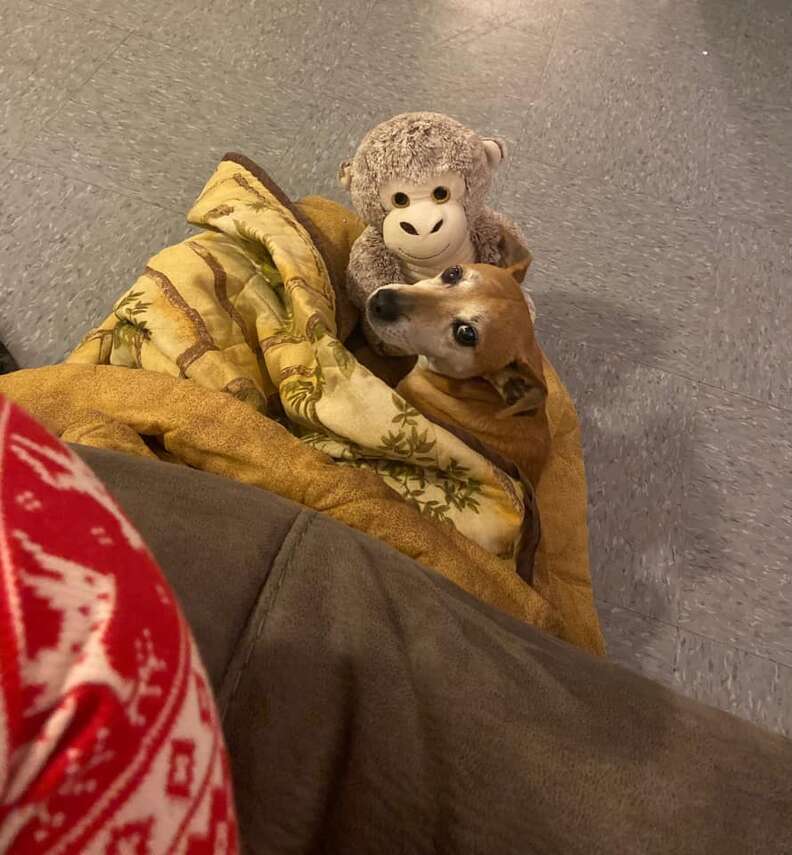
The current tugged at her body, her arms straining as she swam while guiding Sandy’s fragile raft. Stroke after stroke, she pushed toward the rooftop. The container wobbled, threatening to tip, but Sandy clung to it, trusting Chloe completely. Finally, exhausted but determined, Chloe reached the edge of the roof, pulled herself up, and carefully lifted Sandy to safety.
For the next five hours, they sat there together—soaked, cold, and shivering in the relentless rain. Chloe kept Sandy in her lap, shielding her with the plastic container like a tiny roof. The water below them kept rising, and fear gnawed at Chloe’s chest, but she never let Sandy go.
At last, a familiar figure appeared in the distance: her uncle, paddling toward them in a kayak. Relief washed over Chloe as he reached the rooftop. They climbed in—both tired, both shaken, but alive.


In the hushed corridors of a pediatric cancer ward in the late 1990s, a nurse stopped outside a room, stunned by what she heard. Inside, a boy whose body was failing him was laughing so hard he had tears streaming down his cheeks. On the edge of his bed, in scrubs several sizes too big, with a stethoscope dangling crookedly and a bright red clown nose, was Robin Williams.
No cameras. No reporters. No applause. Just Robin, one-on-one with a child who had almost forgotten how to smile.
These weren’t publicized visits. They weren’t arranged by Hollywood agents or designed for headlines. They happened quietly, almost secretly, set up by hospital staff who knew him not as a celebrity, but as a man who called anonymously, asking: “Are there any kids who could use a laugh today?”
Sometimes he showed up with a bag of puppets. Sometimes he slipped into the unmistakable voice of Mrs. Doubtfire. Often, he simply sat down and made funny faces until a child in pain remembered how to giggle.
One nurse recalled a visit in 2003 when Robin spent over an hour with a 10-year-old boy who was dying of leukemia. The child’s father had been stoic for weeks, determined not to cry in front of his son. That day, as Robin “conducted” an invisible orchestra of squeaky IV poles and sang an absurd operatic ballad to the rhythm of heart monitors, the boy laughed—and for the first time, so did his father. Tears rolled down the man’s face, not from grief, but from relief.
Robin never spoke of these visits in interviews. Even close friends only learned of them secondhand. Families who tried to thank him publicly found he always declined. The moments, he believed, belonged to the children.
In 2006, after a comedy show in Denver, Robin drove over an hour to visit a teenage girl who was nearing the end of her life. Her favorite film was Aladdin, and she had memorized every line the Genie had ever spoken. When Robin walked in and began improvising in that familiar, booming voice, her face lit up. Her mother later said he stayed far longer than expected—listening to her daughter, not just performing for her.
It took enormous emotional strength to walk into those rooms. There were no scripts, no second takes, only children slipping away and parents aching for more time. Yet Robin sat on the floors, shared popsicles, held hands, and laughed with them like it was the most natural thing in the world. Later, he often sat in his car alone, sometimes crying, sometimes calling a friend just to steady himself.
By 2010, nurses in multiple cities had learned to expect his calls when he was in town. They never advertised it, because that’s how he wanted it. His only request was simple: “If I can make one kid forget where they are, even for ten minutes, that’s enough.”
His visits didn’t cure illness. They didn’t change the brutal math of life and death. But they did something just as important: they gave joy to the fading, eased the grief of families, and reminded everyone in those rooms that even at the edge of goodbye, laughter still had power.
Robin Williams left behind countless movies and unforgettable performances. But perhaps his greatest legacy was what he never asked to be remembered for—the quiet, anonymous moments when he gave children facing the unthinkable a reason to laugh again.
Because sometimes healing doesn’t come from medicine or miracles. Sometimes, it comes from a man with a red clown nose, pulling faces in a hospital room, and proving that even in the darkest hours, laughter is still light.
