After I Won $2.5 Million, My Family Destroyed My Check, and Revealed the Truth About Love, Money, and Betrayal – America Focus
I won the lottery on a Tuesday that felt aggressively ordinary. The sky was the color of old tin, the grocery store parking lot smelled like hot asphalt and spilled soda, and my car was cluttered with unopened mail and reusable bags I never remembered to bring inside.
Nothing about the day suggested it would become the axis my life would turn on.
I had bought the ticket on impulse, the way you grab gum at the register. A few dollars. A shrug. Something to do while waiting in line. I scratched it in my car with the edge of a key, half-listening to the radio, already thinking about dinner.
The numbers revealed themselves slowly, silver dust collecting on my fingers. I remember blinking, then leaning closer, then freezing completely.
Two million. Five hundred thousand.
I scratched again, harder, like I had somehow imagined it. The numbers did not change. They sat there calmly, indifferently, as if they had always belonged to me.
My hands began to shake so violently I had to drop the ticket into my lap. My heart slammed against my ribs. My mouth went dry. For a moment I couldn’t breathe at all, just sat there in my car with the engine off, the radio still playing, the world moving on as if nothing had happened.
“Oh my God,” I whispered. Then louder, to no one. “Oh my God.”
I laughed once, sharp and startled, then clamped my hand over my mouth. The laugh threatened to turn into something else. Tears, maybe. Or hysteria.
$2.5 million.
The words felt unreal, like something borrowed from someone else’s life. That kind of thing didn’t happen to people like me. I was Elise Turner. The quiet one. The responsible one. The extra one.
I grew up in a family that had room for one star, and it wasn’t me.
That space belonged to my younger sister, Natalie. From the moment she was born, she was described as a miracle. She had nearly arrived early, nearly had complications, nearly something tragic. Nearly. The word followed her everywhere, proof that the universe had almost taken her and thought better of it.
She deserved everything, my parents said. She had fought to be here.
I, apparently, had not.
I was never abused. That mattered, I knew. My parents fed me, clothed me, sent me to school. They came to my events, though often late, and left early. They loved me, I think, in the abstract way you love something reliable. Something that doesn’t need much. Something that won’t disappoint you by wanting more.
Natalie wanted everything, and they gave it to her. Attention. Praise. Forgiveness. Excuses.
I learned early how to be easy. How to be grateful. How to disappear without making it obvious.
So when I sat there in my car holding a winning lottery ticket, my first instinct was not joy.
It was fear.
Don’t tell anyone, a voice inside me said. Don’t be stupid.
I folded the ticket carefully and tucked it into my wallet, my hands still shaking. I didn’t drive home right away. I sat there until my heartbeat slowed, until the world felt solid again. I thought about my parents. About Natalie. About Sunday dinners where my accomplishments were met with polite nods, then quickly redirected to her latest crisis or triumph.
If they knew, I thought, everything would change.
And not in a good way.
I did not tell them.
Instead, I called a financial advisor the next morning. Then a lawyer. I followed instructions meticulously, like I always did. I took the lump sum. After taxes, it came to around $1.6 million. Still an absurd number. Still more money than I had ever imagined touching.
I set up a trust. I diversified investments. I moved money into accounts that were boring and safe and solid. I let professionals handle it while I sat on my couch, staring at spreadsheets and trying to remember how to breathe.
The ceremonial check arrived in the mail, oversized and glossy, my name printed on it in bold letters. It felt strangely anticlimactic, like a prop. I slid it into a drawer in my desk, under old notebooks and expired coupons, and closed it without ceremony.
Two weeks passed.
I slept badly. I jumped every time my phone rang. I rehearsed conversations that never happened. I felt like I was walking around with a secret humming under my skin.
Eventually, I told them.
It was a Sunday dinner, like always. Roast chicken. Steamed vegetables. The good plates. Natalie talking loudly about wedding venues, her engagement ring catching the light every time she gestured.
“I have something to tell you,” I said, my voice steady despite the way my stomach twisted.
They all looked at me. Even Natalie paused.
“I won the lottery,” I said. “A few weeks ago.”
For a heartbeat, there was nothing. Then my mother’s fork clattered against her plate. My father leaned forward, eyes wide. Natalie’s expression sharpened, interest flickering across her face like a switch flipped on.
“How much?” she asked immediately.
“Two and a half million,” I said.
My mother pressed a hand to her chest. “Oh my God.”
My father let out a low whistle. “That’s… that’s incredible.”
Natalie smiled. Not happy. Calculating.
“Well,” my mother said after a moment, her voice smoothing itself out, practical already, “you know your sister really needs help right now. Weddings are expensive. And she’s been under so much stress.”
My father nodded, as if this was obvious. “Family supports family. Half seems reasonable.”
Natalie swirled her wine, watching me over the rim of her glass. “You don’t have kids. Or a mortgage. What would you even spend it on?” She tilted her head. “It just makes sense for me to get the majority share.”
The words hit me like cold water.
They were not congratulating me. They were dividing me.
I looked at their faces, at the way they leaned in, already counting, already deciding. Something in me went very still.
“I’m not giving anyone half,” I said. My voice surprised me with its calm. “The money is mine.”
The silence that followed felt heavy, pressing against my ears.
My mother scoffed. “Don’t be selfish.”
“After everything we’ve done for you,” my father added. “Ungrateful.”
Natalie smiled thinly. “You’ll regret this.”
I stood up. I didn’t argue. I didn’t cry. I just left.
I drove home with my hands steady on the wheel, my chest tight but clear. I had expected anger. Tears. What I felt instead was something colder.
Recognition.
The next morning, I woke to the smell of smoke.
It crept into my bedroom first, faint and acrid. I sat up, heart racing, and followed it outside in my pajamas. The air was sharp, the sky pale with early light.
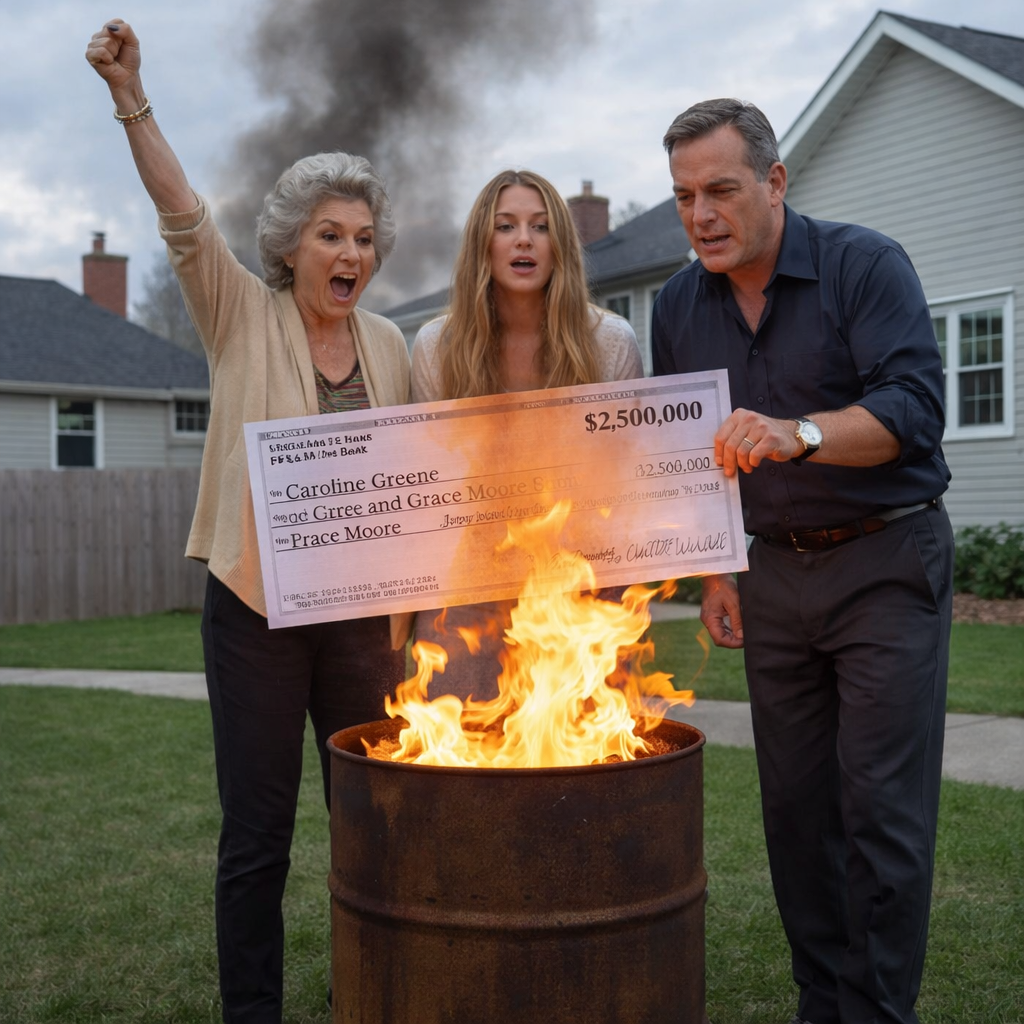
In the backyard, my parents and Natalie stood around a metal barrel. Flames licked upward, curling around paper that blackened and folded in on itself.
My ceremonial check.
My mother crossed her arms, satisfaction etched into her face. “If you won’t share,” she said, “you won’t get a penny.”
Natalie laughed, high and theatrical. “Burn it all.”
I stared at the fire. At the ashes lifting into the air. And then, unexpectedly, I laughed.
It burst out of me, loud and real, echoing off the fence. I couldn’t stop.
They all froze.
“You really think,” I said between breaths, “that I’d leave the real check lying around?”
Their faces drained of color as I spoke. “The money was wired weeks ago. Most of it’s invested already.”
Silence. Shock.
“You didn’t burn my future,” I said. “You burned the last illusion I had about this family.”
I turned and walked back inside. Locked the door. Stood there for a long moment, my hand on the knob.
That night, I packed a suitcase.
And I understood, finally, what I had always been to them.
A month passed before the next blow landed.
By then, I was living in a small apartment across town, a place that smelled faintly of fresh paint and lemon cleaner. It was nothing special. Beige walls. Thin carpet. A balcony that looked out over a parking lot and a line of tired trees. But it was quiet. No footsteps outside my door. No tension humming in the air. For the first time in my adult life, my space felt like mine alone.
I was still unpacking when the knock came.
It was a sharp, professional knock. Not a neighbor. Not a friend. I opened the door to a courier holding a thick envelope, my name printed neatly on the front. The logo in the corner meant nothing to me.
The moment I closed the door behind me, a familiar unease settled in my stomach.
I sat on the floor among half-open boxes and tore the envelope open. Papers slid out, heavy and official. The words blurred together at first. Then they sharpened.
Lawsuit.
My parents were suing me.
They wanted $1.2 million. The document cited emotional distress, implied promises, verbal agreements. It claimed I had led them to believe I would support Natalie financially. That I had caused severe psychological harm by refusing to honor my obligations as a daughter.
I laughed once, incredulous, then pressed my hand to my mouth as nausea surged.
They had listed memories as evidence. Things I had said as a teenager. Thank you for everything. I couldn’t have done this without you. Words of gratitude twisted into contracts.
The audacity left me dizzy.
I sat there for a long time, papers spread across the floor, my apartment silent except for the hum of the refrigerator. Then I picked up my phone and called the only person I trusted with something like this.
Jennifer Moss answered on the second ring.
“Elise?”
“They’re suing me,” I said. My voice sounded far away even to my own ears.
“For what?”
“For winning the lottery.”
There was a pause. Then a sound I had never heard from her before. A low laugh. Not amused. Dangerous.
“Elise,” she said, “this is the dumbest lawsuit I have ever seen. And I have seen some truly stupid lawsuits.”
“Can they win?” I asked.
“Not a chance,” she said. “But they are going to regret filing it.”
Over the next two weeks, my life became paperwork and memory excavation. Jennifer asked for everything. Bank statements. Text messages. Emails. Photos.
I dug through old phones, old laptops, old boxes. What emerged felt like an autopsy of my relationship with my family.
There were years of messages from my mother calling me selfish when I hesitated to send money. Screenshots of Natalie asking for help that never came with repayment. Records showing that I had been financially independent since eighteen.
A neighbor I barely knew emailed me photos she had taken the morning of the fire, worried by what she had seen. The images showed my parents and sister standing around the barrel, flames reflected in their faces.
Jennifer studied everything with methodical focus.
“They are going to paint you as cold,” she said. “Ungrateful. We are going to show the court who actually abandoned whom.”
The courthouse downtown smelled like old wood and floor polish. I arrived early, wearing a navy suit Jennifer had insisted on. She adjusted my collar before we went in.
“Let them be emotional,” she said. “You just exist.”
My parents arrived together, Natalie between them. My mother wore black, pearls at her throat. My father looked stern, composed. Natalie dabbed at her eyes, though her makeup was flawless.
Their lawyer was older, polished, the kind of man who relied on tone more than substance.
The judge was a woman with sharp eyes and no patience for nonsense. She skimmed the complaint, then looked up.
“You are asking this court to compel lottery winnings based on implied family obligations?” she asked.
Their lawyer began a speech about morality. She stopped him mid-sentence.
“I asked for the legal basis,” she said. “Do you have a contract?”
He did not.
Jennifer stood and laid out our position calmly. She spoke of retaliation. Of destroyed property. Of a daughter who had exercised her legal rights.
The judge allowed discovery, but her warning was clear.
As we left, my mother tried to stop me in the hallway.
“Elise, please,” she said. “We can fix this.”
Jennifer stepped between us.
“No,” I said quietly. “You can’t.”
Discovery destroyed them.
Subpoenaed messages revealed a pattern of manipulation stretching back fifteen years. Jennifer’s paralegal found Natalie’s social media posts. Screenshots of her joking about using me. Calling me her personal ATM. One post stood out, dated two weeks after my win.
We’ll see about that.
When Jennifer showed me, I felt something sink deep into my chest. Not shock. Confirmation.
“This proves intent,” she said gently.
Depositions followed.
My mother struggled to name a single instance of financial support she had given me in the last decade. Natalie stumbled over her own words, unable to explain her posts. My father called burning the check a moment of anger.
“So you destroyed your daughter’s property,” Jennifer said, “then sued her when you realized the money was safe.”
The room went quiet.
By the time trial approached, their lawyer called Jennifer.
“They want to drop the suit,” she told me. “But they want protection from a countersuit.”
I thought about it for a long time.
Then I made my demand.
No contact. Ever. A written acknowledgment that they had no claim to my money. Financial penalties for violations.
They signed.
I did not attend.
When Jennifer called to say it was done, I cried for the first time since the ticket. Not out of grief.
Out of relief.
The silence afterward felt expansive. I paid off my student loans. Bought a small house with a garden. Learned how it felt to make decisions without waiting for permission.
I volunteered. I traveled. I built something slow and intentional.
I did not hear from my parents.
I heard about them, sometimes. Natalie’s wedding scaled back. My father working again. My mother quieter online.
It felt distant. Like reading about strangers.
Then, one afternoon, my phone rang.
Unknown number.
“Elise?” Natalie’s voice was hesitant.
“You’re violating the agreement,” I said.
“I know,” she said quickly. “I just wanted to say I’m sorry.”
She spoke of therapy. Of regret. Of seeing clearly for the first time.
I listened. I said nothing.
When she hung up, I sat in my garden until the sun went down.
I did not call her back.
But I did not delete the number.
That night, I opened my laptop and looked at my investments. They had grown steadily. I began drafting a business plan.
For something that felt like mine.
Something that did not require approval.
The idea stayed with me for weeks, hovering at the edge of my thoughts while I did ordinary things. Washing dishes. Answering emails. Walking through the neighborhood at dusk when porch lights flickered on one by one. Every time I passed an empty storefront or stepped into a quiet café, the feeling returned. A pull. A sense of recognition.
I had spent most of my life in spaces that did not belong to me. Homes where I was tolerated. Rooms where I took up as little space as possible. Even at work, I had learned to make myself useful rather than visible.
If I was going to build something, I wanted it to be the opposite of that.
I wanted warmth. I wanted intention. I wanted a place where people could exist without having to justify themselves.
The business plan grew slowly. I researched neighborhoods, foot traffic, lease rates. I talked to small business owners who were honest about the risks. I ran numbers until they stopped being intimidating and started being familiar. I chose caution over ambition, sustainability over flash.
When I signed the lease, my hand shook slightly. Not with fear. With awe.
The space was small, just over a thousand square feet, with tall windows and uneven floors that creaked softly when you walked. Sunlight pooled near the front in the afternoons. I stood alone in the empty room one day, dust motes drifting through the air, and tried to imagine shelves. Chairs. A counter with a coffee machine humming behind it.
Second Chapters, I wrote at the top of the page.
It felt right immediately. Not clever. True.
The renovation was modest. Fresh paint. Warm wood shelves. Comfortable chairs that invited you to stay. I sourced books from independent publishers and local authors. I chose coffee carefully, refusing anything burnt or bitter. If I was going to do this, I was going to do it with care.
I hired three part-time employees. Quiet people. Thoughtful people. One was a college student who worked two jobs. Another was a single mother who needed flexibility. The third reminded me painfully of my younger self, eager and apologetic, as if grateful just to be allowed into the room.
I paid them well. I told them to take breaks. I meant it.
When we opened, I expected nerves. What I did not expect was the way the community showed up.
Parents brought children for story hour. Book clubs claimed the corner tables. Students camped out during finals, fueled by espresso and desperation. People lingered. They talked. They read.
Sometimes I stood behind the counter and watched it all happen, my chest tight with something that felt like gratitude and disbelief tangled together.
Six months in, Jennifer came to visit.
We sat in the café after closing, the lights low, the smell of coffee still lingering. She looked around slowly, taking it in.
“You did it,” she said.
“We did,” I corrected.
She smiled. “You know, a year ago you could barely breathe.”
“I know.”
“Do you ever regret it?” she asked carefully.
I thought about the silence at my parents’ dinner table. About the fire in the backyard. About the lawsuit papers spread across my floor.
“No,” I said. “I regret that I didn’t leave sooner.”
She lifted her cup. “To second chapters.”
I clinked mine against hers.
Life settled into a rhythm. Not perfect. Just honest.
I still caught myself worrying about money, even though I no longer needed to. Old habits die slowly. I still felt a twinge of guilt when I chose myself first. But the twinge faded faster each time.
Two years after the lawsuit, I ran into my father in a hardware store.
We froze in the aisle, carts between us. He looked smaller somehow. Grayer. Tired in a way that went beyond age.
“Elise,” he said.
I waited.
“You look happy,” he said. “I heard about the bookstore.”
“Thank you.”
He nodded, cleared his throat. “We were wrong. About everything.”
The words were awkward, unused. I believed him anyway.
“I appreciate that,” I said.
We parted without promises. Without closure wrapped in a bow. Just two people acknowledging the truth too late to change anything.
That night, I sat on my porch with a glass of wine and looked out over my garden. Roses climbed the fence. Lavender spilled over the borders. The air smelled like summer and dirt and growth.
My phone buzzed. A text from Jennifer asking about drinks.
I smiled.
Three years after the lottery, a young woman stood in front of me at the counter, her hands shaking slightly as she pulled a crumpled ticket from her bag.
“I just won fifty thousand dollars,” she whispered. “And I’m scared my family will take it.”
I looked at her and saw myself, sitting in my car, heart racing, instinct screaming to hide.
“Come sit,” I said.
We talked for hours. About boundaries. About protection. About choosing yourself even when it feels wrong.
When she left, she had a plan. And hope.
That night, I locked up the bookstore and stepped into the cool air, stars scattered overhead.
They had burned a check once, thinking it would destroy me.
Instead, it freed me.
I was never just the money.
I was the woman who learned she was allowed to leave, allowed to choose, allowed to build something better.
And that made all the difference.
-
Michael Reynolds is a contributor who enjoys writing about real-life experiences, people, and everyday situations. His style is clear and approachable, focusing on stories that feel genuine and easy to connect with. Michael is interested in culture, current events, and the simple moments that often say the most.
The night my parents tried to steal my life savings, they did it politely.
They passed the bread basket first. My mother asked if I wanted more wine. My father commented on the weather, the way he always did when he was nervous but pretending not to be. The dining room glowed with soft yellow light, the expensive kind meant to feel warm and safe. Porcelain plates. Linen napkins. The illusion of a functional family laid out as carefully as the table setting.
While all of that was happening, my parents were actively committing federal crimes.
They had a forged signature ready. A fake ID in my father’s wallet. My personal account information pulled from places they had no legal right to access. And the kind of confidence that only comes from thirty-two years of never facing consequences.
I smiled. I ate my chicken. I let them finish.
What they did not know, what they could not possibly have known, was that the moment they logged into that account, they tripped a system designed to catch predators exactly like them.
By the time dessert was plated, federal agents were already moving.
But to understand why I let it happen, you have to understand the family I came from.
My name is Morgan Harrington. I’m thirty-two years old. I’m the chief financial officer of a mid-sized tech firm in Seattle, a job that pays me very well to be suspicious. I spend my days buried in numbers, risk assessments, fraud detection models, compliance reviews. I look for patterns that don’t belong. I follow money trails that people desperately hope no one will notice.
I am very good at my job.
Which makes it almost funny that for most of my life, I couldn’t see the longest-running fraud of all.
My own family.
From the outside, the Harringtons were immaculate.
My father, Victor Harrington, was a real estate developer with a firm handshake and silver hair that made him look more trustworthy than he deserved to be. He knew how to work a room. How to laugh at the right moments. How to make people feel like they were in good hands.
My mother, Sylvia Harrington, built her identity around generosity. Charity luncheons. Hospital volunteer work. Handwritten thank-you notes. She was the kind of woman strangers trusted immediately, the kind who could say something cruel in a voice so gentle you’d thank her for it afterward.
They lived in a pristine house in one of those suburbs where every lawn looks identical and every family pretends to be happy behind closed doors. They drove expensive cars, belonged to the right clubs, donated to the right causes.
To anyone watching, we were the American dream.
Inside that dream, there was a hierarchy.
And I was not at the top of it.
My sister Bianca was born three years before me, and from the moment I arrived, the family narrative was already written.
Bianca was special.
That was the word everyone used. Special. She had been born after a difficult pregnancy, after weeks of fear and whispered prayers. My parents talked about it like a near-miss with tragedy, a miracle narrowly saved.
She was the sun in our family. Everything revolved around her gravity.
I was the moon. Useful only when reflecting her light. Noticeable only when she wasn’t shining.
Bianca was loud, charming, impulsive. She cried easily and dramatically, and people rushed to soothe her. I was quiet. Observant. The child who learned early that being easy was safer than being honest.
She got ballet lessons, acting classes, trips abroad. I got praised for being “low-maintenance,” which is a word adults use when they’re relieved you don’t require effort.
“You don’t need as much,” my mother would say, smiling like it was a compliment.
The pattern was set early. It never changed.
The memory that still surfaces when I least expect it is my tenth birthday.
I had wanted an art set for months. Not a cheap one, but a wooden case with real compartments, colored pencils arranged perfectly, pastels wrapped in paper. I was a shy kid who loved to draw in the margins of notebooks, who found safety in quiet corners and blank pages.
When I unwrapped it, I felt something I almost didn’t recognize.
Being seen.
Then Bianca started screaming.
Not sulking. Not pouting. Full-body, theatrical sobbing. She threw herself onto the carpet, wailing that it wasn’t fair, that she wanted an art set, that nobody loved her.
She was thirteen years old.
I remember standing there, the box still in my hands, watching my parents’ attention snap to her like magnets. My mother shot me a look that wasn’t sympathetic or apologetic.
It was annoyed.
As if I had done something wrong by receiving a gift.
My father knelt beside me, his voice calm and reasonable. “Look at your sister. She’s really upset. You don’t want to be the reason she’s sad, do you?”
I was ten. I didn’t know how to say, It’s my birthday.
My mother snapped her fingers. “Give it to her. We’ll get you another one next week. Be the bigger person, Morgan.”
So I handed it over.
They never bought me another one.
That was the moment I learned the rule that governed everything after.
Bianca’s feelings mattered. Mine were negotiable.
By high school, I had perfected the art of disappearing.
I got straight A’s quietly. Worked part-time jobs. Saved every dollar. Filled out college applications alone at the kitchen table while Bianca argued with my parents about which school she’d drop out of next.
She flunked out of three colleges. Crashed two cars. Maxed out credit cards that my father paid off without complaint.
“She’s struggling,” my mother would say whenever I asked why the rules were different.
“She needs more support,” my father added. “You’re so independent. You’ll be fine.”
Being fine meant being invisible.
When I graduated college with honors, they missed the ceremony because Bianca was having a crisis in California. When I landed my first real job, my mother said, “That’s nice, dear,” and went back to planning Bianca’s birthday party.
When I was promoted to CFO at twenty-nine, the youngest in my company’s history, my father congratulated me and then spent an hour talking about how Bianca was “really finding herself” in yoga instructor training.
Eventually, I stopped sharing my life.
It hurt less not to hope.
The only person who ever truly saw me was my grandmother, Beatrice.
She was my father’s mother, a woman with sharp eyes and sharper instincts. She had built her own investment firm from nothing at a time when women were expected to smile politely and let men handle the money.
She never bought into the family mythology.
“You’re brilliant,” she told me once, tapping my forehead. “And don’t let anyone convince you otherwise.”
She encouraged me to study finance. Mentored me through my early career. Treated my ambition like something admirable instead of inconvenient.
“Don’t let them make you small,” she said often. “You were born to take up space.”
She died six months ago at eighty-seven, sharp until the end.
At the funeral, Bianca sobbed loudly, performing grief for the room. I stood quietly, feeling something crack deep inside me. The one person who had always been on my side was gone.
Two weeks later, my father called.
“Your grandmother left a substantial estate,” he said carefully. “About seven hundred and fifty thousand dollars each. You and Bianca.”
My breath caught. That kind of money could change things.
“There’s some paperwork,” he continued smoothly. “Nothing complicated. Why don’t you come to dinner next Friday? We’ll take care of it together. As a family.”
Something about the way he said it made my stomach tighten.
But I said yes.
Because some part of me still wanted to believe.
Before that dinner, I did what I always do when something feels wrong.
I prepared.
I pulled the will myself. Read every clause. And found the provision my grandmother had buried like a landmine.
If either beneficiary attempted fraud, coercion, or theft, their inheritance would be forfeited and donated to charity.
Grandma had known.
I also made a call to an old friend.
And by the time I pulled into my parents’ driveway that Friday night, recording devices armed, a monitored account waiting patiently, I knew exactly what I was walking into.
They thought they were bringing me to dinner.
I was bringing them to the end of the story they’d been writing my entire life.
The house looked exactly the same as it always had.
White siding scrubbed clean, hedges trimmed into obedient shapes, warm light glowing through the windows like an invitation. The kind of place real estate listings describe as “welcoming” and “timeless.” I sat in my car for a moment longer than necessary, hands resting on the steering wheel, breathing slowly until my pulse steadied.
I had already started the recording.
The app ran silently in the background, capturing audio, syncing time stamps, uploading redundancies to a secure cloud. The small camera tucked into my purse was angled just right. Agent Chen had walked me through it twice, patient and precise.
“You don’t need to bait them,” she’d said. “Just let them do what they’re planning to do.”
That part hadn’t been hard to believe.
I stepped out of the car and walked up the front path, past the roses my mother kept alive with military precision. I rang the bell.
My mother opened the door almost immediately, dressed in cream cashmere and pearls, her hair perfectly set. Her smile was soft, practiced, maternal.
“Morgan. Come in, sweetheart.”
The house smelled like roasted chicken, garlic, and expensive candles. Everything was staged. The good china. Cloth napkins folded just so. A centerpiece that screamed effort without ever admitting it.
My father came out of the study, beaming. “There she is. You made good time.”
He hugged me, firm and familiar, and for a split second my body reacted the way it always had. Automatic. Dutiful. Daughter-shaped.
Bianca was already seated, scrolling on her phone, one manicured nail tapping the screen. She glanced up.
“Hey.”
“Hey,” I said.
We took our places like actors hitting their marks.
Dinner unfolded the way it always did. Small talk. Complaints about traffic. Bianca ranting about her yoga studio not appreciating her “vision.” My parents nodding sympathetically, murmuring encouragement, promising support.
I ate. I smiled. I kept my voice even.
Every few minutes, my phone buzzed softly in my pocket. System checks. Passive pings. Everything quiet. Everything waiting.
Finally, my father set his fork down.
“So,” he said lightly, “we should talk about your grandmother’s estate.”
There it was.
My mother reached beneath the table and pulled out a thick folder, sliding it toward me with both hands like an offering. “We’ve taken care of the paperwork. The estate attorney said it’s all very straightforward.”
I picked it up and began to read.
The first few pages were well done. Clean formatting. Professional language. The kind of thing meant to lull you into trust.
“Dad,” I said without looking up, “which attorney did you say handled this?”
“The one your grandmother always used,” he replied smoothly. “You don’t need to read every line.”
“I do,” I said. “It’s my money.”
A flicker crossed his face. Gone almost instantly.
I kept reading.
The longer I looked, the clearer it became. The account numbers were wrong. Not random wrong. Specific wrong. Numbers that belonged to the monitored account Agent Chen and I had set up three days earlier. The honeypot.
They had accessed my private financial records.
My mother noticed my pause. “Is something wrong?”
“These account numbers,” I said carefully. “Where did you get them?”
“The attorney provided everything,” she said quickly.
“That’s interesting,” I replied. “Because my attorney gave me different numbers.”
Bianca scoffed. “Oh my God, here we go. Why do you always have to complicate things?”
I looked at her then. Really looked. At the impatience in her eyes. The entitlement. The complete absence of guilt.
“Because someone accessed my accounts without permission,” I said. “That’s identity theft.”
The room went still.
“Morgan, don’t be dramatic,” my mother said, her voice tightening. “We’re family.”
“Family doesn’t break into each other’s financial records.”
My father leaned forward. “Just sign the papers. Let’s not turn this into a thing.”
I set the folder down.
“I want to see your IDs.”
“What?” my mother snapped.
“Your identification. All of you.”
“This is ridiculous,” Bianca said, but she was already reaching into her purse.
Slowly, my parents followed suit.
I examined them carefully. When I reached my father’s license, my stomach clenched. The photo was subtly wrong. Younger. Cleaned up. And on the back, the magnetic strip carried information that did not belong to him.
“You had a fake ID made,” I said quietly. “With my data.”
My father’s face drained of color.
That was the moment everything snapped into focus.
They hadn’t planned to pressure me into sharing. They had planned to take it all.
“How much were you going to steal?” I asked.
Silence.
“All of it?” I continued. “Everything Grandma left me?”
“Morgan, listen,” my mother said, voice trembling now. “Bianca has debts. We were trying to help—”
“By committing fraud?”
“She doesn’t need that money!” Bianca exploded. “You do fine. I’m barely surviving!”
“You’re barely surviving because you’ve never been allowed to fail,” I said. “They always catch you. And I pay for it.”
“That’s not true—”
“Name one thing about my life,” I said. “One. My job title. My company. When my birthday is.”
Bianca stared at me.
My father stood abruptly. “Enough. This is out of control.”
“No,” I said, standing too. “This is the first time it’s been honest.”
I pulled out my phone and unlocked it, setting it on the table.
“I’ve been recording this entire dinner,” I said. “Audio and video.”
My mother’s hand flew to her mouth. “You wouldn’t.”
“I already did. And the account you accessed?” I met my father’s eyes. “It’s federally monitored.”
His shoulders sagged.
“The moment you logged in,” I continued, “you triggered an alert. Agents are already en route.”
The silence that followed was absolute.
“You can’t do this,” my mother whispered. “We’re your parents.”
“You stopped acting like that years ago,” I said. “You just didn’t notice because I was convenient.”
My phone buzzed again. A new message.
Alert confirmed. Units dispatched.
I sat back down.
“Let’s finish dinner,” I said softly. “They’ll be here soon.”
And for the first time in my life, I watched them realize they were not in control.
No one touched their food after that.
The roast chicken cooled on porcelain plates. The candles burned down unevenly, wax pooling onto silver holders. Somewhere in the house, the refrigerator hummed, oblivious to the fact that the family it served was collapsing in real time.
My mother’s hands trembled as she folded them in her lap. My father stared at the table like it might offer him a way out. Bianca paced, bare feet slapping softly against the hardwood, muttering under her breath about betrayal and insanity and how this was all my fault.
I sat very still.
For once, I did not rush to fill the silence. I did not smooth things over or soften the moment or offer them an exit ramp. I let the weight of what they had done settle into the room.
The doorbell rang twenty-three minutes later.
It was a sharp, official sound. Not the polite chime of a neighbor. Not the friendly knock of a friend. It cut cleanly through the air.
Bianca froze mid-step. My mother inhaled sharply, like she had been punched. My father closed his eyes.
“I’ll get it,” I said, standing.
My legs felt steady as I crossed the room. That surprised me. I had expected adrenaline, shaking, something cinematic. Instead there was only a quiet sense of inevitability, like watching numbers finally resolve the way you knew they would.
When I opened the door, four people stood on the porch.
Two men. Two women. All wearing dark jackets. Badges visible but not brandished. Calm, professional, unmistakable.
“Ms. Harrington,” the woman in front said. “Agent Patricia Chen, Federal Bureau of Investigation. May we come in?”
“Yes,” I said, stepping aside. “Thank you for coming.”
Behind me, I heard my mother start to cry.
The agents entered the house with measured movements, eyes already cataloging the space. Agent Chen gave me a brief nod, something between reassurance and respect.
“We’ve received alerts regarding unauthorized access attempts to federally monitored financial accounts,” she said. “We’d like to speak with everyone present.”
My father tried to smile. It failed immediately.
“This is all a misunderstanding,” he said, too quickly.
“Sir,” Agent Chen replied evenly, “we’ll determine that.”
They asked for phones first.
My parents hesitated. Bianca outright refused.
“You can’t just take our things,” Bianca snapped. “This is harassment.”
One of the agents turned to her, expression neutral. “Ma’am, we have probable cause. If you do not comply voluntarily, we will obtain a warrant.”
She shoved her phone into his hand, tears streaking her mascara.
The agents spread out, examining the documents on the table, the IDs, the folder my mother had prepared so carefully. They photographed everything. Bagged items. Asked questions.
My parents tried to explain. To charm. To justify.
My mother insisted it was about helping Bianca. That she had meant well. That I was overreacting.
My father claimed ignorance. Said he trusted professionals. That he thought everything was legitimate.
Bianca screamed.
She screamed that I was heartless. That I had always been jealous. That I had ruined her life because I couldn’t stand to see her happy.
Agent Chen listened without interrupting.
When they were done, they placed my parents and sister under arrest.
The sound of handcuffs clicking shut was quieter than I expected.
My mother sobbed openly as she was led toward the door, reaching for me instinctively, as if I might still save her. My father did not look at me at all. Bianca fought, yelling until one of the agents firmly told her to stop.
As they were escorted outside, Bianca twisted around.
“You think you’ve won?” she shouted. “You’ve always hated us. This proves it.”
I met her gaze.
“I wanted a family,” I said. “You wanted an ATM.”
The door closed behind them.
The house went silent.
Agent Chen stayed behind for a moment while the others finished outside.
“You did the right thing,” she said gently.
“I don’t feel like it,” I admitted.
“That’s normal. Justice isn’t supposed to feel good. It’s supposed to be necessary.”
“What happens now?”
“Formal charges. Arraignment. Likely plea negotiations. Given the evidence, this will move quickly.”
She hesitated. “Do you have somewhere safe to stay tonight?”
I nodded. “My apartment.”
“Good. If they attempt contact, report it immediately.”
“I will.”
She handed me a card, then paused at the door. “Your grandmother was very smart.”
I swallowed. “Yes. She was.”
Six months later, I sat at my kitchen table in my new apartment, sunlight pouring through floor-to-ceiling windows, reading plea agreements.
My parents had pled guilty to wire fraud and identity theft. Four years each. Restitution. Probation afterward.
Bianca had refused every deal.
She went to trial.
The prosecution laid out everything. The forged documents. The fake IDs. The digital trail showing weeks of planning. The recordings from the dinner table.
She was convicted on all counts.
Seven years.
The house was sold to pay legal fees. The luxury SUV was repossessed. The illusion my parents had spent decades building collapsed in under a year.
I received my inheritance exactly as my grandmother had intended. Seven hundred and fifty thousand dollars. Clean. Untouched.
I bought an apartment downtown. Invested conservatively. Started therapy with someone who specialized in family trauma and financial abuse.
My parents called from prison. Bianca wrote letters that swung wildly between apologies and accusations.
I did not respond.
My therapist asked me one evening if I felt guilty.
“Sometimes,” I said. “I think about the kid I used to be. I wonder if she would think I went too far.”
“What do you tell her?” the therapist asked.
“That she deserved better. That protecting yourself isn’t cruelty. That refusing to be exploited is not betrayal.”
“And do you believe that?”
I turned the simple gold ring on my finger, my grandmother’s initials etched inside.
“I’m learning to.”
A year later, there was a knock at my door.
A woman stood in the hallway, professional, calm, carrying a leather portfolio.
“My name is Patricia Wells,” she said. “I’m a therapist. Your mother asked me to reach out.”
I almost closed the door.
“She says there are things she should have said thirty years ago,” Patricia continued. “This would be mediated. Controlled. Entirely on your terms.”
I thought of my grandmother’s voice. Don’t carry hate. It’s too heavy.
“Give me her information,” I said. “I’ll think about it.”
After she left, I sat on the couch for a long time, the city humming outside my windows.
I didn’t know if I would ever speak to my mother again.
But I knew this.
If I did, it would not be as the invisible daughter. Not as the accommodating one. Not as the child who handed over her birthday gift to keep the peace.
I was the woman who had watched her parents log into her account at the dinner table and let them finish.
Because sometimes the safest move is letting the system respond.
-

Olivia Harper is a contributor who enjoys writing about everyday experiences, lifestyle topics, and the moments that quietly shape people’s lives. Her writing style is thoughtful and approachable, with an emphasis on clarity and genuine storytelling. Olivia is interested in culture, personal stories, and the details that make ordinary moments feel meaningful.