A Mother Who Survived the Unsurvivable: The Story of Motola and Her First Steps Toward Hope. – Daily News
For years, the world knew her only as the elephant who stepped on a landmine — a tragic symbol of how human conflict scars even those who have no part in it.
But on a quiet morning in Thailand, nearly a decade after that life-shattering moment, Motola did something extraordinary.
She walked again.

Not with pain.
Not with fear.
But with a new leg, a new strength, and a new beginning.
And those who witnessed it said it felt like watching hope itself rise and take a step.
The Day Everything Changed
In 1999, Motola was working at a logging camp near the Thai–Burmese border — a place where danger was buried beneath the soil itself. Decades of civil war had left the forests seeded with landmines. No animal could know where it was safe to walk.
One morning, her owner let her wander into the forest to forage, something elephants do instinctively.
She took a single step.
Then the world exploded beneath her.
The blast tore through her foot and shattered most of her left leg. The forest echoed with her screams — the kind of sound that haunts rescuers for the rest of their lives.
She survived, but barely.

Her leg, mangled beyond repair, had to be amputated.
In the months that followed, Motola became a symbol of the silent victims of human violence. Photos of her — standing on three legs, trembling with pain — were shared across the world. Thousands wept. Thousands asked how such a gentle giant could suffer this way.
But her story didn’t end with tragedy.
Because one woman refused to let it.
The Woman Who Would Not Give Up
Soraida Salwala, founder of the Friends of the Asian Elephant Foundation, had built the world’s first elephant hospital years earlier — a sanctuary designed specifically for these giants who had nowhere else to turn.
When Motola arrived, Soraida made a promise:
“We will help her walk again.”
It sounded impossible.
Elephants weigh several tons. No one had ever made a prosthetic limb strong enough to carry that weight. And even if they could build it… could Motola trust it? Could she learn to use something that felt nothing like the leg she had lost?
But Soraida didn’t flinch.
For three years, Motola wore a temporary supportive device — a crude but effective brace meant to strengthen her remaining muscles and prepare her body for a future no one had ever created for an elephant.
A future with a new leg.

The Day the Impossible Became Real
On the morning of her fitting, the hospital was tense. Dozens of caretakers, veterinarians, and prosthetic specialists stood outside Motola’s enclosure.
It took enough anesthesia to knock out seventy humans just to get her safely sedated — a procedure so massive it entered the Guinness Book of World Records.
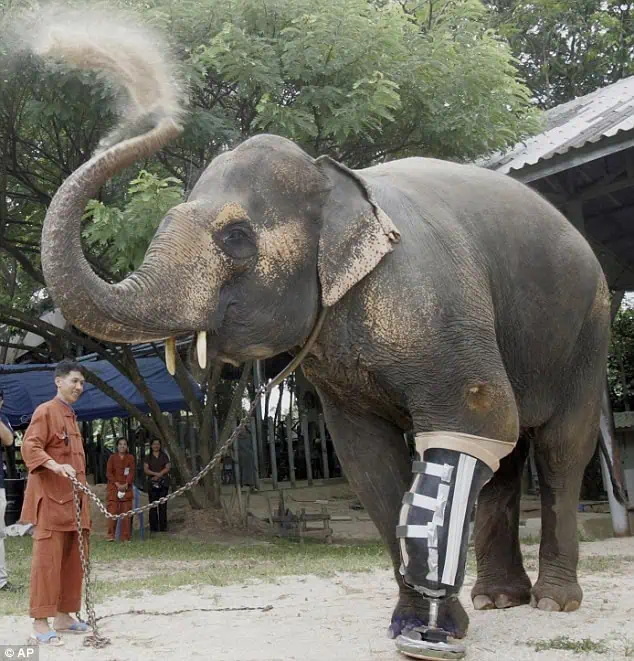
The prosthetic team, usually crafting limbs for human amputees, had created something entirely new: a custom-built, reinforced, precision-designed artificial leg made specifically for Motola.
It was heavy.
Complex.
Revolutionary.
And no one knew if she would accept it.
As the team tightened the final straps around her leg, Soraida knelt beside the sleeping elephant and stroked her cheek.
“You’re strong, Motola,” she whispered. “Stronger than what hurt you.”
When the anesthesia wore off, Motola opened her eyes.
For a moment, she looked confused — the weight of the new limb foreign and strange.
Then she shifted.
Tested it.
Leaned into it… gently at first, then more confidently.

And she stood.
Everyone watching held their breath.
With a deep rumble vibrating through her chest, Motola took her first step forward — her first real step in more than ten years.
The entire team erupted into tears.
She walked once around her enclosure. Then twice. Each step was slow, careful, deliberate — but she walked.
And in that moment, the world changed.
The Elephant Who Taught the World to Hope
Motola didn’t just adapt to her new leg — she embraced it.
She walked toward the sunlight.
She tossed dust into the air with her trunk, a playful celebration.
She looked, for the first time in years, like a creature rediscovering joy.
Her recovery was more than a medical victory.
It was a message.
That even the deepest wounds can heal.
That even the largest beings can rise after being broken.
That compassion can rebuild what violence tries to destroy.
Motola became a global icon — the face of thousands of elephants injured by landmines, bullets, logging accidents, and the tourism industry.
Because her suffering was not unique…
…but her chance to recover was.
A Hospital Built on Heartbreak and Hope
The Elephant Hospital where Motola was treated has cared for thousands of elephants over the years:
-
some blinded by slingshots
-
some with bullets lodged in their bodies
-
some beaten by handlers
-
some collapsing from exhaustion in the tourism trade
Motola’s mother endured the logging industry, along with countless others forced to haul tourists or timber until their legs shook from pain.
The number of working elephants in Thailand has plummeted from 13,400 in 1950 to just 2,500 today — not because their suffering ended, but because their world vanished around them.
Sanctuaries like Soraida’s give them something they have rarely known:
Safety.
Dignity.
A second chance.
Motola’s prosthetic wasn’t just a medical achievement — it opened doors for other elephants who suffered amputations. Innovations created for her have since helped many more.
Her courage became a blueprint for the future.
The Moment That Lives Forever
When the camera captured her walking out of her enclosure, raising her trunk to toss dust into the sunlit air, people around the world fell silent.
It wasn’t just an elephant taking a step.
It was a survivor reclaiming her life.
It was a wound transformed into strength.
It was proof that healing — real, impossible, breathtaking healing — is still possible in a world filled with cruelty.
Motola lived the rest of her life in comfort, protected, loved, and honored. She became a teacher, a symbol, a reminder that kindness is not a small thing.
It can rebuild legs.
It can rebuild lives.
It can rebuild hope.
And her story will continue to be told — because one elephant survived what should have destroyed her…
…and took a step that changed everything.
Bryant Fritz had planned for nothing more than a quiet afternoon of fishing — the kind of peaceful escape a middle-school science teacher grabs whenever he can. The November air was cold, the lake was still, and the world felt calm.
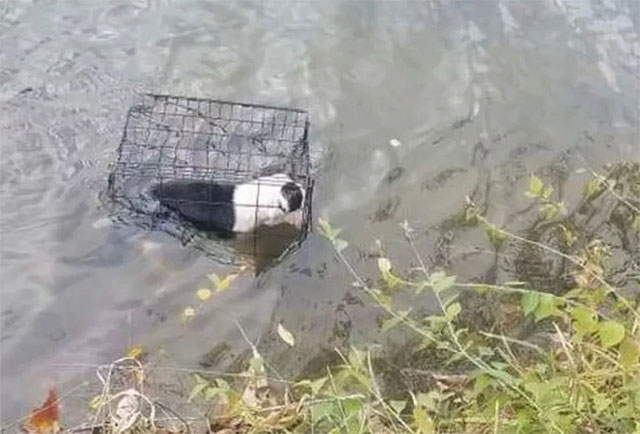
Until he saw something that made his stomach drop.
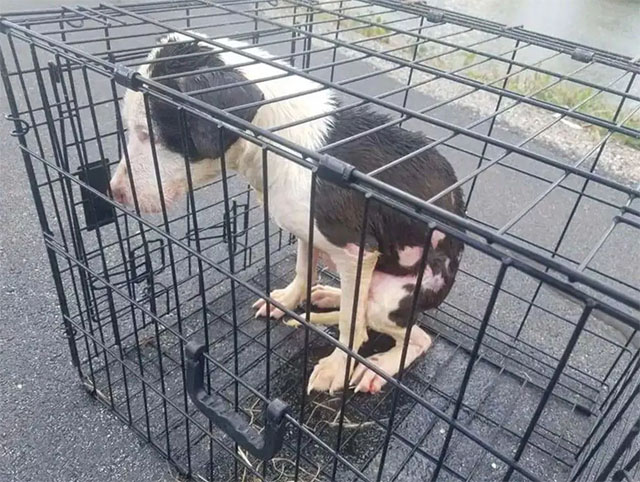
Floating near the edge of Kaufman Lake was a dog crate.
Not empty.
Not abandoned.
A tiny head — black and white, trembling, barely above the surface — was fighting to stay alive.
A puppy was drowning.
Bryant froze for half a second, trying to make sense of the scene. Then instinct took over. He kicked off his shoes, peeled off his outer layers, and waded straight into the icy water without hesitation. The wind was brutal, the lake biting cold, but none of it mattered.
The only thing he could think was:
“She’s going under.”
He pushed through the freezing water — 15… 20 yards — until he reached the crate. The puppy was pressed against the top corner, eyes squeezed shut, shivering so violently it rattled the crate. Her paws were raw. Her back was bleeding. She was exhausted… but she was still fighting.
Just like the little fish in Finding Nemo.
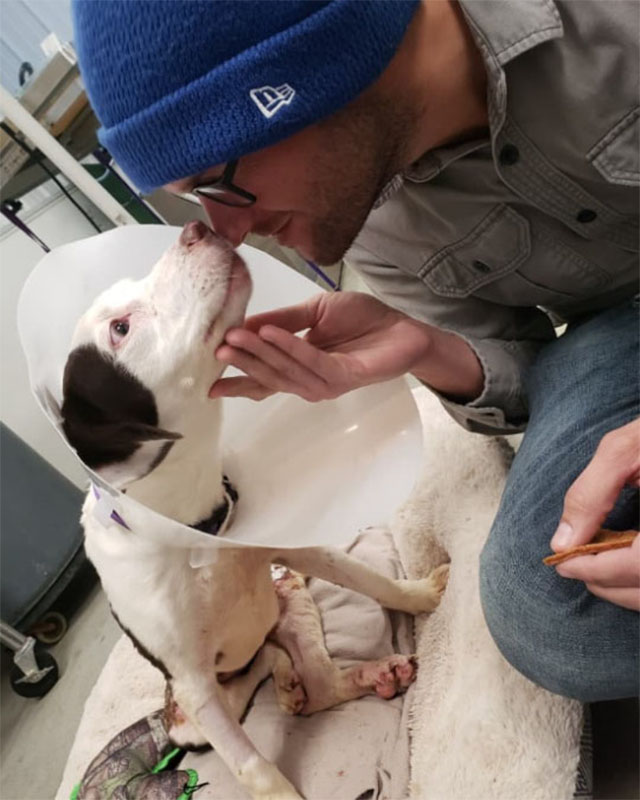
Bryant lifted the crate out of the water and pulled her into his arms. She weighed maybe 15 pounds — all bones, fear, and pure willpower. On the shore, he realized how bad things were: torn paws, missing fur, open wounds, body ice-cold to the touch.
She was alive, but only barely.
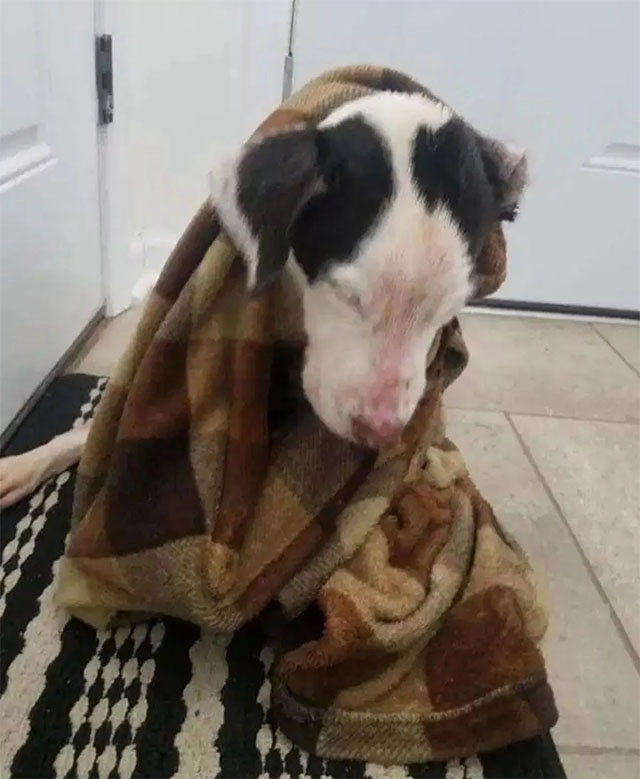
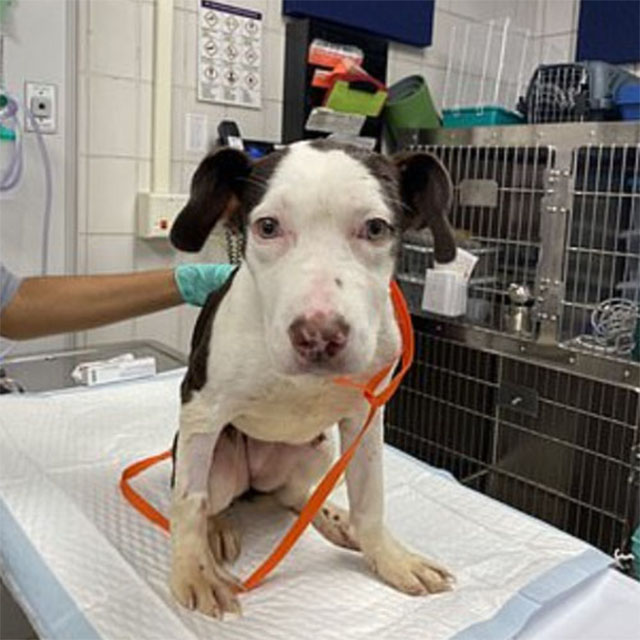
Bryant sprinted to his car, wrapped her in a blanket, and called ahead to the University of Illinois Veterinary Teaching Hospital. The emergency team was waiting when he arrived. They whisked the puppy away, warming her, treating her hypothermia, cleaning her wounds, and giving her pain medication and antibiotics.
Against all odds… she survived the night.
The vets said her recovery would take time. Her body was battered, her paws damaged, her temperature dangerously low — but she was responding. She wasn’t giving up.
And somewhere in the chaos, between the forms he had to fill out and the updates from the veterinary team, Bryant felt something shift in his chest.

He didn’t know this puppy. But he couldn’t imagine handing her off and walking away.
By the time he stepped out of the hospital, he already knew:
“I want this dog in my life.”
He called his girlfriend, Krystal, who agreed without hesitation. They even knew her name:
Dory.
Because just like the Pixar character…
“She didn’t quit in that water.”
Dory is now under the care of Animal Control and receiving continued treatment — and Bryant is hoping, waiting, and praying that he’ll be allowed to adopt her the moment she’s ready.
He didn’t go fishing that day.
But he did save a life.
And he may have found a new one to share his own.