A Miracle in the Dust: When Rare Elephant Twins Reminded the World What Protection Looks Like. – Daily News
In the wild, miracles do not announce themselves with fanfare.
They arrive quietly—on padded feet, beneath open skies, carried on patience rather than promise. And if you are not paying attention, you might miss them entirely.
That is why what happened at Pongola Game Reserve felt so extraordinary.
Because for the first time in more than a decade, the land witnessed something almost unheard of.
Elephant twins.

A Birth That Nature Rarely Allows
Elephants are known for many remarkable things—their memory, their intelligence, their emotional depth. But twins are not one of the things nature gives them easily.
Less than one percent of elephant births result in twins.
And even then, survival is uncertain.
In the wild, a single calf already demands immense energy. Two newborns place an almost impossible strain on a mother’s body. Most elephant mothers cannot produce enough milk for both. Historically, one calf is often lost within weeks.
Which is why, when the herd at Pongola slowed its movement and began to gather closely around one cow, the moment carried weight long before anyone understood why.
Her name was Curve.
She was thirty-one years old—experienced, steady, respected within the herd. When she went into labor, she did not do so alone. Like all elephant mothers, she was surrounded by family. Sisters. Aunts. Older females who had walked this path before.
But this time, the outcome would be different.

Two Lives, One Breath Apart
When the first calf emerged, there was movement—but not surprise.
Birth is familiar to elephants.
What followed was not.
Moments later, another tiny body appeared.
Another trunk.
Another set of unsteady legs.
Another heartbeat entering the world.
Elephant twins.
The herd did not scatter.
They did not panic.
They closed in.
Large bodies formed a living wall around Curve and her newborns, shielding them from danger, noise, and intrusion. Tusks angled outward. Ears lifted. The message was unmistakable:
These lives are protected.
For reserve staff and wildlife experts watching from a careful distance, the significance was immediate. The last known case of elephant twins in the region had been recorded in 2006—nearly twenty years earlier.
Many conservationists go their entire careers without witnessing such a moment.
And here it was.
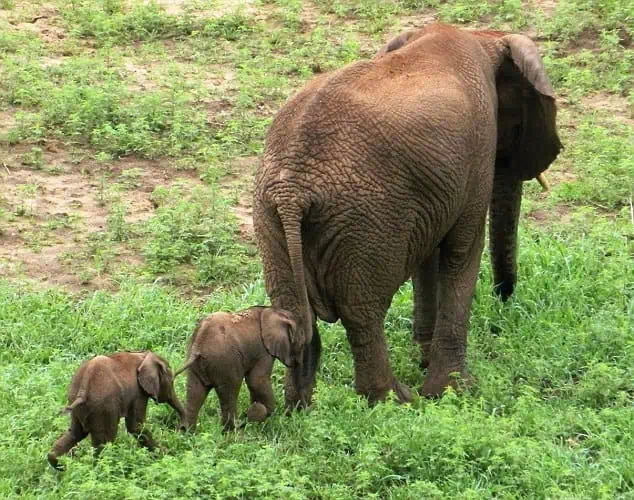
Two calves, pressed close to their mother, their skins still creased from birth, their movements uncertain but determined.

A Mother Named Curve
Curve did not hesitate.
She adjusted her stance, her body language shifting as instinct and experience took over. She lowered her massive head, guiding the twins with her trunk, encouraging them to stand, to nurse, to breathe.
Nearby, other cows remained close.
Not interfering.
Not overwhelming.
Just present.
Elephants understand something deeply: survival is communal.
Curve’s mate, Ingani—the bull believed to be the twins’ father—had passed away more than a year earlier. But absence did not mean abandonment. In elephant society, fathers may come and go, but family endures.
The herd stepped into the space Ingani left behind.
The Weight of What Comes Next
As the days passed, the twins stayed close—so close they were often partially hidden beneath Curve’s body, their small frames tucked behind her legs, their trunks occasionally brushing against one another as if seeking reassurance.
Experts watched carefully.
Dr. Ian Whyte, an elephant specialist with decades of experience, explained the challenge plainly: the odds are never in favor of both twins surviving. Milk production is finite. Energy is limited. Nature is unforgiving.
And yet, something about this moment felt different.
The reserve made a conscious decision—to give Curve space. No interference. No pressure. No disruption. Just privacy, calm, and trust in the herd’s natural intelligence.
Curve was allowed to nurse uninterrupted.
The twins were allowed to bond.
The family was allowed to do what elephants have done for generations—protect their own.
The Herd Steps In
When Curve led the twins to water, she was not alone.
Another cow walked alongside her, positioning her body carefully, creating a corridor of safety. When the calves struggled with their footing, trunks reached out—not to lift, but to guide. When the twins tired, the herd slowed.
Every step was adjusted to the weakest members.
This is not sentiment.
This is elephant society.
Elephants do not leave the vulnerable behind. They adapt the entire group to protect them.
It is why calves survive droughts.
Why injured elephants are escorted.
Why grief is shared.
And now, why two fragile newborns had a fighting chance.
Watching Without Touching
Determining the sex of the twins would come later. For now, no one rushed. The priority was simple: keep them alive.
Reserve staff monitored from afar, resisting the human urge to step in, to manage, to control. Because sometimes, the most respectful act is restraint.
Curve knew what she was doing.
Her ears flapped softly as she stood over her calves. Her trunk traced their backs, memorizing them. Elephants remember their young not just by sight, but by touch, by scent, by vibration.
She would never forget these two.
Why This Moment Matters
In a world where wildlife stories often end in loss—poaching, habitat destruction, extinction—this moment arrived like a breath held too long and finally released.
Hope.
Not loud.
Not naïve.
But real.
Elephant twins are not just rare. They are symbols of resilience in an ecosystem that demands everything from those who live within it.
Their survival is not guaranteed.
But neither is anything worth protecting.
A Quiet Celebration
No crowds gathered.
No announcements echoed across the reserve.
Instead, celebration came in quiet forms.
A calf nursing successfully.
Two tiny shadows walking beneath their mother.
A herd moving more slowly than usual—choosing care over urgency.
Wildlife enthusiasts across the world felt it too, even from a distance. Because stories like this remind us of what conservation is truly about.
Not control.
Not spectacle.
But protection, patience, and humility.
Two Lives, Carried Forward
The twins do not know they are rare.
They do not know how unlikely their existence is.
They do not know how many eyes are watching, how many hopes rest quietly on their small backs.
They only know warmth.
Milk.
The steady presence of their mother.
The safety of bodies that never stray far.
And that is enough.
For now.
What Elephants Teach Us—Again
Elephants continue to teach humanity lessons we struggle to learn.
That family is not optional.
That strength is shared.
That the vulnerable deserve the most protection, not the least.
Curve did not ask whether this would be easy.
The herd did not ask whether this would cost them time or energy.
They simply stayed.
And in a world that often moves too fast to care, that choice may be the rarest miracle of all.
Two elephant twins were born at Pongola Game Reserve.
But what truly arrived that day was something even rarer—
A reminder that survival is strongest when it is shared.
For seventeen days, the forest held its breath.
Hidden deep within a remote stretch of land, an elephant lay still—too still for an animal whose life depends on movement. His name was Moti, and at thirty-five years old, he was balanced on the edge between survival and surrender.
Each passing sunrise marked another day closer to death.
And yet, somehow, he held on.
The Fall No One Saw in Time
No one knows exactly when Moti’s suffering began.
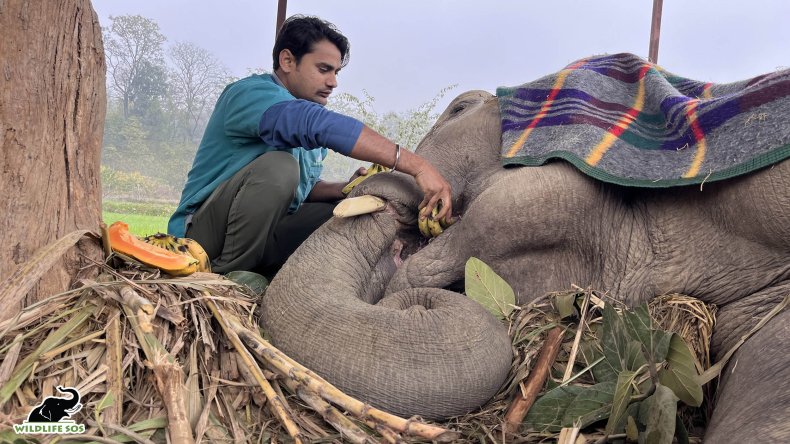
What was clear, when rescuers finally reached him, was that this was not a fresh injury. His front leg had been broken for a long time—long enough for infection to take hold, long enough for pain to become routine, long enough for his body to slowly give way beneath him.
At some point, Moti collapsed.
An elephant weighs several tons. When an animal of that size is unable to stand, the danger multiplies quickly. Prolonged immobility causes something called hypostatic pressure—the crushing weight of the body pressing against internal organs. Blood flow is restricted. Muscles deteriorate. The heart and kidneys begin to fail.
For elephants, lying down too long is often a death sentence.
By the time help arrived, Moti had been unable to stand for seventeen days.
Seventeen days of pain.
Seventeen days of pressure.
Seventeen days of waiting—without knowing if anyone would come.
A Body Giving Up—But Not a Spirit
Rescuers from the conservation charity Wildlife SOS were the first to fully understand the gravity of the situation.
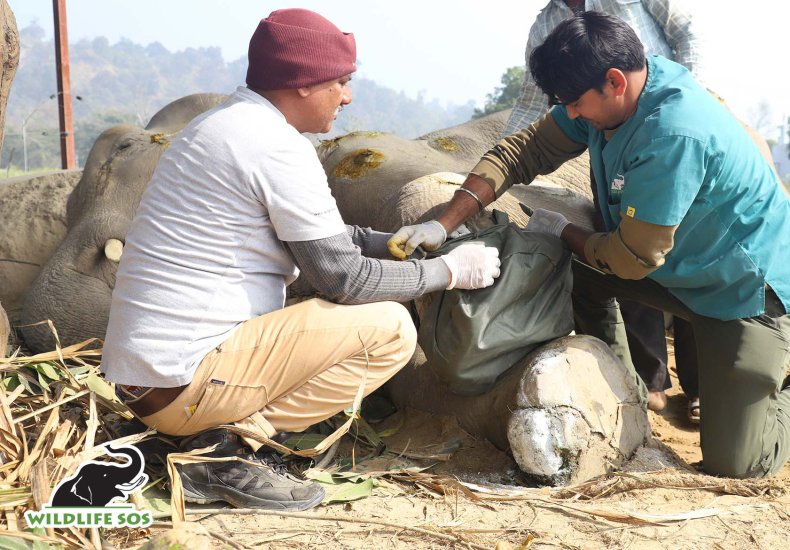
Moti’s foot pad and toenails were severely infected. His leg fracture had gone untreated. His body showed signs of extreme exhaustion. And yet, when people approached him, something unexpected happened.
He did not panic.
He did not lash out.
He did not surrender.
He watched.
Elephants are intelligent beyond words, capable of recognizing intent. As veterinarians and caregivers moved carefully around him—treating wounds, cleaning infections, offering water and food—Moti remained alert.
Weak.
In pain.
But present.
It was as if he knew this moment mattered.
The Race Against Time
There was one terrifying truth everyone involved understood: if Moti did not stand soon, he would die.
No amount of medicine could reverse the effects of hypostatic pressure indefinitely. His organs were already under strain. His body was losing the battle.
The solution was as risky as it was necessary.
Moti had to be lifted.
Not nudged.
Not encouraged.
Lifted.
But lifting an elephant is not something done lightly—or safely—without immense planning. One wrong move could worsen his injuries or cause catastrophic failure.
Recognizing the urgency, the Indian Army was called in.
What followed was a rare collaboration between wildlife conservationists, veterinarians, forest officials, and military engineers—all united by one goal:
Keep Moti alive.
Seventeen Days End in One Moment
The day of the lift arrived quietly.
Ropes were carefully positioned. Support systems were secured. Veterinarians monitored every breath, every sign of stress. Pain management was administered. The forest itself seemed to fall silent.
Then—slowly—Moti began to rise.
Cameras captured the moment, but no video can fully express what it meant.
As his massive body was lifted upright for the first time in over two weeks, gravity shifted. Blood began flowing properly again. His organs were given a chance to recover.
He stood.
Not confidently.
Not easily.
But enough.
Enough to save his life.
For those watching, many of whom had spent days preparing for the possibility of losing him, it was overwhelming. Seventeen days of waiting had come down to a few fragile minutes suspended between hope and heartbreak.
And hope won.
Standing Is Not the End—Only the Beginning
Moti’s rescue did not mean his suffering was over.
His front leg remained incapacitated. The fracture was severe. Transporting him to Wildlife SOS’s elephant hospital—a journey of nearly eight hours—was too dangerous in his condition, especially given the remoteness of the location.
For now, Moti remains where he is.
But he is no longer alone.
And he is no longer collapsing into death.
He is supported while standing.
He receives continuous pain relief.
He eats.
He drinks.
He responds.
These may sound like small victories.
They are not.
For an elephant who lay on the brink of organ failure, every bite of food, every swallow of water, every steady breath is a declaration of resilience.
Compassion in Action
Kartick Satyanarayan, co-founder and CEO of Wildlife SOS, later spoke of the rescue with gratitude and humility.
This was not the work of one organization.
Not the success of one team.
It was a collective act of compassion.
The Indian Army.
Veterinarians.
Forest Department officials.
Caretakers.
Conservationists.
People from vastly different roles and backgrounds came together—not for profit, not for recognition—but because a life was at stake.
Moti is not just an elephant.
He is part of India’s natural heritage.
A living reminder of the bond between humans and the wild.
Saving him was not only an act of rescue—it was a statement.
That suffering should not be ignored.
That neglect should not be normal.
That even the largest, most powerful animals can be heartbreakingly vulnerable.
What Moti Teaches Us
Moti’s story is not extraordinary because he is an elephant.
It is extraordinary because he endured.
Seventeen days without standing.
Seventeen days of pain no one treated.
Seventeen days where the easier outcome—for the world—would have been to look away.
But someone noticed.
Someone cared.
And when one group could not do it alone, many stepped in.
In a world that often measures worth by convenience, Moti was inconvenient.
Heavy.
Difficult.
Expensive.
Time-consuming.
And still—he was saved.
Still Here
Moti’s journey is far from over.
Recovery will be slow.
Uncertain.
Challenging.
But today, he stands.
Today, his heart still beats.
Today, he eats and drinks under watchful eyes.
Today, he has a chance.
And sometimes, a chance is the greatest miracle of all.
Seventeen days on the brink of death did not break him.
Instead, they revealed something profound:
That life—when met with compassion—can endure far longer than anyone expects.
And that even in the quiet corners of the forest, hope can rise… one careful lift at a time.