A Love Written in Gentle Touch: When a Zebra Found Family Again. – Daily News
In the wild, love is not always loud.
It does not always roar or trumpet or announce itself with dramatic displays. More often, it is quiet. It is patient. It is written in small, deliberate gestures that say, I see you. I am here. You are not alone.
For Little Notty, a young zebra whose life had already known loss far too early, love spoke through her teeth and her careful touch.
This was her language.
Notty should have been running beside her mother across open plains, learning the rhythms of survival, memorizing the scent and sound of the family she was born into. Zebra foals grow up wrapped in community. Mothers, aunts, sisters—all watching, protecting, guiding. Grooming one another. Standing shoulder to shoulder against the world.
But fate interrupted that story.
Notty’s mother fell from a cliff, her life ending in a moment no one could undo. And just like that, Notty’s world collapsed. The family she was meant to grow up in vanished overnight, leaving behind a small body with striped legs and a heart that still needed connection.
A week later, tragedy struck again.
Another baby was found alone—Tytan, a young rhinoceros calf. His mother, too, had fallen from a cliff. He was discovered frightened, vulnerable, and confused, standing in a world suddenly much too quiet.
Two babies.
Two losses.
One week apart.
Both rescued not because the world was kind—but because it had been cruel.
They were brought to the same nursery, a place designed not just to keep bodies alive, but to help broken beginnings mend. There, caregivers worked tirelessly to replace what had been lost: warmth, safety, consistency. Bottles replaced mothers. Gentle hands replaced protective flanks. Time replaced panic.
But there was something humans could never fully give.
Belonging.
That is where Notty stepped in.
From the moment she noticed Tytan, something inside her stirred. He was different—larger, heavier, rougher around the edges. His skin thick where hers was sleek. His horn budding where her stripes flowed. But loss has a way of erasing differences.
Notty understood grief.
She understood the ache of absence. And instinctively, she knew what to do with it.
In the wild, grooming is more than hygiene. It is trust. It is reassurance. It is how zebras say, You are part of me. I am part of you. Mothers groom foals. Friends groom friends. Family members groom one another as a way of weaving their bonds tighter, day after day.
Notty had lost her family.
But she had not lost her instinct to love.
So she offered it—to Tytan.
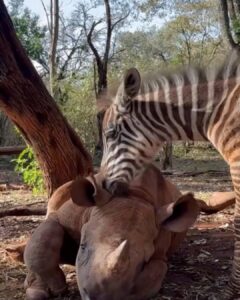
Caregivers first noticed her standing close to him, lingering where others moved on. She leaned her head toward his thick skin, gently nibbling, carefully scratching places he could never reach himself. The rhythm was slow and deliberate, a ritual older than memory.
Tytan responded immediately.
The massive little rhino, still so young and unsure, lowered himself to the ground, rolling slightly onto his side. His eyes softened. His breathing slowed. He let out a contented sigh that seemed far too big for a baby who had already known so much pain.
In that moment, he was no longer an orphan.
He was being cared for.
To an outsider, it might have looked unusual—a zebra grooming a rhino, two different species sharing a quiet space beneath the trees. But to those who watched closely, it was something deeply familiar.
It was family finding family.
Notty groomed him the way she might have groomed a sibling. She lingered at his ears, traced the curve of his neck, worked patiently along his back. She did not rush. She did not demand anything in return. She simply stayed.
And Tytan let her.
He trusted her with his still-healing heart.
As days passed, the bond deepened. Where Tytan went, Notty followed. Where Notty rested, Tytan settled nearby. When one grew anxious, the other remained calm enough for both. They learned the rhythms of nursery life side by side—feeding times, naps, quiet afternoons, long evenings when the world finally felt safe again.
They healed together.
Their caregivers often paused to watch, struck by the tenderness of it all. These babies had lost everything they were meant to have. And yet, somehow, they were building something new—something unexpected and profoundly beautiful.
Notty had turned grief into care.
Tytan had turned fear into trust.
In each other, they found what had been taken away.
There is something powerful about watching animals love without hesitation. They do not question whether they are allowed to. They do not wonder if it looks strange or breaks rules. They simply follow instinct—and instinct, when left untouched by fear or judgment, often leads straight to compassion.
For Notty, grooming Tytan was not a performance. It was not learned behavior. It was memory etched into her bones. Even without her mother beside her, she remembered how to love.
And for Tytan, receiving that love was a gift he did not know he needed until it arrived.
In a world that had already taken so much from them, they chose connection.
Today, they are often seen together—Notty carefully grooming her honorary zebra brother, Tytan resting contentedly beneath her attention. Two orphans. Two survivors. Two souls reminding everyone who witnesses them that healing does not always come from those who look like us.
Sometimes, it comes from someone who understands pain in the same quiet way.
Their story is not just about rescue. It is about resilience. About how love finds a way to reappear even after devastation. About how the instinct to care can survive loss—and even grow stronger because of it.
Notty lost her natal family.
But she did not lose her heart.
And Tytan, once alone in the world, found himself wrapped in a love language he did not speak—but understood perfectly.
In the shade of the nursery trees, where grief once lingered, a zebra and a rhino now share something rare.
Not just survival.
But belonging.
The storm came without warning, the kind that swallows a city whole.
Thunder rolled low and heavy over Phoenix, shaking windows and rattling nerves. Rain came down hard, pounding rooftops and streets until gutters overflowed. And then, one by one, the lights went out—first in homes, then on streets, until the entire block fell into darkness.
At the small animal shelter on the edge of town, the power loss felt immediate and personal.
Emergency lights flickered on, casting long, uneven shadows across the hallways. The building hummed softly with generators struggling to keep essential systems alive. Volunteers moved quietly, their flashlights cutting narrow paths through the dimness as they checked kennels, whispered reassurances, and tried to keep routine intact for animals who depended on it.
For most of the dogs, the storm meant fear expressed loudly—barking, whining, scratching at kennel doors.
But not for the dog in isolation.
She had arrived two days earlier.
No name.
No history anyone could trace.
Just a small note clipped to her chart:
“Unknown, female, approx. 3 years old.”
She had been found tied to a stop sign, her leash a rough rope that had rubbed her neck raw. No food bowl. No shelter. No explanation. Just a silent dog standing perfectly still in the middle of traffic, as if she had learned that moving—or asking—only made things worse.
Since coming into the shelter, she hadn’t made a sound.
No barking when other dogs passed.
No whining when food arrived.
No reaction to voices or footsteps.
Silence like armor.
Jamie noticed it immediately.
Jamie had been volunteering at the shelter for three years, long enough to recognize the different ways animals broke. Loud ones. Aggressive ones. Shaking ones. But the quiet ones—those were the ones that stayed with her.
Because silence usually meant the dog had already learned that nothing came when you cried.
As thunder cracked overhead, Jamie made her way down the isolation hallway, flashlight in hand. The corridor felt narrower in the low light, the air heavier with tension and wet fur. She paused at each kennel, checking latches, murmuring soft words.
Then she stopped in front of the last door.
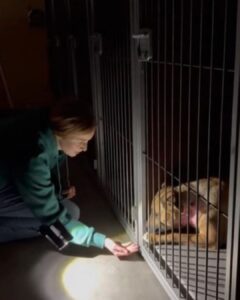
The dog sat in the back of her kennel, pressed against the wall like she was trying to disappear into it. Two amber eyes reflected the flashlight beam—alert, but empty of expectation.
“Hey,” Jamie whispered, crouching down. “It’s just me again.”
The dog didn’t move.
Jamie rested the flashlight on the floor so the beam spilled gently across the kennel instead of pointing straight at her. She knew better than to rush. She always did.
“I know,” Jamie said softly, fingers sliding through the metal bars, palm open. “I know you don’t owe anyone trust.”
Another low growl of thunder vibrated through the building. Somewhere down the hall, a dog began to howl, the sound raw and desperate. Volunteers’ voices echoed faintly as they tried to calm him.
The dog in front of Jamie didn’t flinch.
That scared her more than the noise.
“You’re too quiet,” Jamie murmured. “That’s what worries me.”
Minutes passed.
The flashlight warmed against the concrete. Jamie stayed crouched, legs aching, breathing slow and steady so she wouldn’t startle her. She talked—not because she expected a response, but because silence didn’t feel right.
“You’re safe here,” she said, though she knew the words were fragile. “No one’s tying you up tonight. No one’s leaving you behind.”
Still nothing.
Jamie blinked back tears, frustrated with herself. She had learned not to force moments like this. Animals came forward when they were ready—or not at all. And sometimes, the bravest thing you could do was simply stay.
Then, finally, the dog shifted.
It was subtle—just the lift of her head. Her ears tilted forward slightly. She crawled toward the front of the kennel, belly pressed low to the floor, stopping inches from Jamie’s hand.
Jamie’s breath caught.
“There you are,” she whispered, afraid that speaking too loudly might break whatever fragile thread had pulled the dog forward. “Hi.”
The dog hesitated. Her body trembled—not violently, but in small, controlled shivers, like she was holding herself together with sheer will. Slowly, cautiously, she lowered her chin.
And rested it on Jamie’s fingers.
Jamie didn’t move.
Didn’t breathe.
Didn’t dare hope too quickly.
The weight was light, barely there, but it was real. Warm. Alive.
“Oh,” Jamie breathed, tears finally spilling over. “That’s okay. You can stay right there.”
The dog didn’t pull away.
Thunder cracked again, louder this time, and rain hammered the roof. But inside that small circle of flashlight glow, the world narrowed to two beings who had both learned, in different ways, what it meant to endure.
“In this place,” Jamie whispered, voice breaking, “you don’t have to be afraid of being noticed.”
The dog’s eyes closed halfway—not in sleep, but in something like relief. Her breathing slowed. The trembling eased just a little.
For the first time since she had been found tied to that sign, she leaned into someone instead of bracing for what might come next.
Jamie stayed like that for a long time.
She thought about how many nights the dog must have spent alone. How many times she’d learned that silence kept her safe. How many times she’d been overlooked because she didn’t ask.
Outside, the storm raged on. Power crews would come tomorrow. Phones would ring. Paperwork would stack up. Adoptions would happen. Some animals would leave. Others would arrive.
But right now, none of that mattered.
Right now, there was a promise being made without words.
That silence didn’t mean invisibility anymore.
That stillness didn’t mean abandonment.
That this story—whatever pain had shaped it—was not finished yet.
Eventually, Jamie stood, careful not to startle her. The dog lifted her head reluctantly, watching as Jamie reached for the kennel latch.
“I’ll be back,” Jamie said softly. “I always come back.”
As she walked away, the flashlight beam swept the kennel one last time.
The dog didn’t retreat to the back.
She stayed near the door.
Waiting.
And in the darkness of a powerless building, during a storm that shook the city, that small, quiet choice felt like the beginning of something stronger than fear.
It felt like hope—learning, slowly, how to speak again.